Ivo Sarn had been paid by the village of Ashen for forty-one years, and the retainer was held against the body, and nobody had ever asked him what he did with the money, and he had decided some time ago that this was the arrangement he preferred. The wood was called the Netherwood and it was three miles long, and on the village maps it was a grey shape like a lung. Ivo Sarn was its huntsman. He was sixty-one. He had a cottage at the southern end with a good stove and a bed and eleven chairs, a bow, a wood-cart with good wheels, and he was the most reliable man in the district and had never once been thanked for it, and the reason he was never thanked was the sign.
The sign was nailed to a post at the north end of the wood where the road came in, and the sign had been there since before Ivo was born, and it said that trespassers would be taken at the wood's charge, and beneath that, in red, because somebody in 1094 had a pot of red, was painted a hand. He had never taken it down. He had once, young and in one of his moods, taken it down and put it up again the same afternoon, and had told the schoolmaster, who asked why, that it was the wood's hand and not his, and the schoolmaster wrote it down in a book, and the children of Ashen grow up learning that Red Coat takes children into the wood and does not bring them out.
The appointment was old enough that the village had stopped arguing about it, which is the only kind of permanence available to a village. The huntsman was appointed by the lord, not by the village, but the village paid him, and the terms were fixed in an instrument of 981 that Ivo Sarn could have read any evening of his life. Four shillings the month. The keeping of the wood: the boundary, the ditch, the deer, and the fire on the north stub. The removal of any body found within the bounds, at four shillings and eightpence the body, laid down in the year of the fever and never revised, which was the whole of the joke and the whole of the tragedy, and which nobody could explain who had not been paid by the body. And one clause, the ninth, which governed everything else in the instrument and which no one in Ashen had ever read aloud in the taproom:
the sums received for the removal of any body shall be held by the huntsman in trust for the household of the deceased, and shall be rendered to them on demand, and an account of them shall be kept and produced yearly before the reeve and the six elders. There was no household. That had been true for a long time. The fees went into the chest under the floor of the cottage, in nine cloth bags, one for each year of Ivo's holding, and the chest had a lock, and the key hung on a nail by the stove where anybody who had ever come into that cottage would have seen it. Nobody had ever asked for the account.
He had got the appointment at twenty, because the old huntsman had walked into the wood in the wet season and not come out, and the reeve had told Ivo that the wood wanted a huntsman, and Ivo had said yes before the reeve had finished the sentence, and the reeve had looked at him and said, "You understand what the ninth clause is." "I understand it is a clause," said Ivo. It was the first true thing anybody had ever said to him, and it cost him the appointment for nine years, because the reeve thought he was a fool. "Four shillings and eightpence a body," said the reeve. "And the wood gets three bodies a year, some years. Four in a hard year." "That is nine shillings."
"That is nine shillings in a year when you would rather be at the ales with a girl." The reeve was not a cruel man; that is what Ivo remembered, and he had gone over it for forty-one years. "And you will sit on them, and you will not spend them, and if anybody ever comes and asks, you will say the account is rendered. Can you say that to a man in his own kitchen?" "I can say it to a man in his own kitchen," said Ivo, "but I should rather it never had to be said at all."
The first body came eleven weeks after he was appointed. It was a young woman in a green wool gown with the hood still on, and she had gone into the water and the water had not finished with her, and Ivo got there at the second hour and did what he had been told a man does, which is that you do not look, and then you do, and then you stop, and then you work.
That is the part nobody in Ashen has ever understood, and Ivo has stopped trying to explain it to the schoolmaster's son, who asks every year. It is not that the looking can be stopped. It is that a body is a job with stages: the wood-cart, which takes an hour to get down the north track in October; the lime, a bushel and a half, which goes on the face, and there is no way round that and it is not done out of disrespect; the tar; the four hours; the parish rate, ninepence, paid out of the fee since the fever year; and then the cart up the track, and the parish ground on the far side of the chapel, and a hole, four feet, because four feet is the depth the ground is.
Eleven weeks. She was Anneke Tace, of Nine Elms, and the household of Anneke Tace was a basket at the roadside down the track with three weeks in it, and Ivo had not known that until the reeve's man said so, two days later, in the taproom, in front of eleven people, and one of the six elders said Lord have mercy on it in a voice that made everybody else look at the floor. Ivo had stood there and had said nothing at all, which was, he has thought since, the worst available option, and he would have liked a better one, and there was not one. There were three bodies a year in the wood. Some years four. Once, in the wet of the eleventh year, there were nine, and Ivo had done them all in nineteen days, and had not left the wood.
He got the child on the third day of the first week. Three weeks old, in a basket, at the roadside, with reeds packed round her against the cold, and the reeds were wet, and the child was dead. He took the basket home and put it by the stove and there was nothing he could do with it, and in the morning he carried it down the hill to Ashen and put it on Bess Teale's step and knocked, and Bess Teale was forty-four, with a kitchen, no children, and a husband in the wars, and she looked at the basket, and she looked at him, and she did not ask a single question, and that is the reason the rest of it happened, because Ivo Sarn had gone up that hill ready to be told no and had been told nothing.
He paid Bess Teale from the fee for Anneke Tace. Nine shillings and eightpence, and he put it into her hand on the step, and she put it back in his hand and closed his fingers on it, and said, "You will be wanting to be asked for it back," and Ivo said, "Nobody is ever going to ask you for it back," and Bess Teale said, "I know. That's why I'm giving it back to you to give me again in a month, when you've decided it's a loan," and she was right, and it was a loan, and it was made every month for seventeen years, and neither of them ever wrote it down.
The child was called Nell, because Bess Teale had had a sister called Nell. Nobody in Ashen ever asked where she came from, because a baby on a step is a providence and a providence is not investigated, and so the girl grew up in Ashen believing she had been found. That was a lie of omission. Ivo Sarn, the only other person in Ashen who knew the whole of it, let her have it for seventeen years because he could not think of a version of the truth that would not have broken Bess Teale, and because he was a coward, and it is the same coward he was at twenty.
The girl came through the wood in the last week of Frostmonth, in bad weather, going up to her grandmother's with a bag and a stick, and Ivo Sarn saw her at the second bend at the fourth hour of the afternoon, at the exact place where the water had taken the woman in the gown, forty-one years before. She was seventeen. She had the good eyes, which were Bess Teale's, and she had walked down from the town that morning and had missed the cart and had known better and had come anyway, which was Nell to the bone. He came out of the brush at her and she went down on the wet leaves with her bag against her chest, and he said the only three sentences he had ever had for this. "Now then," said Ivo Sarn. "You'll be wanting to be told this is a wood." "I know it's a wood," said the girl.
"Right you are." He took the bag off her, which she did not want him to. "There's nobody in this wood but me and the deer and the wrong kind of company, and the wrong kind is not here tonight, and you'll go back down to the village on the track and you'll be in before the light. That's all. Off you go." And then the fourth hour went out of the sky, the way it does in that month, all at once, and the wind came round the north end and found the two of them, and the girl stood there in the wet with her bag against her chest and did not go, and did not argue, and did not ask him anything at all, which was the mistake. "Ivo," said the girl.
It is a short walk to the cottage and it took an hour and a half, and by the end of it she had told him that Bess Teale had had a turn in the night and had been told that she had to decide about an operation, and that the operation was in the spring, and that the girl had walked down to the town to see the doctor, and he had been decent and had said come in April, and that Bess Teale did not know about the April yet and would not be told until the spring, because a person is allowed one winter of not knowing. "She'll have to be told," said Ivo. "Before the weather breaks." "I know." "Then there's no road in it." "No."
The cottage had eleven chairs and a stove and a bed. He put the wood in and she sat on the end chair nearest the stove, and he made tea, and he did all the things that a man does in a house with a girl in it, and the difficulty was that they were the ninth clause, played out, in his own kitchen. "She'll want to see you before it," said Nell. "She asks about the wood. She asks if I've been all right in it." "What do you tell her?" "I tell her no." The girl looked at him. "Forty-one years, and I don't have to be told anything."
Here is what he did with the money, and it is the whole of what he did with it, and he has never been asked. It is in the ninth clause. It is a trust. It is a sum held for somebody, and the somebody is the household of the dead. Ivo Sarn has produced the account zero times in forty-one years. He produces it in his head, every night, in a form he keeps behind his teeth, and it has never been out by more than nine shillings in a year. Once, in the thirty-first year, a man came from Nine Elms with a paper about a woman in a green gown, and Ivo went out of the taproom and stood in the cold for an hour and a half, and the paper turned out to be about a different woman, a different water, a different year, and he came back in and paid for everybody's drink, and the six elders thought nothing of it at all.
Nine cloth bags, one for each year. And the truth about them is the truth about the wood: the wood is not valuable and the wood is not profitable and the money will never be enough, and it is the only money in this district that goes where it is supposed to go, and it goes there because a twenty-year-old with a bow said yes before the reeve had finished the sentence.
On the second day he went down to Ashen and did the two things he had decided to do, and the first of them was a lie, and he has never regretted it, and it is this. The girl had gone down the track at seven in the morning, and by ten there was a version, and by the second day there was only one, which is the one the village wanted, which is that Ivo Sarn had taken the girl into the wood and had not brought her out until two in the morning, and there is nothing that a village believes more completely than the thing it has been told since it was small. He went to the reeve's house at ten and he said, "I'll have the old sign down." "You're a-going to do that now."
"I'm a-going to take it off the post this afternoon, and I want the reeve and the six elders to see me do it, and I want the schoolmaster to write it down that I did it and that I asked. Then you can tell the village what you like and it'll be yours and not mine." He put his hat down on the table. "And then you'll pay me the arrears." There were two years of arrears. There were nineteen months of them, because Ivo had declined the summer quarter in the year of the great wet, out of something he had never been able to explain and which he now put down, in his own mind, in the same drawer as everything else. "I'll take it," said the reeve, who had been forty-one when Ivo was twenty and was sixty-one now, and who looked at the two shillings and put them in a drawer and said, "There'll be no next arrears after that." "There'll be no next arrears," said Ivo. "I'm asking for the account as well."
The account is not long. This is the whole of it, in the hand of Ivo Sarn, holder since the year of the fever, produced at Ashen before the reeve and the six elders on the fourth day of Greenmonth, and afterwards copied into the village book because the schoolmaster asked, and he did, and the copy is the one anybody ever looks at. The sums received by me for the removal of bodies within the bounds of this wood, being four shillings and eightpence the body, the parish rate of ninepence the body being first deducted, and the balance held in trust for the household of the deceased. Year one. Bodies, three. Held, one pound eleven shillings and threepence. Rendered, none. Year two. Bodies, four. Held, one pound seventeen shillings and sixpence. Rendered, none. And so of the following years, of which there are thirty-nine, the several bodies being entered in the book kept at the lodge, and the sums held being in the bags in the chest under the floor of the cottage.
Rendered in the year of this account, to Nell Tace, of Ashen, in the household of Anneke Tace, in full, of which she has had no demand, no knowledge, and no occasion; and the account being produced, the same having been produced yearly before the reeve and the six elders according to the ninth clause, and not having been produced in any year of my holding; for which I ask the reeve and the six elders to enter me as a person who has kept a thing badly and has now been asked for it. That is the last line. That is the last line in the schoolmaster's copy, and the schoolmaster has taught it, and it is the only document in Ashen that anybody reads out loud.
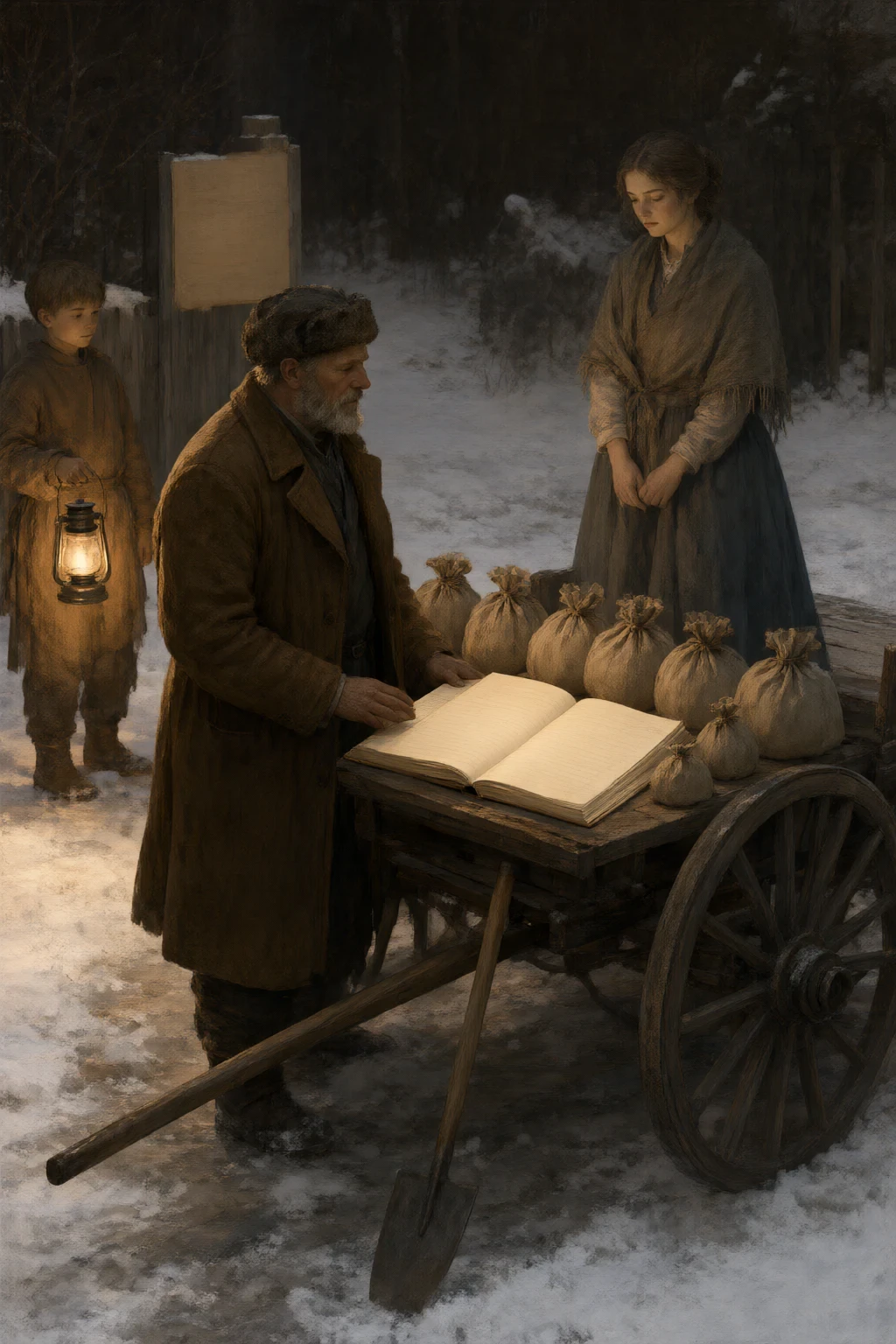
He counted it out on the cart. He would not do it in the house. He said he would not do it in the house and she did not ask him why, and the reason was that a chest under a floor is a thing that lives in a house and a sum does not, and he was not having it in the house. It took two hours in the yard in the light, on the flat of the cart, with a rule and a book, and the coins went into the book in columns by year, and the total came to something in the region of a hundred and forty pounds, and the girl looked at it going into the book, and did not once look away from the arithmetic. "There's nine bags," he said, at the end. "One for every year. That's the ninth clause and that's the only law in this district I have ever learned." "How much of it was hers?"
"All of it." He squared the book on the cart and put his hand flat on the cover. "All of it was her mother's, and the year-one bag was the nine shillings I put in Bess Teale's hand on the step, and it went into that kitchen every month for seventeen years, and Nell ate it and did not know she was eating it, and Bess Teale let me keep coming back, which I have never understood, and I am sixty-one and do not think I ever will." "And the rest of it never went anywhere." "No." "Why?"
"Because the moment I gave a shilling of it to anybody," said Ivo Sarn, "the wood would have had a second keeper, and the two of us would have disagreed about it inside a year, and the book is the only thing holding this together that has ever existed." He took his hand off the book. "And because a man cannot hand back a trust and keep holding it. It is one or the other. Forty-one years, and it was one, and today it is the other, and I am the right sort of fool to be the one who has to make the change."
He put her on the cart at the second hour and walked up the track with a lamp, and the lamp was a good lamp, and it was bought with the ninth clause, and the ninth clause had been empty by then, and he had not bought so much as a candle out of the fee in nine years and had not minded. At the top of the track the girl turned round on the seat and said, "You are not going to be thanked for that." "No," said Ivo Sarn. "Not by me," said the girl. "There is a woman at the cross-roads in the township. Bech. Old Bech's boy. He was taken across the river in the autumn." "I know he was taken across the river." "They are saying in the village that you had him." "They are saying a great many things in the village," said Ivo, "and there is not one of them in the ninth clause, and the ninth clause is the only thing I have ever been paid under."
The light went in and out on the track behind them, and the sign was gone off the post at the north end, which is a thing that can be seen from the top of the track if you know to look for the paler square of wood where it was, and he did not tell her to look, and she looked. They came out on the Ashen side at the fourth hour with the sky going grey, and there was a cart on the road at the top of the hill, and a woman on it in a shawl who had not gone to bed, and Ivo Sarn took the girl's bag off the cart, and stood there while she was got into the other cart, and then took his own bag and put it on his shoulder. "Nell," he said.
She turned round from under the shawl. He had not said her name in forty-one years, because a man does not say a name he has no right to, and he had said it in his head about nine thousand times. "The wood wants keeping from the first of next month," said Ivo Sarn, "and I am sixty-one. So you will tell Bess Teale that the money is in the book, and that I will not be able to be got at for a week, and then you will find me, and there is a list in the lodge of every wood within nine miles, and the one at Harrow is worse than this, and it pays a crown a year more, and I have put it in the book for you, because that is the ninth clause too, and because I am going to be asked what I did with the money, and I want the answer to be true."
He came in at the second hour of the afternoon on the fourth day of Greenmonth, and the reeve and the six elders were sitting in the wood-lodge with the account in front of them, and the schoolmaster was there with his copy, and the schoolmaster was crying in a way that he afterwards denied for a year. Ivo Sarn put the book on the table, opened it at the last written page, and turned it round.
The page had nine columns of figures in a small hand, and a line at the bottom, and the last line was the last line, and the reeve read it out to the room and the room was very quiet, and outside the lodge the north end of the wood was standing in the afternoon light with nothing on the post but a pale square of wood, and Ivo Sarn took his hat off and put it on the table beside the book, and sat down in the third chair, and asked whether the reeve would take the tea, because the reeve always took the tea.