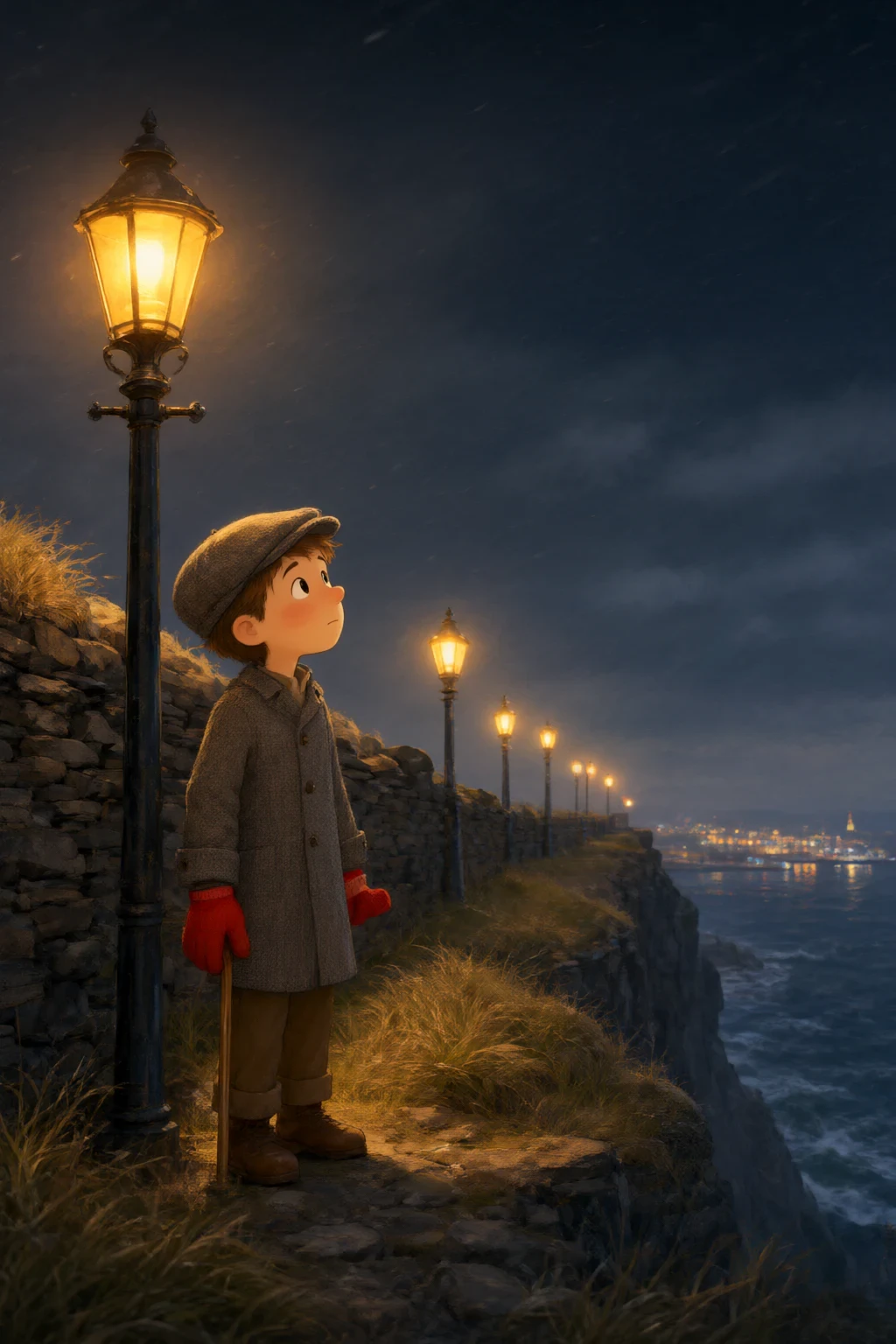
Hadren Vole was in bed with a fever on the evening of the third of November, and the nine lamps still had to be lit. Ansel Quance stood at the foot of his bed with his cap in his hands and did the thing he had been building up to for three years. “One,” he said, counting on his fingers. “I walk the line. Two, I light nine lamps. Three, I bring the pole back. One, two, three, and I do it without anybody behind me.” The old man turned his head on the pillow. The white stubble on his jaw was the pale green of sea foam, and there was a damp cloth on his forehead going warm. “No.”
“You cannot walk a fever off and light a lamp. That is two things.” “You are thirteen.” “That is the whole of the no. Sit down and I will give you three reasons, and you may argue with each, and then light the first four and bring the pole back at the fifth, as you did last month.” Ansel Quance sat down on the stool at the foot of the bed, on the red mitten with no mate, his own, darned at the thumb-end with a strip of sailcloth.
“Reason one. The chain runs the other way. Lights go out from the inside, and the inside is the harbour. If the First Lantern is not lit, nothing out on the head is holding, and I cannot walk out there to find out which post has gone.” “I know about the First every night of my life, which is more than you can say for the lamps.”
“Reason two. There is a jar.” Ansel’s hand went to his coat, and stopped, and came away. “There is no jar.” “There is a jar in the side pocket of that coat, and you are not a good liar and never have been.” Hadren Vole shut his eyes. “I have known about it for three years and never said a word, because a boy who keeps a jar is a boy who is frightened, and I would rather have that boy on the line than none.” “You hoard very neatly. That is the worst kind.”
“Reason three is that the ninth post is four miles from the Lamp House, and there is nothing out there but gorse and a wall and the sea a hundred and forty feet down. If the wind takes your light, you will be standing in the dark at Cormorant Head with an empty jar.” Ansel Quance looked at the shuttered window, where the sky over the bay had gone the colour of a knife. “One, two, three,” he said, to the floor. “Three good reasons. One, two, three, and not one of them is about the walking.” “No,” said Hadren Vole. “They never are.”
He got as far as the door before the old man said his name. Not to stop him. To give him the key board. “My hands are no use this week. Take the whole board, and do not let Pim carry it down the steps, because that child runs.” “She will run with it in the manner of a weasel going downhill with an egg.”
The Lamp House smelled of hot brass and kerosene and a hundred years of trimmed wick ends. A hundred and one lanterns hung on their cedar pegs, sorted by name, and the key board hung on the wall by the door with its hooks in a row. Pim Sabiston was standing in the middle of it with a brass lantern-shaped key on a cord at her throat, waiting, because Pim always knew when the lamps were going. “Which ones?” she said. “The nine.”
“That is nine,” she agreed. “I have counted them twice, and three times, and I would count a fourth time if anybody would let me.” She handed over the board, and Ansel Quance hooked the nine keys onto the ring on his belt, one at a time, as he had been told for three years.
The walking song goes like this. You count the posts out loud as you go, and you count them in, and you do not stop for weather. The tide board outside the Harbour Council house had all nine of the evening’s names chalked on it in the Chief Lamplighter’s hand. Ansel read them, because he read them every night, and tonight he said them out loud, which he had never done. Then he took the pole in his right hand, in the red mitten, and started up the Ridge Line.
The Ridge Line is four miles of salt grass and low gorse along the cliff top, with the sea a hundred and forty feet below you the whole way. The first post is at the harbour end and it is the First Lantern, and it is the Chief’s, and Ansel did not touch it. He had a plan, and the plan was nine hours, and it had a jar in it that was not in the plan.
The second post took four minutes. The third took seven, because the wick wanted trimming and his hands were cold enough to be clumsy about it. The fourth and the fifth were the two on the kink, where the wind comes around a shoulder of rock and stands up the coast behind you, and Ansel sang the walking song into it at each. The sixth and the seventh he did without talking at all, which was the sign that he was frightened. By the eighth he had given eight hours of his own life, and could feel where they had gone, which was nowhere. You do not feel an hour leave; you only find there is less of you at the end of the walk than at the start.
The eighth post is on the last shoulder before the point, and it is where the wall is, and the wall does not blow, it takes. It took the red mitten off his hand while his back was turned. Ansel turned in time to see the mitten go over the edge, turning slowly, the strip of sailcloth at the thumb-end flashing once and then not. He could have gone down for it, if he were quick and did not mind the inside of a rock face.
He did not go down for it. The eighth lamp was standing there burning with his hour in it, and he was the one who had lit it, and he looked at that instead, and went on up to Cormorant Head with his bare right hand going numb in the wind. The ninth post is the last one. The gorse stops forty yards short, then there is a wall of stacked shale, and past the wall there is only the point, and past the point the open sea going away in long grey slabs. Ansel Quance put the pole against the post and took the stoppered jar out of his coat.
He had carried it three years, and it had never gone down, and the light in it was pale and steady and smelled faintly of vanilla, the way eiderdown oil always smells, because that is what it was: hours he had taken out of himself on ordinary nights and put away instead of spending. He unscrewed the stopper and poured it into the ninth lamp, and he named the name on the plaque, because you have to.
The ninth lamp caught and came up to a good bright amber, and the wind came around the point and lay on it hard, and Ansel Quance stood with his bare hand on the cold iron and sang the walking song to the ninth post from the top down, and by the end his voice had gone. It held. He counted it to sixty, which is longer than any lamp on the Ridge Line has ever been counted. Then he turned round to go home, and behind him the ninth lamp was out.
He stood in the dark on Cormorant Head and looked at it, and then at the four miles of line going back down the coast with eight small flames on it, and worked out the arithmetic. One, two, three, and. If the ninth had gone out on its own account, the light would have failed in the middle of the line, and everything on the head would have been fine, because the head hangs off the rest. So the ninth had not gone out first. It had gone out last, into an empty line, and the only lamp that can feed nine is one.
The jar was empty, and three years of an old boy’s afternoons was lying on a rock at Cormorant Head going back into the cold air. He had one hour left, and had been keeping it since the first post, in case. That was what the jar was for as well: the whole of the arrangement he had made with himself in the dark for three years, never once said out loud. He could spend that hour on the ninth and hold the far end of the line for tonight. Or he could walk down to the harbour and light the one.
He could not light nine and walk home. If he had spent the hour here, the harbour would be dark by midnight, and the harbour is the inside, and the inside is the whole thing. So he turned round at Cormorant Head, with his last hour in his pocket and nine lamps of which eight were burning, and began to walk the line back.
Coming out, the cliff is a floor with a wall on your left and the sky on your right. Coming back, the wall is on your right and the cliff is a floor with nothing on it, and a man walking home in the dark has his own feet and nothing else. On the fourth the wind came around the kink and took the last of the feeling out of his bare right hand, and he put it against the empty jar in his coat, the one warm thing he had, and it was cold glass.
He got down to the harbour end at twenty past ten with the First Lantern burning dull brown over his head, exactly as it had been burning when he left. It was the wrong colour, and he could see that from the bottom of the steps, and he had walked past that lamp four hundred times and never seen it wrong. It was not amber. It was a soft warm brown, like a lamp burning anything at all, and a sweet smell was coming off it that he knew, because he had a jar of it in his coat.
And inside the glass of the chimney there was a grey bloom all the way round, on the inside, the way a jar goes cloudy when something sweet has been left standing in it too long. Neel Ferrin was sitting on the edge of the weigh shed with her hood up, with chalk in her hand, because the Blue Tally gets done in the evening too. She had the red mitten in her lap, and when he asked about it she said, “It came down off the wall and I got it off the rocks before the tide. I did not know whose it was until I looked at the thumb.” Ansel Quance took the mitten and put it inside his coat, on the other side, away from the jar.
Then he stood up on the step in front of the Harbour Council house, in front of the men and women who had come out of the door to see what the lamplighter was doing on the harbour steps with no lamp in his hand. “One thing,” he said, and his voice went, and he started again, in order, counting, as he said everything.
“One, there are eight lamps burning and the ninth at Cormorant Head is out. Two, it is out because I lit it out of a jar I have been keeping for myself, and not out of an hour like the other eight. Three, I lit it in the wrong order, and the lamp at the top of your head has not been lit properly for a long time.” “One, two, three, and it was me,” he said. “I am not saying somebody else did it and I am not saying the wind did it.”
Somebody in the crowd said, “The ninth’s a long way off.” “It is four miles,” said Ansel Quance. “And it will come back on its own when this one is lit, because that is the way the chain runs, and every child on this coast can read it. The ninth is not the problem. The ninth is just the end of it.” He got the jar of eiderdown oil out of the Lamp House, and he got the pole, and went to stand underneath the First Lantern.
Hadren Vole came down the three hundred steps in the dark with a blanket over his shoulders and no coat, and had not noticed. He had the fever and could not stand up straight, and came to the foot of his own lamp and put one hand on the iron post to hold himself, and the lamp-black in the crease of his right thumb was blacker than Ansel had ever seen it. “You are not to light it,” said Ansel Quance. “Cheaper,” said Hadren Vole. That is a thing the Chief Lamplighter says when somebody has asked him a question he does not like. Ansel Quance had heard it a hundred times and decided, in the last ten seconds of that dusk, that he was not going to ask. He gave the pole.
Hadren Vole lit the First Lantern the way he has lit it every dusk for forty years, in one movement, the oil going in and the wick taking and the flame standing up without a flicker, because forty years of a thing makes your hands do it whether you are well or not. He put an hour into it the way you put your hand in a pocket for your own keys, and did not look at it, and did not count it, and did not need to. The letters on the plaque filled with light.
And then the chain came back. Ansel Quance stood with his hand on the post and felt it go out of the harbour and away up the coast, one after another, the way you feel a thing go out of a room. Second, third, fourth, the two on the kink, the sixth, the seventh. The eighth was on the last shoulder before the point, and the wind was still up there, and he could not see it from the bottom of the steps, and he waited. It caught.
And four miles away, out past Cormorant Head, a spark came up in the dark that nobody on that coast was standing next to, and it was the ninth, and it was burning, and Ansel had not carried a drop of light up there since eight o’clock.
In the morning the Chief Lamplighter’s hand was on the tide board, in chalk, and it did not look like the hand of a man who had been out in a fever in the night. Nine lamps, he wrote. Nine hours, spent, one of them the Chief’s and one the boy’s, and the Chief’s was not a round number. Ansel Quance stood and read it, and read it again, because the month’s line was a good deal longer than he expected, and nobody could tell him what the other strokes were for, and the Chief Lamplighter did not answer.
He looked at the empty jar in the boy’s hand, and at the smell of it, which had gone out of the coat entirely now, and said the one word again. “Cheaper.” And Ansel Quance, who was thirteen, and who had wanted nothing that evening except to walk nine lamps and come home, looked at the tide board, and did not ask.