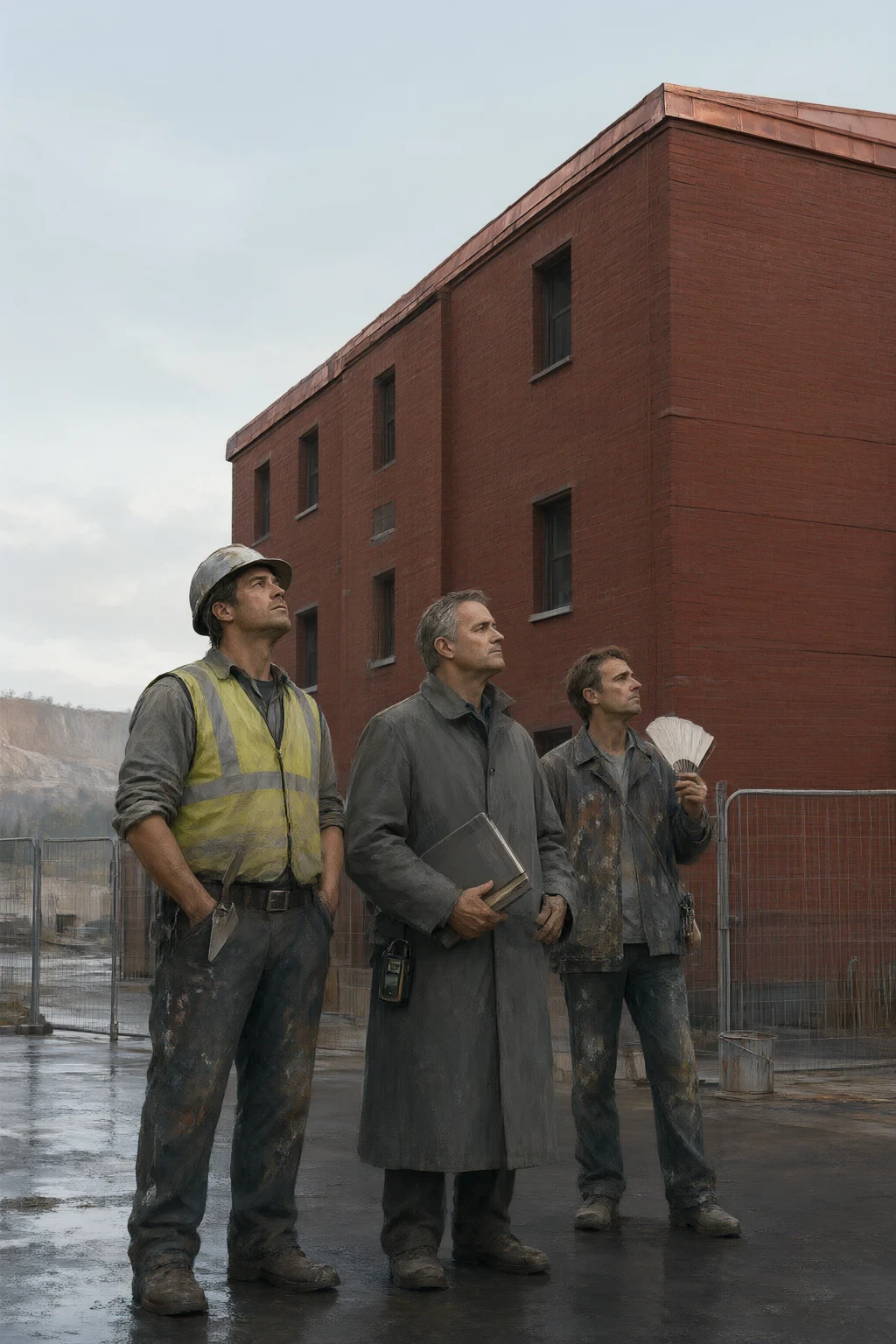
Lot 9 stood on the corner of Fell Street and Quarry Road: six units of Loadstone brick with a copper roof, twenty-two months after the Reinholt family broke ground, and it was the finest thing the firm had ever put on a site. It was also, depending on which of Coldbrook's three newspapers you read, either a monument to private enterprise or the most expensive outbuilding in the history of the district. Both stories had been running since March, and they had stopped being stories and become weather. Elias Reinholt, who was thirty-eight and had the file, stood on the pavement outside the site office with a clipboard he was using as a fan. "We're not on any of the schedules," he said. "The October one, the revised one, the emergency session. We're not a line item anywhere."
Nathan, thirty-one, came out of the hatch in the site cabin wearing a hi-vis vest over a shirt he had not changed since Tuesday. He took the clipboard and used it to point at something in the middle distance, which was a quarry, and which had been there since 1904. "Let it go, Eli." "Gus signed a bid at sixty-one per cent of the engineer's number. That's not a bid, that's a donation with a completion date." "It got us in the room." "It got us in a lawsuit. Twice." The third brother came out last, because Joachim always came out last, having spent the morning on the only job on the site nobody could do for him: looking at a wall that was thirty-one years old and remembering, correctly, in his body, where the cold bridge had been. He was twenty-four and had been on this job since he was seventeen, sweeping, and now he was the only Reinholt who could hear a wall. "Nate's right," he said. "And you're right. Both of those are the same thing this year."
Gerald Wolfe, Building Inspector, Coldbrook Department of Public Works, twenty-two years in post, arrived at seven forty in the morning with a laser measuring device he had used twice, both times on a pillar he was fairly sure was fine. He had a reputation that had outlasted every accuracy it was based on. At forty-one he had refused occupancy on a bed-and-breakfast over an eight-inch step, and a columnist had run a photograph of him kneeling on that step with a folding ruler, and the caption had been THE WOLF, and the name had followed him the way names do in a small town, entire. He had not minded it. It saved him explaining, at pubs, that his job was not to decide whether a building was nice. The line on Fell Street was Lot 9, and it was a good line, and Wolfe knew on sight that he would sign it.
He walked it anyway, starting at the bottom of the six chimneys, because that was where the money had gone and where the failures waited, and working up through every unit with the laser out, tapping each lintel and wall head, listening, because listening was the half of the job that could not be bought. He found forty-one notes. Every one was a note that could be closed the same day. Downpipes discharging onto a lower roof rather than a splash pan, two hundred feet of it. A handrail in the fourth unit's toilet installed on the wrong side. A door the plan called fire-rated and the hardware shop had supplied as solid-core, which Wolfe could see in the grain, and that somebody had gone to the trouble of staining. An expansion joint in the retaining wall that had been filled instead of left open. The brothers followed him up the stairs and took notes, both of them, and did not say anything for two hours, which was the longest Elias Reinholt had been quiet since 1998.
Wolfe came out onto the roof at ten past ten, looked at the parapet, looked at the copper, and said, "Who did the flashing?" "Me," said Nathan. "Nobody else was going to." Wolfe wrote it in the book. The book is where he is now: a hardback with numbered pages, and the entry for Fell Street, page four hundred and nine, is not remarkable. It says, in his shorthand: FLASHING — R REINHOLT — CLEAN. UPSTAND CONTINUES TO COPING. ACCEPTABLE. Then he went down the outside stairs on the north elevation, which is where he stopped. The building had one staircase for six homes. It was a legal building. Under the code, a structure of this height and occupancy could be served by a single means of egress provided the travel distance stayed under the limit, and the engineer had done the arithmetic honestly, and the stair had a door at the bottom, a light at the top and a handrail on the landing.
It also had a landing two feet four inches wider than the building needed and no provision of any kind for anybody who could not climb. Wolfe went back in and up and stood on that landing for a while, and the three brothers watched him do it, and Nathan said, eventually, in a voice with nothing in it, "Say it." Wolfe said, "I don't have anything to say about your building." "Gerry." "Gentlemen. Your building is sound. It is better than sound; it is the only one of its age in this district I would expect to see standing in eighty years. Your brick is laid to a bond nobody uses any more because nobody pays for the man who can do it." He shut the book. "Three notes, in the van. I'll bring the discharge detail tomorrow and we will sign in October, and everyone yelling in the papers can stop." He went down the stairs again and out and got into a grey car with a municipal plate.
The council meeting that Tuesday was not on the agenda, and by the third minute of the second speaker it had a subject, and by the seventh it had a number. The number was £412,000, and it had come out of the Fenn Street lead service replacement program, funded at £780,000 in the March supplementary and transferred in full to Lot 9's overrun account in November, after Lot 9's second drawdown request, with the consent of the assets committee, which met in a room with no windows and which nobody had seen before or since. Fenn Street was forty-one houses. Thirty-one of them had service pipes installed in 1958. Elias had the folder. He had not gone looking for the number; it had come to him in a brown envelope in the ordinary way that numbers come to people about to lose a tender, and he had spent a weekend failing to put it back.
He put it up in his own voice, flat, reading, because he had decided in the parking lot that nobody would then be able to accuse him of making a speech about it. "Move seven. Move the balance of seven. Move the Fenn Street program balance to Lot Nine overrun. The pipe replacement schedule is deferred to the following year." "Following year," said the chair. "Following year is not currently funded, and I have checked twice, and the asset management plan carries no notional line for it. The line is not zero. The line is absent. Those are different, and the department has been clear about the difference in the very document that lets us reopen it in twenty-six years." "Mr Reinholt." The chair was sixty and had been chair for eleven years and had the tiredness of a person who knows that everything said in the room is going to happen to somebody. "Your firm signed a bid that any consultant in the building would have told you was not a bid." "Yes, sir." "Why?"
Elias looked at his brother. Nathan, who had spent the last four minutes staring at the acoustic tile, did not look back. "Because we were out of work," Elias said. "Because there are two masonry firms in this town and one of them is us. Because the bid was arithmetic we did in the truck park and we were right about the arithmetic." "Was the bid rigged?" "No." "It was sixty per cent." "No, sir. It was the number we thought we could build that for. It was also a number we could not afford to build that for, everybody in this room knew it, and the contract documents required the contractor to disclose a qualified bid within ten working days of tender close." He set the folder down. "I want that minuted." The chair looked at the clerk. The clerk looked at the folder. It was minuted.
They did not discuss Fenn Street for another nine minutes, and what they decided, in the end, was to commission a review, which can be written in one afternoon and takes nineteen months to say anything, and to instruct the housing officer to write to the department of health about the 1958 pipes. The answer said the works were not a priority and the water was safe and the water was always safe. None of that was a decision. All of it cost money. That is the arrangement.
It was Joey who found out, because he was the one who ordered the pipe. Coldbrook's plumbing merchant had a stock account with the firm, thirty years of it, and a young woman named Perth who had started there two years ago and did not know that the name on the account made men uncomfortable. Joey Reinholt, six foot one, with plasterer's dust in the creases of his knuckles, came in on a Tuesday for forty feet of fifteen-millimeter copper, and came in a second Tuesday, and a third. "We're fine." "You've bought a hundred and sixty feet this month. Your account says the last delivery to a Fenn Street address was in March of last year." Joey went home and told his brothers. Elias, who had spent four months being a man who had done nothing wrong in public, sat down very slowly on the edge of the site cabin steps and said, "Say that again."
"Fenn Street," Joey said. "He's been buying pipe since the spring. Not repairing. He does not do repairs. He has been doing the whole run, at night, on his own time, and he is putting it on the firm's account at the material price, and he is not taking the labour. Perth says he has never once taken the labour." Nathan Reinholt, thirty-one, the middle brother, who had put up a shed of plywood and a shipping pallet at sixteen and had been the family joke for eleven years, stood in the doorway of a building his family had made and said nothing. "Nate." "Do the arithmetic, Eli." "Don't do that."
"I did the arithmetic." He came out and sat down on the other side of Joey. "We bill material at forty per cent over cost because our cost is a man and a van and we pay him properly. Twenty-two months at night, three houses a week, we are about a hundred and forty thousand in trade pay and we have invoiced none of it. The material came off the merchant. My own two years, off my own hours. I have been calling it the farm." "Nate, the firm has eleven thousand in it."
"The firm has eleven thousand in it and a Gantt chart. I did not want a Gantt chart." He turned a hat over in his hands. "Every one of them is inspected, Eli. Every one is signed off by Gerald Wolfe with a laser and a foldaway ruler, and I made sure of that before I bought the first length. I have not skipped one joint. I have gone in the doors of people's houses at nine at night and asked to take their floors up, and I have put their floors back. If one of those people needs heat in a January, in six years' time, it is already in the ground."
Elias had a great deal to say about insurance, about unpermitted work in occupied dwellings, about what a claim does to a licence, and about the fact that what he was being shown was not a favour to the district but a way of turning the district's neglect into something he could hold by himself, which is the shape guilt takes in a man who would rather be guilty than powerless. He said, instead: "Does Dad know?" "No." "Right." He stood up. "Then he doesn't, and I don't, and if anybody in this town makes a speech about it in a newspaper I will go into the newsroom and say a great many things."
The forty-second house on Fenn Street was the end of the run, a semi-detached on the corner of the allotments, and the family there had a boy of four, which was the exact age the water board's letter was about. Wolfe came to the site on the ninth of September at half past seven in the morning and did not go up on the roof. He had a folder. The department had referred Lot 9 to its solicitor over a leak claim that came from a cold-duct connection, which came from a misunderstanding, which came from a man who had blamed the mason for a thing the plumber had done on a Tuesday. "It came up to me Friday," Wolfe said. "I read it because the top sheet has my name on it. It is a department document; I get to read department documents." "That isn't right, Gerry." "It's entirely right. It's so right it's boring." He set the folder on the cabin table and squared it. "You want the one-line version or the long one." "The long one."
"There is no line on the Fenn Street job. There is no schedule, no line number, no Gantt entry and no inspection request, because you did not ask for one, because asking for one would have meant admitting that one existed." He turned the folder around. "There is a stop-work notice in here dated the second of July, issued by this department to an unnamed site on unnamed ground, on the grounds that works of this scale appearing in this district without a permit is unlawful. It has sat unassigned since July because it has no site name on it. I assigned it to myself in March. I have carried it for four months, waiting to see whether you were the sort of firm that would stop." Elias said, "That's not legal, Gerald. You can't unassign a notice like that." And then, before Wolfe had answered: "Gerry, if your name is on that and somebody in the department finds a retrospective start date on it."
Wolfe looked at him for slightly longer than was comfortable. "I have been an inspector for twenty-two years, Mr Reinholt. I have found something on a retrospective start date in one building in four hundred and six. There is exactly one building in four hundred and six where I would have wanted to find it, and it is not this one." He picked the folder up. "Because this one is going to be built. Forty-two houses, thirty-one of them with the pipes already in the ground, and eleven the money will now have to be found for by somebody. Not by this firm. You are finished, and I would like you to be finished in the ordinary sense, with a house behind you and a certificate on it."
The certificate came in October, exactly as Wolfe had said it would, in a flat grey envelope, and it was the most beautiful document any of the three of them had ever held. It was one page. It said that the premises at Lot 9 were fit for human habitation subject to the three items of August and the discharge detail of August, and it had a number in the corner, a signature, and a stamp with an ink smudge under the R that Elias, decades later, still remembered before he remembered the house. They did the small ordinary celebratory thing: Gus came with the van, and there were eleven people on the site, and someone brought a cake in a supermarket tin that was the right size by accident.
Gus Reinholt was seventy-one and had not laid a brick since the year of the second overrun. He had signed the 61 per cent bid with a pen that had belonged to his own father. He held the certificate in both hands, at a distance, the way he held everything now. "Gus," Nathan said, "Fenn Street." His father looked at him. He was not a fool, and he had not been a fool in 1993 either, and there were things about the Fenn Street that he had understood for a long time and had a reason for. "Nate," he said. "Not at the party." "It's a party. It's six men and a woman with a clipboard." "It is not a party, it is a certificate." "All right." Nathan took a breath. "Then it's the certificate, and I should tell you at the certificate, and I have gone over it about nine hundred times and there is no version where you don't already know." Gus looked at the certificate for a while. "Number forty-one is Mrs Adeyemi," he said. "Number forty-one is Mrs Adeyemi." "Her husband was a bricklayer." "Yes." "Course he was." Gus handed back the page. "Well. She's had the water since the spring then." "Nate." "I'm not having a scene with my father in front of a supermarket cake," said Nathan Reinholt. "I'll fix the stair."
The stair was the problem, and fixing it was the last two months of the firm's life. It was, of course, legal, as Wolfe had said. It was a good stair; it was lit, it had a door, the travel distances were honest, and a nine-year-old could go up it at a run. What it lacked was any argument about the people who could not. They widened the landing. That was a structural alteration, it cost eleven thousand, and it was not in the contract. Joey did it on Sundays with a permit Elias had forged badly and then corrected, in ink, at a laundry. They put a second handrail, at the height of a rail a person of five foot four had chosen, on the wall side of the first turn. Wolfe inspected it, wrote a note, and accepted it. It is in the file on page four hundred and twelve, and it is the only item in the entire twenty-two-month file the department did not require.
They put a lift in the cupboard. Elias said it was absurd. It was obsolescent, and the first person to ride it up was a woman of eighty-one named Trudy Sowerby, who had gone up four hours a day for eleven years to see her sister and had told the housing office three times, and been told each time, pleasantly, that the building was compliant. And in the second week of December, with a cold off the fields that put ice in the seal of the new doors, the firm repainted the whole common stair, because it was new, because nobody had ever said they had to, and because there is one thing that happens at the end of a site and it is not the certificate.
The colour was not on any list. Coldbrook specified its housing in eleven approved shades, and Schedule B ran to a yellow, a yellow-green, and a grey the colour of a wet road. The brothers used all three over the landings, and then, on the last flight, at the turn where the second handrail went, opened a tin from the old store, mixed for a job in 2007 and never used: a flat, soft, ordinary red. Gerald Wolfe came to sign off the discharge detail in the middle of the afternoon and stood on that landing in it with his folder under his arm. "That is not on the schedule," he said. "No, sir." "It is not on the schedule and it is not in the specification, and if a resident writes to complain about the colour of a wall in a building that is not technically public — it is a private stair in a mixed development, the deeds are nonsense — I have no jurisdiction and no appetite." He looked down the flight. "Good." "It's a good red." "It is a very good red. It is a red for a building where you can see the door from the bottom of the flight," said Gerald Wolfe, "which is the entire point of the exercise and which nobody has ever put in a code."
There was no money. Not the shape a small firm is run out of by a bad year, but the other shape: eleven thousand in the account the day the surveyor's invoice cleared, a redundancy claim four days after it, and Elias, who had never once in his life asked a client for anything, going to the Fenn Street households one at a time in his own car to say my brother did this work for nothing and now I cannot pay him, and here is a schedule of what I can do over four years. Forty-one families. Thirty-one accepted. The last morning, they came for the truck.
That is the thing nobody tells you about a small firm: the equipment goes first, and it goes quietly. Gus had bought the tipper in 1991, a Bedford with a swerved chassis and a crane that was a joke in the trade. It was the only thing of real value in the business, and in the March it went to auction in Martingale's with the mixer, the scaffold and the formwork, and Elias sat in the front row with his father's old coat on his knees and did not raise his hand, which surprised him, because he had been certain in advance that he would buy the Bedford back with money he did not have. The truck went to a man who wanted a tipper.
They got it back four months later, repainted, with a different name on the door. It was the last joke the three of them had, and Nathan insisted. The sign writer had quoted for REINHOLT BROS. BRICKLAYERS, because that is what had been on the door for thirty years, and Nathan made him take out the S and the dot and put in & BROTHER in a single line one inch high under a N. REINHOLT in four-inch capitals, and told his brothers, in the yard, with the money gone and the Fenn Street schedule open on the bonnet, that this was not a demotion. "It is a schedule of one," he said. "It is one man, on his own account, doing his own hours. It isn't the firm's and it isn't anybody's, and if I fall over on a Tuesday nobody is out of work but me." Joachim said, "It says Brother singular." "It does." "You're not our brother any more." "I'm not your employer any more," Nathan said, and got in the truck.
It was in the yard the next Saturday, the gate was open, and Joey was letting a woman in who had come about a landing she was thinking of widening. She read the small sign on the door as she came in, and turned round in the yard. "I'm in the truck," said Nathan Reinholt, and pulled the gate shut behind her.