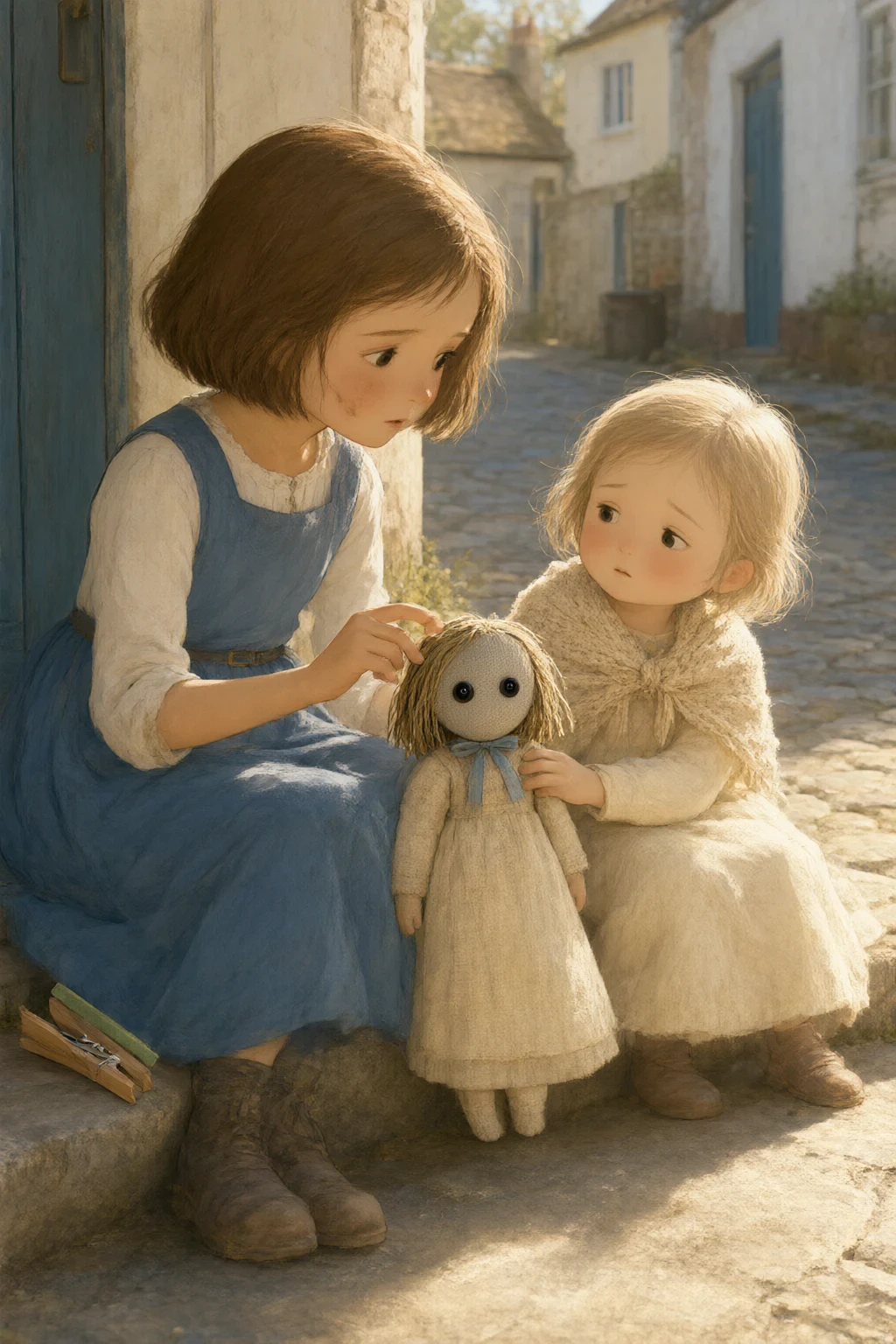
Kaja's doll had a grey face and two black eyes and a blue ribbon, and Kaja had made her with her own hands out of an old shirt of her grandmother's, in the winter, with a shoe box for the pattern. That was three winters ago. Since then Signe had been to the harbour, to the fair, to the bottom of the garden, into the flour, and once all the way to the next village in the basket of the woman who sold apples. Kaja had carried her everywhere. When Kaja walked, Signe walked, because Kaja was six then and did not want to walk alone. The doll did not talk. Kaja had decided early that she would, and then had decided that she would say it in a low voice, and then had not.
It was the first warm day of April when Kaja saw the small girl in the lane. She was sitting on her own front step with a stick, turning it over and over in her fingers, and she was three. Her name was Ilse. Kaja knew her because everybody knew which house was the one with the child on the step. The child had no doll. She had a stick, and a bit of string, and the string had come untied, and she was doing something to the stick with the string that did not seem to be working. Kaja stood at the end of the lane for rather a long time. Then she went home.
Signe was on the shelf. Kaja took her down and sat on the floor with her, which she had not done since she was small. "You have got no name," said Kaja, to Signe. "Your name is Signe, after my grandmother, and she is dead, and that is where you got it from." She looked at the black eyes. They were sewn on. They had never looked at anybody, and Kaja had made a long habit of being looked at by them.
"I am not taking you to anybody," said Kaja. "I am giving you to somebody. You are going to be hers all day tomorrow, and every day after that, and I am not coming to get you, so you had better be worth it." That last part was said to herself, mostly.
She carried Signe down the lane in her basket, which is not a good way to carry a doll and is a very good way to carry a secret. She set her on the step beside Ilse and said, "That is yours. It is a doll. Her name is Signe, and she is not new, and she has been to the harbour." Ilse did not touch her. That was the worst part. Kaja had not thought about what a child does when she is given something and does not have to work for it, and the answer is: nothing, for a while.
"You can sit her on your knee," said Kaja. "I do not want to sit her on my knee," said Ilse. "She sits better on the knee. She has a hollow in the back."
So Kaja showed her. That was the job, and it turned out to be a job, and it took the whole morning. She showed her how to carry her under the arm and not by the ribbon, because the ribbon is not for carrying. She showed her how to say something to her in a low voice and mean it. She showed her the thing about the hollow in the back. "She does not talk," said Ilse. "No." "Then what do you say to her?"
"You tell her about your day," said Kaja. "That is the whole of it. I have said that to her about the well and the hens and the man with the cart for three years, and she has heard every word of it, and she has never once told me I was boring, which is more than anyone else has done." Ilse picked her up by the arm, the way Kaja had said, and put her on her knee. Then Ilse said, "Her arm is stiff." "She warms up," said Kaja, "if you hold her."
Kaja went home by herself and did not feel good about it. She had expected to feel good about it, and she had told herself she was going to, all the way down the lane. She put her hand in her apron pocket, which is where her hand went about nine times a minute, and the pocket was doing nothing at all.
It was a bad afternoon. She looked in the doll cupboard, which held a hedgehog with one eye, a wooden horse, and a ball. She tried the horse. The horse had never cared about her and it never would, and she knew that, and it was still better than nothing for about ten minutes. Then she went out to the woodpile with the drawing knife, because there was a clothes peg in the woodpile that she had been thinking about since the spring.
It was a good peg. The flat kind, with the two halves, and the metal band down the middle. She took the band off with the back of the knife. She took out one half of the peg and sanded the flat side smooth on the stone step. She cut a square of felt from the heel of an old stocking and pressed it into the groove with her thumbnail, and it stayed. She pushed the peg back together, and there was a small flat head, and a small flat body, and a groove.
Then she looked for a long time for a bit of string to be straps, and there was no string, and so she cut two strips off the lining of the old stocking, and threaded them under the band, and pulled them up, and the peg doll hung from her hand by two strips like a baby in a sling.
It was not Signe. She knew that before she had finished the second strip. It had a wooden head and no hair and no history, and it was four inches tall, and it had been made in one afternoon by a girl who was feeling as though she had taken something out of a box and thrown it away. But it hung, and it stood, and the straps held. She put it in the apron pocket, and the pocket was doing something again.
Ilse was still on the step when she came back, in the last of the light, with the doll held stiff and away from her body in exactly the position of a child holding something she has not decided about. Kaja sat down on the step beside her. She did not take the doll. She reached over and pushed the doll's back hair flat with one finger, and put her hand away again. "You have got her crooked," she said. "She was like that." "No, she was not," said Kaja. "I made her. I know how she sits."
She reached into the pocket and took out the peg, and set it down on the step between them, standing, on its strips. "That is a boy," said Ilse. "His name is a peg." "That is his name," said Kaja. "He is called Peg, and he is no good at anything, and he will not last a year in the rain." She stood up and shook her skirt out and started down the lane. At the end of it she turned round, because there was one more thing and she wanted to say it in the lane where it could not be written down afterwards.
"Put her on the knee," she called. "When she is stiff. She likes the knee." Ilse did not answer, which is the answer when a small child is doing something for the first time and is concentrating, and Kaja walked home down the lane with a peg in her pocket that she had made herself, and the evening was long and quiet, and she slept.