The wolf could count to five, and past five it went wrong. He could count sheep, and that worked as far as it went. He could count sacks, and fence posts, and the buckets in the dairy. It was when he got to six that the trouble started, because by then he had to remember which ones he had already done, and the number seven sat on the far side of a gap he could not see across. He had a cottage of his own at the edge of the common, and eleven sacks of wool, and a woodpile, and nobody in it. On the long evenings he counted the woodpile, and it always came out different, and he would start again.
One evening in the early spring he heard counting from a cottage with a good fire in it. It was not music. It was a child's voice, and behind the other voices, doing the counting along, a very small one: one, two, three, four, five, six, seven, and then the older ones again, because a small voice does not trust a number the first time and wants to hear it twice. The wolf stood outside the gate for a long while and listened. Then he knocked, because his mother had taught him to knock. "Mrs Alder," he said. "I heard you counting. I have never got past five." Mother Goat looked him up and down, which takes about three seconds and tells you everything. "You are big," she said. "I am." "Get in by the fire, then, and don't touch the third chair."
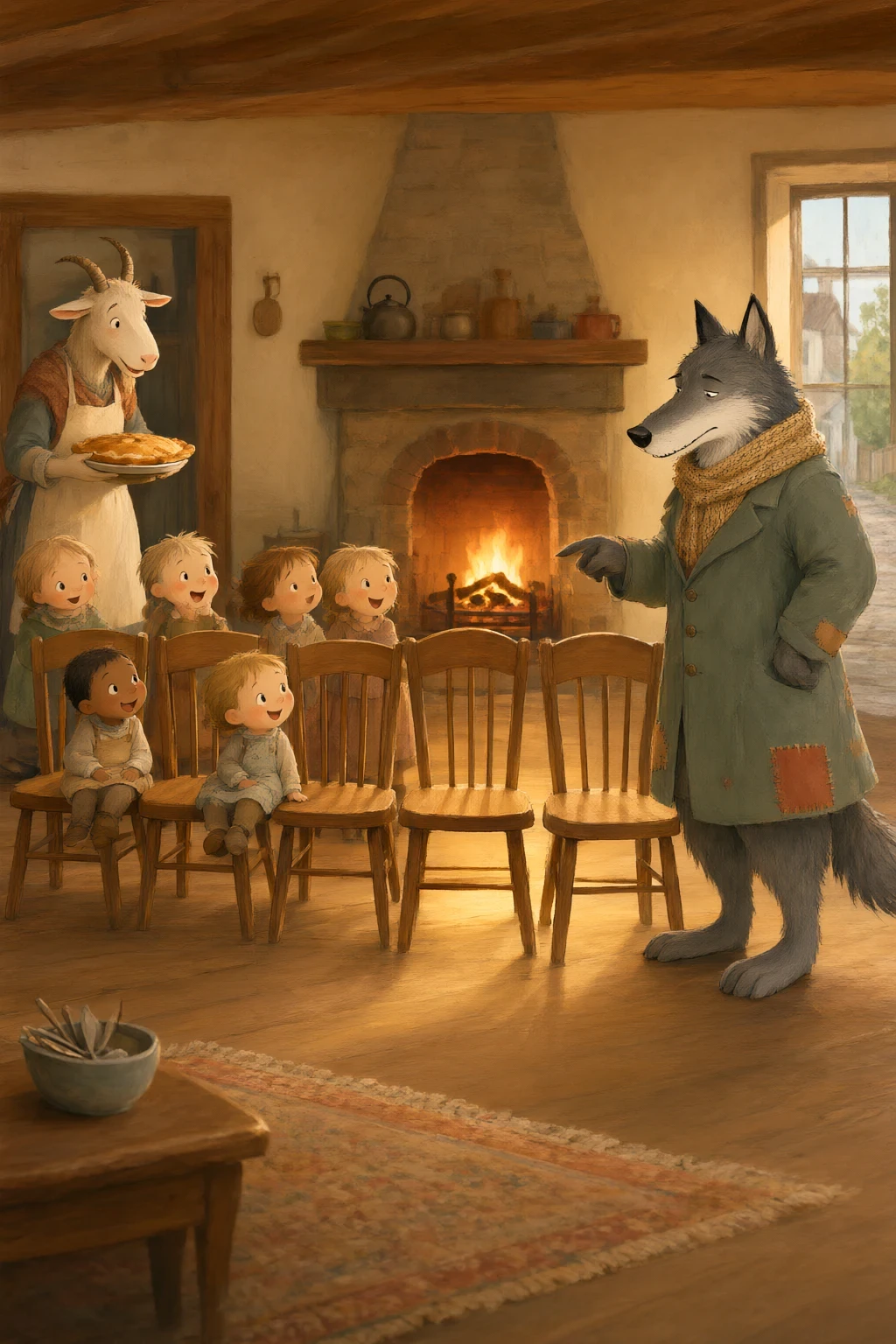
Everybody in the cottage was delighted, and then within four minutes everybody was shouting at once. "Say seven," said the eldest, "and he can have the pie." The wolf stood in the middle of the floor and counted. "One," he said. "Two. Three. Four. Five. Six." He looked at the ceiling for a while. "And then what?" he said. The kitchen went completely silent.
"It is the same every time," said the wolf, unhappily. "I get to six, and I know there is more, and I cannot find the place where the more starts. So I say and then what, and everybody laughs, and I have to go out in the rain and count the woodpile." Nobody laughed. The eldest kid looked at the floor. The second kid looked at the eldest kid. Pim, who was five and small, climbed up on a chair so that he could see properly. "You counted the kettle twice," Pim said. The wolf crouched down. "I did not." "You said five and you pointed at the kettle. Then you said six and you pointed at the kettle again."
They moved the chairs. That was Pim's idea, and it turned out to be the best idea anybody in that family had in a year. They dragged every chair in the house into a row by the table, seven of them, and the wolf was made to sit still at one end and look at the row. "Right," said Pim. "You say one and I sit down." "Rather you point," said the wolf. "I get muddled if I have to watch anybody."
So he pointed, and Pim sat on the first chair. He pointed, and Nell sat on the second. The second boy took the third, the eldest took the fourth, and there were four more children and they went on down the row until there were six children sitting on six chairs and the row had one chair left at the end of it with nobody on it. "Seven," said Pim, and smacked the empty chair with his hand. "SEVEN," said the wolf, and put both hands on his head, because he had got there by himself and nobody had told him the answer.
After that they counted everything for three hours. They counted the spoons in the drawer, and they counted the loaves on the dresser, and they counted the stairs going up and then the stairs coming down, which is harder, and which the wolf got wrong twice and did not argue about. They counted out of the door and along the fence to the gate, and Mrs Alder made them all do it again because the wolf had made a mistake at the gate and had tried to hide it in his coat.
The wolf could count to thirty by the end of the evening, and past thirty it got thin again, but he could go past seven, which was a thing he had not done in nine years. Mrs Alder put a plate of the pie in front of him, and he said he had not earned it, and Pim said, "You got to seven. That is earning it. Eat it before it gets cold."
The wolf told them about the wool. That was after the pie. That was the part of the evening he had been dreading and had not expected to end up telling. "I have eleven sacks," he said. "I have never sold a pound of it. Every autumn I say I will take it to market, and every autumn I count the sacks, and I do the sums, and I get to the part where a man would ask me how much I want for the lot, and I do not know, because I do not know what wool is for." "It is for knitting," said Nell.
"I know that. I have known that since I was small. That is not the same as knowing." Mrs Alder let him talk until the fire went down. "Sell it by the pound," she said. "Weigh it on the market beam. Ask two stalls what a pound is worth and then ask a third, and do not tell the first two what the third said. That is not being clever. That is just how it works." "And if the third asks more?" "Then you have learned something," she said, "and you can carry the sacks back yourself."
The wolf sold his wool in three days, at a better price than he had expected, for enough to mend the roof and buy a second blanket and pay the man who cut his firewood, who he had also been meaning to pay and had not, exactly. He came to the cottage on the last evening of the autumn to say so, and to say thank you, and to say that he was going to bring Mrs Alder some wool, and she said to bring the wool and not to bring the thank you, and he brought both. The children counted him out of the door.
They counted the gate, and the whole of the lane, and the number of ruts in the road, which was nineteen, and which they got completely wrong and had to do twice. Then the eldest stood in the doorway and shouted the numbers after him all the way down the hill, and the wolf shouted them back, going away, getting smaller, and when he was too far off to hear they properly he kept counting under his breath by the light of the window, and he went past seven, and past eight, and past nine, and there was somebody in the world who had heard him do it.