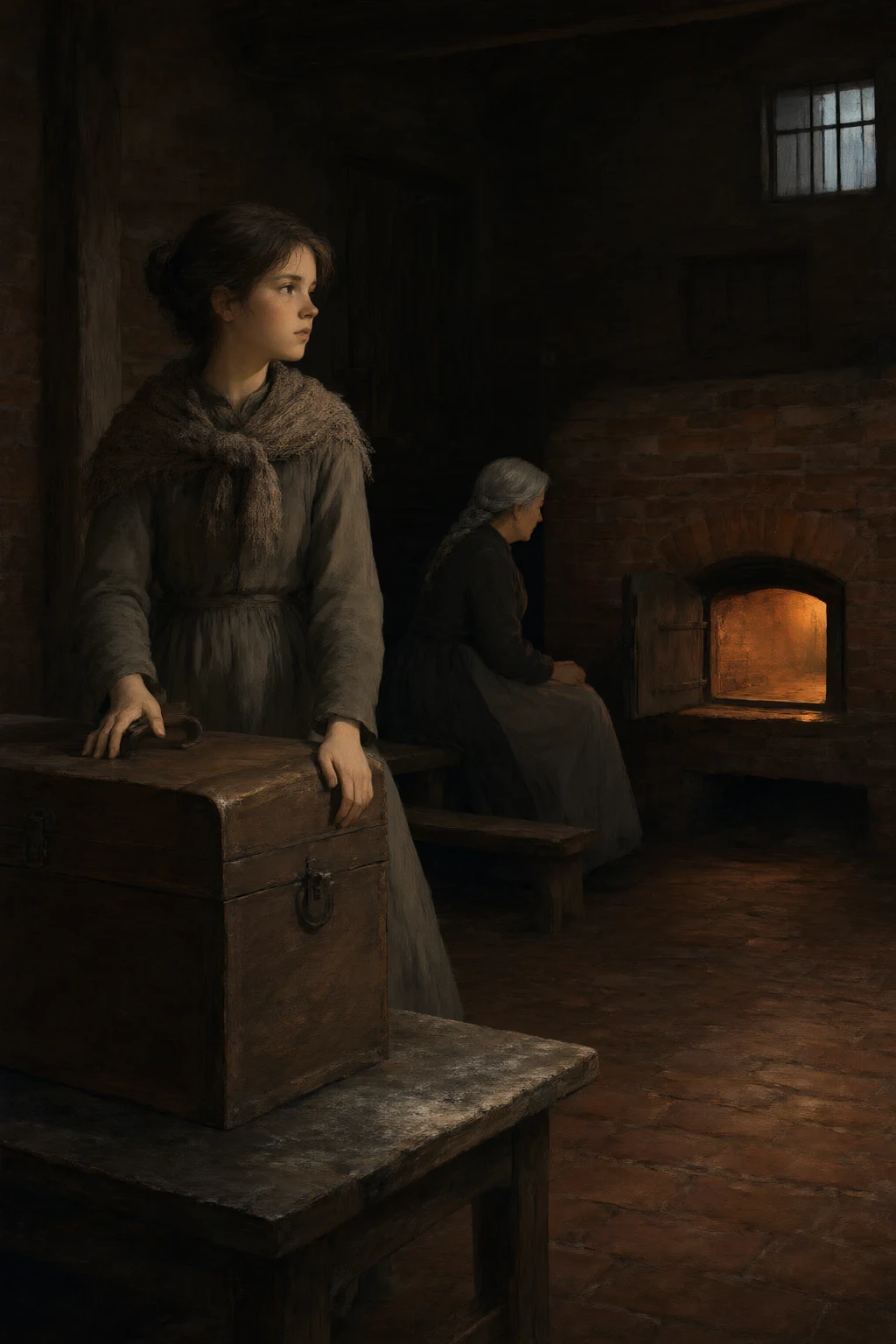
The town of Hollenbeck had four hundred people and a sugar house, and the sugar house was the reason the town was a town. Sugar, in that century, is not a sweet. It is a refinery. You take the beets in the ninth month and boil them down through four copper pans, and the fourth pan has to be fed all night by a stoker who does not sleep. So the enterprise runs on three things: a market, a river for the sluice, and fuel. Hollenbeck had the market and the river. It had no wood within two days' carting, so the house bought prunings, and the cheapest prunings were the spent cane pressed dry and stacked at the back of the yard.
What is not in the gazette is that the house stopped paying its own way in the year of the bad frost, and that the Amtmann of the district came with a clerk and wrote an agreement, and that everybody alive in Hollenbeck knew all nine clauses. In substance: the sugar house will take children off the parish at four a year, and will feed and house them and teach them the trade. The parish will not pay, because the parish has no money; that is why the children are being given away instead of kept. Instead the cost is carried forward against each child's labour, and every child is entered in a book, and the book shows what the child has consumed and what the child has earned, and the balance stands against the child's name. The fourth clause is the one that matters. It says: Where a child's account cannot be closed, the house shall recover the remainder in fuel. The stokers of Hollenbeck have always known what that means. It means the oven.
"The parish does not want you," said the Alte. She did not say it kindly and she did not say it unkindly. She was a small dry woman of about sixty with grey hair braided twice and pinned, and she had been mistress of the sugar house for twenty-two years, first for a husband who could not manage it and then for the district. She read aloud out of the agreement, and she had it in front of her, sitting at the long table by the sluice with the November light coming in flat off the water. "Do not look at me like that. I have read it to a great many people and it is true. I am saying it here because in the village you have all decided I am a witch, and a witch is somebody who does what the paper says."
Gretel, who was fourteen, said, "Then the paper says we are to be burned." The Alte turned a page, because she had it in front of her, and looked for a while. "The paper says the fourth clause. It does not say the oven. There is no oven in the fourth clause. The oven is a matter of how the furnace is stoked, and I have not stoked it in eleven years." That was the first lie Gretel ever heard the Alte tell. Gretel kept it, and the reason she kept it was that she had learned to read a page, which is why she was in the writing room and not in the pan room.
The house had three floors and most of them were furnace. On the ground floor, the four pans and the presses and the wet yard. On the second, the sugar shed, the sleeping loft and the ovens, bricked up by the fourth pan, because a furnace is a furnace and you do not make it tidy. The third floor was the schoolroom, and it was the best room in the building because it was over the flue, and it was built there because a person supervising a child who is stoking has to be somewhere the child can be heard from without shouting. That is the architecture of the whole argument, and it is the same argument in every sugar house in Europe: the child is cheapest where the heat is.
The schoolroom had eleven children in it. The Alte taught herself, badly and unwillingly, and the older children taught the younger, and what was taught was reading, writing and the trade. Four were apprentices, and the trade was stoking and skimming and a sum about the price of a bushel of beets. "There is no one to teach you anything else," she told them. "The trade is a furnace and a wet yard and a bad back. That is what you are apprenticed to. I did not choose it. Neither did the parish. Neither did you."
The ration was cut with a knife in front of them and it was called the Fessel, and the cutting of the Fessel was the most important lesson in the schoolroom. Four hundredweight of bread, a stone of cheese and a measure of molasses out of the second pan, for eleven children and four apprentices, every day, and the eleven were measured, not the four, and the measurement was not weight. It was the slice. "That is mine," said a boy of thirteen called Rupprecht, putting his arm round the loaf. "You had your slice." "The piece on the bottom is not a slice. The piece on the bottom is what is left, and it is bigger." "It is not a handbreadth bigger." "It is a handbreadth bigger, and she measured it, and you all saw her measure it."
Nobody said anything. Rupprecht took the piece on the bottom. This happened every day and nobody said anything, and Gretel learned from it the one fact that has been the whole of her life since: a thing measured in front of people stops being a theft within a year and becomes a custom, and after that the only thing left to argue about is the size of the piece.
Gretel was, by that fourth year, the best in the schoolroom. She could read the second-pan ledger, a book of boiling figures in a hand nobody else could follow, and she could read the agreement itself, which was the real achievement, because it was in the district hand. "Do you understand that document," the Alte said to her in the second year, in a tone that was not a question. "Yes." "Say what it does." "It gives you the children of the parish at four a year. It makes you feed them out of the value of their work. It forbids anyone to ask the parish for money. And when a child's account will not close, it says you may take the balance in fuel." "Yes." The Alte sat back. "Go on." "And it is not your fault."
"No," said the Alte, with real satisfaction, "and it is not the parish's, and it is not the children's. It is the fault of a man in the district office in the year of the frost who needed a sugar house to look as though it had not failed. He wrote nine clauses and went away to another one."
Gretel got the names in the fourth winter, and she got them out of a book, which is the dullest sentence in this story and the only true one. The master book was in the writing room in a locked case, because the Alte was not a fool about it. It had a page for each child with the day they came in, their parish, their age, and then two columns. The first was consumption, the second was labour, and at the foot of each page, where the two were set against each other, was a number. Eleven of the twenty-two names had a number.
Gretel worked it out on her knee over four nights by November light, with her mouth shut, because in this house saying a thing out loud is the last thing you do. Every child with a large number was a child entered low and fed high. Nobody enters a child honestly unless the house is honestly run, and this one was not. She told Hansel on the fourth evening, in the loft, in the dark. Four things. The master book was in the case in the writing room. The Alte had gone down to the district on the eleventh day and would be gone four days. Eleven of the twenty-two had a number. And the number was on the parish side of the paper and not in the house. "So the parish did it."
"The parish did it and then wrote themselves out of it. Look at the fourth clause. There is no parish money in that. There is a child, and a balance, and a furnace." "And the next one in the oven is somebody's number with a name on it." "Yes." "Which one is next?"
The Alte was not gone four days. She was gone eleven, and she came back early because for eleven years she had been asserting from memory a clause she had never seen written down twice, and a woman who asserts a clause from memory for eleven years is a woman who is afraid. She came in through the yard on the second evening with a lamp and a saddlebag and four days of road on her, and the first thing she said was, "Nobody has gone into the oven." "They were going to," said Gretel. "On the fourteenth." "Two of them. On the fourteenth." The Alte set the saddlebag down inside the door. "Nobody has, because I was not here to sign it, and the stokers do not do it without my hand on the paper, and I made sure of that in the first year." "Why?"
"Because a thing like that needs two people to have agreed to it, and I decided in the ninth year that I would never be the second one. I never decided I would not be the first. I have thought about it every year since, in the third month, and I have never improved on the arrangement, and there are four children in this room who would be in that oven within a year if I signed the paper."
Gretel said, "I have the names." The Alte did not ask which names. She unlocked the case, which she did slowly, and stood looking into it, and then said, "Then the exchange is this, and I set it out once and we do it tonight. I have carried that book for eleven years and have never been able to write in it what was in it. The parish clerk came in the fifth year and asked for the balance sheet and I said I did not have it, and I did not have it, because I could not make the two columns meet without writing a false line." "That is the fourth-year class," said Gretel.
"Yes. You may have the book, and I will put my name at the foot of the last page, and you may take the whole of it to the Amtmann yourself, and I will say nothing against you." She took it out and set it on the table. "And the exchange is the oven. I have known since the second year what you came down here for. You want the room beyond the press, where I have never let a child go." "There is a room beyond the press," said Gretel. "There is a bar on the door and it is warm, and there is smoke under it, and it is the only warm place in this house in the fourth month."
The writing room was the room the children called the oven. There was a real oven in it, a small bread oven at the far wall, and it was the only thing in the room that was hot. The rest was tables, a window, a second door, and a brick floor that sloped very slightly towards that oven, because the flues are older than the room. The bar on the door was a bar on a Schreibstube, and what was taught in it was the old formula: the words a person says over an oven to take the harm out of it. Then, the next year, the formula for a person. Then, the year after, the formula for a house. The Alte had never let a child in there, because a child who knows the formula for a house is a child who can be sent to a house.
"Who taught you it?" "My husband's mother taught it to him and he wrote it down, and he is the only man in this valley who ever wrote it down. He taught it here. To apprentices." She sat down. "I shut it when he died, because I am not a fool, and because he had it out of an old woman in a village that no longer exists." "And you have taught the rest of it in the schoolroom for twenty-two years."
"The rest is reading and writing and a bad sum about beets, and I have taught it to about ninety children, and forty of them can do the second-pan ledger this afternoon, and eleven of them are in the seventh floor tonight doing a year of a trade that is shutting." She turned her head. "I know what I am. A sugar house with a bookkeeper is a thing that can be argued with. A sugar house with no bookkeeper is merely cruel."
The Amtmann came in the third month, twice, and the second time he brought the district clerk, and it took nine days. He was not a bad man. That is worth saying, because a story of this kind only works if the man at the top is a devil, and he was a small careful man from a town two days off, with a wife, no money, and eleven more of these houses on his list. What he had done was sign a clause, and the district had stopped paying the reimbursement rate for eleven years, and when the goodwill ran out the clause that caught was the one about fuel.
The release of the twenty-two took the whole of the month. The four apprentices went out to the three houses still working, with their four years of service valued at a figure the district paid. Hansel went to a waggoner on the forest road, and said much later that it was the thing that taught him to read a weight. And Gretel, who was sixteen, was asked whether she would stay on.
She said no to the sugar house, which had closed for want of a district and would not open again. She said yes to the school, which the parish could not pay for either and which was therefore to be paid out of the sugar-house fund: four thousand two hundred guilders, attached in the third month, because the Amtmann had read the same book she had and understood the same thing in it, which is that a number at the foot of a page is either a debt or a weapon. She took the post at sixteen. It was not a great post. One room, one stove, eleven children, a parish that could not feed them and a fund that could, and a book she kept herself, and it went on for forty-one years.
The Alte lived another nine years, in a room over the bakehouse in the village, on a pension of thirty guilders a year, which she spent a good deal of arguing about. She came to the school in the winter and did not teach. She sat at the back and watched eleven children read, and once a girl of nine came back to her chair and asked whether she had ever been able to read, and the Alte said, "No. I can add." "Then how do you know what the numbers mean?" "Because I have looked at them for twenty-two years and have never once found out, and I stayed anyway."
The last thing Gretel did with the master book was have it bound, and she had the eleven names copied onto the flyleaf in a clear upright hand, with the number under each and nothing after it. No cause. No comment. Because she was by then the person who wrote causes into columns, and a column with nothing in it is a column with nothing in it. The oven in the writing room was not taken out. It was a bread oven, and the only warm thing in the room, and the flue under that floor had been there before the room was, and there was no sense in it. So Gretel had the fire lit every morning in the cold months, and the boys' class stoked it, because the boys' class was always the class that was stoking.
On the first morning in the third month, the year after the Amtmann came, a child of nine named Kati was given the first loaf out of that oven, and it was not good, because it was the first loaf, and it had a crack down the middle of the crust and a colour on the underside that the pan room had a name for. Gretel cut it in eleven, and the pieces were not equal, and she did not correct them, because the Fessel was cut in front of the children, and a thing that is measured in front of people is not a theft.