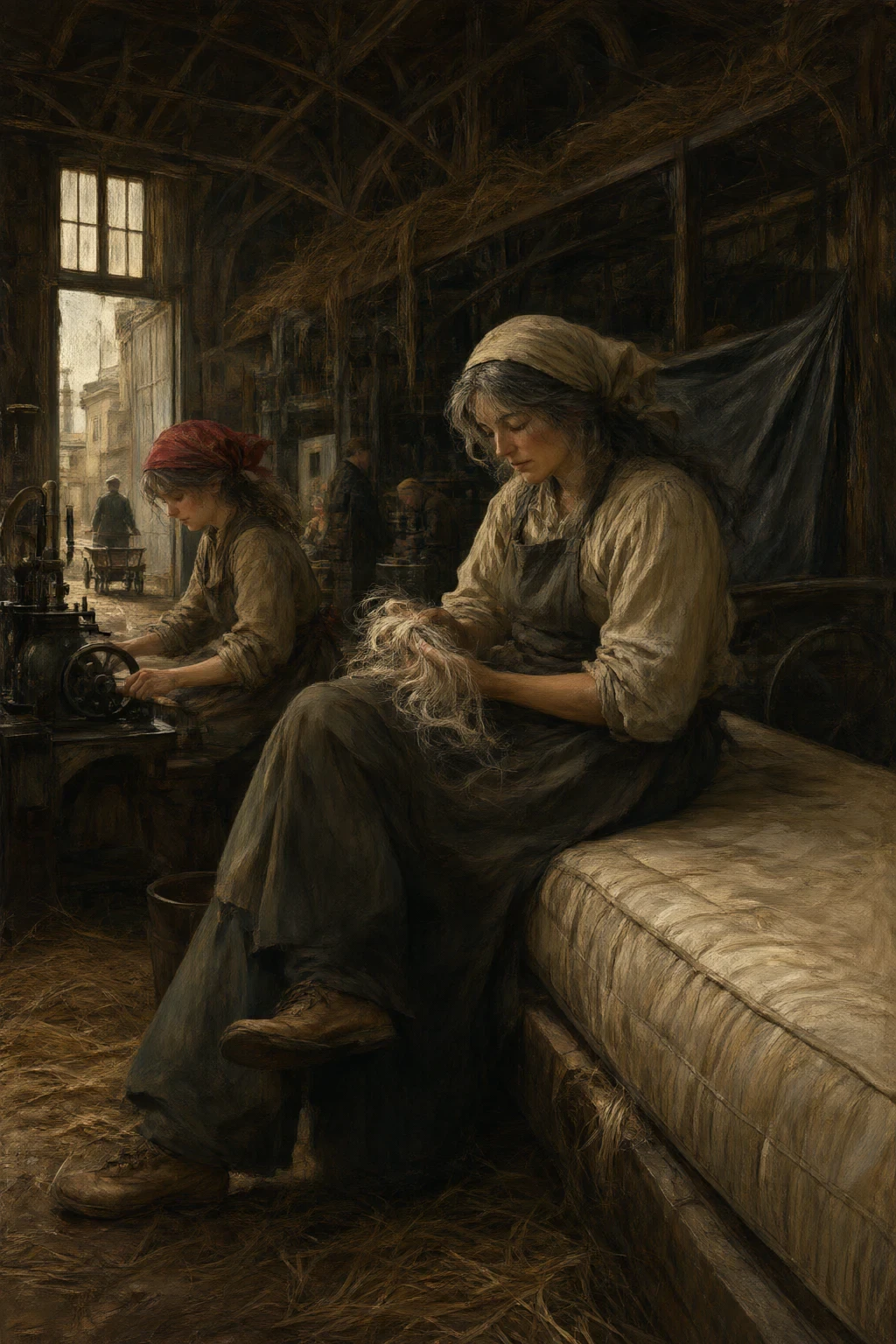
The minute of the standing committee of the Bureau of Standards of Featherstone, of the fourth of September 1990, item eleven, runs to a hundred and forty words and Nell Crumm read it eleven times before she was satisfied with it. It asked her to build one bed deliberately wrong. The minute had been drafted three times. The first draft asked her to construct a mattress exceeding the declared tolerance. The second draft asked her to demonstrate, by the medium of a bed, the degree of error which a tolerance permits. The third draft, which was the one that went to her, said that the Bureau required a bed, to be made by a trade stuffing shop at the cost of the Bureau, which should be out of tolerance beyond the ordinary degree and beyond the reach of correction, for the training of examiners; and it ended with the words and its only concession to anybody in the room, that the trade would be paid at the schedule rate.
Nell Crumm was sixty-two. She had been stuffing in Featherstone for forty years and had owned the shop at the corner of the towpath below the works since 1968, and her hip had been out of alignment since 1979, and she sat on one buttock on the long bench with her right foot on the frame and narrated the stuffing in the third person, because if it was happening to somebody else she could be honest about how much of it was wrong. She had waited thirty-one years to be asked. She said so to nobody. She wrote back on the same day, and the letter is in the finding office, and it is four lines long, and the second line is the one Cobb Tarn read twice when it came up with the minute. It said: I will build it well.
The Bureau sent Aldis Prome down to the shop on the Friday with the specification, which was a foolscap sheet with a figure on it. The figure was 1.6 ounces. That is a house figure, which is a promise about how wrong a bed is allowed to be, and the trade writes it in pencil on the foot of the bed in the hand of the person who promises, and the person is the shop, and the promise is the thing that was sold. “It is written on the foot of your demonstration bed,” Aldis Prome said, “in your own hand, before you begin, and it does not change.” “Then it will be 1.6 on the foot of it on the fourth of September and it will be 1.6 on the foot of it when it is finished, and if it comes out at 1.6 I will have wasted your money.” “It will not come out at 1.6.” “No,” said Nell Crumm. “It will not.”
He put the heel of his enormous careful hand flat on her bench and left it there while he looked at the shop, and she waited for the verdict the way she had waited for verdicts for forty years, and he gave it in the other order, out of habit and without meaning anything by it: “1.6, in, 1.6,” and then corrected himself, because nothing in the shop was in, everything in the shop was on the bench, and the correction took him a moment and visibly cost him something.
The Bureau’s requirement was a bed out by more than the ordinary degree and more than the reach of correction. A returned bed may be re-stuffed, so a bed out by four-tenths is within the reach of correction. A bed out by two ounces is not, because the coir has been worked and the horsehair has been curled and the ticking has been stretched over a shape that will not take a second filling. The Bureau wanted the unreachable figure. The Bureau did not say how far past it, and Nell Crumm read the specification twice and gave them what they asked for, which was 4.1, and she told them the number in the yard on the Monday because she did not hold figures in, and Aldis Prome wrote it on the specification with a pencil and said it was noted.
The frame came from the works, the iron from the stock, and the ticking was woven at the twining shed at fourteen ounces to the yard and cost her four and six the yard before it was cut, and she would not have the cheaper twelve-ounce, and when the foreman of the twining shed said the Bureau was paying, she said the Bureau was not stuffing it. He put in flax and coir and the curled horsehair, and he did it in three weeks, and the girls of fifteen were at the tearing machine in the far shed and the noise of it came through the partitions all day like weather, and the smell of the whole place was hot flax and tar and a hundred thousand small animals.
She had not built a bed to a figure since 1979. She had not built a bed to a feeling since before that, and the last time she had tried to build a bed to a feeling she had put in nine inches at the shoulder line and had had to open the ticking on her own bench and pull it and pay for the ticking, and that was the eleventh, and the eleven before that and the eleven after that are all in a ledger under the bench in her own hand with the amounts she paid against each. The first demonstration bed came out at 6.8.
She knew it while she was doing it. She knew it at the second week, when he was going into the shoulders too well and she was thinking about the shoulders, which is the oldest mistake in the trade and the only one that is unforgivable in a filler, because the shoulders take the weight and the hips take the night. She took the ticking off on the Tuesday and pulled a pound and a half out of each shoulder by weight and it still came out at 4.9, and she said, to the shed, out loud, to nobody: “She has done it again, and she will have to pay for it herself, and she knew at the second week.” She paid for it herself. It went on the ledger as the twelfth, and the ledger is the only place in the town where Nell Crumm is a fool.
The second bed came out at 4.1 on the twenty-eighth of September and she weighed it herself with the two-pound bag at four places, the shoulder, the waist, the hip and the hollow, and the figures were 4.1, 4.1, 4.1 and 1.2, and she wrote them on the back of the specification and initialled them and did not tell the Bureau the fourth figure at all. The 1.2 was under the left shoulder blade, and she put it there on purpose, and it is the best piece of work she has ever done and she knows it and is not going to be asked about it.
They laid it on bed ninety-one on the third of October, which is a hundred yards from bed one, and the walking is the point of the floor, because a man who has not walked a hundred yards has not tested a bed, he has sampled it. The examiners were taken to the burn yard in their first year and there is no examination of their faces. In October they were taken to a demonstration bed instead, and there was no examination of their faces there either, and one of them, who is not named in any book, said afterwards that it was the best-made mattress he had seen in the trade. Aldis Prome would not discuss a bed he had not personally slept in. He lay down on it in his coat with his shoes off and put the heel of his hand flat, first at the shoulder and then at the waist, and he was on it four minutes. “1.6,” he said. “Out. 1.6.”
Then the training officer asked him what it felt like, in the ordinary way, the way a man asks a tester what a bed feels like at the end of a morning. Aldis Prome looked at the floor of the test floor for a while. “I do not know,” he said. “It is out at 1.6 and I cannot tell you what out feels like, and I have felt every other bed in this town.” He said it in the flat voice of a man giving a figure, and Cobb Tarn wrote it in the test book exactly, because it was the truth and the truth was the whole of the Bureau’s method, and there was nobody in the room who could improve on it. Marguerite Fenn was fifteen and she lay on it too, because she asked, and she is the only person in Featherstone who has felt the reference pea and did not sleep well for two days afterwards and told nobody.
“It is not the pea,” she said, sitting up and pushing her hair back. “That is all it is. It is not the pea, so it does not count, and I could lie on it till Thursday.” She had two small red marks on either side of her fourth finger where the calibration case had been held in March, and she showed them to nobody, and she would not go down to the strongroom again, and Cobb Tarn, who writes down everything anybody tells him, wrote down one sentence of that afterwards and put a rule under it because a sentence about a girl of fifteen is not a sentence a registrar may keep.
The five first-year examiners were taken down to the long shed on the Thursday afternoon to be shown the bed the Bureau had bought, and the training officer stood at the foot of it with his hands behind him and gave them the same account of it that he had been given, which was that it was four and one-tenth ounces out at a declared one and six, and that it could not be corrected, and that a man could therefore learn from it what a thing looked like when it was finished for good. One of them was a girl of twenty-two from the fourth year who had been at a school inspection in March and had asked what a thing was for, and who asked now what a demonstration bed was for. “That is what it is for,” said the training officer.
“It is out at 1.6 and the declared figure is 1.6 and the figure is the promise and the promise binds at the declared figure,” she said, “so a person lying on it has found out nothing that a pair of scales and a ledger could not have found out, and the only man in the building who can feel it cannot feel it. So it cannot be used to train the sense and it cannot be used to train the figure. What is it for.” The training officer looked at the chief tester, and the chief tester said, in the form, that the figure was one and six and the verdict was out, and that this was the form, and that the question had been asked before, and that the Bureau of Standards had been asked before whether it was for anything at all.
That was the whole of the instruction and it took forty minutes, and the five of them wrote it down in their own books in five different hands, and the beds they were shown that term were all beds that could answer, and none of the five of them ever went back to the shed. The committee met on the sixth of October in the long room with the north windows and Cobb Tarn taking the minutes in a very small hand, and the demonstration bed was not brought, because the committee is a paper body and the paper said what it said. The first business was the simplest. The Bureau could not buy the bed.
A bed that exceeds its figure must be returned, opened, emptied, burnt and re-stuffed, and the cost falls on the shop that sold it. The demonstration bed was never sold. It was not delivered to anybody. There was no return in it and no shop at the end of it, and the Bureau is a public body with a charter and nine examiners and it is not a shop and it does not sell, and so there was nothing to return and nobody to charge, and the cost of opening and emptying and burning a bed falls on the shop that sold it, and the Bureau had not sold it, and the schedule rate of a hundred and eighty-eight eight was the rate for a shop. That was settled in four minutes and it was the only thing settled in the whole of the meeting.
The second business was the one that took the rest of the afternoon, and Cobb Tarn wrote nine pages and then took four of them back out of the minute afterwards because minutes are not minutes if they contain argument. The bed was out at 1.6, and it was out by 4.1, and it was out beyond the reach of correction. The Bureau could not sell it. The Bureau could not burn it, because burning was part of a return and there had been no return. The Bureau could put it on the test floor and let it be looked at, and the looking was of no use, because the Bureau’s method is one man lying on a bed and asking himself a question, and this bed would not answer the question, and there was nothing in it to answer the question with.
Then somebody — Cobb Tarn’s minute does not name him, and Cobb Tarn could name him, and there are only four men who were in that room — said the obvious thing, which was that a tolerance was a promise, and a promise was made by whoever wrote the figure down, and the figure was the promise, and if the Bureau wrote 4.2 on the foot of that bed instead of 1.6 then the bed was inside its promise and the promise was the thing that had been sold, and a bed that is within its declared figure and outside its true one is in. Rule nine. The promise binds at the declared figure and not at the true one, and there is no amount of arguing about the truth that will move it, because the promise is the thing that was sold.
Nell Crumm was not in the room. She was not invited and she was not sorry. What she said about it was said to the girls at the tearing machine and is in no book anywhere, and Cobb Tarn did not hear it, and the minute of the sixth of October contains one line about her, which is that the trade was informed on the Monday of the figure the bed would be built to, and does not say how she was told.
Aldis Prome said the thing that ended it, and he said it in the form. “4.2,” he said, “in, 4.2,” and then he put the chalk down on the table, and he said: “And I will not sign it.” Nobody asked him why, for about a minute and a half. “It is a bed that is out,” he said. “I know that, and I am the only man in this building who knows it on the first pass, and I have said so in this room twice this morning. If I write 4.2 on the foot of that bed and say in, then I have declared a bed in when it is out, and the word for that is in the tenth rule and it is not a word I am going to lose my pension over in a room with a north window in it.”
He said it without any feeling at all. That is the part Cobb Tarn wrote down, because the flatness was the finding: the chief tester of the Bureau of Standards declined the only lawful solution available to his own committee on the ground that it would work, and would have worked, and was cheap, and nobody in the room thought for a moment that he was doing it out of conscience. He did it because he is the only man who can do it, and a man who is the only man who can do a thing does not get to decide that the thing will not be done.
Nell Crumm came to the town hall on the Monday, on her own, which she had never done, and stood in the corridor outside the long room for twenty minutes because she had not been summoned and a stuffing shop does not walk into a committee. She was let in at eleven because the chairman had asked the office if the trade would attend and the office had written to her and the letter had come back the same day with the words yes and nothing else. She was given a chair with no arms, and she sat on it on one side.
“Four point one,” she said. “It is 4.1 and it will not stay 4.1. A year of sleeping takes a point four out of a bed, and two years takes a point eight, and by the spring after that it is 3.3 and it is still out at 1.6, and a bed that is out is returned and opened and burnt. You would be buying a demonstration bed with about fourteen months in it.” “Then the figure is a lie.” “The figure is the trade,” she said. “You do not put a figure on that bed at all, and it is the only honest thing in the room, and I know that you cannot do it, because you do not sell it, so there is no promise, and a promise is the only thing you have ever had.” She was not looking at the chairman and she was not looking at Aldis Prome.
“There is one thing I will say and then I will go down to my own work,” she said. “You did not commission a bad bed. You commissioned a bed. You want to be disappointed in it on purpose, and there is no way to buy that, and you know there is no way to buy that, and you asked me to build it anyway, and I have built it, and I would do it again tomorrow, and I have been waiting thirty-one years to be asked for something.” Nobody wrote that down. Cobb Tarn had his pencil out and then put it in his pocket, and there is no column anywhere in the Bureau for a thing a shopkeeper said to four examiners in a chair with no arms, and he has never regretted the pocket and has never been able to say why.
The minute of the seventh of October 1990, item two, is the whole of the decision, and it is eleven lines long. The Bureau did not certify the demonstration bed. It did not declare it in and it did not declare it out. It bought the ticking, the stuffing and the frame of the bed at the schedule rate for a returned bed, which is a hundred and eighty-eight eight, less the ticking, less the iron, and the net sum, computed by the registrar, is thirty-four pounds six shillings and eightpence. The reason is in the minute and it is short. A tolerance is a promise about how wrong a thing may be. No promise was made to anybody. There was therefore nothing for the promise to bind, and a bed is a thing sold with a promise on the foot of it, and the Bureau had bought this one for thirty-four pounds six shillings and eightpence, and a thing that has been bought is not a bed.
There is not a line in the schedule for a bed that has never been sold, and Cobb Tarn had to choose between the returned rate and the trade rate, and he chose the returned rate, and the reason he put in the margin of the minute is that it is the rate for a bed that has failed. Cobb Tarn had entered one item in the strongroom anomaly column in eleven years before that week, and he entered a second one in the same week, and this one was not about himself. It said, in three inches of pencil at the head of the page, that a bed had been built in the trade and had not been certified and had been paid for at a rate that does not apply to it, and that the Bureau would require to be told in advance if that were to be done again.
They opened it on the tenth of October on the floor of the long shed at the works, with a knife, along one edge, the way a returned bed is opened. The ticking came off in one piece and the stuffing came out of it in a grey heap that stood up where it fell and did not settle for a while, and the girls of fifteen at the tearing machine stopped for eleven minutes and then started again, and there was no examination of anybody’s face. The frame was carried down to the works and broken up for the metal on the Saturday, and the foot board was the last piece, because the foot board is the last piece of anything, and Cobb Tarn was the only one of them still in the shed at that hour and he carried it under his arm himself.
On the foot of it, in pencil, in a shopkeeper’s hand, was 1.6. It was not crossed out. It was not the hand of a testing hand and it was never going to be, because the trade is not a testing hand and was never intended to be one, and the figure had been there since the fourth of September and it was legible from the doorway, and there was no longer a bed.
The tarpaulin went over the heap on the fifteenth and the heap was still in the yard in March when the river came up, and the flock went into the water below the towpath in the first week of the month, grey, in a long slow line along the edge of the cut bank, and the town saw it and nobody stopped walking. The frame was iron and it was sold for iron. Iron is not a bed, and there is no tolerance for it, and it is not in the wall of drawers upstairs, and the drawers in that wall are for findings, and a finding is a thing found under a mattress, and nothing was ever found under that mattress, because there was never a pea in it and there never was going to be.
The foot board went into the same load with the iron, and the pencil went with the board, because pencil does not outlast anything, and by the summer there was a boot in the yard that found it, and the boot belonged to a girl of seventeen who worked the tearing machine and had been told in October that there was a demonstration bed, and who turned the board over in the yard, out of nothing, on a Monday, and read the number on the bottom of it, and did not know what it was for, and put it back in the scrap.