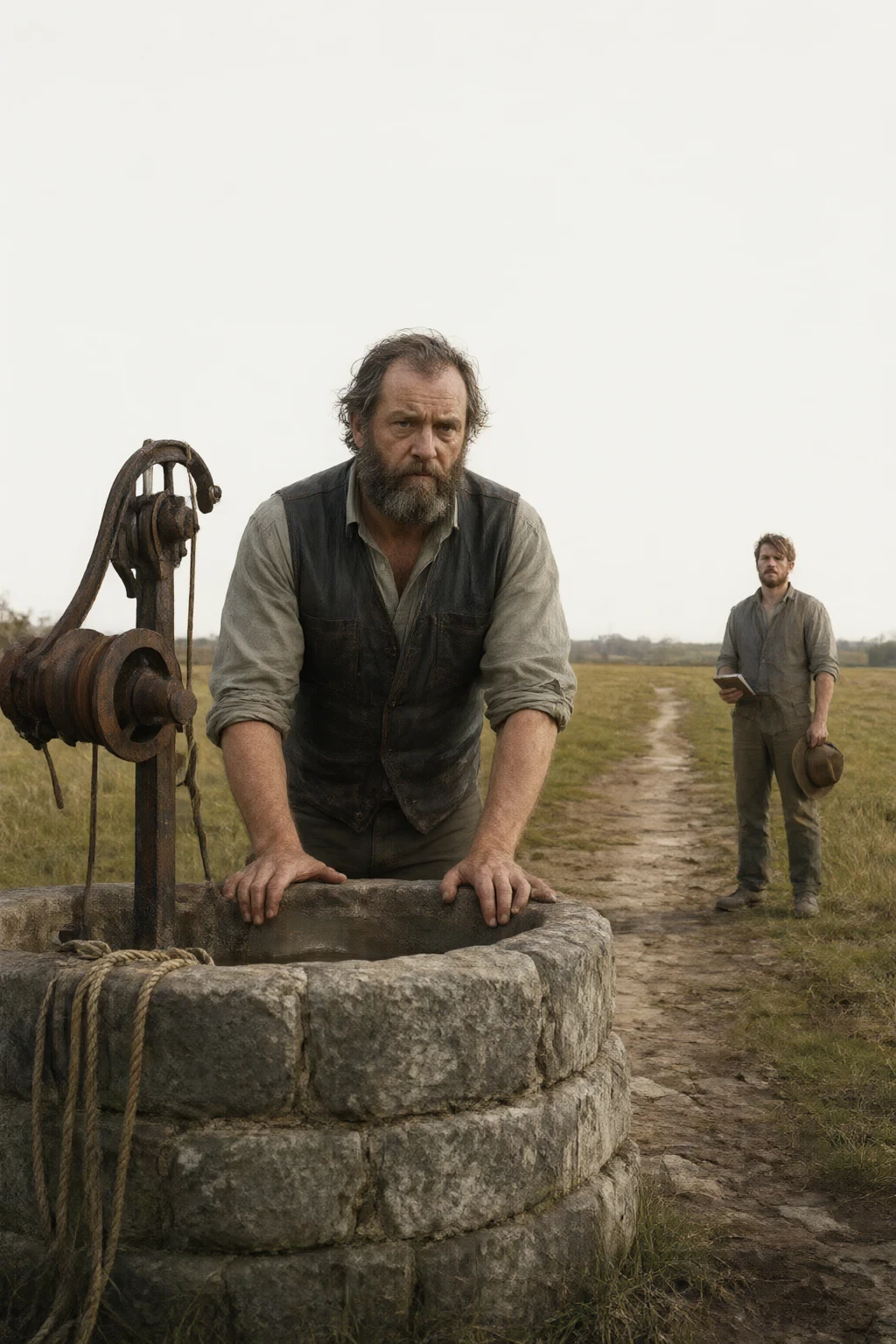
The assembly of the fen sat on the first Thursday in April in the tithe barn at Coldwick, with the sluice house, the nine villages, the Well Court, and a clerk from the sluice, and the terms of reference were drawn up in advance by Nell Drury on three sheets of the backs of rate returns, and they are worth setting down first because everything that happened afterwards happened inside them. The first sheet: the assembly is to find out whom the fen of Coldwick-under-Fen owes. Not how much. Whom. The second sheet: that the answer is to be provable. That is to say, that any figure the assembly states is to be capable of being produced again, by another person, at another time, in the presence of a witness, and is to be entered in the parish book as it was spoken, including the spelling. The third sheet: that the method of proof is the standard of the fourteenth of November, which stands on the wall of the tithe barn in four lines, and that the standard is available to every party, including the sluice house, without condition and without fee.
There were nine villages in the fen and about four hundred people in them, and sixty-one people were in the barn, and about forty of the rest were at the four, and the stove in the middle of the tithe barn was the only warm thing within two miles and the reason anybody comes. Gideon Sparre put the demand first, because he had come eleven miles to put it and because he had put it in writing in January and had it in a leather case. The sluice house is the parish’s creditor. It takes the August lock money and it rates the water that comes out of the fen, and it has rated it since 1841, and its claim is made in a figure that is the sum, at the rate of the year of each claim, of all water claimed under bond from the nine wells of Coldwick-under-Fen since the book began. “Nine thousand one hundred and forty-four pounds, eleven shillings and sixpence,” he said. “As at the first of January. Without prejudice to anything.” Nobody in the barn made a sound, and the number sat there, and it was not a large number to be frightened of and it was a very large number to be looked at for long, and after a while somebody at the back laughed once, the way a person does. “Then let us take it in order,” said Nell Drury.
They took it in order, and the order was where the fen had been wrong for a hundred and eighty-four years, and the person who found it was not the clerk from the sluice and was not the clerk of the Well Court. It was Hester Colm, on the second afternoon, and she did it by refusing to say a word for about a quarter of an hour, and then by saying this. “Eleven hundred years. Of what.” “Of claim,” said Gideon Sparre. “Of water claimed under bond. There are nine wells. There are bonds outstanding against nine wells. The oldest entered bond in the parish is of 1802 and the date of the claim is the date of the bond, and the claim has been accruing at the rate of the year of the bond.” “Then show me the year,” said Hester Colm. He showed her the year. She looked at it for a while. “That is Peter Rill at the Sluice Well and I never met him,” she said, “and that is a date, and the rate of that year, and a sum of money, and it is in a column headed water claimed.” She put her finger on the column. “But nobody has ever claimed anything. A bond is a claim, a claim is a right to draw, and a right that is never used draws nothing. It is a column of numbers of a thing that did not happen.”
“Then that is four thousand and something pounds of nothing,” said Gideon Sparre. “It is,” said Hester Colm, “and I am not the person who is glad about it, and you may put down that I said so.” She said a great deal more, over three weeks, and all of it was correct, and the part of it that mattered to her was not about the accounting at all. Hester Colm was bonded to the Cold One in the spring and has been paying in use ever since, which in this country means that for thirty years she has kept other people’s fields. She draws at the Cold One every day and the water goes onto ground she does not own and grows crops she does not eat, and the claim of the Cold One on her goes down, and by the afternoon of the first Thursday in April it stood at eleven days and a bit of a fourteenth, and it was the only live claim in the parish. Every other claim had been released in the March, by a green thing with a bad cough, at eight collars, in front of ninety witnesses.
The Cold One is hers. It has been hers since she was eight. It is the one thing she has that is hers, and the reason she stands at the back and does not sit down, the reason she washes her hands that are clean, is that she has spent thirty years building a life out of not being discharged. She is the only person in the fen for whom being discharged would be a catastrophe, and everybody in the barn knew it, and not one of them said so. Gideon Sparre took his objection to the sluice house and it came back on the Saturday, and the reason it came back at all is that he was right about the arithmetic and the arithmetic was the only thing he had. The sluice rates water drawn. The sluice cannot see use. A claim that is being paid in use is, to the sluice house, a claim that is being paid in nothing, and a claim paid in nothing is a claim outstanding. “All but one of your claims are dead,” said Gideon Sparre, on the Saturday of the first week, at the sluice house, reading from his own notes. “The eight released in the March were never exercised. The Third is held by a person who cannot draw. Which leaves one. The Cold One. One claim, live, thirty years, and every gallon of it has gone onto somebody else’s field and not through a sluice meter, and the sluice house has no instrument that can see a gallon of it.” “So the figure is her,” said somebody.
“The figure is four pound odd,” said Gideon Sparre, “at the rate of the year of the bond, and the rate of the year of the bond is this year, and the figure of the claim in days is eleven and a bit, and eleven days of the Cold One at the published rate is four pound two shillings and threepence, and I have had it computed twice.” Hester Colm stood up when he had finished, which she had not done in nine days, and said one thing, and it is in the minute in her words because the clerk does not paraphrase. “Then find me somebody to give it to,” she said, “and let the assembly decide, and do not do it in this room, because you have all been very careful in this room and I have watched you do it.” Nobody did anything in that room for about ninety seconds, and then the chair said that the matter would be taken at the next sitting, and everybody agreed, and the clerk entered the words “the witness was not disposed to proceed on the question” and read them back exactly.
The wet fortnight came in the second week and it was the thing that nearly finished the assembly, and the reason it nearly finished it is that the instrument the assembly had decided to trust cannot be used in a wet fortnight, and the assembly had not thought to ask. A lien is read off the surface of water a bonded person has stood in. People in Coldwick can read a debt off a puddle and children do it without being taught. But a surface standing in rain is not the surface it was on Tuesday, and Micken of the Third, who was the reader, and who is eleven, and who was in and out of nine wells a day for three weeks, gave two different figures for the same person on the same morning an hour apart. They tested it. They took the Cold One, and Hester Colm, on three consecutive days in a rain that did not stop. Fourteen days. Eleven days. Nine days. “It is the rain,” said Bess Brack. “It is not her. She is not paying. The rain is going into the vessel and standing in it, and it is in her, and it is in the drain, and it is in the butt behind my cottage, and it has been in the Sluice Well since Tuesday.” She put her hand flat on the table. “You cannot read a person off a wet thing. A wet thing has everybody in it.”
The second sheet said the answer was to be provable, and the reader was provable, and the reading was not, and Nell Drury sat down in the end of the second week and wrote out the problem in the form she always wrote problems in, which is a list with nothing at the top of it. The standard of the fourteenth of November has four conditions and the third of them is that the person is alone: no second person in the vessel, no second person in the ditch, no second person’s water in the same vessel. In a wet fortnight, in the parish of Coldwick-under-Fen, there is no water in the parish of Coldwick-under-Fen with nobody else in it. A ditch takes nine villages. A butt takes a household and every household the pail has been to since it was filled. The fen is raised four feet above the water table so that the wells go down sixty feet, and the wells are the only water in this country that belongs to one person, and a rain of that kind does not go into the wells first. It goes into everything else. “We cannot do this in April,” said Bess Brack. “You cannot do it anywhere,” said Gideon Sparre, “and I am going to write that in my report, and it will end this, and it will be the shortest audit in the history of the sluice house.”
The control surface was found on the Wednesday of the second week by a boy who was asleep in it. There is a thing about a reading that nobody had thought to put in the standard. A figure read off a wet surface is not only contaminated, it is offset: it carries whatever else is in the water, and two surfaces read at the same hour on the same day can be subtracted one from the other to give a figure that belongs to somebody. That is arithmetic, and the assembly had spent a fortnight discovering it the hard way, and what it needed was a surface with nothing in it. A plain. A zero. And there is exactly one, and it is a hundred yards from the school, and the children are not allowed to play there, and nobody can explain why, and the sign has been repainted four times.
The Salt Pits are a spread of grey-white shallow water in old chalk workings at the west end, where the breach happened in the year the parish does not discuss: standing water the colour of a shaving, dead fish, and a schoolyard fence in the far distance. Nothing has grown there. Not sedge, not reed, not duckweed. It is the only standing water in the parish of Coldwick-under-Fen that carries no lien, and the reason it carries no lien is that the well which gave it up went to salt on the night of the breach, and a well that goes to salt gives up everything it was holding, and what it gives up does not go anywhere. “A well that has gone to salt is the only clean water in this country,” said Micken of the Third. Nobody asked him anything for about half a minute, and then the chair asked him why he was in it. “I sleep in the water because the dry is too loud,” he said, “and it is the only water in this fen I can sleep in, and I have been in the middle of it since Tuesday and there is nothing in it at all. It is the only clean thing in the parish. That is why they will not let the children play.”
So the control is the Salt Pits, and this is what the assembly did about it, and it is the only piece of procedure in the history of the fen that anybody has ever thought to be funny. On the Friday of the second week, nine men from nine villages and two boys and one girl walked out to the west end with thirty-one pails, filled them at the edge of the salt flat, carried them back up the track to the tithe barn, and set them in a row on the long table under the stove. Then Micken of the Third read the Cold One at the collar of the Cold One, at about two in the afternoon, in the rain, with Hester Colm standing in her own vessel alone, and gave a figure. Then he read the thirty-first pail of salt water on the long table in the tithe barn in front of sixty-one people. And subtracted. Fourteen days became eleven days and a bit of a fourteenth. It held. It was checked nine times over three days against the dry readings the assembly had taken in January, and the correction was constant within a day and a half across nine wells, and the boy said the flat would hold for a fortnight and after that it would want rain on it like everything else. “Then we have a fortnight,” said Gideon Sparre, “and I will take a fortnight.”
The conversion was the whole of the argument and it is where the fen was actually robbed, and it was not robbed by the sluice. The sluice house rates in money. The fen pays in use. A figure in days of a claim at a given well, read off the water, is not money and cannot be made money except by a rate, and the rate is a decision, and the decision is a policy, and every rate the sluice house has published in a hundred and eighty-four years has been made by a clerk with an interest in the answer. That was Hester Colm, at the third hearing, and she had thought about it for a fortnight while the rain came down. “The rate of the year of the bond,” she said. “Do you know what that is? It is the rate at which the sluice house thought water was worth in the year the man pressed his thumb on the collar. It is not what water was worth then and not what it is worth now. It is what somebody in an office decided to charge for it, and if the office wanted the number large the office had only to set the rate high in that year, and there is no book in this country that says which years were set high.” “I set none of them,” said Gideon Sparre. “No,” said Hester Colm. “And you are the first one in ninety years who has said that in a room, and I have not forgotten it, and I am not doing this to be thanked. I am doing it because the rate is the whole of the argument and the rate is a choice and it is being made in a room with no other people in it.”
The rate of the day, fixed at the third hearing, in open assembly, by nine villages and a clerk from the sluice and a clerk of the Well Court, was the published rate of the sluice house for the current year, and not the rate of the year of the bond, and not an average, and not a compromise. It is entered in the rate book in four hands, because nobody would give the other three the pen, and the four hands are the four parties. Then the arithmetic, which is short, and which is the whole of what three weeks produced. Nine claims at nine wells. Eight dead, never exercised, nil. One dead by release in the March, nil. One held by a person who cannot draw, nil, and entered at the bottom of the page at no value. One live. One live claim, at the Cold One, at eleven days and a bit of a fourteenth, at the rate of the day. Four pound two shillings and threepence. “Nine thousand one hundred and forty-four pounds, eleven shillings and sixpence,” said Nell Drury, “against four pound two shillings and threepence.” “Against nothing, for ninety-three years of it, because it was never drawn,” said Gideon Sparre, “and against four pound two shillings and threepence, which is the balance.” “I am not going to say the rest of it,” said Hester Colm, from the back. Nobody asked her to.
And then the unmeasured item, and it took the week between the two hearings, and it cost a family its well, and it was nobody’s fault, which is the part that is hard to hold in the mind afterwards. The Bent is nine hundred yards north of the Third, in ground that gives. It leans. It is the coldest water in the fen and the best, and four generations of one family have carried from it, and the reason it matters to the assembly is not sentimental and is arithmetic. The assembly cannot certify a figure that cannot be produced again. The figure for the Bent cannot be produced again. There is no figure for the Bent. “Give me a yield,” said Gideon Sparre, at the Bent, on the Thursday of the third week, standing at the collar with his notebook out. “Gallons in the hour. I have a table for it. I will take anything in the week. I will take three figures and take the mean.” Teb Furroway put his thumb into a joint at the base of the collar and worked it, which is what he does to test a seal, and he said: “That is down to the marl, that is. Sixty-one feet to the marl and the marl is eleven feet and there is a stone in it that I put in myself in the spring of the year before the war.” “I did not ask how deep it is, Mr Furroway.” “No,” said Teb Furroway. “You did not.”
Nobody in Coldwick-under-Fen would give a yield for the Bent, and nobody refused to either, and that is the difference and it is the whole of the second afternoon. Bess Brack went down it. She is sixteen and she is the only person in the parish who has been inside the Bent, twice, and she went down on the Friday because there was no one else to send and because the Bent is nine hundred yards from the Third and Micken of the Third does not go down wells and says so. It took her fifty minutes. She would not be drawn up the first time and came up the second time with her skirt wet to the waist and a dip rod in her hand and a bad cough, and she put the rod on the table and said: “The water in that well moves.” Nobody spoke.
“It comes up while you watch it and it goes down while you watch it, and it does it twice an hour, and I timed it on the rod, and there is nothing in the well but the pump. It is the drain. A main off the cut goes under the Bent, and when the cut is at half it pushes up under the floor of that well, and when the cut is slack it draws down, and the difference is four inches and the well is full to the collar either way.” “Then give me the difference as a number of gallons an hour,” said Gideon Sparre. “No,” said Bess Brack. “You cannot. Because the cut is fed by nine villages, and the cut is a different height on the Blind than it is on the Gleaners’, and the Bent takes the middle of it, and the middle of nine villages’ worth of water is not a number of gallons. It is a number of gallons on the day.” She wiped her hands on her skirt, which was already wet. “There is a yield off the Cold One and a yield off the Blind. That is why the Caws have never been asked for a figure and have never paid one.”
The Caws came to the fourth hearing at about two in the afternoon and there were six of them, and Ivo Caws spoke, and the claim he made was made in nineteen sentences and it is entered in the minute entire. The family had drawn at the Bent for four generations. They had never spoken a bond at it and had never been asked to. They had paid nothing to the sluice house on account of it, because there was no account of it, and in exchange they had carried four pails a day up a track for four generations and had never once had anybody tell them the water was not theirs. “In the November the first lining came out,” said Ivo Caws, “this well was taken out of the book.” “Yes,” said Nell Drury. “By whom?” “By the parish,” said Nell Drury. “The minute is of that date. It is in the book. It is the only entry in a hundred and eighty-four years that anybody has ever been able to find, and I found it on the second day, and I did not tell the assembly for ten days, and I did not tell your family for twenty-two.”
Here is what the rate book at the sluice house says about the November the first lining came out, and Gideon Sparre read it out in full, and it is four lines. A payment of four pounds, ten shillings, entered against “Bent, Coldwick, lining, night work, three men”. Below it, in a different hand, an entry that has been referred to in three audits and never once explained: “Bent removed from the schedule at the request of the parish, pending.” No end date. No resumption. It has been pending for eleven years. And the parish asked for it in September of that year, in writing. The parish had gone round the parish asking. The parish had asked thirty-one people. Every one of them had said no, and every one of them had said no for the same reason, which is that holding a well forever means there is no end to it, and the Caws had been asked, and Ivo Caws had been twenty-eight at the time and had said no in front of his father. So the parish paid the wright four pounds ten shillings to take the Bent out of the schedule for a year, and the well was not sealed, and was not bonded, and was not closed, and was not drawn by anybody for a year, and then the year ended, and then nothing happened, because nothing is what happens in Coldwick.
Nobody had failed. That is the finding, and it is the reason a family of six stood in a tithe barn and were told that the fen owed them a well they had been drinking from for four generations and had never once had title to. The wright had done what he was paid to do and had said so at the time. The parish had asked thirty-one people and had a list of thirty-one noes. The sluice house struck a well off its schedule on the parish’s application and never chased it, because a well off the schedule is nobody’s business. The Caws had drawn the water anyway, without knowing there was anything to know, and had paid the man who dug it nothing because nobody asked. And then the audit came, eleven hundred years late, because a clerk from outside had been sent to find out what the fen owed, and had found out, and the unmeasured item had a name on a board in a village four miles away and it was the best water in the fen.
What the assembly had to do with the unmeasured item was not a matter of taste. A settlement holds. That is the only test of a settlement and the only test anybody in Coldwick-under-Fen has ever applied to anything: does it hold, or does it come apart at the first Thursday in August. A settlement containing a figure which cannot be produced again by another person at another time does not hold, because the figure will be asked for, and it cannot be given, and the person who cannot give it will be the clerk. Or a settlement contains an item that is excluded, and an excluded item in a fen is excluded by being closed, and a well is closed by being bonded, in one person’s name, forever, so that it can never be reopened as a claim. It is not an instrument for shutting anybody out. It is an instrument for shutting everybody out, permanently, including the person who holds it, and it is the reason the salt pits have a fence. “So the Bent goes out,” said Gideon Sparre. “That is the finding. I will not sign a settlement with a well in it that has no figure, and I have said from the first day that I will not, and the chair has told me from the first day that she believes me.” “No,” said Hester Colm. “Nobody is going to do that to a well with people in it.” “You cannot stop it,” said Gideon Sparre, “and I have not stopped anything for three weeks, and I am a man from the sluice house and I have no power to stop anything in this parish, and that is why I have spent three weeks saying what I am going to do before I do it.”
Nobody in the barn had expected the man to be there and he did not put his hand up. He was seventy-four. He had been hired to stand by at the Bent on the night the lining came out, at four pound ten, to see that nothing was done to the parish that ought not to have been done, and he had been paid, and he had written a receipt, and the receipt was in a book at Sallow that nobody has ever wanted. Rowland Tread of the low cottage at Nether Sallow had watched three men take out eleven courses of lining stone with a barrow and a crowbar, in a wet night, at the direction of the wright, and had watched the pit stand open and the water come up and a man climb a ladder out of it. “What did you see?” said Nell Drury. “I saw men take a lining out,” said Rowland Tread. “That is what I saw. I have been asked four times in eleven years what I saw and I have said the same thing four times and it has never once been written down, and I have been told twice that I saw nothing, and I did see it. I was paid to stand by and I saw three men and a barrow and eleven courses, and a pit with nothing in it at eleven o’clock, and the wright put his thumb in the collar and said that was down to the marl, that is, and I heard him say it.” “Was the lining bad?” said Gideon Sparre. “I do not know what a lining looks like when it is bad,” said Rowland Tread. “I was hired to stand by, not to look at stone.”
“There is a void in the marl behind that lining and behind the first lining,” said Teb Furroway. He put his hand out and spread it flat, the way a man does over a wound. The well had been leaning since the year I was thirty-one, which is the year the fen calls the wet year, and a void at sixty feet in ground that gives is a void that takes a well. It was going to go in a bad winter and there were two households within forty yards of it, and I told the parish so in writing in September, and I have the letter, and it is in a box in my workshop, and nobody has ever asked me for it. The room was very quiet and the stove ticked. “I have not been able to say that for eleven years,” he said, “because the first lining did not fail, and there is nobody in this parish I could have said it to, and every time somebody has asked me how the Bent is holding I have had to say nothing, and they have all taken the nothing for a thing about the well, and it is not a thing about the well.” He stopped. “Mr Tread has told me,” said Teb Furroway. “I am obliged to him.”
The resolution was moved at the fourth hearing, on the Thursday of the third week of April, by the man from Sallow, in a room with the stove lit, and it was carried by nine villages, the Well Court, and the sluice house, and the sluice house did not vote, because the sluice house is not a village and had no vote, and said so. That the total obligation of the parish of Coldwick-under-Fen to the sluice house, from 1841 to the first Thursday in April, is four pound two shillings and threepence, at the rate of the day, on the standard of the fourteenth of November, controlled upon the Salt Pits, and is to be struck from the rate book in the sum of nine thousand one hundred and forty pounds nine shillings and threepence. That the claim of the Cold One, being the only claim in the parish outstanding and undischarged, is discharged in use and is satisfied, and that the holder is to be so entered. That the Third Well is held in perpetuity by a person in his own name and is not to be drawn, and the parish is not to be discharged.
And that the Bent Well, having no ascertainable yield, being unrated and unrated for eleven years, and being unable to be entered in any schedule of this settlement, be closed under the seventh rule, that is to say, be bonded in the name of one person forever, and be removed from the schedule, and be not reopened. It holds. It holds the way a well holds, and the clerk entered it in the book in the words she had been given, and added a line of her own underneath, in the margin, in a hand nobody is going to argue with: “A resolution which holds, and which holds the well, and which cannot be got out of this book again.” The person was found in about four minutes and it was the only four minutes of the fourth hearing in which anybody in the tithe barn spoke, and it was done by the chair and it was done because nobody else could do it. She asked the Well Court first, and the Well Court said it was not the wright’s, and then she asked the sluice house, and the sluice house said it was not the sluice’s, and then she asked the room, and the room said nothing for about two minutes, and then Teb Furroway put his hand up, and put it down again, and then said: “It is me.” “You have refused it once.”
“I refused it in October of the year the lining came out, when I was asked to hold a well that was going to take two households, and I said no because I had a house and because I am not a fool,” said Teb Furroway. “It has been asked for eleven times since and the answer has been no eleven times, and the reason has been that nobody would say to a man, you shall hold this for the rest of your life. Now it has been said, and it is in a book with a hundred and eighty-four years of other things in it, and I have built that well twice and I am the only man here who has stood in the hole.” He held the collar with both hands and the thing was said at the Bent Well on that Thursday in April, and it was the shortest bond in the parish book and the only one anybody present could remember being made, and it took eleven seconds, and it cannot be withdrawn. Then the assembly did the last thing it had to do, which was the thing nobody had put on any of the three sheets, and which took about twenty minutes. The Caws were six people in a barn and they had been drinking the best water in the fen for a hundred years and had just been told by nine villages, a sluice house and a clerk of the Well Court that they were to be compensated for it, and Ivo Caws said, before anybody had started: “If you are going to pay us, pay us in water.” The room was very still, because everybody in it had spent three weeks on the difference between water and money, and everybody in it had got it wrong. “Where from?” said Gideon Sparre. “There is one place,” said Bess Brack.
She worked it out on the back of a rate return with a carpenter’s pencil and it took her a quarter of an hour and she was right to the penny, and nobody in the barn checked it, and it is the only figure in this story that nobody thought to argue about. The Caws are at the high ground. The Bent is nine hundred yards from their gate. The next best is the Cold One, a mile and three-quarters by the Fen Track and off the track at the last half mile, and the Blind, two miles and a quarter, with the better water but a pump a woman of sixty has to work with both hands. Four pails a day, four hundred days, at a rail of about a mile and three-quarters each way with the drop of two feet into the drainage, is eleven hundred and sixty rail-miles a year for the Caws, and a rail-mile with four pails is done by a boy of thirteen at a walk and takes fifty-one minutes. Eleven hundred and sixty rail-miles, at the fen’s own pail wage, which is the sluice house’s published figure for a boy on a rail for a day, less the value of the eels and the celery and the cow parsley that a boy of thirteen in the Caws’ household does not sell because he is on a rail: Thirty-one pound four shillings a year.
Nobody in the tithe barn said anything about that number, and Gideon Sparre said two things about it, and both were in his report and both were correct. “That is the first payment the parish of Coldwick-under-Fen has ever made to anybody, in a hundred and eighty-four years of rate books, and I have checked all of them.” “And it is the first figure in this settlement that anybody has offered me which I can produce again on a wet day in August,” he said, “which is more than can be said for the other nine thousand one hundred and forty pounds, and I withdraw my objection to the rate of the day, and I ask the chair to record that I withdrew it after the figure was fixed and not before, so that nobody can say the sluice house was reasonable.”
On the Friday of the fourth week the assembly went to the sluice house, because there was one item left and it could not be done in a barn, and the one item was a person. The rate book of the sluice house has a page for every ratepayer in the fen, and the page has columns: name, wells held, water rated, water drawn, rate, and a column at the right-hand edge headed remarks, which is four inches wide and has held, in a hundred and eighty-four years, the words widow, absent, no water, silted, and once, in 1878, lies about the eels. The assembly had to enter a person who holds a well and cannot draw and has never been a ratepayer and whose name is not in any rate book in England, and who has held eight claims in this parish for a hundred and twenty-four years, and who cannot be invoiced, cannot be chased, cannot be sent a notice, and cannot be entered on a page in a hand that will still be legible in a hundred years. Gideon Sparre did it himself, on the Friday morning, at the desk in the sluice house, with the rate book open and Nell Drury standing beside him reading the spelling of it out of the parish book, which she does, and which is the only authority either of them recognises for a name.
“Remarks,” he said. “What goes in remarks.” “Whatever is true and is not in the other columns,” said Nell Drury. Gideon Sparre wrote for some time. Then he stopped, and went to the press, and pulled a new column rule across the page, because the one he wanted did not exist, and ruled a column an inch and a half wide, and headed it, and wrote in it. Nobody has ever seen the entry but the two of them. It is in the rate book of the sluice house for the year, at the last page, and the page is the one that is bound in at the back and the one that nobody turns to. He went home on that Friday, at about four in the afternoon, and he was told that he could go home. The chair said it, in front of everybody, in the yard of the sluice house, and she said it in the words the sluice house uses, which are strictly and without prejudice, and she said them badly, and everybody understood that she had said them badly on purpose so that it would be on the minute. Gideon Sparre looked at the yard for some time and then said that he would be obliged, and went down to the drain, and checked the latch on the sluice gate behind him, which is what he does.
The next August money came in on the fourteenth and the Caws were paid thirty-one pound four shillings out of it, in the back room of the Sluice House, in notes and silver, by the man who had come to the fourth hearing and been asked what he saw. The Bent Well is closed. There is no seal on it and no gate and no water in it and nobody can put water in it or take water out of it, and the collar is dressed chalk blocks worn round and bright in one horseshoe where four hundred years of hands have gone down, and the horseshoe is dry now and has been dry since the fifth of May, and it is the only collar in the parish with nothing polished on it. The name board is still up. It has been up since before the book, and a well cannot be renamed after it has been bonded, and the board says The Bent, and it will keep saying it, and a well that leans and gives no water and holds a stone the wright put in himself in the spring of the year before the war is still called the Bent, and the parish has not voted to change it and would not be allowed to. Hob Caws was thirteen and went out on the track on the sixteenth of May with a rail and four pails, because the Bent was shut and the Cold One was a mile and three-quarters, and the rail-miles were counted from that day, and there are eleven hundred and sixty of them in a year, and the parish book has the figure in it in a hand of its own, under his name.