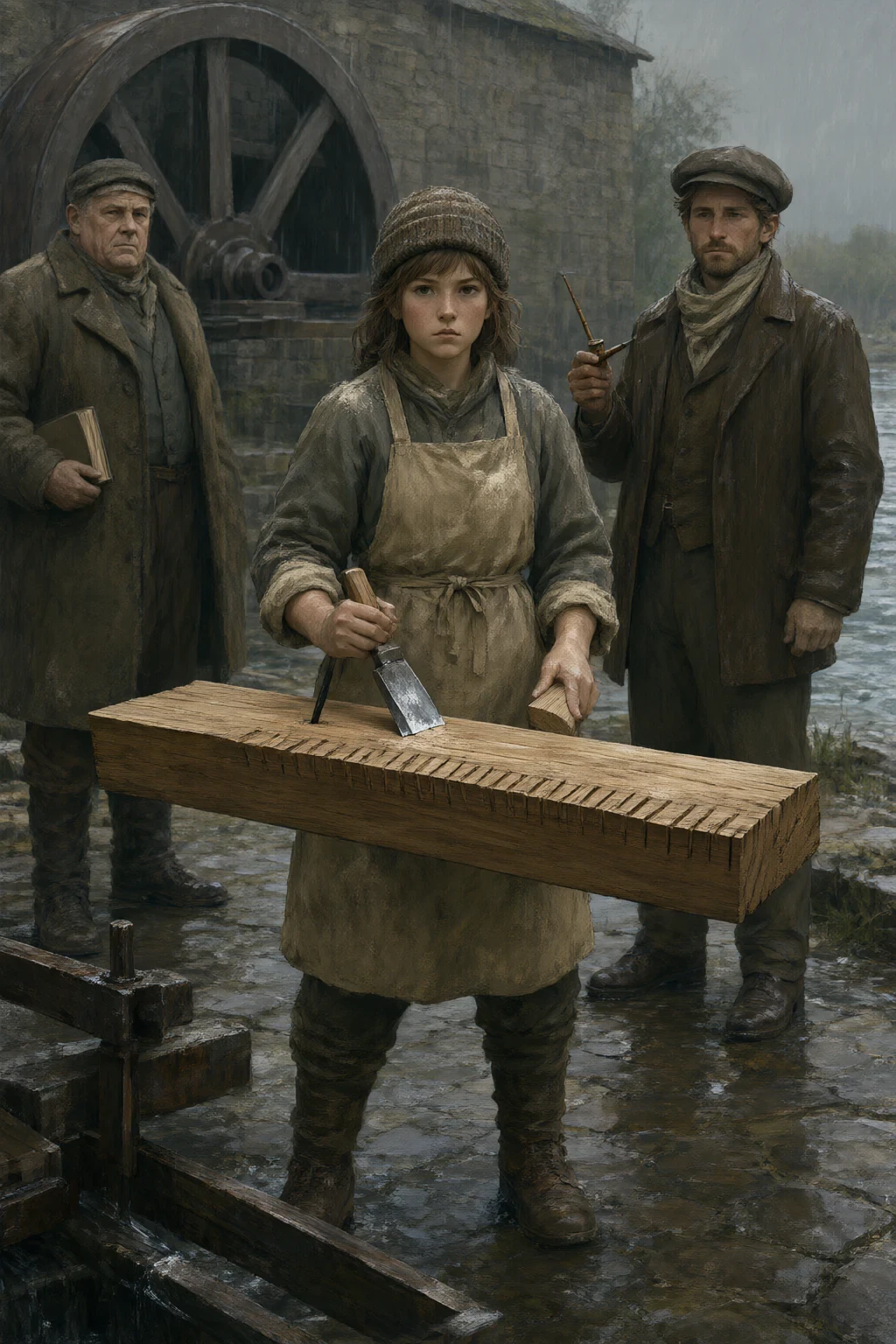
The mill at Osterly was built in the year of the black water, when the river Wray came up over the low field and put four feet of silt in every cellar in the town, and the corn that was in those cellars was ruined, and the seed corn with it. What the mill had against the flood was eleven quarters of the Company's grain. What the town did about it was borrow the same eleven quarters back from the Company, against the mill itself, at a rate the Company set, and the rate was one in four. The mill was the security. The mill has been the security for forty years.
Petra Kolb was thirteen and she kept the mill's books, and her mother had kept them before her, and her mother's mother before that, and the whole of the family had known one other thing, which was how to read.
"Read it again," said Petra. The thing on the table was a plank of oak, two feet long, with the grain raised in ridges along one edge, and the ridges were cut. A rat does not write with ink and it does not write with a pen. It cuts, with the lower jaw, in strokes that are not letters and are not quite numbers and are, once you know how, exactly as exact as letters: a stroke for a quarter, a double stroke for a year, a long single stroke for a whole debt, a short cut for interest received, and at the end of a year, always, a small hook, which is not a full stop but is a place to stop and count. Her mother had taught her that on her knee at the mill wheel, with the flour on their hands, in the year before she died. "The Company is not plague," said Petra. "No," said Kettil Amren.
He had come into Osterly on the Thursday with a satchel, a reed pipe in a leather case, and a white enamel badge of the kind factors wear, which is a small flat white disc with nothing on it, because a factor's badge is a promise that he will not cost you anything you have not agreed to. He was twenty-six, and he had been three years in the guild, and he was the third factor the town had ever called. The town had called two before him. The first had left. The second had stayed nine days and had gone into the mill by night and had not been heard from again, which the town told as a joke and Petra did not believe as a joke. "You are a long way downriver," said Amren, "for a man with a white disc."
"You are a long time coming," said the bailiff of Osterly, "for a man with a reed." "I count first," said Amren. "It is not a discourtesy. It is that a factor who counts badly is a thief with a licence, and I have never wanted to be that." So he counted. He counted the way you would count anything else, with a stick and a string and a tally board, and he was in Osterly for nine days, and this is what he found.
The rats of the town were not numerous. That was the thing that undid the old explanations. Plague does not leave a tidy border. A plague comes over a hill and dies out or does not, and it does not stop at the miller's wall, and it certainly does not stop at the mill door. These stayed inside the mill yard. They stayed in the mill, and the miller's own house, and the two granaries, and nowhere else, at a rate of between four hundred and six hundred animals, and the arithmetic of that is not an arithmetic of plague. It is an arithmetic of a payroll.
"They are employed," said Kettil Amren, on the ninth night, in the mill, sitting on the sacks. "That is what you are looking at. You have been calling it an infestation for forty years, and a pest is not employed, and an employed thing has hours."
"They came for the children," said Eber Kolb. He said it the way a man says a thing he has said once, out loud, at a council meeting, in front of a factor, and never again. The bargain had been made in the black-water year, when the Company understood that the town could not pay and the town had nothing to give except what it had always given. Kettil Amren read the term out of his satchel, from a copy, because the original was on the plank and the plank did not have words on it.
Principal, four hundred quarters. Interest, one in four by the quarter, taken in kind from the mill's own output, at each grinding, without a miller being consulted. Security, the mill and its gear. On default, in the year thirty-one, the Company was entitled to enter and collect, in the person of the debtor, to the value outstanding. "Collect, in the person of the debtor," said Petra. "Your grandmother understood it," said Amren. "It is a phrase the Company has used since the year of the black water and it has a meaning. In the person. Not in the property. The mill was never what was on that plank. The mill was what they meant when they wanted the town to think there was something on it."
The town had paid the interest faithfully for forty years, in grain, at every grinding, and had said the words the rats are taking the mill's flour the way you say the weather. "They have taken the interest," said Amren, "and the interest on a mill at one in four by the quarter is a third of the mill's output, and the mill has been grinding at a loss for thirty-one of the last forty years, and nobody thought that was strange, because everybody knew the mill was old."
"Then take it," said the bailiff. "That is what you are for. Take it and be rid of us." Kettil Amren took the reed out of its case and looked at it, and put it back. "Listen to me once," he said. "The Company is a guild, and I am a factor, and I have a licence, and I want a matter closed that I can carry on Thursday. If the rats go out of Osterly on Thursday, the Company's claim on this mill survives the rats. The claim does not die with the borrower. It goes to the estate, and there is no estate, and it goes to the ward, and the ward will be a hundred years paying men like me to stand in a yard and blow at a wall." "How much is outstanding?"
"Seventy-one thousand quarters," said Amren. "Which is the mill, four times over, and will be nine times over by the year your grandchildren are born. Nobody is going to pay that. It is not a debt. It is a shape." "Then what do you want?" said the bailiff. "Payment."
Payment is a word with a shape too. What the town had was this: a mill with a rotten third wheel and a cracked axle and a sluice gate that leaked; thirty pairs of hands in the winter, because Osterly in February is a town of thirty people with nothing to do; and every beam, stone, nail, and hour of labour in the parish, which was worth something, though nobody had ever valued it because nobody had ever needed to.
Amren wanted that. Not the money, which did not exist. Not the children, which he would not have, and when the bailiff said the children, as in the old term, Amren said: "I am a factor. I take payment. I have never taken a child in my life and I am not going to start in a town with a good wheelwright," and the room was very quiet, and that was the moment the town understood that there was a way this could end. But the Company was not the town, and the Company did not want timber.
"It takes grain," said Amren. "It has taken grain for forty years, that is the whole of its nature, and there is no carpenter in the Warrens and no clerk but the old one, and it will take a mule of oak and a stone of the wheel and a hogshead of nails from a mill and think nothing of it, because it is an animal and it eats what it is given." "You have just told me it cannot be paid in work." "I have told you it cannot be paid in what it wants, which is food, and that food is what the mill makes." Amren leaned forward. "Then find the year it stopped making it."
The mill's books were in a chest under the stairs and they were water-stained and complete, and Petra Kolb read them the way her mother had taught her, out loud, on the mill steps, with the Company listening. Four hundred quarters lent. One in four by the quarter, taken in kind. Four years of the black water, no grinding at all, no interest accrued, no grain, no entry. And then, in the ninth year, four lines she had read in that same chair for years and had never once looked at. They were not interest. They were not principal. They were a different mark entirely, cut deep and set apart, and it took her most of a night to be sure of it, and then she sent for Amren at the second hour and made him listen to the two strokes and the hook. "That is a suspension," he said.
"Yes." "Twice." "Yes." "They suspended it themselves. Twice." He was quiet for a while. "Then there is a rule. In the Warren's articles, where a term is suspended by the creditor, the whole of the reckoning is put away, and when the term is ended, and the debt is called, the arrears are taken at the rate of one in four by the year from the date of the call, and not by the quarter, because quarters were put away with the term." "How much is it then?" "Seventy-one thousand quarters at one in four by the year, from the date of the call, is two hundred and forty quarters," said Kettil Amren, "and the mill is worth two hundred and forty quarters, and there is enough to pay it."
The last rat left Osterly on a Thursday, at the ninth hour, in the rain, and nobody was taken. The old one came out of the mill first, because the old one is always first, and it came out into the yard and stood up on its hind legs in front of nine hundred people and waited, and Kettil Amren blew three notes on the reed, low, unhurried, the same note three times, and the old one turned and went through the sluice gate and down the race and away, and after it the rest of them went, in a line, over four hours, and the mill yard was empty before dark, and the town stood about in the rain and did not entirely know what to do with itself.
Petra's father mended the sluice gate that winter, and Eber Kolb, who was fifty-eight and whose right arm had gone in the threshing, could not lift a hammer, so the work was done by the parish, thirty at a time, in shifts, and they were fed at the mill, because the mill was open, and grinding corn is not a favour, it is the trade. The payment was made in the yard over eleven weeks. Two hundred and forty quarters, valued by three men the Company had sent and four men the town had sent, in oak and iron and stone and nails, and in every hour of labour put into the mill and the race and the wheel-house, each of which was entered on a slate, and hung on the mill door at the end of the day, and rubbed out with a wet cloth. The old rat came back twice, in the yard, in daylight, to check, which is what a clerk does, and Amren chased it back down the race both times without any particular temper, because it was doing its work.
On the last Thursday of the eleventh week, the piper was paid, and there was nothing left to pay him in, and the bailiff came out to the yard to say so. "Out of it," he said. "Take your percentage. Take ten in the hundred, and the town will find it, and it will take a year." "No," said Kettil Amren. "Take twenty. There is no one to stop you and I will not look."
"No," said the piper, "and here is why, and then I am gone. If I take a percentage I go home rich and the town goes home ruined and the mill stays in a state that will fail in eleven years, because that is what happens when a thing is repaired with somebody else's money and not with their hands. I have been three years in the guild and I have closed thirty-one matters and I have taken a fee out of two of them, and both of those towns are the reason I sleep." "Then take the ledger." Amren looked up.
"Take the plank," said the bailiff. "It is yours, it is the Company's record, and it is nailed to the outside of the mill where every child can see it. It is the only piece of evidence anybody in this town has ever had that a debt is a thing with a shape. There is a fee in that. Take it off the wall, take it home, put it in a case, and it will be worth something to a guild, and you will have been paid, and the town will keep the tax on the mill and the mill will be the town's."
Petra Kolb took the plank off the wall herself, with a chisel and a block of wood under the blade, so as not to split it, and it took most of a morning, and the town watched. Then she carried it inside and set it flat on the bench by the door, under the lamp, where the miller could see it every day of his life, and she did not give it away, and the bailiff did not mention it again. The piper went downriver on the Friday morning with a satchel, a reed pipe, and a receipt for two hundred and forty quarters of oak and iron and stone, which was not money, and which was, he wrote in his own book, the best fee he had ever taken.
Petra went back to the mill books. The mill ran, at a profit, for the first time since her grandmother was a girl, which was not a miracle and was not a story, and every year after that the miller set aside, out of the profit, one year of interest at one in four by the year, and hired a man to put it in the mill-race, where the water could not reach it, because in thirty-one years somebody would want to read a ledger again and she had no intention of the ledger being hers to write.
That spring, when the third wheel was out and the new axle was going in, she cut a mark on the frame where the join was, the way a miller marks what he has repaired, and she cut it deep, and small, and the same shape every time, and the millers of Osterly have cut that mark on their wheels ever since, and they do not know whose it was, and the oldest man in Osterly will tell you that it stands for a woman who was paid a debt, which is not true, and which he believes entirely, and which is the closest thing that town has to a story about itself.