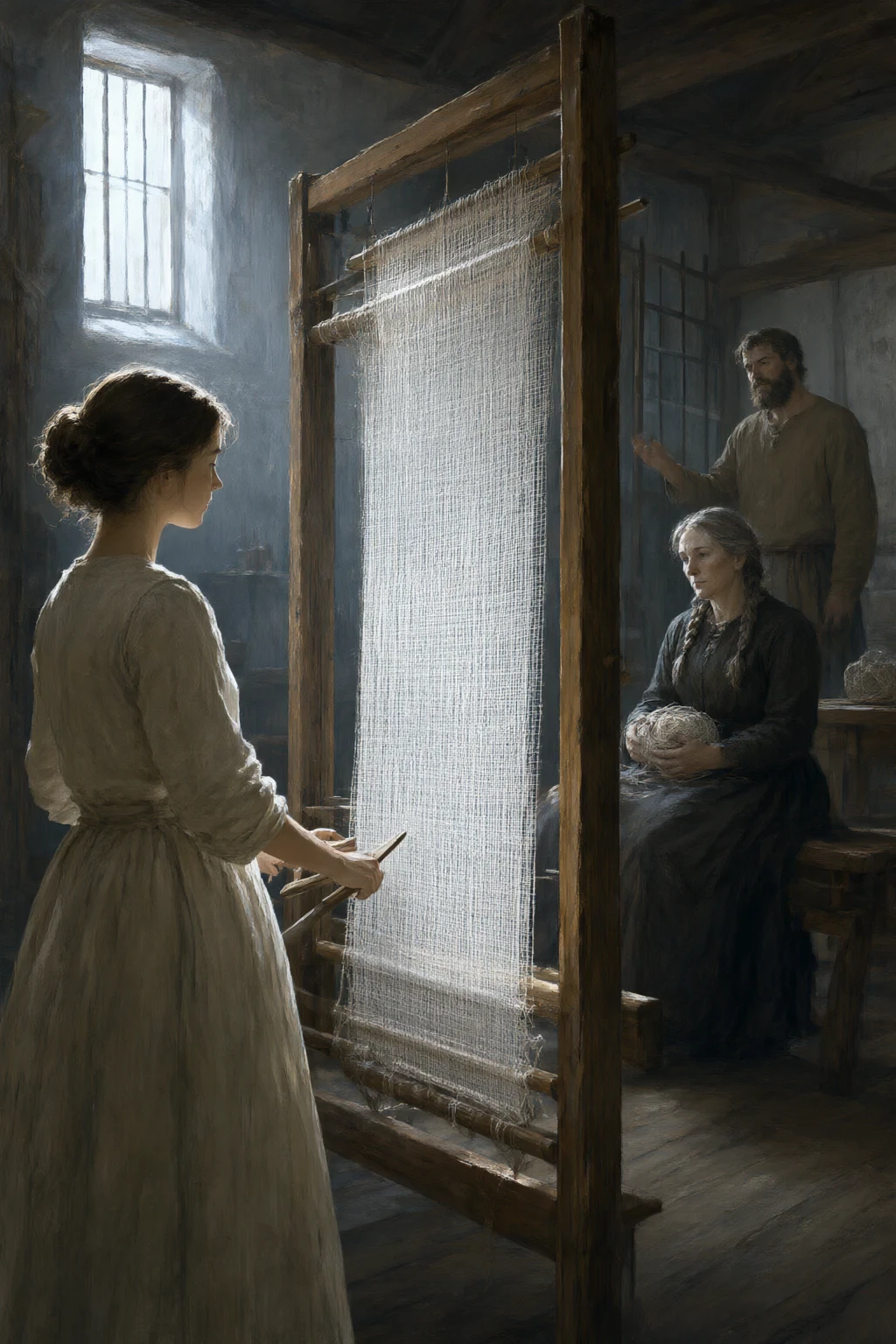
The house at Skagen head had a weaving house, a flax field and a priest, and for eleven years all three were employed. Sigrid was the seventh child and the only one of the seven who could be found in the weaving house at any hour of any day. Her six brothers had been sent away at the ages of nine, ten, eleven, twelve, thirteen and fourteen, in that order, on six consecutive mornings, on horses their mother did not see off. There was a story about a school at Roskilde and another about a merchant's house in the south. Nobody in the parish asked which was true, because the house at Skagen head was the queen's house, and a queen's children can be sent where the queen's reasons are.
The mother had been a queen by marriage and had been, before that, the daughter of a woman who wove. The priest who kept the coast chapel could write, and he could bind, which is the same work done to a different material, and he could do the one thing her family could do and no clerk could: put a name into a thing so that the thing would hold it. She had taken a lover who came as a swan. That is in the tale and it is true and it is not the interesting part. The interesting part is procedural.
She made her sons swear. That is the whole mechanism. She came down to the hall where the six of them were sitting after supper and made them swear, one at a time, in front of the priest, in the words her own mother had used on her. The words are not a promise. A binding takes something loose and gives it a shape it cannot be pulled out of, and she bound six boys without asking them what they thought of the words.
And the six of them, being sixteen to twenty-one, and being the sons of a man dead four years, went out of the hall after supper and told the steward what they had sworn, and why, and who to. They told him in the morning, in daylight, sitting down. It is worth recording that they did not do it to be free. Three of them were quite sure afterward that they had only wanted to be asked.
The priest came back from Roskilde in the ninth month, and the queen heard him out, and then she said a sentence that is the whole of this story, in the weaving house, because that was the only room in the house where the light was good enough for the work she was about to do. "You have learned," she said, "that a binding is not a promise." The six of them did not understand. They were standing in a flax room in the ninth month and the queen's hands were already on the warp.
"You have learned that a thing can be said to you and be done to you, and that the two are the same act, and that they do not have to be fair. You are going to live in that for a while. And you are going to hate it, because you are honest men and it is a dishonest arrangement. And at the end of it you will not be able to tell anyone what has been done to you, and that is not a punishment. It is the cloth."
Sigrid was seventeen, she was at the loom, and she was the only one in the house told anything, and the reason she was told is that she was useful. She was the seventh child and the least of the money and the best at the work, and her mother chose her out of the seven for the same reason a person chooses a good axle for a cart. Here is what she was told, over four days, sitting on the bench with her mother. It is the terms, and they have never been written down anywhere else.
One: a swan may not die. The form is a bird until the name is closed. Two: the name is closed in a net; a shirt, woven of net, with the name in it, legible, continuous. Three: a binding is made in a shuttle and a net is made in a shuttle, and they are the same words, and she who made the oath and she who holds the shuttle are the same kind of worker. Four: six shirts. The first five must be cut off the loom complete. The sixth, for the youngest, must be woven complete and must not be cut off, because a shirt still on the loom is not yet a thing a man can be in. Five: the youngest brother is to know a name that has not been closed. Six: Sigrid is not to speak of the six, nor name them, nor laugh, while the sixth shirt is on the loom.
She made the five. That is four years of work and it is where the whole of it is decided. The net is not a metaphor. It is the only cloth a swan can be put back into, and the weaving of it takes a year and eight months for a shirt a man can wear. Sigrid made five, and she cut off the first five, and she did not speak. When she cut off a shirt she did not cry. That is not stoicism. She had woven the thing for eleven months and she knew the exact row at which the shuttle passed when she wanted to stop, and stopping there is a decision, and a decision of that kind leaves no room for crying. She counted the last row. She took the knife off its nail. She cut. And then she sat on the bench and could not speak, because five of the six were out of their swans, and one was not.
Five of them were men, and enormous men, and they were a lord's sons in a lord's house, and they were given rooms and good clothes and a great deal of quiet. Two took the north estate and did it badly. One began to learn the accounts of the house, badly, and Sigrid understood within a year that this was not a recovery. It was a man with a mind, unemployed. And the sixth was on the water. He was called Ravn, and he was a swan for four years with a shirt on a loom in his own family's weaving house, two hundred paces from the sea. He was not permitted inside, because a swan in a weaving house is a bird in a room with a bolt of linen in it.
So five of the six came out and the sixth did not, and the family called him the swan, and the girl who was his sister called him by the name they had used in the house when he was six, and did not say it aloud, and the not-saying-out-loud is the term.
Sigrid did not laugh for three years and eleven months. That is the part the tale tells and it tells it wrong. It is not that she could not. It is that the binding and the shuttle are the same words, and the binding took the laugh out of her the way it took the arms out of a swan, and it did not feel like sorrow. It felt like a trade she had learned badly. What she did instead was work, and this is what nobody has ever understood about Sigrid, which is that she was not suffering. She was extremely good at a very hard job, and by the third year she was better than her mother. "You take the weft too tight on the return," her mother said, in the second year. "I take it the way you taught me."
"I taught you the way I was taught. I have been doing it forty years and I have got round it." Her mother set down her shuttle. "You will go on taking it that tight for another two years and then you will not be able to do anything else, and I have decided it is not my business to decide."
A net shirt for a swan cannot be cut off, because a cut shirt is a closed name. So the sixth shirt grew and stayed on the loom, and Ravn stayed on the water, and the two of them were held in a single condition by a piece of linen a foot off the beam and growing. In the fourth year, on a Tuesday in the third month, Sigrid came to the end of it. The priest wrote the account out at the time, because an arrangement which has lasted four years ought to be written down while it still works. The binding of the six sons of the queen, Skagen head. Made in the ninth month, in the hall, at supper, one at a time, in the presence of the Rev. Absalon. Witnessed by: none, which was the fault and the whole of the case.
Cost: the tellers cannot speak of what was told to them, for so long as the sixth shirt is on the loom. The youngest of the six remains in the form of a bird until the name is closed, and the name cannot be closed by cutting. The cloth, to be finished, is to be finished by the weaver of it. That is in the terms and was not explained to her, and she was seventeen, and there is no clause requiring that an explanation be given, and the absence of the clause is the reason she was usable. On the matter of the seventh: the seventh is to weave, and to be silent, and to be owed. That last line is the only line in the whole business written down for Sigrid's sake. It does not name a figure, and there is no column anywhere in that document a sum could go in.
"It ends with the shuttle," she said. "The whole of it is a piece of cloth, and it ends when the cloth is finished, and the last pass is mine, because nobody else is going to be at this loom." "You knew," she said, "when you made me seventeen and put me on this loom. You did not have to. There were four hundred people in this kingdom who would have taught me net for nothing and never asked for anything at the end of it, and the reason you did not use one of them is that you wanted somebody who could not leave." Her mother did not answer for a while, and then she said, "Yes."
"I am going to sit in the west room now, and you are not to look at me while I do it, because I have not earned any of your looking." She stood up. "I did not want it finished. I wanted the boys. Six of them, and no argument about the work or the money or the coast, and I had a house, and a very good weaver, and no sons in it."
Sigrid sent the last pass on the Tuesday. The sixth shirt came off the loom on the Thursday, in the presence of her mother, of the five brothers who were men, and of the priest, and there was no swan in the room, because a swan could not be in the room. The sixth brother stood at the end of the loom as a man of twenty-five, enormous and silent, looking at a shirt.
It took him nine days to put on, because the binding had a term on that too and nobody had read it out loud: he could not be told what he was until he was in it. The oldest of the six read it from the priest's book on the fourth day, and the man at the loom did not move while it was read. Then he put the shirt on in front of six people, and the name closed as the cloth came over his own name, and there was no sound in the weaving house for about a minute. Then the girl of twenty-one put her face in her hands and cried like anything, which she had not been able to do for four years, and the priest wrote the date on the page, and that is the last page of the book.
The queen's health began to go in the sixth year, and nobody said why. The shroud was Sigrid's, because the shroud was a net, because the house had one weaver and the net was what the house wove, and because a woman who has spent four years in a binding does not die in a shift she has been promoted out of. "It will take eleven months and I will not be able to talk to you," said Sigrid. "A shroud is finished, and a finished thing is a closed name, and I do not know in advance which name you would hear yourself say." She set the warp. "So we will do it as we did the shirts. You will sit at the other end of the room, I will ask for thread, and neither of us will say anything else for eleven months."
The account was rendered in the sixth year, with the shroud on the loom behind the bench, in the presence of six of the six brothers. It took an afternoon and it is not a dramatic scene. Sigrid opened it. Nobody had ever taught her to keep figures; she had taught herself, and she was very good at it. The account established this. Each brother owed one year. Not one year of labour. One year of life, taken out of her, and she could not show it, because nobody in that family had ever been able to show a swan's leg, and the whole of the first term is that a swan has no mark. Ravn said, "I will work it off."
"You will not," said Sigrid, "because you cannot do the work. It is a year, and it cannot be done in an afternoon by a man who does not know net from a fish fence, and if you spent four years on this loom learning badly you would be spending four years of my life, which is the coin, and you would be paying me back out of the only purse I have got." "My life, then." "Your life is the one thing in this room that is not mine to spend," she said, "and I have noticed that all six of you came to this afternoon thinking it might be. It is not. None of it is. That was the entire arrangement."
What the brothers did was sit at the loom. That is the account as it stands in the house books, entered in the sixth year under a heading that reads, in the copy that survives, assistance in the weaving, six persons, various. They took turns at that loom in the long evenings, under instruction, and they were bad at it, and they went on doing it for eleven years. The eldest got a straight line about half the time. Ravn took three years to be allowed to touch the shuttle, and when he was allowed he wove so evenly that the priests who came to look said it was the work of a man, which it was, and the remark cost Sigrid something she never told anybody about.
The shroud came off the loom in the fourth month of the seventh year, and it was folded in four and put in the cedar chest, and there is one thing about it that the family records. On the outermost fold, in the corner, worked in the same net and the same shuttle as the names of the six brothers, there is a seventh name. She put it there in the sixth year, at the back of the cloth, in the same row as the other six and in the same stitch, without telling anybody, and the reason is that the sixth term ended with the closing of the sixth name and not with the shutting of the loom.
When the priest died, the family asked him about it, and the family will tell you what he said: that he had written down owed, in the fourth year, in a document about a binding, in a hand that did not shake, and that a man who writes a number down does not thereby agree to pay it, and that the girl at the loom was not a creditor. She was a clerk. And the clerks of this world can tell you the truth about what is owed, and are the only ones who are never allowed to collect it.
The loom is still in the weaving house at Skagen head. It has not been a working loom for a long time, and the cloth that was on it when they stopped is still on the frame, because cloth left on a frame in a weaving house is cloth that has not been finished, and Sigrid was very firm about that, and she was right. It is forty-one years now, and on the last morning of every month somebody from the parish beats the dust out of it, because a thing that has not been finished is still worth looking after.