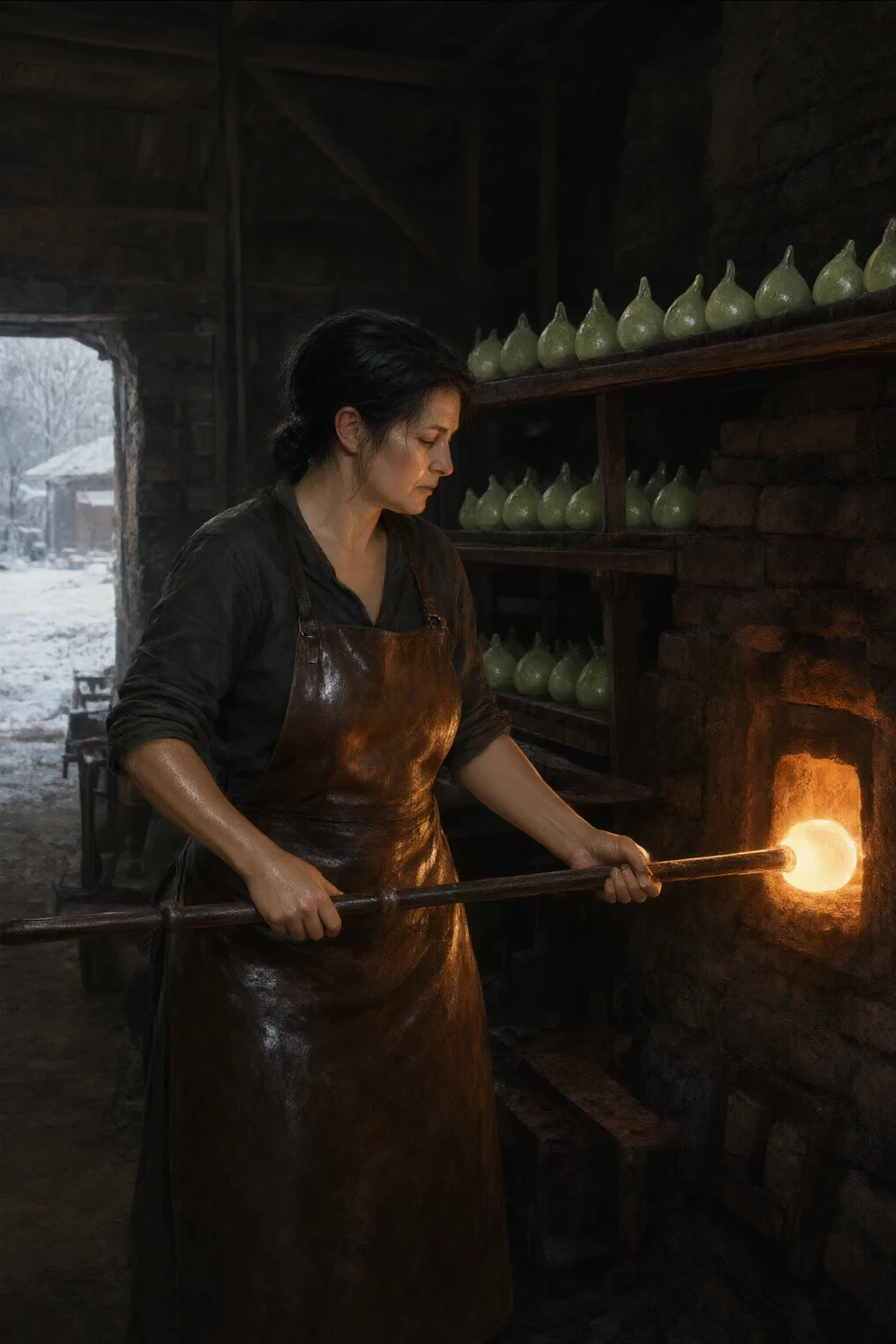
The Crown Kiln had no clock. It had a furnace, and on a furnace morning the furnace was the clock, and the morning was as long as the fire would bear and not a minute more. Perrin Vole came up the gravel from the Washing Steps at ten past seven with his coat over one arm and a sheet of paper inside it, and he stopped in the doorway to count, because he counted things now, and because the doorway was the only place in Coldrow where a boy could stand and see the whole of a thing at once. Eleven hooks on the board beside the door, every one of them holding a coat. The eleventh hook was the one his own coat would have gone on if he had brought it, and he had not, on purpose, because a boy with his coat on is a boy on his way home.
Inside, the hall ran the length of two cottages. Firebrick black with soot. The furnace mouth at the far end was a low arch of orange, and the light it gave off was the light of a foundry and not of a lamp, and it lay along the floor and came up the legs of everything in the room. Along the north wall stood the annealing racks, and above them the cooling bells lay in rows like sleeping animals. The floor was a black glass crust, laid down by four hundred years of accidents and never scraped off, so that a man crossing the hall walked on a floor that appeared to move. Green dust hung in the air and made the room look like weather. Bela Truce had a gather on the end of a blowpipe and did not turn round. “Furnace morning,” she said. That was the whole of the greeting. The Crown Kiln heard requests on furnace mornings, once a month, in the eighth hour, and the rule of it was older than anybody living. The asker might speak once, and might not be answered with a question. The fire would not wait, and a gather that has gone over cannot be brought back.
Behind her, at the marver, Marget Oskell was grinding a lump of cullet with the flat of a steel plate, unhurried, in a black apron gone white at the knee. She had not been asked to come. She came anyway, because in the Crown Kiln the ash reader is the only person whose presence can stop a thing before it becomes glass, and nobody had ever thought to write it down. In the doorway behind Perrin, Tamsin Quill put down her father’s second basket and looked at the floor.
The sheet of paper had a man’s careful capitals on it and, at the foot, a disc of lead about the size of a coin, punched crooked, with two letters in it. R Q. They had closed the petition with a seal. There was no other way to close anything in Coldrow, and a man with a piece of paper worth anything in this valley put the mark of the dead on it and paid with the dead. Ione Sarrack took the sheet in her gloved hand and read it standing up, because there was nothing to sit on that was not covered in glass. Her plait was pinned in a coil at the back of her head and one grey hair had come loose and lay across her collar. “Eleventh of Sleetmonth,” she said. “Fourteenth year of the turning wind, and —” She stopped. She had not said the rest. She read the first line again. “You have brought me a petition.” “Aye.” “From Renn Quill, of the Washing Steps, ash hauler.” “Aye.” “It is a request to the Crown Kiln.” “It is.” “Then it is properly made, and it is spoken once, and the fire is at the glory hole.” She folded the sheet along the crease he had put in it and gave it back. “Say it.”
Renn Quill had not come into the hall. He had left the sled at the yard and stopped in the door, in the cold, with his hands behind him, in a coat mended at the shoulder eleven years ago by somebody no longer alive. He had the eyes of a man who has spent a long time looking at the ground. He said: “My daughter is named on a bell in the ninth year of the turning wind, and she is alive.” Nobody in the hall said anything. The furnace made the sound a furnace makes, which is not a sound so much as a place where sound would be if there were any. “The Crown Kiln blows one bell for one person, and the Crown Kiln does not blow a second. I have read that rule and I do not argue with it. I am here because the first bell was blown on a bad seal, and if it is a bad seal then there was never a person in it, and if there was never a person in it then there is a bell in the ninth bay with nothing in it and my daughter is standing in this hall.” He stopped, and it was not a rhetorical stop. “I want a second bell made. For her. So that the first can be emptied.” “Emptied how,” Bela said, from the furnace.
Renn did not know. There was no such act; the act that came nearest to emptying a bell was breaking it, and everybody knew what breaking a bell cost, and nobody said it out loud in the same breath as anything else. He said: “Some way that is lawful.” “And you will pay the lawful price,” Ione said, “which is your voice, or a sound out of your life, or a day of the working life of four men and the use of a furnace that stands idle for a year. Are you asking for that.” “I am asking for it.” “Then the request is in order and the refusal is in order, and the refusal is the kiln’s.” Ione turned to Marget. “Have you a certificate for a bell for Tamsin Quill, of Coldrow, aged sixteen.” “No,” said Marget. “Have you had one at any time.” “Yes.” “Then read it out.”
Marget Oskell took her spectacles off the knotted grey cord and cleaned them on the hem of her apron, which did nothing for them, and put them back on. The black lead dust had got into everything. Her fingers were stained brown to the second joint. “Eleventh of Sleetmonth,” she said. “Eleven years back. The name on the crown seal is Tamsin Quill. The age is given as five years, which is correct. The cause is given as cold, taken at the weir, which was a lie, because I did not see a body, and I said it to close the day. There is a weight beside it. Three stone two, which was the right weight for a child of that age, and I have never been able to think where the number came from.” She put one burnt fingertip on the table. “That is the entry. It is the whole entry. It is in the seal ledger, second volume, and it is in my hand.” “Have you seen the seal twice,” said Bela. Marget did not answer at once. She took the shallow tin out of her apron and tapped it once with her thumbnail, the way she did when she was thinking, and then again, which she did not do when she was thinking.
“I have read the entry eleven times in six years,” she said. “That is not the question and you know it is not the question.” “It is the only question the Crown Kiln asks,” Bela said. “Not what you have read. What you have seen with your eyes, twice. Once is a mark on a lead disc that a five-year-old girl in my glasshouse would have had the strength to punch. Twice is a name.” “I have not seen it twice,” said Marget, “and I will not see it now, because if I look at it a second time with the intention of certifying it, I will be certifying it, and I will be certifying a child who is standing in this hall with her hand in a cloth, and I will be doing it for the reason that I did it then, which is that the day wanted closing and I am the one who closes days.” In the doorway, Tamsin said: “It was the flue.” Everyone turned. She had not moved from the doorway. She spoke late, the way she spoke, half a beat behind the end of what had been said, so that her words arrived at the room after the room had finished with the question.
“Sleetmonth, eleven years back,” she said. “The flue was down. Father said so. He said the yard was doubled and the sieves were rung and he was sent for the sled twice in one day, and the second load was heavier than the first, and he asked and was told not to ask.” She lifted her right hand, the one in the broad strip of cloth she had never taken off, and turned it over as though the cloth were a page. “That is not in the ledger.” “No,” said Marget. “It is in me.” “It is,” said Marget, “and it is not a record, and the Crown Kiln does not blow on what is in people.”
Bela Truce put the gather into the glory hole and turned it and laid it on the marver, and it went from white to orange to a colour that had no name, and she rolled it forward under the steel with both hands. “Marget,” she said. “Ash reader. You have asked me for a second bell, so I will show you what a second bell is.” She lifted the marver stone clear. Underneath, on a scarred oak board, were thirty-one marks in white chalk, a set of small brass weights, a tin of grey dust, and a strip of oiled paper folded into quarters.
“One thimble of ash to a gather,” she said. “That is not law. That is what I was taught, and what my mother was taught, and the hand that wrote it down is in the book that is in the chest. A bell of the size we blow stands a person’s height. It wants a great deal of glass, and the glass wants a great deal of gather, and the gather is what the fire will give you in one pull.” She looked up. “I can take two bells out of this gather. I have done it. I did it once, in the fourteenth year, with a bell that cracked in the lehr, and I put the second one in the fire and it came out better than the first, and I have never told the Head Tuner, and it is in no column, and I have had it in my head for nine years.” Ione said, “The rule of the kiln is one bell to one person.” “The rule of the kiln is what the lintel says,” Bela said. “Have you read the lintel.” “There is a stone over the furnace door with a mason’s cut in it. I have read it four hundred times.” “Then read it out, and do it the way it is cut, and not the way it is said.”
Ione did not move. Marget counted something on her fingers under the table where the light was bad. The furnace drew. Somewhere behind the hall a bell on the cooling shelf ticked as it cooled, which was the only sound in Coldrow that day that was not the furnace. “ONE GATHER,” Ione said. “ONE NAME.” She stopped. “And the chart to hold it,” Bela said. The hall was quiet in a way Perrin had heard exactly twice before in his life, both times at the Chart House, and both times followed by somebody clearing their throat. “A mason cut that in the year the colonnade was finished,” Ione said. “It is a builder’s line. It is a specification for a record. It says that whatever the fire makes, the wall holds, once, and that the two things to be held are the gather and the name.” She had her hand out of the sleeve now, and there was chalk in the creases of it that had been there so long it had stopped being dust and become colour. “It says nothing about glass. It is a sentence about the wall.”
“Then the kiln’s rule is the chart’s rule,” Ione said. “And the chart’s rule is that a bell is a line. Date. Bay. Bell. Ringer. Called. Five columns. Every one of them exact. The chart can hold a gather and a name without ever saying which is which, and that is not a defect in the chart, because a chart is not required to say which is which. A chart is required to have a column for the thing you need to say.” She looked at nothing. “There is no column for a bell that is not a bell.”
Perrin had been to the cooling shelf twice before and had been told not to touch. He went along it now, close, with his hands behind his back the way you are shown at a funeral, and he counted. There were forty bells on the shelf. He had counted them for two years and had got forty every time, and once had got thirty-nine and had been so ashamed of it that he had counted again in the dark by feeling the crowns with his thumbs. Past the last bell, along the end of the shelf where the furnace light did not reach, there was a row of lumps. They were the size of a fist and a little larger. They were pale sea-glass green, and they had the shape that cooling glass takes when nobody has decided anything further about it: a teardrop, a foot, a heavy bead with one flat side where it had been set down. Some had gone cloudy. Some were the colour of a bottle held up to a window. He counted them twice. Nineteen. He went back down the hall. “There are nineteen lumps on the end of the shelf,” he said. “And no crown on any of them, and no seal, and they are not bells.” “No,” said Bela. “What are they.”
“Gathers.” She did not turn round. She was at the glory hole again, and the fire was going orange-white at the mouth. “A gather taken and blown and not made into a bell. It is waste. It goes on the shelf and it stays there because there is no place to put it and no column to write it in, and no person to give it to.” “Who made them.” “My grandmother made some. My mother made some. I have made four.” “Four.” “They are not on the chart,” Bela said. “They are not in the ledger. They are not in the Crown Kiln, which blows, and the Chart House, which holds, and the Ash Yard, which signs. They are in the third place, where the fire is.” Renn Quill had come the length of the hall. He stood in front of the shelf and looked at the nineteen for a long time, and nobody told him to go back to the door, because he had been in the door for an hour and a half and was now, in the only sense available, inside the institution. “My father would have blown one of these,” he said. “Yes,” said Bela. “For a person who was not dead.” “Yes.” “Then the answer to me is not new.” “No,” said Bela. “It is nine generations old and it has never once been written down.”
Ione Sarrack took out a stub of chalk. She did not approach the wall. “Twenty-second of Sleetmonth,” she said. “Fourteenth year of the turning wind. A petition was heard at the Crown Kiln in the eighth hour, from Renn Quill of the Washing Steps, ash hauler, for a second bell for Tamsin Quill, aged sixteen, of Coldrow, who is not certified dead and is not dead. The petition is refused on the ground that the Crown Kiln does not blow a second bell for one person; the ground being the lintel over the furnace door, cut in the year of the colonnade, which requires one gather and one name and the chart to hold it; and the chart having no column in which a refusal could be held, that being the same absence.” She stopped with the chalk up. “Two witnesses are required,” she said. “Marget Oskell and Bela Truce, and they have said nothing, so I will ask them now. Marget Oskell, do you witness this.” “Witness what,” said Marget. “That a man said a thing. I have heard a great many men say things in the last two hours. I have not seen a bell.” Ione put the chalk down. “Then the minute cannot be taken,” she said, “and that is not a failure of the minute. That is the minute telling the truth about itself.” “Twenty-second of Sleetmonth,” said Ansel Roke.
He had been in the hall for the whole of it and had not spoken until now, which was his habit and not his modesty. He had a long black coat with ink at both cuffs and a green-shouldered satchel over the wrong shoulder, and he had cleaned his spectacles four times and ended with them on his head. “The petition carries a filer,” he said. “That is how a petition is addressed. It carries a name on the outside and a mark at the foot, and the mark is a lead disc with two letters in it, and the petitioner is a man of the valley. That is why the Crown Kiln has to hear it, and that part is sound. It stands in the record as follows — a petition requires a petitioner, and a refusal requires a petitioner to be refused.” He turned the sheet round so that they could all see the disc. “There is no column on which to write that this woman is alive.” He said it without any weight at all, which was how he said the things that mattered.
“I compiled the Register of the Living,” he said. “Nineteen years, and it is a good instrument, and it is in every cottage in this valley, and it names nine hundred and four people who have not been certified dead. Tamsin Quill is not on it. She has not been on it since she was five years old, and she has not been off it, because a name cannot be struck, only lost.” He pushed his spectacles up onto his head. “So there is no record of her to blow a bell for, and no record of her to refuse a bell for, and if this morning is to be written anywhere it goes on the page of a man who is asking for something, and the page will say that Renn Quill asked for a bell for his daughter and was refused, and it will not be able to say that his daughter was in the room.” The furnace drew. On the cooling shelf a bell ticked.
“So the refusal we made this morning is not a thing that happened,” Ione said. “It is a thing four people remember. And the Crown Kiln does not keep what four people remember. The Crown Kiln keeps what the wall holds, and the wall will hold nothing about this, and in eleven years there will be a fifth person who does not know it was refused, and if that fifth person is asked, the answer will be that the Crown Kiln does not blow a second bell, which is true, and the reason will be a lintel that says something about a chart.” “Then the kiln has refused,” Bela said. “The kiln has not refused anything,” Ione said. “I have. Write it where it stands, and where it stands is nowhere, and I will not pretend otherwise to make the morning tidier.”
The wind came round at nine, off the high ground at the head of the valley, and the hall was full of noise and nobody heard it, and it was not until Ione went to the door to draw the day that any of them knew the colonnade was sounding. It was not the ordinary evening. The ordinary evening is nine bays in an even order, from the near end to the far, a chord that goes up the valley like water down a stair. What was sounding was a single note, and it was not in the run of it. Perrin went out into the yard and turned his head the way a man turns to find a dog. The note was coming from the far end. He knew that without deciding to know it, because the sound reached his left ear before his right, which only happens at the ninth bay, a kilometre down the Pillar Walk, which he had walked forty times and had never once seen anything at the end of. He stood in the yard and the note came across the frozen grass, and it did not stop, and he did not think about it in the way that a person does not think about the sound of their own name. He hummed it.
It was not a decision. His throat was doing what it had been doing for a year without his leave, taking up whatever the colonnade was doing and carrying it two or three notes behind. He had hummed the new note perhaps two hundred times: over bread, over the trough, on the Pillar Walk at night, in his sleep, which he knew about because Marda Illis had told him he did it and he had not believed her. Now he hummed it, and the hall behind him was loud, and a bell a kilometre away was sounding the identical pitch, and for a moment the two of them were the same sound in two places. And then he was not producing it. There was no hurt. His throat was exactly as it had been, and his breath was exactly as it had been. The note was simply gone, the way a word is gone when you reach for the name of a thing and there is a shape where the word was and no word.
He stood in the yard with his mouth slightly open. The note went on sounding from the ninth bay, and it did not come back, and he waited for it the way a man waits for the place in a piece of music he knows, and then he understood that he was waiting. The wind went on moving and the note went on sounding, and from that moment they were two separate facts about the world, and one of them had a man attached to it and the other did not. Behind him somebody said something. Tamsin had come out of the hall and was standing on the step with her shawl over her hair, looking at the colonnade, her right hand up out of the cloth and at her throat in the way a person puts a hand at their throat when they are singing. She hummed it. Perrin opened his mouth to take it, and what came out was nothing, and he made a noise with his lips like a man who has put something away. Tamsin turned and looked at him. She went on humming, and the note she was making was not coming out of her throat either, not for long. It stopped the way a line of water stops when the sluice is shut: all at once, from the outside, in the middle of a fall. She looked at her own hand. She put it behind her back. “Sorry,” she said, late. “It does that.”
The fire was drawn at the eleventh hour, and drawing the fire is a job, and while it was being done the hall cooled from the mouth outward, and the green dust that had been standing in the light all morning began to come down, and everyone in it found the same thing on themselves, which was that they were white to the elbow. Bela Truce had taken a gather out of the glory hole at ten and had not made anything of it. She set it on the marver and let it go, and it cooled on the board for a quarter of an hour, going from white through orange to a heavy green, and it came off the steel with the sound of skin coming off a burn. She carried it to the end of the shelf and set it down in the empty place at the end of the row, next to the nineteen. Nobody counted. Marget was looking at the door. “I want it said in this room,” she said, “that I did not refuse a girl. I refused a seal. I have spent six years refusing a seal.”
Marget Oskell put her right hand out flat on the cooling shelf, away from the glass, and she counted the words on it with the fingers of the other hand, one at a time, the way she did when she was frightened, and she got to nine and started again. “Have you seen it twice,” she said. She was not talking to anybody in the room. She was looking at the row of green lumps, made by four generations of her trade, the last of which was still cooling. “Have you seen it twice. Have you seen it twice. A man hauled a sled twice in one day. A flue was down. A child spoke in a yard. And there is not one object in the whole of this valley that any two people have looked at twice.” “Twenty-second of Sleetmonth,” Ione said, to nobody, from the doorway, with the chalk still in her hand and no wall in front of her. “The refusal is made and the refusal is not held. Write it where it stands.” Outside, the colonnade was going quiet bay by bay.
Perrin Vole walked up the gravel towards the Chart House with his hands in the sleeves of a coat four sizes too large, and he was humming. He had been humming all morning without knowing it, and he went on humming now, and the tune was an ordinary one, a thing the older boys at the mill did, four notes and a turn, and he had it well. He never got the other one back. A thing you have had since you were six is not a thing you have, it is the way the air is; and it was not until the eleventh year, in a cold week at the end of a turning wind, when somebody hummed it out loud in a doorway and he found that he could not join in, that he had any idea of what the valley had taken off him, and by then there was no way of asking to have it back, and the only person who might have told him was a girl with a cloth round her hand who heard the colonnade all day whether she was in the valley or not.
The second of Sleetmonth, Ansel Roke ruled a column at the end of the audit sheet, six inches wide, and left its heading blank, because he did not know what went in it, and he had spent nineteen years finding out that he could not be trusted to decide a thing on the day he wanted it decided. The room was cold. He could hear the colonnade through the north window, the way everyone in Coldrow could hear it whether they admitted it or not: not the words, never the words, only the interval, coming up the valley on the frost-hard ground.