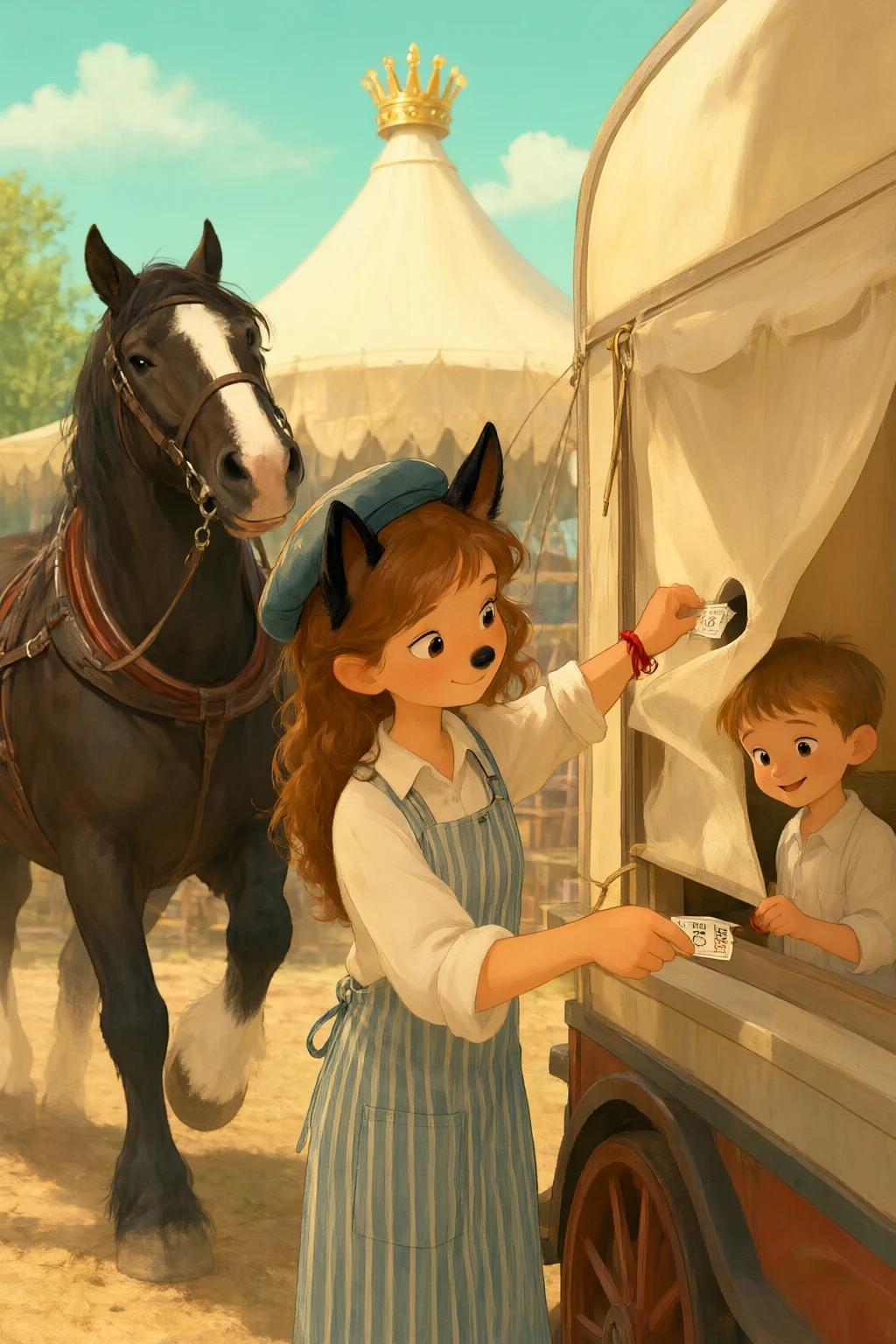
By nine o’clock Nell Ferrule had decided that nobody was going to see her face. That took one look in the cracked hand-mirror wedged behind the ticket drawer, and one small sound she did not make out loud.
Her ears had gone. Gone up, past the hair, the two of them standing proud of her head like a cat’s, and fur on the outside as well. Her nose had a long way of running, and everything smelled too much: beer from the barrels, hot iron off the Lantern Works, and under all of it the wet chalk of the drainage ditches, which was the smell of the road itself.
She was thirteen. She had been signing for three years. A length of red thread was knotted round her left wrist, knotted over until it had become a small cuff of knots, and the whole company said she was the best ticket seller in the Gilded Menagerie, and today she was too far into her fox to face a queue.
The booth was a canvas hood on the end of a wagon, with a flap that tied back and a hole cut in the flap about the size of a cat. Nell tied the flap from the inside, one corner and then the other, and squeezed out through the hole. Her nose came through last. It was nine o’clock, and the queue already went round the obelisk.
She counted. It helped. One. Two. Three. The count went past ten and kept going, the way it did, forty, forty-one, and by fifty she had the shape of it: three hundred and something.
Then a boy came up to the flap. He was about nine and thin as a wet rope, and he put a penny on the plank. “I want a ticket for the horse,” he said. “There are six horses,” said Nell, from the hole. “They are all horses.” “I mean the counting one.” “Who told you about that?” “My dad drove for a circus once, and he says there is one that counts, and it does it all night, and people pay just to see it.” Nell thought about a penny. “There is a queue,” she said. “There is always a queue,” said the boy. “I will not take your place. I will wait. Can I wait?”
She said yes, because what else do you say, and that was the trouble with saying yes. So she sold the penny, and then a shilling’s worth besides, through a hole in the flap with her face out of the light. The boy’s name was Wilf. His father was a carter out of Pettifer Bridge. Wilf had been told that a horse which can count is a horse which has been to school.
And because the flap was only so wide, you got a slice of her every so often: one black wet nose, one strip of cheek, one of the great pointed ears.
At four the queue went inside and the tickets were done, and the boy was still there. “Which one is it, then?” “I cannot tell you. You pay at the gate. I sell them. That is not the same as knowing.”
And Wilf, who was nine, and who had come back four times and had not gone home, said the thing that untied the flap. “You could just tell me. You told me about the beer and the ditch and the boiler shed. You told me everything except the thing you are hiding.” Nell stood in the dark of the booth with the tickets in a stack and the brass bell cold against her palm.
She could have said nothing. She thought about it a long time. Then she untied the corner, and then the other corner, and she came out into the sun with her ears up and her nose wet and the red thread cuff showing on her wrist, and she said:
“I am not a fox because I am sly. I signed because I was frightened and I did not read it. And there is a horse out there who can count because he listens to me. He does the numbers I say, because he is the one who taught me to count, and he is not, he is not what I call him.” Her voice went, and she started again. “He is not what I call him, is he,” said Wilf. “No,” said Nell. “No, he is not.”
They walked out past the rope tights together. By the time they reached the hitching rail she had stopped apologising for her ears, which was the first useful thing that had happened to her all day. The horse was called Comfrey. That was what was on the file. He was black-bay and heavy, with a white stocking on the near hind. He was eating, and nothing about him looked like a man. Nell’s heart did the thing it did. She crouched in the dust, put two fingers flat on the rail, and said, quietly, so that only he could hear:
“Comfrey. No. Tomas.” The horse did not move. Then Nell counted, the way she did when she was frightened, the way her brother had taught her in the summer when there was a bed and a window. One. Two. Three. Four. The horse stamped his near forefoot. One. “Five. Six. Seven. Eight. Nine. Ten.” Stamp. “Eleven. Twelve.” Stamp. Stamp. “He is counting with you,” said Wilf, who had made a noise like a kicked cat.
“He is listening,” said Nell. “He has the numbers in his head the way I have. It is not a trick. It is him and me.” “That is the best trick there is,” said Wilf, with enormous sincerity.
Over the fairground the corona was going up jet by jet, and the one at the north side was sooted dark. “Show in twenty minutes,” said Nell. “Will he be in the show?” “I do not know. They write his file. I sell the ticket.”
They went back past the booth. Wilf put his penny on the plank, and Nell picked it up and gave it back. “That is not a ticket,” she said. “It is for the boy that stood here all afternoon.” “I stood here because I wanted to see a horse,” said Wilf. “That is how it works.” Nell, who was thirteen, said: “Right.”
The Board of Terms was nailed to the wall of the Paper Caravan in letters so big a man on a cart could read them going past. Nell had seen it every night for three years and had never once read it. She had learned the ticket hand, which is not the same as learning the words. Wilf could not read it at all.
So Nell stood up on the ticket plank and read it out loud, slowly, the way her brother used to read the shipping list at the yard, saying the whole of it again so you were certain of it. And this is the part she had not been meant to read, and she got to it because a boy from Pettifer Bridge asked her one question too many.
“While a name is unstruck,” said Nell, “a transformation cannot be given, or lent, or sold, or left to anybody. Nobody can take it. Nobody can hand it on. It sits on the name.” She looked up at the green curtain behind the one window, where a man in a green eyeshade was writing down something that was not her business. “So it is not somewhere,” said Nell.
“Tomas. He is not gone off somewhere. It is on his name, and it is in there.” She pointed with her whole hand at the door, at the brass key as big as a fist. “It is on a piece of paper with a wax seal, in a room with green curtains, and there is a man in there who writes the names.” “Can I come in and see the paper?” “No,” said Nell. “They make you leave your matches at the door.”
The show went up. Nell went round the back of the booth on the inside of the rope, and she put her hand flat on the red thread and counted the knots, which she had done every night of her life. There were forty-one of them.
The boy got his ticket. He stood at the rail with his mouth shut and his eyes the size of saucers, and when Comfrey stamped his number, Wilf Merrow shouted so loudly that two hundred people heard him. Out on the road the shadow from the sooted jet walked all the way round the ring, and the Salt Line saw it pass.