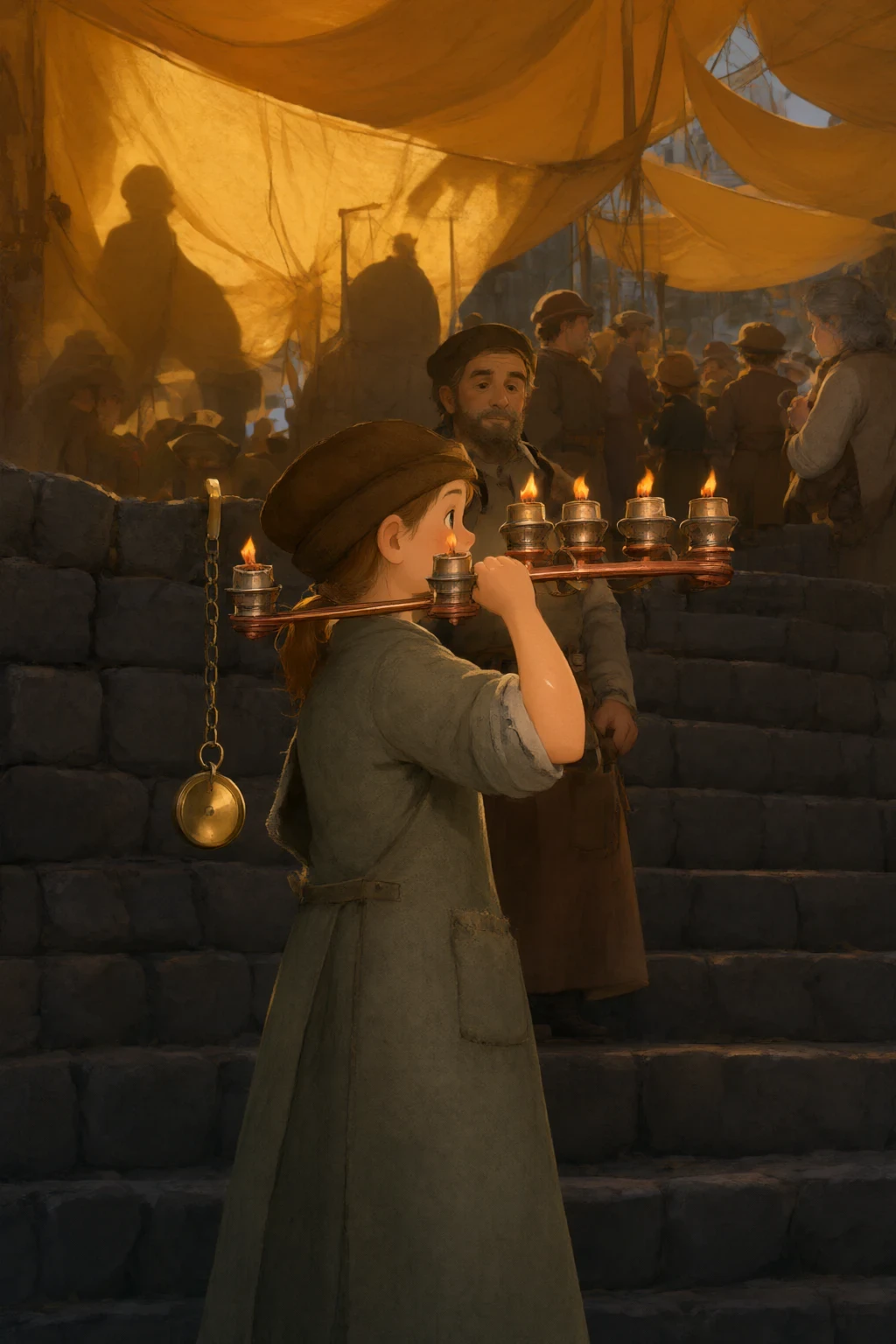
Wren Cask was nine years old on the morning her fire came due. The lantern house stood at the top of the market row on the Ninth Terrace, where the street began to climb the first of the nine switchbacks. Past the last house the caldera opened out grey and wide, with one long orange crack running along it.
Wren woke before the bells and put her palm flat on the wall, feeling the night’s heat still come through the stone. Then she dressed in her felt cap and her mended coat, because a trimmer’s turning is not a day for a good coat. Master Gell had a dead lantern waiting on the bench. “Your lamp,” he said. “Trim it. I will watch and I will not help.”
Wren’s hands were cold. She took up the scissors and the hooked wire and went slowly, because the wick must be cut on the slant or the lamp smokes and a smoking lamp eats oil. She cut. She drew the hook. She set the flame. It caught on the third try and made a small round sound, like a kitten. “Proper flame,” said Master Gell. “Wash your hands. The market-fire is lit at the seventh bell and you will carry it.”
On the way down the switchbacks the town smelled of ash-roast bread and chimney smoke. At the third turn a mason with a beard burnt short on one side gave her a roll and said, “For the carrying.” The market row was already up, slate trestles in two ranks under yellow-brown oiled sailcloth. At the north end, beneath a copper grille the colour of a beetle, stood Master Oren Quill, the flame-keeper. Beside him on a plinth stood a stone pole as tall as a man, with nine small lamps set in it, one above the other.
Wren had seen that pole every market day of her life. She had never once asked what it was for. “Master Quill,” she said, before he could speak. “I am here to carry the market-fire.” “You are here to carry the market-fire. Do you know what that is?” “Nine lamps.” “Nine oaths.” He put a hand on the pole. “One flame, they think. It is nine flames, and each one is somebody’s promise, and today all nine are yours to carry at once.” “Tell me the shapes. You always say the shapes.”
“A promise to come is a comma.” He touched the first lamp. “A tail and a dot that leans, like a person stepping off a step.” “A promise to pay is a bar. Straight across, because it wants paying.” “A promise to protect is a hooked stroke. It comes down and turns, because it is holding something back.” “And the nine?” Quill held out a small wooden card, one line for each lamp with a shape at the end of it. Wren read it out.
One. I will come at the first bell. Comma. Two. I will pay the stall-fee by the second bell. Bar. Three. I will keep the bread dry. Hooked stroke. Four. I will bring cold water to the troughs. Comma. Five. I will pay for the salt. Bar. Six. I will guard the fire against the wind. Hooked stroke. Seven. I will come back at the eighth bell. Comma. Eight. I will pay what the wax costs. Bar. She stopped.
Nine. The shape was there, a comma, but no words. The line ended in a hook drawn by a different hand, smaller and quicker. “Nine is blank,” Wren said. “Nine is not sworn yet. Nine is the oldest and the plainest. Nine is: I will bring my daughter to the market on the day she is turned.” “That is my mother’s line.” “It is.” “She said she would put it in the roll at the turning, and she is up on the vent-cut with the ash-carts until the sixth bell.”
“Then nine is blank, and a pole of nine is eight, and eight does not balance. A market-fire with a hole in it puts out the other eight when the wind gets up. That is not a story. That is a fact about fire.” Something at the edge of her arm began to itch. She pulled her cuff down, and then looked at it anyway.
There was a mark on the inside of her left arm, a hand’s width above the wrist. She had always thought it was a burn. It was pale and hard and slightly raised, and in the middle of it was a core the colour of a coal that had not finished deciding. “Where did you get that?” “It has always been there.”
“Then somebody made it when you were very small, and somebody was holding you at the time.” He dropped his voice to the voice he used for a flame. “A mark cannot arrive on its own. Flame and a sworn word together, and a hand that means it.” “My mother,” Wren said. “Or your mother’s oath with your mother’s hand on you. There is one shape a mark may be given in before you are turned: a promise to come. A mother may swear it for a child not yet able to stand in the market.”
“Then nine is not blank,” she said. “Nine is on me.” “It is on you. Noted.” Quill lifted the pole off the plinth and held it out, and then stopped, because there are things a keeper does not lightly. “You are nine. That oath is yours to keep whether you keep it or not. If the ninth lamp does not light, you will have carried eight oaths to market for nothing.” Wren looked at the eight cold wicks, and at the ninth, and thought about nine words spoken over somebody small enough to fit inside one arm.
“Does it cost anything?” “A small oath costs a day of your life. Not a year. A day. That is the price, and it is the same for everybody.” “Then it is a fair trade,” said Wren, and took the pole.
It was heavier than the market boys made it look. She got her shoulder under the collar and lifted, and the bottom lamp swung and steadied. “Trim nine first.” Wren took the scissors up the pole. One, two, three, four, five, six, seven, eight, and at the top her hands were shaking so badly that the hook would not go in. The ninth wick caught. It caught orange and it caught clean, and every shadow on the market wall stood up straight and long, all the way to the awnings.
“Awnings first. Then the trestles, one lamp on each table. That is eight. And nobody blows on the ninth.” Wren walked the length of the market with a pole of nine small fires on her shoulder and her shadow going ahead of her over the black basalt. She was the slowest thing in the market, and the market let her be slow, which is the thing about a promise: nobody hurries it for you.
At the trestles she set the lamps down one at a time and the market went gold. A stallholder paid his fee and marked his own arm with a bar without a word. The eighth bell went. Seven was a promise to come back, so Wren sat on the apothecary step and waited for it.
At the ninth bell there were feet on the switchback above her, and she knew the walk. Her mother came down the last four steps with ash-grey in the creases of her sleeves. She stopped when she saw the ninth flame burning on top. “Your lamp was out,” Wren said. “I trimmed it.” “Who told you about nine?” “Nobody. I had it already.” Wren pulled her cuff up and turned her arm over so the mark lay in the open air. “You put it in. The day I was born. You swore it and you held me while it took.”
Her mother was quiet for a moment. Then she took the far end of the pole, low, where the weight was, and lifted. “A promise to come is the only shape you may swear in another person’s skin. I swore it because the ninth lamp must have an oath by the turning, and I did not know if I would be back off the vent-cut in time.” “You were late.” “I was late by one bell. You were early by nine.”
They set the market-fire into its bracket, all nine of it, and Quill counted with his eyes, one and eight and nine. “Nine small. Balanced.” Wren’s arm ached, the way it always did after a carrying, and somewhere under the ache was a day she was not getting back and had not asked for. “It was a good trade,” she told her mother. “I checked.”