Tamsin Quill kept a list. It was on a sheet of ash-yard paper, brown at the edges from the flue, folded into eight and unfolded so often that it had gone soft along the folds like cloth. It had begun as a way of keeping herself from going mad and it had become, without her noticing the year it changed, an account. The first line said: a bird at the weir, the black one, third week of Thawmonth, first year. She could not write what she had lost, because what she had lost was a sound, and a sound is not a thing you can put a name to, so she had done the only thing a person can do with a loss she cannot describe, which was to describe the moment. The bird at the weir, on the black stone, with the water going over it. Third week of Thawmonth, first year. And under that, a second line: a stair at the Ash Yard, the top one, fourth week of Thawmonth. And a third: my mother’s voice saying my name, second week of Sleetmonth, first year — and under that she had written, and then scratched out with a knife blade, what it had been to lose that particular thing on that particular evening, which had taken her three days to get down, and which she had ended by writing instead: it was a Tuesday.
There were two hundred and eleven lines. She had counted them at the end of every year, in the yard, sitting on the bench with her feet off the cold flagstones, because counting was the one operation she had never lost. She had never shown the list to anybody. The reason was not modesty. The reason was that to show a list is to hand it to an institution, and she had spent eleven years learning exactly what institutions do with a list, which is to look at the columns and see what is not in them. Eleven years is a long time to be a thing that a document says about you. Renn Quill’s cottage was the fourth from the Ash Yard, low and limewashed and shingled in grey larch, with the shutters closed on the windward side the way they were closed in every house in Coldrow, because a shutter on the windward side is not against the weather, it is against the valley’s evening angle, and a house with its windward shutter open is a house where people talk at the wrong time of day and the wrong things come out. They ate barley and hard cheese and oatcakes, and there was honey, and the honey was from a hedge that had frozen twice. “She’ll go,” Renn said. “She’s got the basket.”
“She’s not going to go for the test. She’s going to go because it’s the yard and the basket’s on her arm.” He turned his cup. “What I mean is, she knows what they’re doing, and she’s the one they all looked at, and I’d not have her stood in a colonnade for a day with the whole valley in it, and I’ve told her so, and she’s looked at me the way she looks at a person who has said a thing she already settled.” She had a burn the length of her forearm and her hand, and it had closed over a hand that was not the right shape afterwards, and there had been nobody to sign for it. An injury in Coldrow does not want a certificate; a certificate means a person is dead. What an injury wants is a witness, and there had been nine people in that yard and none of them had stopped what they were doing, and one of them had been a boy of nine on a stretcher going out of the yard, and the girl had watched him go, and then had said something.
Not a word. Tamsin had never got as far as a word. In eleven years she had been able to establish that she had said something out loud, in her own voice, in that yard, in a voice that was loud enough to be heard over a fire, and that it had been the loudest thing in the yard, and that she had been five. “Don’t do it,” Renn said. “It’s already done.” She was looking at the cloth. “They’ll take a bell down and put it in the light, and if the light says the wrong thing they’ll write the wrong thing down, and then I’m a name on a bell I never went into, and then I’m a girl in a yard with a list in her apron and no other proof at all.” The scar at the edge of her left eyebrow was from the same afternoon, from the flue door swinging when she came out of it. It was a shallow crescent and it had never once hurt her. “You’ve a list in your apron.” “I’ve had a list in my apron since I was six,” said Tamsin Quill. “You’re the only one who’s ever seen it and you’re the one person in this valley who can’t read.”
Renn laughed, which he had not expected to do, and then he put his hand over his mouth, because a man who laughs in his own house in Sleetmonth is a man who has heard the colonnade. “That’s fair,” he said, from behind his hand. “That’s fair.” “Father.” “Aye.” “When they ask whose sentence it is, don’t tell them I said it was mine.” “I wasn’t going to.” “I know you weren’t. I’m telling you not to, so that if you ever do, it was a decision and not an accident.” She stood up and put the basket on her arm. “If I say it, it’s a girl saying she thinks a thing is hers. If you say it, it’s a father. And a father has a daughter on the school list of the living, and a school list is made by a schoolmaster, and every person in this valley will believe it, because it comes with a sheet of paper on it.” “And if it isn’t yours?” “Then I’m a girl who has been hearing a bell for eleven years and cannot stop, and the bell is the bell’s and not mine, and that is a worse thing to be, but it is at least a thing I can say out loud without everybody in the valley losing a sound over it.”
She was at the door when she stopped and turned round, and Renn saw the thing he had seen a hundred times in eleven years and had never got used to, which was that she went half a beat behind whatever had just been said, as though the words had a short distance to travel to reach her and might be turned down on the way. “They’ve stopped listening to each other,” she said. “That’s all that’s wrong. There’s a note in the colonnade and they’ve all gone over to the note, and the note is one sound, and one sound is not a conversation.” She pulled her shawl up. “That’s why the sheet’s got two hundred and eleven lines on it. It isn’t that I lose them. It’s that there’s one of me and one note, and the whole valley has gone to the same place to listen to it.”
The argument for closing the colonnade was made on the twenty-seventh of Sleetmonth, in the Chart House, by Ione Sarrack, and it was made properly and without heat and it failed properly and without heat. “A bell is sounded by wind and by nothing else,” she said. “If the bays are veiled for a week, then for a week the valley is a place where nobody can be overheard, and the price of that is not a week. It is a year. There is one wind in this valley that goes through all nine bays and finds every one of them, and it comes at the end of this month, and if we miss it then sixty-one people do not say the one thing they have, this year, in the year they have, and we do not get it back until the next turning wind, and by then the people who needed to hear a particular sentence will be a different set of people.” “We are not proposing a season,” said Marda Illis. “We are proposing six days. The market day is tomorrow. The turn is on the thirtieth. Six days does not lose the dead.” “It loses the dead from the day book, which is the only almanac this valley has,” said Ione. “And I will not have it said afterward that in the year of the audit the colonnade was shut.”
“Very well,” said Marda. “Then you are proposing to do it in front of them.” That was the end of it. The colonnade was not closed, and everybody understood in the next half hour what everybody else had understood at once, which was that there was going to be a crowd, and that a crowd in a colonnade is a crowd listening, and that the whole valley was going to come and stand in the sun and pay for it, all of them, on purpose, in the last week before the turning wind. “The ash is the only thing in this valley that cannot be cross-examined,” said Marget Oskell. They were in the Ash Yard, which in the ninth week of Sleetmonth was the warmest place in Coldrow and smelled of banked ash and cold brass, and the nine weirs were making no sound at all behind the wall because of the frost. Marget had the graduated sieves out on the bench in a row, the way she always had them, and the shallow tin beside them, and her spectacles up on her head. “It does not answer,” she said. “That is what makes it evidence. A person answers. A person can be hurried and can be mistaken and can be brought here from the far end of the valley in a cart and asked the same thing twice. The ash is the same whatever you ask it, and it has been the same for eleven years, and nobody has been able to improve it in the meantime.” “It has no columns,” said Ansel Roke.
“It has no columns and it does not need them, which is more than can be said for any document in this building.” She turned round on the bench. “A bell is blown with the ash of the person dusted into the gather. That is the first law and the only law that touches glass. How much ash is in a bell is a question about glass, and glass keeps it, and I can put a bell to the sun and read it, because ash in glass makes it cloudy: a bell blown from one body is clear, and a bell blown from two is not.” “Two bodies,” said Ione. “You have a date in mind.” “I have a day book and a margin and a signature on a wall in a furnace, and I have had them for eleven years, and I have not been permitted to use any of them.”
By half past eight the colonnade had more people in it than had stood in it in living memory, and they had all come out of the same village, which meant they all knew one another, which meant that whatever they were about to do together was a thing people do in front of each other. Ansel Roke had set a bench in the courtyard with a slate and a stub of chalk on it, and he had ruled a grid on the slate with nine rows against four columns, and the four columns said BAY, BELL, CLOUD, SEAL, which was the first document anybody in the Chart House had thought to carry out of the door in nineteen years. Perrin Vole had been sent along the Pillar Walk at seven to walk it and count the bays and come back and say the number, because the walk is a kilometre long and nobody can count a kilometre from a yard. He came back at ten past eight and said nine, and was made to say it again in front of the crowd, and did, and the crowd said nothing at all, and afterwards he put his hand flat on the Chart House doorframe on the name he had scratched there himself, at a height he had to reach further up for every year since.
“Stand clear of the ninth bay,” said Ione. “A bell that comes down wrong does not roll. It goes down and it stays where it goes down and it takes a piece of the paving with it, and there are worn bowls in this floor because four hundred years of people stood in them to be under a particular bell, and nobody in Coldrow has ever stood under a falling one.” Nobody moved. That is the thing about a crowd that is very cold: it does not drift. They began on the twenty-eighth, at the ninth hour, because that was the hour when the sun came low and hard down the length of the colonnade and made a shaft of it nine bays long, and because a bell has to be down to be read, and a bell is not taken down in a hurry.
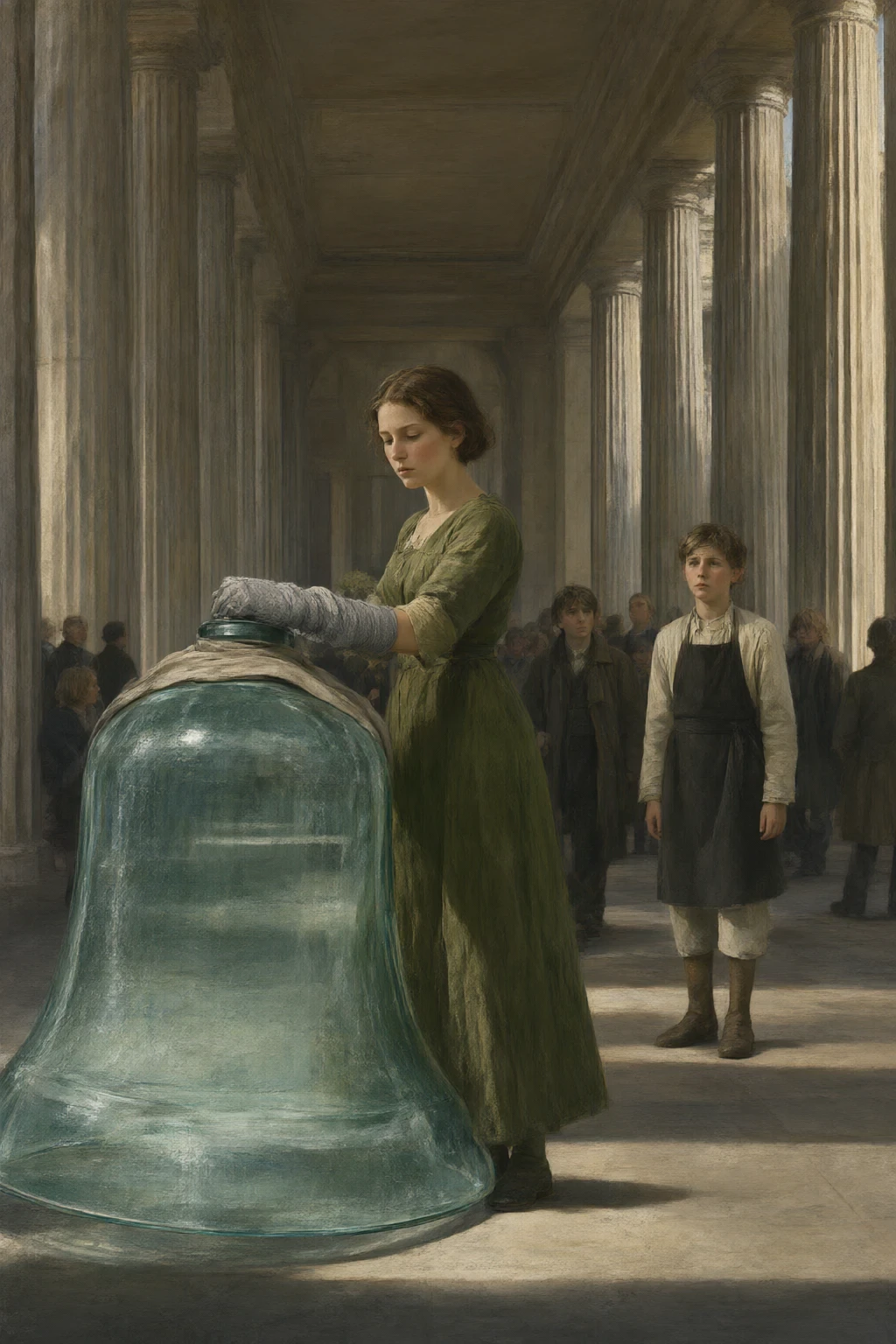
The colonnade was full before the first yoke was touched. People stood in the worn bowls in the paving where four hundred years of them had stood to be under a particular bell and had been careful where they put their feet. Nobody opened a shutter. Nobody had a jar or a basket. It was not a market day and it was not a funeral and there was no form of it that anyone in the valley had a name for, and the closest thing to it in nineteen years of the Chart House minutes was an audit. They took the ninth bay first, because the ninth is at the far end and everybody could not see it from the yard, and a thing that is being done a kilometre away has to be done first or the crowd will spend the day walking. Ione Sarrack gave the order and the terms. Six men on the purchase. Three on the brake. The line was tarred hemp and forty years old and it was the only line in the valley and it had been used for every bell ever hung. The yoke was wrought iron gone to orange bloom and it had not been off its pillars since the colonnade was built, and it is not in the record that it was ever designed to come off, and it came off. The bell came down slow as a plumb line. It came down into a sunbeam that was full of glass dust, and the dust went up round it and turned and turned in the light, so that for the length of four minutes there was nothing in the world but a pale green mass the size of a man moving in a column of sunlight with nine hundred people holding their breath, and then it was on the ground. It lay on its side, which it had not lain since the day it was made.
“An ash reader is the only person who may say what a bell is made of,” said Marget, “and I am not going to say what this bell is made of, because I did not put it in. I am going to read it. Hold the crown to the north light and turn it, and do not stop turning it, and do not let anybody stand in front of the light.” They held the crown up. Perrin Vole took the line with Marda Illis on the other side, and it was heavier than either of them expected and it went over sideways twice before they had it true. Bela Truce looked at it for a long time and then said: “Cloud.” “Hold it against the pillar. Look at the pillar through it.” They did that. The fluted limestone behind the bell was the colour of a wet roadstone where the sun was on it. Where the bell was between the eye and the stone, the stone had gone the colour of a pond. “That is one body,” said Marget. “It is as clear as the day it was made. That is the best glass in the colonnade and I could pick it out of a hundred.” They brought the eighth bay down. It was cloudy. They brought the seventh down. It was cloudy, but only in a band, low down, in a place where a hand could not get.
They worked down the row. In the whole of the colonnade, in the ninth hour of the twenty-eighth of Sleetmonth, in the fourteenth year of the turning wind, four bells were cloudy. Four out of sixty-one, in four hundred years. The first was blown in the year of the colonnade. The second in a bad summer. The third and the fourth in the same week of the same winter, eleven years back, in the ninth bay and the bay before it. The first could not be read. It was in the second bay, and it was cloudy from the foot to the shoulder, and it had been cloudy since the day it was hung, and the yard books for the year of the colonnade had burned in a fire in the third year of the building. Eleven bells out of sixty-one have no week and no day and no bank behind them, and are hanging in the colonnade this minute with ash in them out of a fire that nothing in Coldrow describes. “That is the limit of it,” said Marget Oskell. “The ash is the only thing that cannot be cross-examined, and it is also the only thing that cannot be asked a second question. It cannot improve and it cannot be extended, and eleven of these have nothing behind them at all.” “Write that in the finding,” said Ione.
“I will write it in the finding. I have been writing limits in findings for forty years and not one of them has ever been read.” Marget Oskell took the second volume of the seal ledger out of the satchel and put it on the low wall of the colonnade with the wind coming over it, and held the pages down with both hands, and read. “The ninth of Sleetmonth, eleventh year,” she said. “Two certified. Nesk Sarn, thirty-four. Tol Sarn, nine. Both taken from the fourth weir, and the day book says the first on the seventh and the second on the ninth, and the flue was down on the ninth and the bank was banked double and the sieves were rung, and I signed it and I saw the bodies and I saw the two seals.” “Read the crowns.” “The bell in the eighth bay is sealed Nesk Sarn. The bell in the ninth bay is sealed Tamsin Quill.”
There is no hearing in a colonnade. There is a roof and nine bays and a shaft of light with the dust in it, and whatever is said in there is said in the voice a person has out of doors in the cold, which is a voice that carries, and which nobody in Coldrow has ever been able to modulate. Tamsin Quill was standing in the third bowl of the paving, because it was the only place with a rim to stand on and her boots were wet through. She had come with the Ash Yard basket, as she came everywhere, and she had put it down when the bell came down, and she had not picked it up. The first thing that happened was that nobody said anything at all, which took a while. The second thing that happened was that Marget Oskell looked at the crown of the bell, lying on the ground, nine feet from where the girl was standing, and then at the girl, and then at the crown again, and said the sentence that had ended six years of re-reading a ledger in a small voice so that nobody in the courtyard would turn round. “Have you seen it twice.” “I have seen it every evening since I was five,” said Tamsin Quill.
Bela Truce brought the annealing rack out into the colonnade, which had never been done, because the rack is oak and black and it is four feet by twelve and it weighs more than a man and it is the only record the Crown Kiln has ever kept. Six men carried it down the Pillar Walk and set it down across the mouth of the ninth bay, and the wind went over the top of it and did not move it. She found the mark with her thumb and did not use the light. “Third from the mouth on the second rack,” she said. “Two strokes where every other season has one. I have shown you that mark for eleven years and you have all written it down and none of you ever asked what a doubled season is.” “A season is doubled when the yard burns twice in it,” said Marget. “A season is doubled when I make two pulls at the glory hole in one week,” said Bela, “which is the same thing said by a different person, and I want you to notice that it is the same thing said by a different person, and that in this valley that has been the whole of the trouble for four hundred years.”
The ash was in a larch box in the corner of the Ash Yard under the corrugated lid, with a card nailed to the lid in Marget's hand giving the season and the weight, and the weight was wrong. Marget weighed it twice on the balance in the corner, which is a stone on a beam and is older than the Chart House. Then she weighed a box from an ordinary year. Then she went along the row of boxes with the brass sieves and the shallow tin and did the thing she had done every working day for forty years, which was to take a measure, put it through, and see what the sieve kept. The flue ash went through the coarse and stopped at the second. The banked body ash stopped at the fourth. What stopped at the second and went through the fourth, grey and light and slightly greasy, was what a person leaves when a fire is too cold and a flue is down and the ash has been banked with the coal that heated it. “That box is two people,” she said. “And it is the ninth of Sleetmonth, eleven years ago, and the two are written on the card, and the card is in my hand, and the two are Nesk Sarn and Tol Sarn, and I read their faces and I did not read them twice, because I was in a hurry, and the hurry was my own and the flue was down.” She put the sieve down on the bench and squared it to the edge. “And the thimble is a habit,” she said. “Bela Truce put into those two bells as much ash as the habit allowed her to put in, and the habit did not know there were two of you, and the habit is not a measure, and that is the whole finding, and it has taken eleven years and one morning of hard sun to arrive at it, and I would like it minuted that it is a finding about a habit.”
The question of whose sentence it was took the rest of that day, and it was not settled, and the not settling of it was the finding. “You are asking me to weigh one document against another,” said Marget. “The ash is a document. The girl is a document. They are both evidence, and I am the reader, and a reader who says which document is heavier has stopped reading.” “It stands in the record as follows,” said Ansel. “The seal on the crown establishes whose mouth the glass was set to. The pitch was ground into the lip by the blower’s judgement, and the judgement is that person’s, and the person is dead and cannot be examined, and the Crown Kiln keeps no note of a judgement, because a judgement is not a number and the rack has no column for it.” He put the chalk down. “So the bell says Tol Sarn, and the bell sounds a sentence, and no instrument in this valley can say whose mouth made that sentence, and the only person who has heard it every day for eleven years has never once been asked.”
“Nobody can say whether the boy repeated her, or the girl spoke it to him, or the girl said it and he caught it and said it back, or whether a woman with a blowpipe in her hand heard the loudest sentence in that yard and set the lip to it out of her own head, which I have never seen her do and would not swear against.” “And could it be that the girl is right and the boy is wrong?” “No,” said Marget, “because the glass does not hold a sentence that nobody said in the valley, and the girl said it in the valley, and so the sentence is in the bell. The mouth is a different matter entirely, and there is no column for a mouth.” “Then what goes in the six inches.” Marget Oskell took her spectacles off the knotted cord and cleaned them on her apron, which did nothing for them. “The mouth goes in the six inches,” she said. “Not the sentence. The sentence is a sound, and the sound is out of all of us by now, every one. The mouth is a person, and a person can be written down.”
Somebody proposed MOUTH as the heading of the new column that evening, and nobody ruled it out for two hours, and then Marda Illis said that a column for a mouth would hold a name, and a name is what that wall already has five columns of, and that if there is ever to be a sixth column it had better be a column for a thing the wall has never once had. And Ansel Roke wrote that down and could not think what the thing was, and it came to him four days later, in a yard, on a bench, with his feet off the cold flags, when a girl gave him a sheet of paper that had been folded into eight for eleven years. Wenda Sarn came down from the far end of the valley on the morning of the twenty-ninth, in a cart, with her daughter-in-law's sister to hold the shafts, and she was sixty-one and she had been certified eleven years ago — not certified herself, that is the wrong way round; her son had been certified, and her grandson had been certified, and there was a bell with her son’s name on it that she had been listening to for eleven years, and a bell with a stranger's name on it that held, in its ground, some of her son, and no sentence of her grandson at all. They took the two bells up in the Chart House courtyard, on trestles, because the Crown Kiln takes only one gather at a time and the two had to be worked cold. Wenda Sarn would not go in to the bench alone. She brought her hand up to the side of the bell with the stranger's name and left it there for a while without saying anything.
“This is nine years old,” she said, to the glass rather than to anybody. “He was nine for about a day. There was ice on the inside of the window and he had a blister on his heel from a new boot and he would not take the boot off because it had been a present, and I have not said that to a person out loud in eleven years, and I am saying it to a bell.” Marget had the new seal blank on the bench, and the punch, and the punch was a hand punch and it needed a hammer and the hammer was on the bench, and it was the same punch that had cut the wrong name eleven years ago off a lead blank that had been rounded down from a sheet and used twice, which was the ordinary practice, and which nobody had thought to change in four hundred years. Cutting the seal was quick. It took the length of a minute and the making of one noise. A lead disc, a hand, a hammer, and Tol Sarn, punched crooked, because they are all punched crooked and this is not a defect and has never been a defect. Then Wenda Sarn had to be asked whether she wanted the crown opened.
The crown is opened only to re-pitch. To re-pitch is to grind the lip, and grinding the lip takes the sentence off the bell for ever and leaves a tone behind, and it is a legal act, dated, minuted, with the ash reader and two witnesses, and no bell in the colonnade has ever been re-pitched twice. They asked her in the Chart House, at the long table, with the rota on the wall behind them and six inches of blank wall to the right of it, and nobody advised her, because there is nobody in this valley whose business it is to advise a widow about her grandson's last sentence. “No,” she said. There was a silence in the room that had a different shape from the others. “No,” she said again, more slowly, in case she had been heard wrongly. “You open it, you grind it, and he has said nothing, in his own mouth, in the whole of his life, ever. And I have one of those and I will not have it ground off me for tidiness.”
They cut the seal on the morning of the thirtieth, the last morning before the turning wind, in the Chart House courtyard, on a bench under a slate awning, with the wind off the weirs going through the colonnade nine bays deep behind them, and the whole valley standing in the gravel in the hard low sun, and every one of them hearing it. Marget Oskell made the cut. It is the only signature in Coldrow that puts a person into glass and she had made one hundred and forty-one of them and had made one that was wrong, and she made the hundred and forty-second, and she did it without hurrying, and she did not ask Renn Quill to hold the anvil this time, because there are two witnesses and one of them must be a person who is not connected, and the other must be a person who is. Two witnesses: Marda Illis, and a boy of fourteen with a chapped red nose and one bare foot through a hole in a boot sole, who had been taken out of the colonnade at ten and put on the bench at ten and had not been told why, and who had asked, twice, and been given the answer, both times, that he would be told why at the end.
Tamsin Quill asked for one thing, and she asked for it late, in the voice she used, half a beat behind the end of what had been said, and Marget heard her and stopped. “A crown takes one name,” Tamsin said. “I know that. I have known that for eleven years. Put Tol Sarn on it. And put me somewhere.” “There is nowhere,” said Marget. “That is the entire architecture.” “Then put me in the new one. The six inches.” She nodded at the east wall, where the light from the north window lay across the limewash and found the chalk line. “Nobody knows what goes in it. You have all argued about it for a week and you are not going to agree, so write down the one thing about me that nobody can get any other way, and it is not that I am alive, because you can get that from the yard. It is that I am alive, and it has cost me two hundred and eleven times, and there is not one other person in this valley who could tell you what that is worth, because they have all been losing them quietly and separately and out of earshot of each other.”
She gave them the sheet. It was brown at the edges and soft along the folds and it had been folded into eight for eleven years, and Ansel Roke took it and did not read it standing up, which for him was a kind of showing off, and read it sitting down with his spectacles on. Nobody spoke for a while. The wind went through the bays behind them. Perrin Vole was the only person in the yard who was not looking at the sheet, because he had gone the colour of the frost and was looking at Tamsin Quill with his mouth open. “Two hundred and eleven,” said Marda, from the far end, in the voice of a woman measuring ice. “Since I was five,” said Tamsin. “One a week, near enough. Some weeks none. Some weeks I could have had four and I only wrote one down because I did not want to seem to be the kind of person who —” She stopped. “That is not true. I wrote one because one was survivable and four was not a list.” “That is a very good line and I am not going to use it in a minute,” said Marget.
The ash reader's finding was entered in the seal ledger in Marget Oskell's own hand, on a new page, because the ledger is a book of findings and this was a finding, and she wrote it the way she wrote everything, in a small upright hand with a nib that had been resharpened so many times it had a flat on the left of the point. It said: that the bell in the ninth bay was blown in the ninth week of the fourteenth year of the turning wind, from the bank of the ninth of Sleetmonth of the eleventh year, that that bank held the ash of two certified dead, Nesk Sarn and Tol Sarn, that the crown of that bell was cut with the name Tamsin Quill, that the said name was cut in error upon a blank used twice, that the said Tamsin Quill is alive and was at the making of the error and has been in the valley throughout, and that this finding is made not on the testimony of any person but on the ash, which does not answer and cannot be improved upon. And underneath it, at the foot of the page, in a different ink, because it was a different act and a different day and it would not be true otherwise: I have seen the child. I have seen her twice. She is not dead. M.O. “Take it to him,” said Marget. “He will copy it, because he cannot refuse a certificate, and then it will be in the Register in his hand and the Register will be the Register again, which is what we want, and it will be a line in it that he did not write, and that has never happened, and I would like to be in the room when he finds out that it feels like that.”
The week of the test was the loudest week the valley had had in four hundred years, and it was loud in the way the colonnade is loud, which is to say that nothing in it was meant for anybody. By the Thursday there was a queue at the Chart House door in the morning, and they were not all of them there about the Register. Old women stood at the bar of the north window and said that they could no longer whistle, and that they had not been able to whistle since the frost, and that they were telling somebody because there had never before been anybody to tell. Perrin took their names on the slate, and the names were no use to anybody, and he wrote them down anyway, because he was fourteen and he had been given a slate. No institution took the queue seriously. That is what happened that week, and it is the only part of it that was never minuted: the Chart House considered the queue an interruption, the Ash Yard considered it a nuisance, and the Crown Kiln considered it nothing at all, and so the queue became the only thing in the valley that was entirely true, and it is still true, and by the end of the year it had a rail nailed to the Chart House wall for it.
The thirty-first of Sleetmonth was the turning wind, and the Chart House courtyard held nine hundred people at ten in the morning for the reading of the wind, which is done by a boy-tuner in the middle of the yard with a slate in his hand, and the yard goes quiet for exactly as long as it takes him to finish, and then it makes the noise of a market again and everybody pretends they were not just listening for the note. Perrin Vole read it out. “North-west, off the weirs, backing two points before noon. Nine bays in order. One note out of the run, ninth bay, as of the eighth of the month, and the bell in the ninth bay was raised on the twenty-eighth and has not been hung again, and I am to say that the note was not in the wind on the twenty-eighth at the ninth hour, and that when the bell was in the wind it was in the wind, and that when the bell was not, it was not.” The yard was very quiet. “Nine bays in order,” Perrin said, and put the slate down. And the wind went through the colonnade from the near end to the far the way it does once a year, and the chord went up the valley like water going down a stair, and in the middle of it the ninth bay was empty, and the note was not there.
On the first Thursday of Thawmonth, a year later, when the frost had come and gone and come again and the market day filled the yard with capped and shawled people carrying jars, the first Thursday after the first hard frost, the Register of the Living was read out in the Chart House courtyard in nineteen sections by a boy of fifteen, and in the eighth section, between a woman named Fisk and a man named Garrow, there was a name that had not been in that place for eleven years, and it was in the schoolmaster's hand because schoolmasters copy what ash readers write, and schoolmasters do not put their own opinions in a Register. It said: Quill, Tamsin, of Coldrow, aged seventeen. Not certified. Sight the person. And to the right of the last column, six inches wide, with the heading that had been argued over for a year and had at last been written by the Head Tuner on the first cold morning because it was the only word anybody could not rule out — COUNT. Under COUNT, in the first cell, in a hand that got smaller as it went because the writer had been copying for four hours and was cold: a number, and then the list, which was folded into eight and came to two hundred and eleven lines and then did not stop coming, and which by the end of the market day had four hundred and six names on it, and by the end of the following year had a page-rail nailed to the wall of the Chart House for it, and which is not, to this day, a document anybody has been able to reduce to a number. Ione Sarrack wrote under it, in chalk, before she went in: the heading may be argued again in the spring. Write it where it stands.