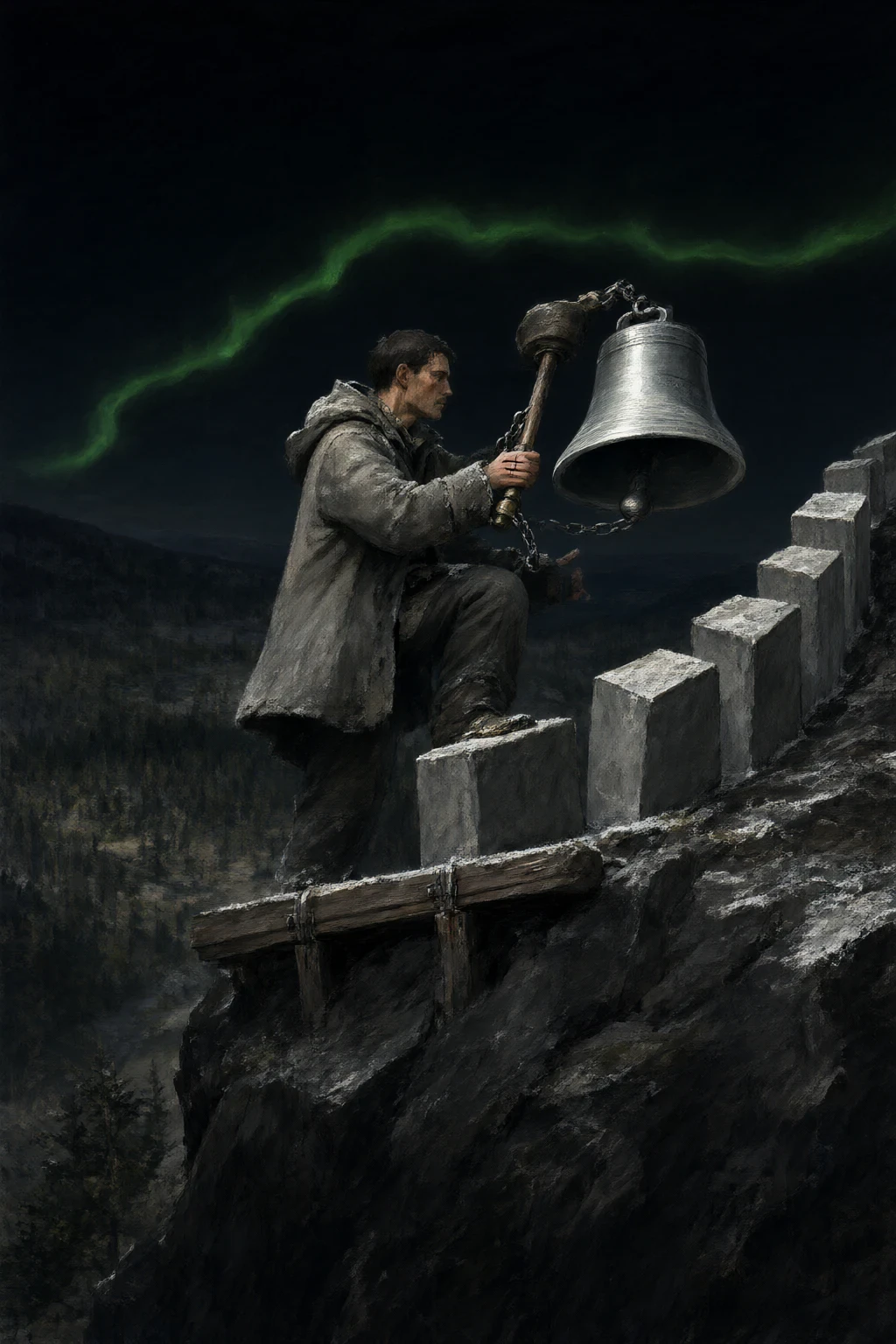
The ninth chime wanted a quarter turn. The ear wanted a half. Sef Anhalt stood on the gantry with his cheek against cold brass and both hands on the collar and did not move, because the collar said one thing and the mountain said another, and in eleven years he had never once made those two agree by arguing. The wind came over the wall from the west with a whistle in it that never dropped. Frost lay on all of it in a fine white ash, and the ash was in the crease of his scar, and the old burn in his hand stung the way a fresh one does. The fourth segment held the three great chimes, silver-strung, and above them the five small ones rung for the changes. The ninth of the small ones was in his hands, a quarter turn out, and he had been at it most of an hour.
Through the gap under his boots he could see the ring laid out below: the black slab, the heartwood drum on its cradle, the black mouth of the bass pipe with its ladder going down into the warm shaft. Maran on the horn-line, her left hand white to the second knuckle, a mitten with the thumb cut off so the fingers could work. Ysolde at the third chime with her eyes shut. The apprentice on the drum stool, waiting her count. “Chime-keeper,” he called. “Come up and tell me what you hear.” He called everyone by their instrument. It was easier than the other thing. She came up the ladder one-handed and stood with her head tipped. The whistle in her chest went out and came back in and went out again while she listened to a note she was hearing without making it. “That one is true,” she said. “By the ear.” “By the ear,” she allowed, “which is not the same as by the mountain, and the mountain is the one paying.”
“Every note in this ring is a half tone sharp,” Sef said. “Horns, chimes, bass. The whole Held is sitting a half tone above where the Founding Hours have it.” “A half tone,” Ysolde said, “being the smallest step there is. Close enough that the ear slides across it. Far enough that the ear slides and then stops.” “The drum is not sharp. The drum has been under us by a half tone for as long as it has been here.” “The drum cannot be tuned, being cut from the heart of a tree that grew before there was weather, and a heart does not take an instruction.” She looked down at it: six feet of black wood, hide pegged over, gone brown and wet in the middle. “It is the oldest thing on this mountain, and the only honest instrument in this ring.” “Then we bring the ring down onto it.”
“The Held does not stop. There is no rest in a chord, and the wall does not want one.” “The chimes are struck, not held, and they carry the pitch. Damp the three, put the collars a half tone down, strike them again inside the window, and the Held comes down onto the drum in one movement, and nothing is ever silent.” “Ninety seconds,” Sef said. “The bass valve is counterweighted off the shaft wind. It was set by the last person down. It gives ninety, and then the wind in there takes the note and the Low drops out from under us.” “On a ladder, in the wind, at night, on the outside of the wall.” “The gantry is on the wind side. Damp the chimes in here and the hole is in the middle of the room. Out there it is a hole in the sky, and the sky is thinner than the stone.” She was quiet a while.
“The ninth clause,” she said at last, in the voice she used for the written things. “A player who lies to the ring is heard by the ring, and the ring makes no distinction between a lie and a wrong note. You may correct the ring, striker. You may not correct it and blame yourself, nor correct it and keep it quiet. Those are the same lie with two different mouths on it.” “Then you know you will have to put it in the book true.”
To hear the Founding Hours you had to hold a note long enough to get cold enough to listen. Sef took it from Maran, who gave it up without a word. He blew and held, and it went on being a note, and then a note under the note, and then six hundred years. Nights laid end to end, each a wall of sound with a person standing in it, every one of them a half tone sharp. He heard the wrongness go by like a fence in a cart for a long time. And then he was cold enough to hear what was under it: another note, a half tone below the drum, older than everything on the rock, with no players in it at all. He came off the brass with his mouth full of cold. “Say it out loud,” Ysolde said.
“The Held and the Underheld. The one we hold, and the one underneath that holds us. And for six hundred years we have held a note a half tone above the Held, so the two never touch.” “They never touch because if the Held comes down onto the Underheld, the weight of six hundred years comes down onto it at once.” “Yes. And the Underheld is what the wall is made of.” She looked up through the gap at the curtain, one unbroken line along the ridge from the west end of the sky to the east. “So the wall is holding the Held,” she said, going steadily on without stopping, “and the Held is a lie, and the lie is six hundred years old. It is not a tuning error, striker. It is a wall of sound with a falsehood built into the outside of it, put there by somebody who did not wish to lay the true chord on the mountain’s own note.”
Wend Cassock came out of the ninth segment with the roll under her arm, narrating it under her breath as she came, quiet, in the third person, because that is how she wrote things down. “Read out the pitch column. Every year. Six hundred years.” She opened it and put her knee on the pages. “It is the same mark. All six hundred of them. The same mark, copied, every year, by a different hand.” “Nine places where the mark is different. Under each, a line in a different hand that says THE NIGHT CAME IN.” Her finger stayed on the page. “The ninth is dated three winters ago, and it is in the striker’s hand.” “It is in mine,” Sef said. “I was thirty-one. I found the old man dead on the fourth step of the bass ladder with the collar a quarter turn loose, and I put it right, and Horn-line thanked me for it.”
“Nine times in six hundred years,” said the apprentice. She had the notebook out and was not writing, only looking at the page with the numbers in her head, which was a thing she did. “Once every — what is the number for that.” “Seventy-one years,” Wend said. “Give or take the first, which never ended.” “So the ring has been right nine times, and every time the night came in, we put the lie back.” “The record never asks why,” Ysolde said. “That is the ninth clause in its second mouth. Six hundred years of a true record, faithfully kept, and not one line asking what was coming in.”
They did it at the change of the second watch, when the green was at its lowest and the wind had settled into the long flat note it holds all night. Maran went to the horns and worked the Low and the Middle and the High down onto the second valve and the third and back, testing each twice, saying numbers under her breath. “I’ll take the middle,” she said. “The middle is fine.” Ysolde set the third chime a half tone down with her hand flat on the silver. Pell took the drum and could not take the drum down a half tone, because the drum does not take instructions, and understood that she was the one thing on the mountain that would not move. “Valve is set,” Sef called down. “I have ninety seconds from the counterweight. Damp, drop, strike. First, second, third. Maran, I want the fingering changed with the strike.” “After it is wrong. With it. The High stays.” He went up through the gap in the fourth segment and out onto the wind side.
Out there was the gantry: a timber frame bolted to the outer face of the wall at the height of a three-storey house, plank floor, outboard rail, a chain along it for the hand that could not hold. The wind came up the face of the mountain and over the top and did not slow down, and below him there was nothing under his boots but nine metres of air and three thousand feet more of it. He had the padded mallet in his right hand. Lambskin on a two-foot ash haft, made by a man in Sillvane who had died the year Sef came up. The scar in the web of his hand was white and hard and took the mallet well enough, which was the only hand of his that did. He put his left arm through the chain and set the mallet on the first great chime.
The chord came up under him, eight parts of it, a half tone sharp and six hundred years old, and he damped the first chime, and the chime went out of it like a lamp being pinched. Twelve seconds. The second. Twenty. The ash got into his eyes and he could not blink it clear, because blinking meant letting go. Forty seconds gone. The third chime was the thick one, its wire the width of his little finger. He put the mallet flat on the clapper and leaned into the wind, and the wire fought him, and the sky over the west segment came apart. Not thinned. Came apart. There was an edge to it, a straight one, running along the top of the range, and beyond the edge no green at all. Not the black of a night with no aurora in it. The other thing. The unending. Sixty-eight seconds.
Out of the black, from under the drum, from under the mountain, came a note. It came up through the ladder and the sole of his boot and into the bones of his leg. A half tone below the drum. No player in it. So much older than everything on the rock that he could not tell whether it was a sound or the place where one used to be. “Seventy-eight,” Maran’s voice came up the wall, flat. “Horn-line, all three, changing. Changing. The High stays.” Eighty-four. He dropped the third collar a finger’s width, drew the striker back, and let go. The mallet went out of his hand in the wind. He caught it against his chest with his left forearm, took the haft in both hands, and struck, and the chord came down a half tone onto the drum, and the two notes that had been arguing for six hundred years were the same note, and the argument stopped. Ninety.
The counterweight reached the end of the shaft. The wind in there took the Low and dropped it out from under the world, and Maran got her mouth on it a beat later and blew, and the wall came up green out of the black. Thinner than it had been an hour ago, and unbroken. Sef came down off the gantry and stood in the ninth segment with his back to the wall and shook the ash out of his hair. Eighty-nine, he thought. It is done, and I am alive, and I have ninety seconds of thinking left for the rest of my life.
The valley had it for two hours. Wend sent a runner down the Gallows Stair at a dead run, and he came back at the grey hour with a list. The green line had come down off the west segment and laid itself along the floor of the valley, and where it lay the frost stopped forming. Eleven houses lost their peat. The bell in the Sillvane tower rang once by itself. Fourteen people were out in it and all fourteen came back, and the market clerk said the man who went in at the ninth hour came out at the seventh, nine years older, and would not speak about it. And when the line lifted, the night did not go back to where it had been.
It is the ninth clause in its third mouth. The chord keeps the shape of the break. A break of ninety seconds in the smallest part of the ring, the part that was not being played at all, came back as two hours in the whole of the valley’s night, and the mountain kept it. Every night since, the dark comes up the valley two hours early, and for those two hours the sky has no curtain in it whatever, and Sillvane sits in the plain black singing the words of the Standing Chord. For those two hours the wall holds itself up by itself. Sef sat on the stone step with his back against the roll box and looked at the two true notes in his head, one on top of the other, a half tone apart, and neither of them possible.
“You have ninety seconds of thinking left,” Ysolde said from the gap. “After that you are a player with a decision in his hands, which is the most dangerous kind of player that has ever stood on this ring.” “I caused the two hours.” “You lifted the mask. There is a difference and it is not in your favour.” “Then what is it.” “It is that the Underheld was always sounding. Six hundred years of it, under everything, and nobody heard it because the Held was a half tone above it and the weight of six hundred years was sitting on top. The mountain has been holding itself up with a note nobody was playing, and now it has found a payer.”
Wend stood over him with the roll open on her knee. “The record is going to say what happened tonight. Not what it means. The ninety seconds. The chimes damped in order. The re-strike a half tone lower. The west segment opened on the wind side. The two hours. The eleven houses. The bell. The fourteen. And the striker’s name against it, because that is the shape of a fault.” “Put it in.” “The collector would also like to write what she believes the two hours will do, and that is a different line, and the collector has been careful to keep the two apart.”
“Wend.” He looked up at her. “Tonight it is all the same line. I do not know which parts of it I am answerable for. Write the whole of it, in my name and yours under mine. It is true that I did it. It is also true that it was me or the lie, and I would rather have that in a book than the half of it that lets me sleep.” She wrote for a while with the wind on the page, then read it back to herself in a whisper, in the third person. The small-bell sat down on the step beside him with her notebook out. “Two true notes,” Pell said. “I can put them in columns.” “They don’t add up.” “No. They never will. A half tone doesn’t add to anything. It just is.” She wrote the two marks side by side and ruled a line between them, and then stopped with the pencil down. “What is the number for the two hours, Sef?”
“Two hours. Every night. It starts at the ninth and it ends at the eleventh and I am the one who is in it.” “That isn’t a number. That is a sentence.” “It is both, small-bell. Put down whatever you think it is and I will not argue with a column.” She thought about it. Then she wrote a single dash where the number should have been, and closed the book on it.
The stair was at the north gap. Two hundred and forty worn steps down into the dark, and the top four were the four he could see from where he sat. There is a thing that happens to a man on the ninth of the ninth night with the mask off his face. The wall is not up. For two hours there is nothing between the Shoulder and the plain black with no curtain in it, and the stair is there, and it goes all the way down to the valley floor. Sef Anhalt got up and stood on the top step. The stone was worn into a shallow bowl in the middle, the way they all were, the way two hundred and forty years of somebody coming up had made them. He had heard from Sillvane that you could stand in the bowl and not slide, and now he had a pair of cold feet in the bowl and could confirm it.
Below him, three thousand feet down, the peat smoke stood straight up out of the chimneys because the air had stopped moving, and people sang the Standing Chord indoors with the doors shut, and the bell was quiet. He stood there an hour and ten minutes. Then he came in, and went to the ninth segment, and set the mallet against the stone, and he took the Underheld: a half tone below the drum, a half tone below the Held, the loudest thing on the mountain, and no one in Sillvane or on the ring could hear a note of it. It is the coldest work there is, and it is not a chord. It has no rests in it and no other player in it, and every hour comes out of the man holding it, and he gets colder and greyer and thinner, and the ring does not count it as a part, because the ninth part is not played. The ninth part is held.
He held it until the Held came up under him at the eleventh hour and the eight parts found their places on top of it, and then he did not stop, because there is no rest in a chord, and he has a two-hour debt on the calendar every night of his life. Behind him, out over the range, the curtain stood where it had always stood, one unbroken green line from the west end of the sky to the east. Sef listened for the other one, and after a while he heard it: a second edge, lower and colder and very much quieter, running parallel to the first the whole length of the sky, and not broken anywhere at all.