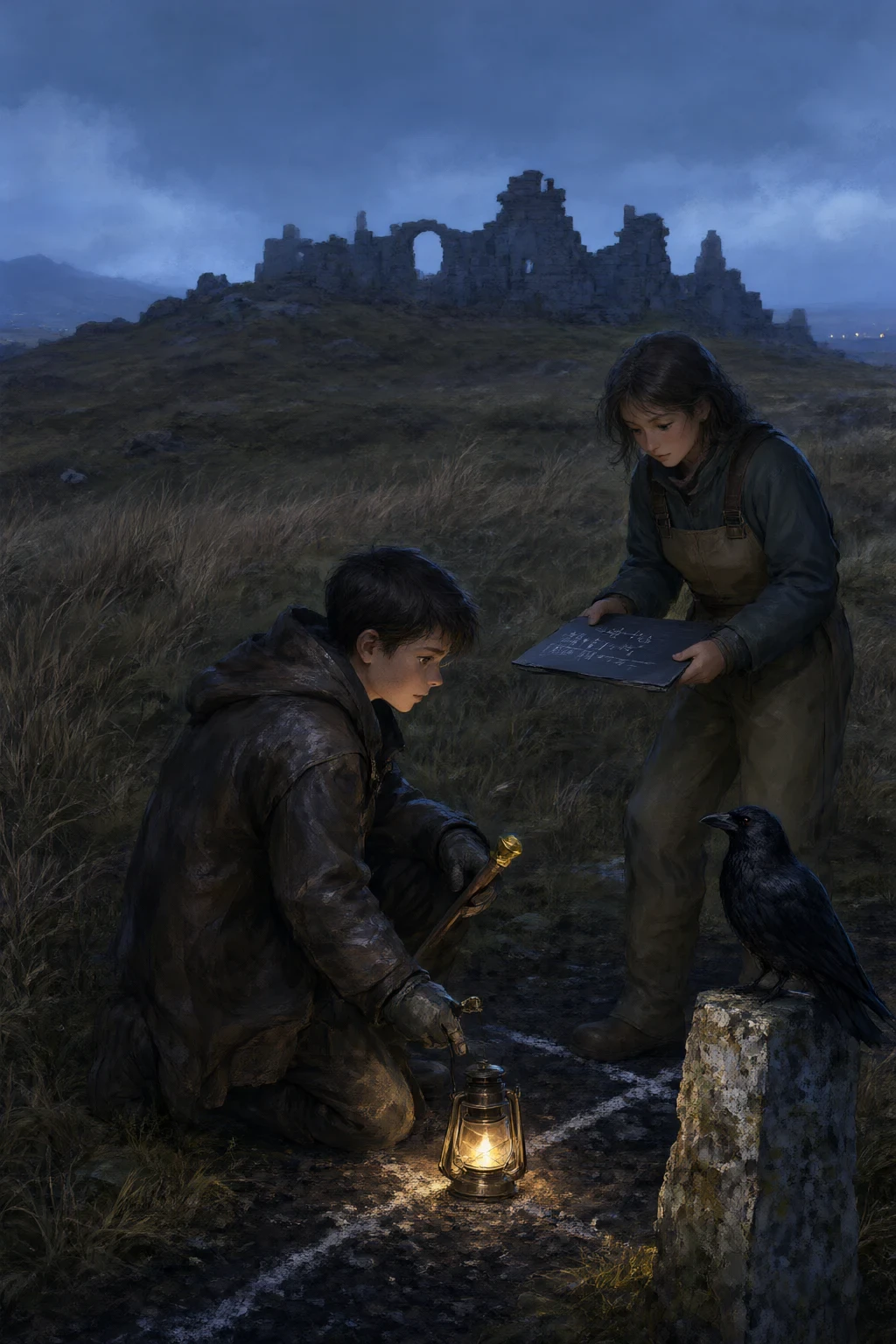
The boy from the Barren Ring came in on the Thursday market with four miles of mud on his boots and a sheet of birch bark under his arm, and he stood at the notice-slate until somebody spoke to him. Oren Vall found him. He was fourteen, and thin, and he had a way of holding his chin up that Oren recognised from the inside because he had done it himself, at fourteen, on a horse. “Warder,” the boy said. “I have brought a line for the Ring.” “You have brought a complaint, and it is nailed up in public, and I have to argue with it in public, and I would have walked out and met you at the top of the hill.” “My reeve said you would say that.” “What is your reeve’s name?” “Bess Corr. She said if you asked, she is not your reeve, she is the arithmetic.”
The complaint was four strips of birch bark, sewn at the corners with a thread of chopped reed, and the writing on it was charcoal on the pale side, pressed hard, by somebody who had been taught to write late and taught it properly anyway. Nettlefold read it out at the Cross that evening with a lamp held to each strip in turn, and Oren stood where the orders were usually nailed and let it be read to him.
The complaint of the Ring, to Nettlefold, in the matter of the bracken. First. That the light which stands upon the border of Nettlefold is the same light which keeps the Wood back from the ground of the Ring, and that the Ring has been dark for four hundred years, and has been dark on purpose, and has had no voice in the matter at all. Second. That the Ring asks for its bracken back, and does not ask for it because the bracken is good, which it is not, being fit only for pigs, but because bracken is what a poor hill can be, and a hill with nothing on it is a hill that men leave. Third. That the Ring will accept lamps, on four conditions. That a line shall be read for the Ring at the reading, and the Ring’s answer after it.
That the sap be paid into one pot, out of which every lamp is fed, and that the Ring shall pay its share in bracken cut and burnt, which is worth nothing, and in labour on the peat, which is worth something, and that the village shall enter the worth of both in the tally at the Cross. That the number of lamps on the Ring shall be set by the Ring and the village together, and not by one of them alone. And that the mark-stones on the Ring shall never be moved inward by the village alone. Fourth. That the Ring has voted, and that the vote was close, and that the losing side has asked that it be recorded that they voted against.
Somebody at the back of the crowd said “well” in the voice people use when they have not yet decided what they think. Oren Vall stood at the standing stone with his staff in his left hand and let the lamp go round the ring twice. On the top rail of the notice-slate, above his head, in the one place in Nettlefold where a bird can sit and be looked at by two hundred people, a hooded crow with the top third of his left beak gone had been sitting since the boy came round the corner. “Count it,” said Sixpence. “That is a strange thing for a bird to say to a crowd,” somebody observed. “He says it to everybody,” said Oren Vall. “He has never once said it to me in a sense I could defend.”
And then he said the thing he had known he would have to say as soon as he had read the fourth strip. “It is a good complaint,” he said. “I have been the Warden eleven years and I have never received one I could have signed.” Nine people laughed, and two of them were not laughing.
The arithmetic took him eleven days, and he did it in the Scriptorium because the Scriptorium had one north window and a table and no fire, and he wanted to be cold while he did it. A lamp burns a gill an hour. A winter night is eleven hours from the lamps-on call to the lamps-off call, and there is no version of a Nettlefold winter in which that is shorter. A spoon of sap is a season’s allowance for one lamp, and the Cindermill renders it into the tallow with a resin, and the oil is bought in winter and rendered in spring. The Row has forty-one lamps. He wrote that down, because it was the kind of number you had to write down. The Ring has eleven marks on it and none of them has ever carried a lamp, because no lamp has ever stood on the Ring, and the terms now on the Cross would require four of them to.
Four lamps is four gills an hour for eleven hours, which is forty-four gills a night, which is a hundred and thirty-two gills a week, which is a little under two gallons before anybody has counted the wick or the losses or the oil that goes into the sump. Two gallons a night. Over a winter of one hundred and sixty nights, three hundred and twenty gallons, fed by a spoon a lamp a season, and there are four lamps and no more, because the terms say four. The sum was not the problem. Oren wrote out the whole of it and it came to the same number every time, and the number was small, and the number was about two per cent of what the village burned, and the number was comfortably inside the pot. What was not inside the pot was the fourth condition.
He read the fourth condition eleven times that week and could not get round it, and on the ninth night he sent for Nessa Brack, because she was the only person in the village who was both honest and awake at the same hour. “Nine paces,” she said. “It moved nine paces in one night and the lamps were lit all the way.” “They were lit to a proper flame.”
“They were lit to a proper flame for half the night, and to a proper flame for the rest, and at midnight the wick-watchers came round and found a good lamp and went away again, and one good lamp with nine wick-watchers behind it is not the same as a good lamp being watched.” She put the slate down on the Scriptorium table. “Oren, I am going to say a thing and you are going to be annoyed. Dimming a lamp is not a smaller version of keeping it. A dim lamp is a lamp that is asking somebody to look at it twice. Nobody looks at anything twice.” “That is a very good point and it is not going in the document.” “It ought to go in the document.”
“It cannot go in the document,” said Oren Vall, “because the document says the village shall not take the light down, and the village is not taking the light down. The village is being economical, and there is a difference, and the difference is about eleven paces a fortnight and I have to live inside it.” He walked her to the stair and stood listening to the knee, and then he said, to the stair rather than to her, “Miss Brack, whose shifts did you take last week?” The silence on the stair lasted about as long as his pauses did. “Mine,” said Nessa Brack. “So it goes.”
He went out to the Ring on the Tuesday, alone, on the grounds that a Warden with a retinue is a Warden making a speech, and Oren Vall had never in his life made a speech and did not intend to start at sixty-two. The Ring is two miles east across the flat, and then uphill. The flat is where the trees can root, and the light ends on the flat, and the Ring starts where the light stops: a bare hill of chalk and gorse with the ruined walls of an older village standing in the middle of it like a jaw with the teeth gone. The walls are Oren’s great-grandmother’s walls, or his great-grandmother married into them, and the newer roofs are inside the shell, and the smoke comes out of the shell, and from a distance it looks like a fire in a ruin.
The border between the lit gravel and the unlit hill is not a fence. It is where gravel becomes bracken, and the two grounds meet in a line you can see from a hundred yards if you know what you are looking at, and everyone in Nettlefold knows what they are looking at, in the way you know where your own front door is in the dark. Bess Corr was waiting at the top with a slate of chalk figures under her arm and a boy beside her holding a lamp. “Warder,” she said. “You are late by a day, and I have written that down.”
They stood on the hill in the wet with the lamp between them and did the whole thing in under an hour, which neither of them had expected. Bess Corr was fifty-eight and had been the Ring’s arithmetic since her mother died, which is a job here in the sense that a bailiff is a job. She had a way of putting a number down and then waiting, which Oren recognised as a technique he used himself and did not enjoy seeing used on him. “The bracken,” she said, “is four hundred years of nobody asking. There are thirty-one of us. Nine are under sixteen. In a bad year the peat goes under at the Mere and the eel goes down and the bracken is what is left. You want to know why we voted for the bracken.” “Yes.” “We did not vote for the bracken,” said Bess Corr. “We voted against the dark. The bracken is what we wrote down because a complaint about the dark sounds like ingratitude.”
Oren laid out the counter on the flat of his hand, because he had learned in the last eleven days that if you spread paper out in front of this woman she would go through it in order. “Nettlefold will dim and will not extinguish. That is the whole of the counter-offer, and it is everything I have, and I have thought about it for eleven days.” “By dim how much.” “Half the flame, which is about two-thirds of the oil, which is about a third of the spoons, because a dim wick smokes and a smoking wick eats.” He turned his hand over. “The light comes back to the gravel edge. It does not come back to the Cross. And I will not put a lamp on the Ring this year, and I will tell you why, and it is not politics, and you may check it.”
He told her about the stone. He told her the way he told everybody, which was quickly, because it is easier to get through a thing quickly. A stone on the north side of that hill with a woman under it, and a promise made on a deathbed, and no lamp on it and none within a mile of it. He did not tell her the woman’s name. It was not hers to carry into a negotiation. Bess Corr listened with her hands flat on the slate. “Then you have a promise on that hill,” she said, “and I have a vote on that hill, and only one of us is a person with a mouth.” “No,” said Oren Vall. “Neither of us is. That is the entire difficulty with hills.”
Here is what the two of them agreed in the wet on the hill, and it took nine more days to write down, and it was read at the Cross on the twenty-second, and it is a real document and not a summary of one. The village shall dim and shall not extinguish, and shall pull the line of light back to the edge of the gravel, and shall set four lamps on the Ring at the end of the season named, and shall set none this year. The number of lamps on the Ring shall be set by the Ring and the village together. The Ring shall pay into the one pot in bracken cut and burnt, which is worth nothing, and in labour on the peat, which is worth something, and the village shall enter the worth of both in the tally at the Cross, in a column of its own, with a heading. The mark-stones on the Ring shall never be moved inward by the village alone. Nor by the Ring alone. They move by both, or not at all. And the light shall not be a thing the village gives and takes back.
The border moved an inch on the first Samstag after that, and Nessa Brack measured it and it moved more than an inch. She was fourteen and in her third season and she had two fingers of her left hand stained permanently green-black with sap that she did not hide, and she carried a chalk in a fold of oilskin and she measured everything twice, because the Warden had asked her to, and because she was that kind of person. The ninth mark had stood at one hundred and four paces from the seventh house for as long as anybody could remember. On the Samstag it was at ninety-eight. “That is six,” she told him. “Yes.” “It is not an inch.” “It is not.” “Warder, if it is six paces on the first night of dimming, then in a month of dimming it is not six paces. It is a road.”
Oren Vall had known that. He had known it the way you know the shape of a thing in the dark in a room you have lived in for sixty years. It went like this. It is not a thing anybody in Nettlefold had to be told, because it is what a light is: where the light stops, the Wood does not stop so much as forget where it was supposed to stop, and it comes in by however far the dark was. The bracken showed it first. Nessa chalked the mark-stones and the bracken inside them went black in a band, a foot, two feet, a yard, the ash dying from the root up in a hard straight edge you could put your hand along. Fourteen days after the dimming the band was nine feet wide along the whole eastern front. Nessa told a child it was frost. The child’s mother knew better and said nothing, which is what people here do about a border.
By the fourth week the ninth mark was at eighty-one paces and the bracken was coming back into the gravel where the gravel had been bare for a generation, and there was a smell off it like a green coal, and Nettlefold had four hundred people watching their own village get a little bigger every Saturday and being careful not to say so in the same breath as the oil. The charcoal seller came to the Cross on the third Thursday with his cart, as he came every Thursday with his cart, and the cart was four feet further east than it had been in the autumn, and everybody in the square could see it, and nobody said anything for about ninety seconds. Then Tace Aldren said it. “He is east of the line.” “He is,” said Oren Vall. “Then move him.”
“No, Miss Aldren.” The Warden put his staff down in the gravel and looked at the cart, and the man sitting on it, who had a permanently black thumb and had never once been a villain. “I cannot move him. The line is where the light is, and I have just moved the light, and if I move him I have moved a man out of a place he has traded in for eleven years on my word and nobody else’s. He is east of the line because the line went west. That is my doing and not his, and the honest thing is for me to stand here and be shouted at about it.”
“Then stand here and be shouted at,” said Tace, “and let me tell you what else is going to happen. In a month the wood will be close enough that a man with a barrow does not need to cut anything to burn it. He will not be stealing. He will be gathering. And when he does it, the village will be the one that did it, because the village moved the line, and I would like somebody in this square to write that down now while it is still true.” Nobody wrote it down. It was said again at the Cross the following Thursday, twice, and on the Thursday after that it stopped being said, which Oren Vall took, in the end, as the most serious thing that happened to him that winter.
Merrin Vale asked him for permission on the ninth, in front of the woman who was her mother, which is the worst possible place to ask for anything. “Warden, I want to go and see the line.” “No,” said her mother. “Is that allowed?” said Merrin, to Oren Vall, who was the only person in the square who had ever answered her honestly. “No,” said Oren Vall. “It is not allowed, and the reason is that it is dark out there and you are nine and I am responsible for the light and not for the manners.” She thought about it for as long as a nine-year-old can think about anything, which was about a second and a half. “When is it allowed?” “When the four lamps are up and lit and somebody who knows the ground is standing on the other side of it, and not before,” said the Warden, “and I will take you myself and you may complain about the pace.”
Before the reading, Elder Sable Ashdown came down off the stand and stood in the aisle with her hands in her sleeve, and asked the Warden for four minutes, and got them, because nobody in Nettlefold has ever asked that woman for four minutes and been refused. “I have tidied the Ring’s answer,” she said. “You have what.” “Nine words came in from the Ring and I have made them seven.” She said it without any expression at all, in the sing-song she read in. “The two I took out were a word about debt. There is a debt in that sentence, written by a woman who has not read the pact, and I thought, and this is the exact thought, I thought that it would be better for them if the first thing that was read for them in four hundred years was not also the first thing that was said against them. So I took the word out.” Oren Vall looked at the floor for a while.
“Eldress, have you ever had that word read at you?” “No.” “Then you have made an edit on a document you are the only living hand that can read, on the morning of the first reading, and you have told me about it four minutes beforehand, which is more than the last one got.” He took up his staff. “Put it back. I will read the nine words as they came, and the Ring will hear its own sentence in a room that has never heard it, and if a word about debt is in it then the debt is in it and it can be answered in the proper way instead of being quietly improved.” “And if nobody answers it?” “Then it stands unanswered in a document that gets read aloud every Samstag night for four hundred years,” said the Warden, “which is a very loud place to leave a thing, and I would rather it were loud.”
The Ring’s line was read for the first time on a Samstag in the twelfth week, and Elder Sable Ashdown read it, and then she stopped, and then she read it again slower, which is what she does. The room did not go quiet. The room went something else, which was worse, and which is difficult to describe: about two hundred people in a cold room all turning to look at about forty other people who had walked in from two miles east that afternoon and were standing at the back in their outdoor coats, and not one of whom was on any roll in Nettlefold, and every one of whom had a vote in the thing that was being read. The Ring’s answer was read after it. It was nine words long and it said that the Ring would hold its end, and the Warden read it, and the crowd made a noise that nobody could afterwards agree about.
The last thing that happened in that winter was not in the document. Oren Vall went out to the Ring on a Thursday night in the first hard frost with a lamp that was not his and a tinderbox, and walked the four lamps that the terms required to be named before they were set, because the terms said named, and nobody had yet established in writing how a lamp got named, and it seemed to him that this was the kind of thing that got decided by whoever happened to be standing there. He did not take the lamp to his sister’s stone. He took it to the mark nearest the stone, two hundred and six paces away, and he measured it twice, and wrote the number on the back of his hand in chalk, and rubbed it out, and did it again the following Thursday, and the Thursday after, because a thing you have promised to do ought to be done the same way twice.
Two hundred and six paces. One thousand and thirty yards, near enough. A mile and a bit. It was a little over a mile. He stood at the mark in the dark with the lamp in his hand and worked out, standing up, in the cold, with a Warden’s arithmetic, that a mile was the distance at which a lamp stops being a thing that can be promised about, and that he had been relying on a number for forty years that he had never once walked. Then he went home, and he did not tell anybody, and at the end of the season the four lamps went up on the Ring at the marks he had named, and the nearest of them was two hundred and six paces from a grey stone with no lamp on it, and there was a lamp two hundred and eight paces the other way.
On the first clear night in the twelfth week, a girl who had wanted to see a line walked the whole way up to the edge with a Warden, and stood on the gravel with the light on her face and her red knitted cap pulled down over her ears. “There,” said Oren Vall. “That is where it stops.” “Stops what?” “The light.” He nodded down the slope into the dark, where the wood stood up out of the ground and moved, forty feet of it, on slow root-fists, far below and much further away than it looked. “And the other thing it stops is the remembering. Past there, the Wood does not know where the border is supposed to be, and it comes in by however far the dark was. So we keep it lit.” “And if we stop lighting it?”
“It comes in here,” he said. “It comes in to the step you are standing on, in about nine years, and it does not hurry, and that is the part I would ask you to remember.” Merrin Vale looked at the dark for a long time. “Warden, does the Ring know that?” “The Ring has known it for four hundred years,” said Oren Vall. “It is the only thing about the dark that anybody out there has ever been able to agree on.” He turned to go, and she said, “Is that allowed?”, meaning the walk down, and he said, “Aye,” which from him was a considerable speech, and they went down the chalk in the light of one lamp held low between them, and the line of gravel and bracken went back up the hill behind them, visible for a long way, and then not.