The half was at seven, and for the forty minutes before it the building was the inside of a sealed jar. The mantles were shut and the house sat in the dark at the colour of weak tea, four hundred and twelve backs of coats, and out front on Ardle Street the rain was coming off the pavement in the particular Verrow way, not falling so much as being unable to stop having fallen. Bram Sillet stood in the green room with his coat still on and his hands pushed into the sleeves, because taking it off in front of the mirror was a thing he had stopped being able to do. He looked at a man of forty-one with a tan that had never washed off since he was twenty-two, and two small strips of flesh-coloured tape over the cheekbones where the paint of the Younger Brother had been worn through and re-laid so often that the skin underneath had given up and agreed to be painted. Under the tape the face did the thing. It had begun four years ago and it was not a matter of expression any more. It arrived before he did, and waited, and he stepped into it the way a man steps into a coat cut for him by somebody who knows him too well.
“Eleven minutes,” Corvin Ashby said from the doorway, holding the call sheet away from his coat so the wet ink would not take a thumbprint. “Third lamp amber. Fifth green. You enter on nineteen, not eighteen, and he will be late, and he means to be late.” “He takes the tray to the left of the door,” Bram said. “He takes it at the wrong moment and the Widow sees him take it. Cue forty-one. Nine seconds.” “Nine seconds,” Bram agreed. That was how they talked. Nobody in that room had ever said to him that he was the best actor in the building, and nobody was going to start, because it would not make any difference to a single clause. Hester Vaile came in with the Younger Brother’s coat over her arm and put it down hard enough to make the kettle jump in its cradle. She had a steel thimble riveted to her right thumb and a tape measure round her neck gone soft and grey. She did not look at Bram. She never looked at a garment while it was on a person; it was bad practice.
“Two inches at the shoulder and one at the underarm, and I have taken them out and put them back in twice this week,” she said, to the table. “That is serge, not wool, and serge does not forgive you the way you are standing. It is a coat that was cut for a man with a chest.” “It was cut for the Position,” Bram said. “It was cut for a man with a chest,” Hester said, “and there is no such thing as a chest that size, and the theatre may hang the difference on whoever it likes. Button your own hook, not the third. The third is mine now and it is only there because I do not trust the seam.” Down the plank corridor, through the swing door, in the total dark behind the heavy drape, there were eight hooks and two metres of bare board and a hot pipe running underneath, and on the board sat eight people in their coats in numbered order, watching one twenty-metre crack of lit stage. It was the most uncomfortable place in the theatre and the only place in it where nobody was performing.
Nell Tarrant was on the eighth hook. She was seventeen, and she had the Position of the Correspondent, four words in the second act, and had never once been given them. Round her right wrist was a length of bright red thread knotted with a single knot, which is what every member of the corps wore who had decided not to go on; there was one knot and never two, because two meant you had changed your mind.
The first act went the way it had gone nineteen hundred and eleven times, which is to say that it went, and that four hundred and twelve people breathed in the rhythm a house breathes in when it has been given what it paid for. In the fourth scene the Younger Brother crosses the workshop and puts his hand on a door frame to steady himself, because he has come in out of the rain and the frame is there. Bram does it. It is not in the text. There is no rain in the fourth scene, and no door frame within eleven feet of the Younger Brother. The carpenter put a workbench there in the first season; the Younger Brother has leaned on that corner of it once a night for nine years. Bram had invented the rain in the winter of his thirty-seventh year. He knew the exact date, because the prompt book had it in Corvin’s hand on a leaf at the back, where changed calls were kept with the reason written opposite. The reason opposite was four words. Not in the text. He had written them himself, in pencil, in the margin, and then gone out into the fourth scene and done it.
He had done it because the Younger Brother had nothing to do in the fourth scene. The text gives the older brother four hundred and eleven words there, and the Younger Brother nine, none of which require a body. So a body must do something, and if it does only what the text asks, then a man stands in the middle of a stage being looked at, which is not a performance. It is an absence with a coat on. So he invented the rain. Because the rain required a reason, he invented the year of it. Because the year required a winter, he invented the winter, and the winter arrived in the autumn of the following season, in the wrong order, at nine years old, above a chandler’s shop on Nyle Street where the tar came up through the floorboards in the hot weather. He invented his sister. He called her Ada. He gave her a cough, and the habit of reading aloud from a play’s programme because the family could not afford the play, and a candle stub that she saved, and which page the programme was folded to when she stopped: the fold between the third act and the cast list, which is where his own thumb finds it in every programme he has ever handled.
In the second year of inventing he invented the way he held a door. The Younger Brother had nothing else to be asked for, so he held every door in the play four seconds before he went through it, and by the third season of it he was holding them for Ada, in the loft, for a play performed eleven hundred miles away to an audience that had never heard of him. That is what a Position does. Not to the people in it. To the people holding it. At the interval he sat on the second hook with his back to the brick and his heels off the hot pipe, and Nell put her head round the edge of the drape. “You are doing the bench thing.” “There is no bench thing.” “You go round the corner of the pipe. Three times, every interval. And then you put your hand on it. Last night you did it four times.” “Four is not a number I keep.” “Four is a number I keep,” Nell said. “Because I sit at the end of it.” The gas came up in a long hush, a hundred and forty jets finding their burn together, and the wet smell of four hundred and twelve coats came forward over the footlights like weather. In the circle somebody turned a programme over, and eleven hundred other people did the same at once.
“It is in the book,” Bram said. Corvin did not answer. He was in the dark left of the stage, in the prompter’s box, where the whole left side of the auditorium went away from him in a single step, and he was feeling for the page of the thin black notebook with his thumb, the way he always did. “It is in the book,” Bram said again, “and it is in your book differently, and I need you to tell me which one of us is wrong. I am asking as a formality. I have already decided what the answer is and I would like to be wrong.” “That is a filthy thing to say to a man at a quarter to nine.” “Twenty-two minutes to the curtain.” “The book is the book and my book is the text,” Corvin said. “Two different objects. They have never once agreed in my life and I have never needed them to.” They went up. Not the whole corps. Bram and Corvin, and Nell because Nell was already standing, and Amos Derwent because Amos was fifteen. The Subscription Office door was never locked, because the only thing in the office worth taking is paper, and paper without the book is not worth fourpence to carry to a solicitor.
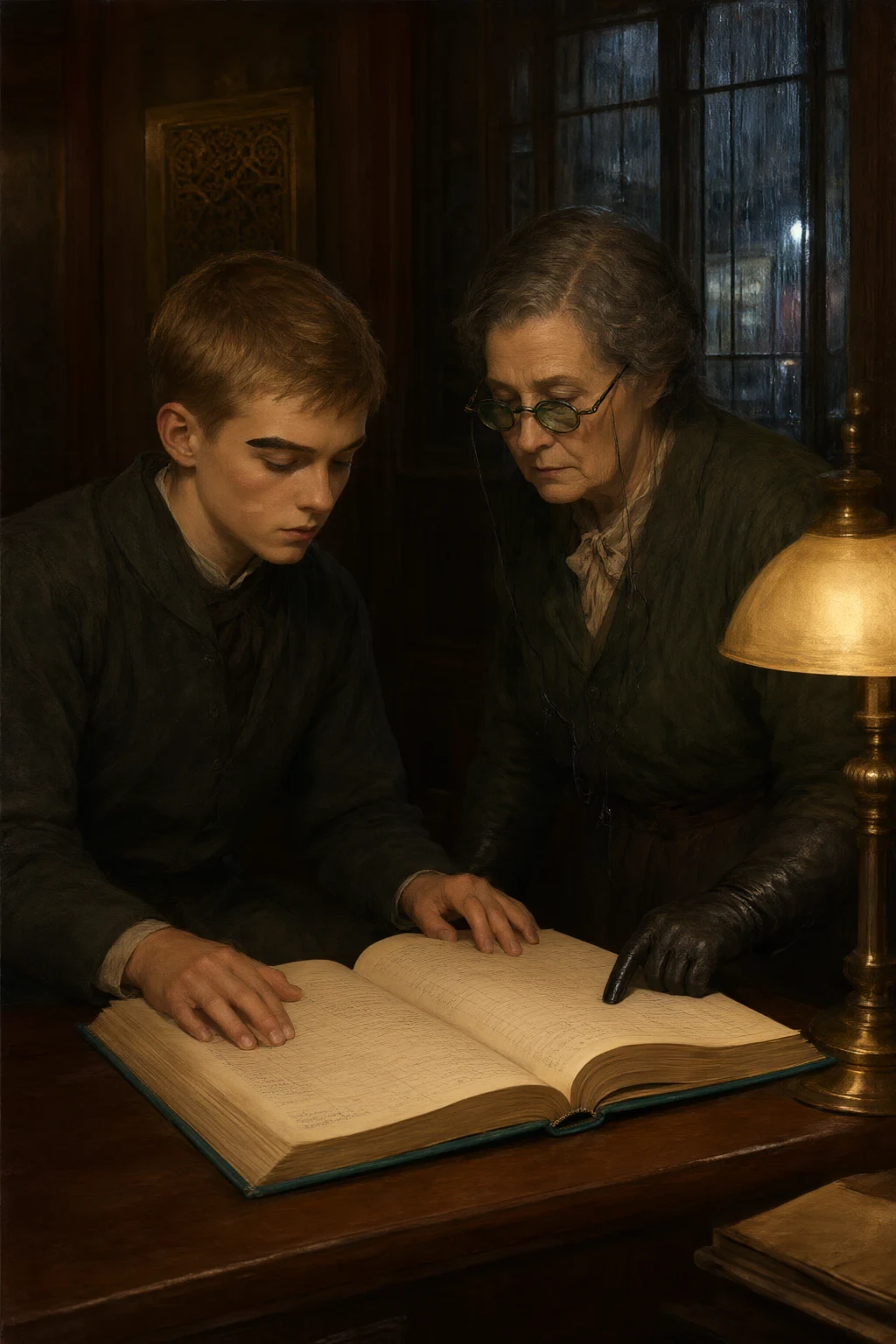
The room was cold in the way a room is cold when nobody has lit the fireplace since somebody’s grandmother. A barred window, a brass grille, a deal desk. The Season Book lay open on it, quarter-bound in teal cloth with a gilt edge gone green at the corners, opened to the same page it was opened to every day of the year. “Sorry,” said Ilse Karrow, to the chair she had just come round. “Sorry. Chair is mine.” She was fifty-two and had never once sat in the house. She had a green lorgnette on a black cord that she never once looked through, and her right hand in a black kid-leather glove whose index finger had gone shiny with the pen. She had come up to make the Friday entries, which she made every week at this hour, in advance, because she liked a page done in advance. The book was open at the season’s page: four hundred and twelve columns of names in eleven different hands, all of them paid, all of them the book’s people, none of them ours. And at the foot of the page, in a smaller hand, the roll. Bram had seen the roll a hundred times. Eight numbers in a column, a wage beside each, the numbers were the hooks, the names were never there and had not been there in living memory.
“Seventeen thirty-one,” said Corvin, to nobody, the way he said everything. It was the roll, and it was Bram’s wage, and the season was young. Then nobody went to the roll, which was the thing that happened next, and it happened in a way that made four adults in a cold room stand very still for a moment and then pretend for the rest of their lives that they had not. The roll was the eighth column. It went all the way down the page and on to the next, because the roll was not on the page at all; the page was only where the roll stopped. It went back a hundred and forty seasons.
They were there for the rest of the interval. Corvin held the book flat on the desk with both hands and Amos got up on one knee to see over the top of it. The roll began, in the first season they had, as names. A hundred and forty seasons of names in a clerk’s hand, with the Position beside each: the Father, the Younger Brother, the Widow, the Captain, the Doctor, the Correspondent, the Woman at the Door, the Clerk of the Court. Eight Positions and eight names a season, and the Fridays. And then, in a season somebody had entered as the year of the hard winter, a name thinned. And in the next season it was gone, and the number was in its place, and the wage was the same, and nothing else on the page had changed at all. The numbers ran to the present. One to eight, in order, for a hundred and thirty-odd years, with the wages and the Fridays, and not one with a name on it anywhere in the volume. Nell found the last of the names in a hand that was not any of the eleven and read it out: “Ivo Sarn, the Younger Brother, and he was the best of us and he is dead of the lungs in his own bed in Fenner Cut, and I would not want the like again.”
“He is a real one,” Nell said. “Ivo Sarn. He is a person.” “He was,” said Corvin, with his thumb in the book and not turning the page. “Eleven seconds, Bram. Two minutes. The second act.” “Then he is the last one and I am the next, and there is a hundred and thirty years between the two of us, and not one of them has a name.” “No. That is the arrangement. It is not a secret. Nobody has ever hidden it. The book does not need to hide it, because the book is not lying. The book says what is true, and what is true is that the roll is a roll.” The entry for the current season sat at the bottom of the column. Four. The number four was Bram’s, and beside it the Position, in the same small hand that had entered it: the Younger Brother. And under the Position, in the same small hand, in the same ink, and in the same flat administrative register that Ilse Karrow used for a seat number or a shilling, there were notes. Bram could not read them standing up. He put both hands on the desk.
The first was a line about the paint. The second was about the coat, and it gave measurements, and the measurements were Hester’s. The third said that the Younger Brother enters on the fourth scene by way of the bench at the left, which is not where the text puts him and has not been for nine years, and which is a thing Bram had asked Corvin for in a corridor, in eleven words. The fourth line was: walks as though the left foot is not trusted, in all scenes, no exceptions, and shall be held to it. The fifth line was: the Younger Brother opens every door, and waits on the far side of it, and does not speak across the threshold. He read it twice. Then a third time, because the second reading is where you find that the thing is not going to change. “That is not a description of a part,” he said. “That is a description of me.” “It is a description of the Position,” said Ilse Karrow. She was not being clever, and he understood that while she was saying it. She had never sat in the house, and did not know that the person on the stage was not the person in the gilt letters. She had read this exactly as she read the seat numbers and the Fridays, because the book is the only version there has ever been.
“That is the Younger Brother,” she said. “It is the fullest description we hold, and it is why it is in the book in that detail and not in three lines. You do not enter a person in a roll and leave out what they must do, Mr Sillet. Somebody would be misled.” Somebody would be misled. In a hundred and forty seasons, in a theatre of four hundred and twelve seats, standing in her own office with the gas burning blue-white outside the barred window, the manager of subscriptions had arrived at a scandal by the shortest road available to a careful woman. “Is it in the text?” Bram said. “The text is the acting version. The text is what a body says with its mouth. There are two documents and only one of them is a contract, and I could not tell you which half of a sentence of the acting version is in the contract without the manager upstairs, and the manager upstairs does not read the acting version.” “Then get it,” said Corvin Ashby from the dark of the doorway. “Thirty-one seconds, Bram. Get the manager, by the throat if you must. It is a two-page document in a tin on the stage manager’s shelf and I have read it nine hundred times.” “The acting version is not mine to give,” said Ilse Karrow, “and I would not give it if it were. That is not modesty. That is the one sentence I know by heart, and it is this: the book is the play’s memory and the play does not remember. I would not know where to begin.”
He went on because the Position had to be finished by the curtain, and because a Position not completed before the curtain falls is unpaid and the strike is the whole season’s wage taken out of the book on the Friday, and because eight wages were in that column and seven of them were not his, and because a scene with a Widow and no brother is not a scene. He went on, and he did the text. That was the decision, made in the wings, on the left, in the dark, eleven seconds before his cue. He decided to be faithful. Not to be good, not to be moved, not to be the best actor in the building, which he was, and which had never once been worth anything. In the fourth scene he came in and did not put his hand on the frame. He crossed nine paces of bare boards and had nothing to do with any of them and did it anyway, and the house made no noise at all, which is what a house does when it is looking for something. And the second act came, and the Younger Brother came to the door, and took it, and went through it sideways, and did not wait on the far side.
It was not a decision. That is what he could not get past, when he tried to lay the whole thing out in front of himself like a man laying bricks. He had made no decision. The Position finished the scene without him. He heard it. That is what nobody in the book has a column for. He was standing in the wings with his weight on the good leg, and he heard his own lines come out of the dark on the left of the stage, in Corvin Ashby’s voice, flat, forty seconds ahead of where he would have been, in a rehearsal-note register, third person. “He takes the tray to the left of the door, and he is late, and he means to be late.” It was not an impression. It was Corvin, in the prompter’s box, giving the lines of a Figure whose body had gone missing, which is the one thing a prompter is for, and which he had done before, for a man who dropped a cue, and had hated, and had never spoken of. Bram listened to the Younger Brother he had made for himself go through a door on the other side of the stage, and hold it, and wait on the far side in silence, and go.
Four seconds. Nobody in the house knew. Nobody in the house had known for nineteen years and nobody was going to know tonight, and the four seconds had been his, all of them, and they had gone on without him like a tide going out from under a boat. Then the stage finished the scene and went on into the next, and it did not want him, and he was not in it.
He woke on the understudy bench with his coat across his chest and the pipe hot against his shins and eight people in numbered order in the dark, and a piece of paper folded under his head that Nell had made into a pillow for him and had not mentioned, and which he put in his pocket and never did mention either. “Seventy-one seconds,” Nell said. “You were off for seventy-one seconds. The Widow did the whole thing with nobody. I watched it from here. It was wonderful, and it was about somebody else.” “Was it?” “It was not you. Your boots were in it.” Corvin came along the back of the bench and crouched in front of him, and in the dark of the wings you could not see the bruise under his eye, which was the only reason he had ever let anybody crouch in front of him. “There are forty lines in that book,” Corvin said, “marked supplied. I have never told anybody how many, and I have never told anybody that I know what I did with them. I am telling you now because you will not sleep otherwise and I am tired.” “You wrote them.”
“I did not write them this year. I wrote them at some point in the last nine years, at an hour when nobody was watching, and I put them in because the scene could not go on without them, and the theatre has been saying my sentences out loud to four hundred and twelve people for nine years and nobody has ever checked them.” He turned the notebook over. He did not open it. “Put yours in,” he said. “It will be the only one of the forty-one that is true. And in ninety years somebody will find us both and not know which of us was making it up.” Bram thought about it. It was the first clear thing he had thought for four years. “A loft,” he said. “Above a chandler’s shop on Nyle Street. The year the barges stopped. Nine years old, and eleven, and then twelve. The tar comes up through the boards in the hot weather and the kindling is cut too green to light until eleven o’clock, and my sister saves the candle and reads the programme out loud because we have never been able to afford the play, and when she stops she is always at the same fold, and it is the fold between the third act and the cast list.” “The cast list,” said Corvin. “The cast list.” “Write it down yourself.”
“That is the one thing in the world I have not got the use of,” Bram said. “I have no name. I have got a number and a roll and a column of wages and a Friday. If it is in your hand then it is yours, and if it is in my hand then it is in a book, and I would rather it was in yours.” So Corvin Ashby wrote it, in the dark, on the knee of his own coat, in a small neat hand, and neither of them said anything else about it, and the pencil went back and forth for a long time, and what he wrote down was not invented. That is the part that put the cold into Bram Sillet for the rest of the night and into every year he had left. He knew the fold. He knew the hour. He knew that the kindling was cut green, and the exact bitter cold of a loft in February, and he knew the smell. Tar, split kindling, wet wool, and under all of it the sour green smell of a river that had frozen and was only pretending.
He had never in his life smelled anything at all. He had been born in a room off Ardle Street, his mother had died in it, he had gone into the corps at nineteen, and he had not been outdoors in daylight for nineteen years, and the river, on which all of Verrow was agreed, he had taken to be a rumour. He had not invented that winter. There was nowhere in the world for him to have got it from. It was too particular. It had a smell in it, and smells are not written down, and the book does not deal in smells. Somebody had lived it. Somebody who stood on this bench in a numbered place, in a coat, for a season a hundred and thirty years ago or a hundred and ten or sixty, and had put it in, and had been let go, and had died without a name in a street with a cut through it. Ivo Sarn had been the last one with a name, and he left no note either. Nobody leaves a note. The book is not lying.
The last scene played to a house that had no idea. Four hundred and twelve people had seen a faithful performance of a play by a woman called Adela Marchmont, first performed at this house in the year of the long frost, and had liked it, and had come out into Ardle Street at ten past ten into a rain that had not stopped since the afternoon. Nell was still on the board when he stood up. “They are going on,” Bram said. “They always go on.” “Not me.” She was at the drape with the red thread on her wrist catching the twenty metres of amber coming through the crack. “I have got the Correspondent and I have four words, and I have said them twice already, to the drape, and the drape is a very good drape, and I am not going on. Not on Friday. Not on any Friday. Not to the bit where somebody in the stalls has paid money for the Younger Brother and I have not got a name and he has not got a name either, and it is the same for both of us.”
Bram did not answer that. He put his palm flat on the pipe to see whether it was hot, the way he had done it every night for four years, and it was hot, and then he moved his feet, once, in the dark, to find out which one he had been favouring since the winter he had made up. The right one. It came back the same as it had come back every time for four years, and it did not hurt. He stood still on the second hook of the bench and worked it out slowly, the way a man works out a sum he has known all his life and has never once written down. The pain had not been in the leg since the twenty-second minute of the second act. Everything he had invented had been keeping the pain in a place that was no longer there, and the Position had taken the limp and the door out of him the moment it stopped needing a body to hold them, and had gone to the end of the scene without him, correctly, and exactly as written. So there was no arithmetic in which that came out right.
He had done it once, on a Tuesday, in a cold room, four years ago, out of a silence nobody else had noticed, and the silence had gone into the book, and a book does not give a thing back. That was the whole of the arithmetic. There was no night on which he had begun to owe. Nell was at the drape, and behind her were eight hooks and eight people on a two-metre board in their coats who had not gone on, and under the floorboards a boy with one burnt black eyebrow was putting the lamps out in an order that had a name for every colour in it. Bram Sillet sat down on the second hook, and put his hands between his knees, and stayed, because there was nowhere to go to, and because a term cannot be given back to the person who wrote it.