The founding page was not in the book. Hesper Vail found that out on a Thursday, in the warm room, with a candle in a brass holder and her hair up off her neck in the damp. She was seventeen and she was the under-reader, and the under-reader reads the cancelled pages aloud as a check, and on the fourth Thursday of the month she also reads the founding entry, because the founding entry is read once a year by whoever is under-reading and because it is the only page in the Ledger of Columns that anybody reads out loud as well as down. The founding entry is page one. It is not a column page, though it is ruled like one, and it is the first leaf in the book and the only leaf that is counted among the four hundred and eleven without belonging to a column. It has six lines in the witness column. It has seven. “There are seven,” Hesper said. “Hesper has counted seven.”
Lida Trask did not look up from the schedule. “There are six.” “There are seven lines. The sixth one has a name in it. The seventh one is ruled and it is empty and it is ruled a slightly different hand, because the ruling is closer together on that one, and the rule on the seventh line stops a finger short of the gutter on the right and the rule on the other six does not.” She said it in the third person because she was about to do something with her finger and the rule of the third person is that you announce it first. “Hesper is going to touch the seventh line.” She touched it. It was the same paper and the same sizing and the same ink in the ruling as the others, four hundred years old, and it was empty, and the bottom of it had been left longer than the others because the pen had been set down mid-stroke by somebody who had run out of reasons. “It is not a mistake,” Lida Trask said. “It is a ruled line. Somebody ruled it and nobody filled it. That happens.” “No,” said Hesper. “You do not rule a line and then not fill it. You do not rule it a tighter hand, either. You rule one line in a hurry when you already know what the line is going to say, and then somebody comes and looks at the book.”
The succession list is at the back of the book, after the count, in a hand that belongs to nobody living. It runs down the inside of the back board in a single narrow column and gives, for every office in the cathedral, the names of the holders in order, with the years. At the top of the list, in a hand older than the rest, six names. Those six are the founding six. They are the names on the founding page, the page that is not a column’s page, and it is not in this book, and it is not loose in the box with the schedules where the Reader keeps what the book has no place for.
“It has not been in the box in my time,” Lida Trask said. “And my predecessor kept the box for twenty-nine years, and her predecessor kept it for eleven, and the list of Readers is on the wall and goes back to the founding, and no Reader in ninety years has seen the founding page. We have the six names because my predecessor copied them off the page in her first month, which is the only entry in the succession list that is not a succession.” “Then where is it.” “The box,” Lida said. “The box, the tin, the envelope with my key in it, the carbon under the twelfth-month schedule, and the page, which is not there.” Hesper looked at the box. The box was small and it was on the lectern and the tally on the lid was scratched, and she had been in the box twice in her life, both times for envelopes. “Then nobody can enter her,” she said.
“There is no page for her,” Lida said, in her speaking voice, patiently, as a woman reading a figure off a wall. “The book is four hundred and eleven pages and there are no more. A woman is not a column. I have been Reader nine years and I have wanted to strike out a page and add one in its place, and there is no such form, and the only thing anybody has ever done about it is rule a line and leave it.” Garrick Bole heard about it at the second set, with the book not in the room and the ink still on his thumb from the morning. He listened to the whole of it twice and then he said the only thing anybody could say, and he said it in the voice he used for figures.
“No,” he said. “No, and no, and I will not do it, and I would like it minuted if there is anything to minute it on. Per the count, the book is four hundred and eleven pages. Per the entry, a column is paid for when its note is in this book, in ink, by hand, with a date. There is no page for her, so I have nothing to write on, and if I write on the page of another column I am not entering a woman, I am putting a woman inside a spire column, which is a lie with a ruled line down the middle of it. I will not merge two entries belonging to one person. That is the whole of my trade.” “You have a leaf,” said Nissa Ashkel.
Garrick did not answer for a while. Down in the Wellmouth the water was doing the thing it did at the fourth hour, drawing in toward the middle, and the tap was slow, and it had been slow for nine days, and it was not in any book that it was slow. “I have a leaf,” he said at last. “The leaf is not a page. The leaf is damp and it is un-numbered and it is ruled with two lines because I ruled them, and it is the only page-shaped thing in this building that has never had a number on it, and I have put two things on it already that I could not put anywhere else.” “Put a third.” “That is not the same as agreeing with you,” said Garrick. “It is the same as having a third line.”
The hundred and forty ladder rungs go up a shaft cut in the rock and the cage is always late, and Hesper went up on a Friday because Friday is market day in Verrick and the bakery is open and the wind comes off the Rim across nine hundred square miles of white pan and makes the sound of a room being swept. Verrick is forty-one houses at the wellhead and it smells of the bakery from four hundred yards out. There is a windmill. There is a chapel that is not the cathedral. There is a pub called the Unwitnessed with a genuinely bad sign, and a market day is not a market, it is a trade in labour: the block tally, the shift rota, the water allocation, and the argument about the cage, which was late.
The wellhead is a square of coping stone with an iron windlass over it, and the shaft goes down from it, and the water comes up the shaft from four hundred feet below into a stone crock that the village divides in the morning by a man with a dip-rod and a chalk. The rota board is nailed to the windmill leg. It is the laundry rota, in chalk, in a hand that is not the Reader’s hand. Every house in Verrick has a day. It is the oldest board in the village and it is repainted every spring and nobody has ever thrown a page out of the bakery’s washing book in four hundred years, which is how Verrick owns more history than the cathedral does. Hesper had a day and a reason and the reason was a nail.
There is a flat stone at the head of the shaft, between the school and the chapel that is not the cathedral, and it has no inscription on it, and on its north face, cut shallow and not finished, there is a V with the second stroke stopped halfway. Hesper had seen it every day of her life. Her family had never once mentioned it. The washing book is kept in the bakery because the bakery is where the water is carried, and the water is carried because a house cannot wash on another house’s day. The founding week is on the second leaf of the seventh book. The hand is small and very even and it does not change for forty entries and then it changes. “Vail, week of the founding,” Hesper said, reading down the column. “Vail, Vail, Vail, and then —” The line had been scored through with a single stroke, and beside the stroke, in a second and later hand, somebody had written: “no wash — one at the wellhead.” The score went down the whole week. Seven days, all of them struck, and the same four words. “Not the family,” Hesper said. “One.”
“One person, at the wellhead, for the whole week. The other six houses washed. The Vails did not wash, because whoever the Vail was, they were at the wellhead, and the wellhead is where the shaft is.” She put her finger on the second hand. “And this is later, and later than the first, and whoever wrote it did not know what they were writing down, because nobody had told them there was anything to write down. They were writing down a laundry.”
Her grandmother’s album was on the shelf above the kneading board, where it had always been, and it had a name on the spine that was not a name but a date, and inside it there were forty pasted things: a lock of hair, a rubbing of a brass rule, a cutting of a chalk tallied wall, four name-cards in four hands, and one folded slip of writing paper folded so many times along the same crease that it had gone soft as cloth. The rubbing was of a V with the second stroke stopped halfway. The name-cards were the same name, written one under another down the leaf. Hesper Vail. Hesper Vail. Hesper Vail. Hesper Vail. Four of them, in four hands, in the order the hands got older, and the fourth was her grandmother’s, and the ink on the fourth was a woman who had been told to write it and had written it well. The slip, unfolded, said:
“She sang the water out of the rock. The water went down six inches and did not come back up for a year, and we did not know what to do with a year in which the well was low, so we did not tell anybody about the year. The six entered themselves. Nobody entered her, because there was nothing to enter her in, and because nobody thought to stand beside her and say that it was happening. The note she sang is the note you get if you are humming anything at all and you change the word you are humming to salt. It is hers. It has not been hers since. Hesper, for the girl who sang it, until there is a page for her.”
“Nobody told me,” Hesper said. “Nobody told me either,” said Garrick Bole. He had come up on the cage, which was late, and he was standing in the bakery doorway with the wind coming in behind him off the pan, and he had his working book under his arm. “I have been in this book for eleven years. I have read the founding entry forty times. I did not see seven lines because I was reading six names.” “Nobody told me because of the last line.” “Yes,” said Garrick. “The last line is why. It is not secrecy. Nobody in your family has ever known how to break that sentence, and the sentence is doing exactly what it was built to do, which is hold a debt in the shape of a name until there is a page to enter it on. And I am not going to stand in a bakery and tell a woman her name is a debt, because you already know. You counted the lines.”
The founding note is the first thing every singer in the cathedral is taught, and it is taught in one sentence, and the sentence is: hold this, it is the note the building was made on, and do not ask who sang it. Sula Iven taught it to Hesper in the stalls with the rail against her back, and it took four attempts to get her to hold it, and when she had it, Hesper said the only thing she had ever wanted to say in that room. “It doesn’t have a column.”
“It has never had a column,” Sula said. “It is not a column’s note. It is older than the columns. It is the note the brine was sung out of the rock with, before there was anything here to hold a note, and there was no page for it because it was not about a page, it was about the water, and water is not a column and has never been a column and is not on any page in this book, and that is the whole of why it is dangerous, and you knew that before you asked.” “What answers it, then.” “Anything,” said Sula. “That is what answers it. The building will take it. The water will take it. Whatever is nearest will take it, because that is what salt does with a pattern, and water does it too, and water is the loudest thing down here. The only reason this cathedral is not a lump is that six people are holding six orders apart from each other every hour of the day.”
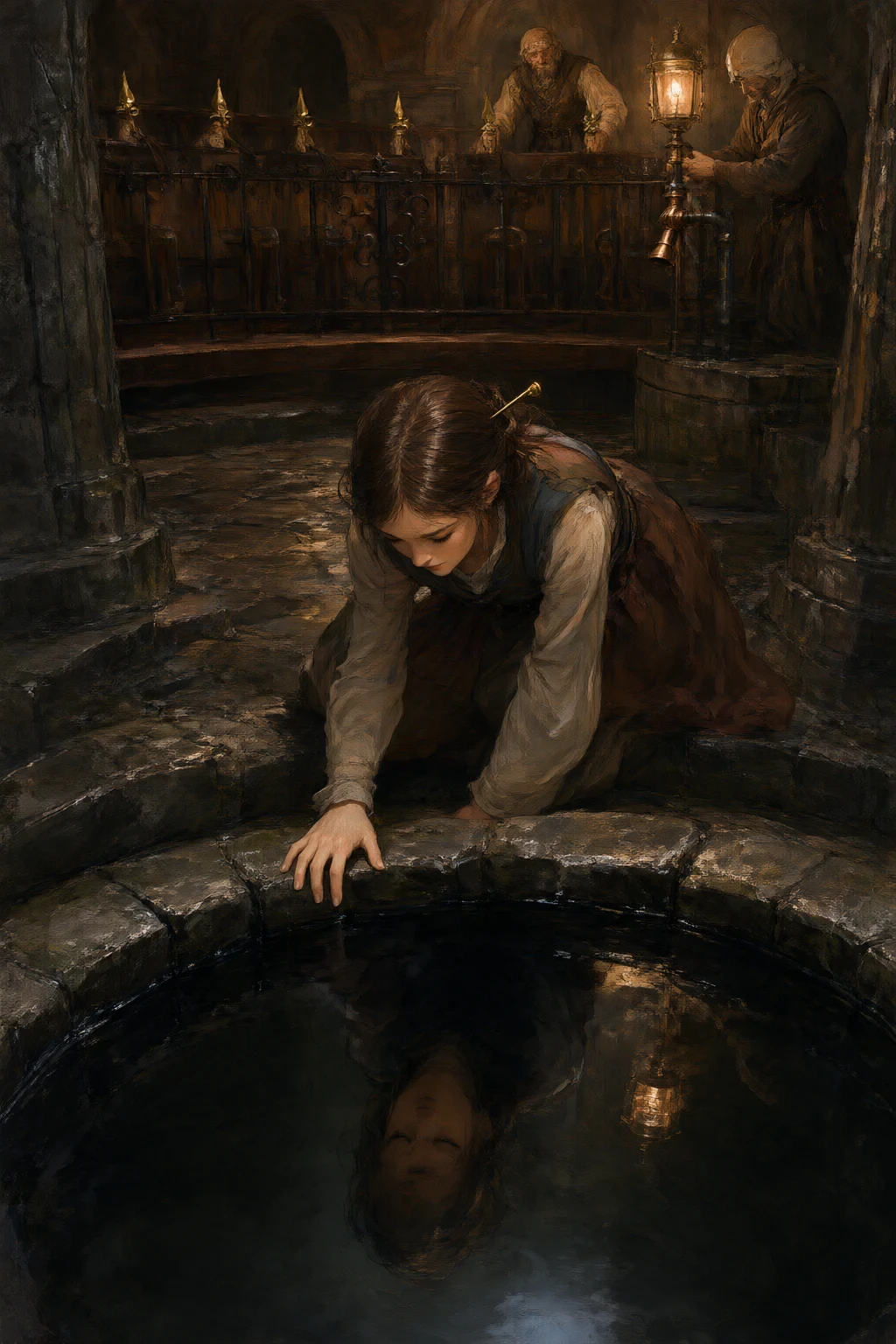
They tried it once, in the crossing, at the second set, with Merrin Salk on the canto and the water moving the way he keeps it moving, and the pool was black and warm and perfectly still, and the copper tap above it was polished by two centuries of hands. Hesper sang the word salt on the note she had learned, quietly, to herself, the way you test a note in a cold room. The surface of the pool went glassy in a circle nine feet across. It did not splash. It did not move. It went smooth, the way a floor goes smooth, and it stayed smooth, and it was not a surface any more, it was a face, and the face had a horizon in it, and Hesper Vail took her mouth shut and stepped back and everybody else on the floor took a step back as well.
Merrin Salk got his canto into the water in about four seconds and the ring broke up and the pool went back to being a pool. He was fifty-one years old and his beard was braided once a year and bound with copper wire, and after that night there was white in it at the sides, and it did not come out. Ordin Brack was on the ladder with his dip-rod in his hand and he did not say one word about the book or about the woman or about the note. “Closer,” he said. “The floor carries.” They went closer.
“The level was at the fourth stud,” he said, “and it is at the third and three-quarters, and I have chalked it on the rock, and I have chalked the date, because you cannot argue with a thing you have not marked. It was a pool. Now it is a pool with a face on it, and I do not know how to get the face off, and I know exactly what happens at two studs.” “What happens at two studs.” “The wellhead runs slow,” said Ordin. “At two it runs half. At one and a half it stops, and there is no water in Verrick, and there is no water in the pan either, because there has not been rain in this district since my father was a boy, and forty-one houses and a bakery and a school and a chapel that is not the cathedral do not exist without that crock.”
Hesper went up and turned the allocation board round herself, in front of forty-one people on a Friday, and wrote the new figures on the back of it in chalk, and somebody said something about the girl from the cathedral, and she said: “Hesper is putting the water back to a full crock on Sunday if the level holds. Hesper is not going to promise it more than once.” Then she came down the hundred and forty rungs in the dark with the wind coming down the shaft behind her, which is the one way down that a person can be frightened in this world, and she did not sleep, and the pool had a face on it and the face was still there at the sixth hour, and it was smaller.
Three days later it was gone. Not gone — set. The middle of the pool had a flat place on it about four feet across, the same temperature as a hand, and it hummed a fifth above the choir, and the tap ran at the rate it had run for four hundred years. It was not a face any more. It was a plane. And Hesper Vail, who could not stop listening to it, lay on the loft floor with her arms over her face and listened to a note under the floor of a building that had no column and no page and no witness, and it had a face on it once, and it had been a pool, and it was the only liquid in nine hundred square miles and it was warm, and it was the loudest thing in the cathedral.
“Give me the sixth,” said Hesper. Ilde Marrow was on the sixth rail with her forearms on it and the file in her hand and a white moustache above her upper lip kept daily to a length you could measure, and she had been holding the room’s own quiet in shape for twenty-two years, and holding the quiet is not resting, and everybody who has ever done it knows that it is the most tiring work in the building. “The sixth is not a note,” she said. “It is the holding of a shape of air so that five other orders can exist. If you take the sixth and the other five are not perfect, the air comes in and everything in the building comes down at once, in the way that a jar comes down when you take the lid off.” “I know what the sixth is.” “You know what the sixth is the way a person knows what a number is when they have been told it.”
“I have been reading the cancelled pages aloud for two years,” said Hesper, “and I have never once been asked to hold anything.” Ilde Marrow looked at her for a while. She had spent twenty-two years wanting to stop singing and be allowed to leave that building alive and unrecorded, and she had never said it aloud, and she had a form of her own she had been shortening in the hope that nobody would count the difference, and the girl in front of her was seventeen and wanted a page. “If the water takes it,” Ilde said, “I will not be able to bring it back. Merrin brought back a ring in four seconds and I do not know that he will do it twice, and the second time he does it he will be a column, and they will enter it as a column, and they will not write that a man set himself for a girl’s arithmetic.” “Then what do I do.”
“You do not sing it,” said Ilde Marrow. “That is the whole of it and it is the hardest thing in this building. You take the sixth, and the six of us find the note without putting it into the room, and I hold the air out of it while the page is written. The sixth is the only order that has no surface. A note with no column and no water has nothing to be held by, and the only thing left in the room is the quiet, and the quiet is a form, and a form can hold a fact for as long as somebody is in it. And in the moment it is written down it does not have to be held at all.” The sixth stall has a brass tip and a seat worn to a mirror shine at the mouth by four hundred years of one singer leaning forward to listen, and there is a chest for water and a chest for bread under it and a coat that nobody claims. Hesper Vail sat down in it at the second set of the fourth day and the seat took her and the shine came up under her hands where she put them, and below her in the dark the pool was black and flat in the middle and warm and the loudest thing in the cathedral.
“Nissa is going to give you the note,” said Ilde Marrow, “and you are not going to answer it. I am going to sing the sixth under the room and hold the air out of it, and Sula is going to put the note into the room once, and Garrick is going to write it down, and then I let go, and the whole thing lasts about as long as you can write a sentence.” Nissa Ashkel had her hand flat on the brass rule laid across the last cut at the mouth of the gallery, because that was where the note was loudest, and she had not slept more than three hours a day for a fortnight, and she had not told anybody, and she said, to nobody in particular, in the flat voice she used for everything: “and then it is standing up.” Sula Iven sang the founding note into a room that had no water in it and no column in it and nothing in it at all but air and six people and one girl holding the shape of the quiet, and the air in the Wellmouth went absolutely cold and clear and perfectly still, and the pool, which is the loudest thing in the cathedral, went silent, and in the silence the note sat in the room like a thing in a hand. “Stop,” said Ilde Marrow, in a speaking voice. “It is in the book. Let go.”
They let go. The water came back in on itself with a sound like a door being shut in another county, and the flat place in the middle of the pool lifted and closed over and was a pool, and the tap was slow for an hour and then it was not slow. Garrick Bole was standing at the lectern in the warm room with the book shut and his hand flat on the cover and his thumb in the brass corner and the damp leaf open at the three ruled lines. “Write it as an interval,” he said. “Write it against the tap, because the tap has a note and the tap is a thing that a person can do again on purpose. Merrin. Strike the copper once and stop it dead, and tell me where the note is.” “A fifth below,” said Merrin Salk.
“A fifth below the tap, struck once and stopped dead.” Garrick dipped the pen. “The founder’s note is the fifth below the tap struck once and stopped. Sung by Hesper Vail’s family, at the founding, at the wellhead, in the week of the scored line in the seventh washing book. The water went down six inches and did not come back for a year. There was no witness and no page and there was no form for it, and it is entered here on a leaf that is not a page, and the leaf is damp, and the line is ruled, and I am the only person who can say so, and I am not the only person who believes it, because thirty-nine people watched a girl hold the quiet and the water did not take it.” He read it back and dated it and signed it, and put the hour down, and closed the book, and the leaf did not grow. The book did not make another page, because a page with a ruled line and a fact on it is a form, and the fact had a form, and the salt does not lie. It only returns.
Verrick had a full crock on the Sunday. The allocation board was turned back round and the figures were put right and nobody asked her anything about it, and on the Tuesday the baker’s boy came down the shaft with a message from the wellhead and gave it to the under-reader and would not come further into the room, because there is a point at which a man knows the room he is in. Hesper read the message out loud, and then she said, “Hesper is going to go and measure the mouth of the gallery,” and went down. The growth at the mouth of the gallery was measured with a brass rule laid flat across the floor, and the figure was chalked on the wall with an arrow, and the date was cut beside it, because that is what the book requires. An eighth of an inch for the week.
It had been a half-inch a week for two hundred years, and it was an eighth, and Garrick Bole stood beside her and did the second reading himself and made her read it back because he was not to read it. “One-eighth,” she said. “One-eighth of an inch.” “An eighth is a quarter of the rate,” said Garrick. “Per the count, we have paid down a quarter of it. We have not paid down the rest, and I am not going to write a word on this leaf tonight that says we have, because she was not a column and a column is what the book pays for, and what we entered was a woman, and the building has been extremely polite about the difference and has taken a quarter off the figure and left the other three quarters where it found them.” “Will the rest of it come down?”
“It will come down by itself,” said Garrick, “at a half-inch a week, over about three years, and there is no form in the world for holding a note for three years, and no singer in the world who could do the sixth for three years, and I have looked at the succession list, and there is nobody.” He put the chalk in the tin and the rule under his arm and looked at the gallery, which went on into the dark, smooth and warm and humming a fifth above the choir, and which at its end had eleven feet of growth and, behind that, a small room. “The founding page is in there,” Hesper said. “The founding page is in there,” Garrick agreed, “and it has been in there for four hundred years, and it has a V cut into the ruling on it, or a page will have, and I do not pretend to know. And the room is eleven feet in and it has been eleven feet in for two hundred years, and this week it is eleven feet and an eighth, because an eighth is what is left of what the book could not pay for.” “That is not a good week.” “It is a dated week,” said Garrick Bole, and chalked the figure, and chalked the date, and put the arrow beside it, because that was what you did.