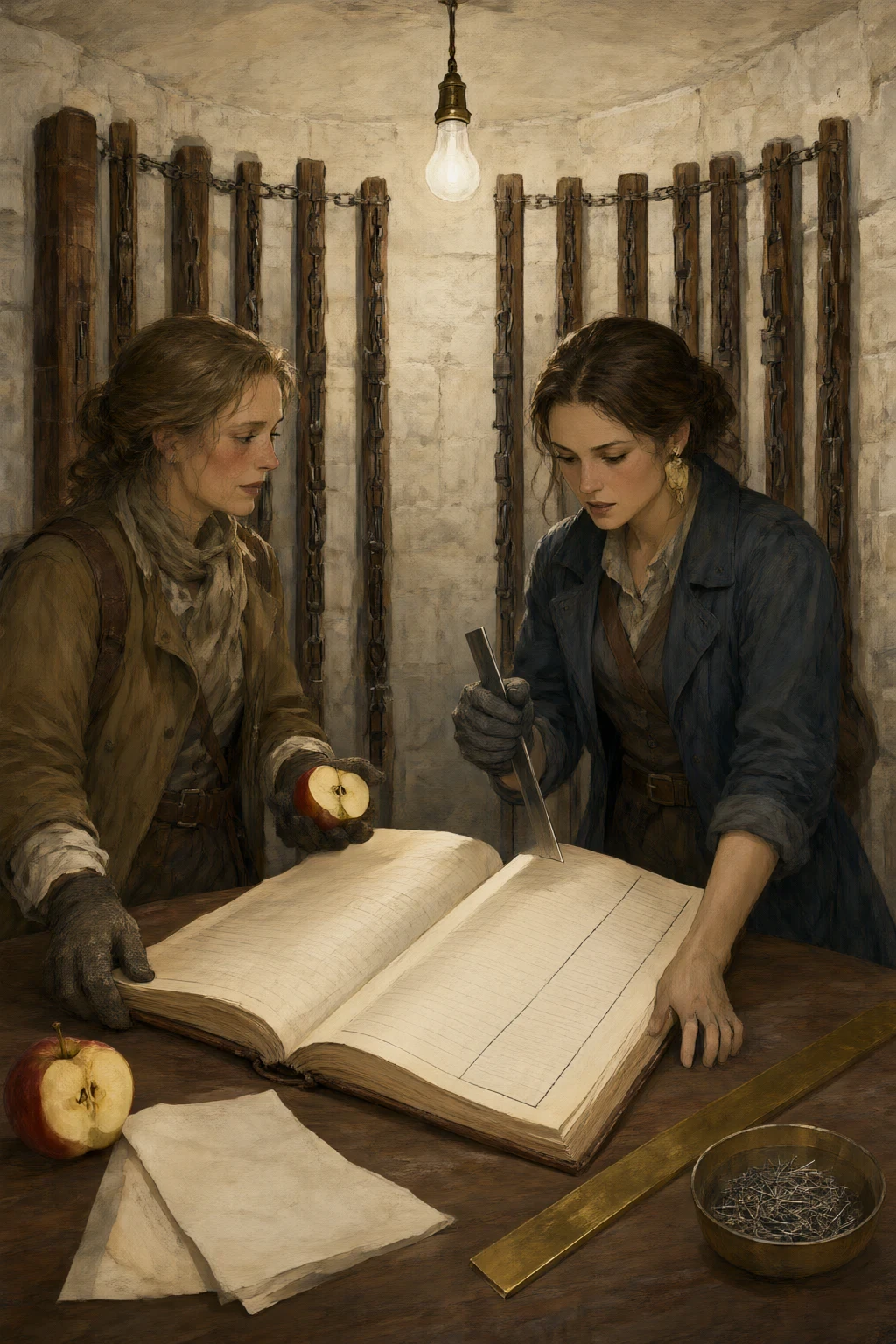
The frost came on the night of the first of December and the district had nine hundred crates of stock fruit in three cellars and no way of knowing what any of it was. That is the shape of it. Not a mystery. A wall. Nine hundred crates is the figure in the stock book at the end of the east end of the packing shed, in a column of ink carried forward from one keeper to the next for sixty years. Three hundred in Bellhouse Cellar, cut into the bank behind the schoolroom, where the floor is stone and the air tastes of a cellar and the temperature never moves more than four degrees between July and January. Three hundred in the packing shed cellar, a brick chamber under the boards of the long shed that nobody has ever measured and everybody uses. Three hundred in the old kiln at the river end, which is only a hole in the ground with a door on it, and which the district has been careful for sixty years not to look at too closely in the wrong month.
Nine hundred crates of last season's fruit, in three places, in an ordinary year, when it would have been eaten or sold or drunk out of the barrel over the winter and nobody would have needed to know anything about any of it. The trouble is that the stock book is not a list of crates. It is a list of places, and it works by writing a block number on the end of each crate, and there are eleven grafted blocks in the Fenrows and the stock book is how the district knows what those blocks are still for. Ottiline Vrey had been in the Register Room since seven with a pencil, a grey archive glove on her right hand and the boxwood pin in her left ear, going down the east end of the stock page with a glass, because she is the keeper and the glass is hers and the alternative is being told by somebody else what her own book says. “Row four,” she said, at about nine. “Number seventeen. Give me the tally from the middle crate of the middle layer and do not tell me what you think it is.”
The tally was the picker's own. Every picker chalks a private mark on the end of a crate so that he can find his own fruit in a cellar of nine hundred crates, and the mark means nothing to anybody else on earth, and the district has never tried to abolish it, because it is the only system anybody has ever had for knowing where a thing came from after it has been in a dark room for five months. It said 4/17. “Four seventeen is a block and a tree,” said the man with the glass, patiently. “It has been a block and a tree since my grandfather. What is the matter with four seventeen?”
“The matter with four seventeen,” said Ottiline Vrey, “is that the register says its parents, and I have had it in front of me for an hour, and its parents are on the ninth row of the eighth block of the Fenrows and a tree of unknown stock in the Middle Orchard, and the union took in the spring of 1958, and the last four crops off that tree have come down to the pack shed sour and thin and tasting of a stone floor with water standing on it, and no two of them have tasted the same as the block they are supposed to be.” She put the glass down. “Nine hundred crates,” she said, “and one tree in nine hundred that I cannot put back where it came from, because the register cannot tell me where it came from, because the register is a document of descent and it was never, in ninety years, a document of content. It tells me who its parents are. It does not tell me what it is. Those are two different questions and this book only ever agreed to answer one of them.” Here is the whole of the trouble, stated properly, because it needs stating once and then it needs working on.
A graft is a survey. When a union takes, the two root systems are continuous, and the grafted tree reads both locations at once, and for as long as the union holds, so does every other tree sharing a rootstock with either parent. That is a fact about ground. It is also, in this valley, a fact about paperwork, because a graft entered in the Grafting Register is stable for the life of the tree, and a graft made, used and not entered is a stranger's graft, and a stranger's graft holds for a growing number of years and then comes apart in a single night with all of its held information going into the soil of that night permanently. Nobody in the district knows why the unrecorded grafts are so old. Everybody in the district knows.
The other half of the trouble is older and slower and has no dramatic night in it at all. A grafted tree does not stay itself. Year on year it grows weaker at describing its own ground and stronger at describing the ground it was grafted to, and the fruit changes section, and the taste changes, and eventually a tree stops yielding its own variety entirely and becomes a pure function of where it was grafted to. The trade calls that a drifting tree. It is the permanent cost of every improvement anybody has ever made in this orchard, and it is paid silently, one row at a time, by trees that are perfectly healthy and that everybody is proud of.
Every grafted block in the Fenrows is drifting. Four of the eleven have drifted far enough that the district no longer has a name for what they bear and has been selling the fruit into the cider barrel for years because nobody wants to be told what is in it. Row four, number seventeen, was entered in the register in 1921 as a seedling of the ninth row stock, and has been grafted seven times in sixty-two years, and the seventh is the one that has finished it. That graft was made in the spring of 1958 on the middle of the block by a man who is still alive, and it is in the register, in ink, in a hand that has never been questioned, with a docket number and a scion count and the rootstock written out in full. The register is correct. That is the part that will not let go of you at two in the morning. Every word in the entry is true. The number is right and the hand is right and the wax cloth is right and the tree took. And the tree is not the tree the entry describes, and will never be again, and there is no column in ninety years of the district's most careful book in which anybody could ever have written that.
They worked out the drift in the first three days, and it was worse than the ledgers, and it was better than a mystery. The method was Sennet Bray's, because it was a foreman's method and not a clerk's. You take a tree, and you cut a fruit, and you cut it in half in two hands, and you taste it. Everyone on this ground can read a fruit. It is not learned. A child raised here can put a windfall on the tongue and tell you what is under the field it fell in. That is the whole of the world's magic and it is not rare. So they cut fruit. Row by row, tree by tree, in the wet, with a barrow and a folding saw and a crate lid to cut on, and they wrote down what each one said and where it was standing and what the register said about it. By the third of December the block had a shape.
The drift is not random. It moves in a front, and the front is a line, and the line has a direction and a rate. Row four had been grafted in one line along the middle, in 1958, from the lane end, and everything that has happened to that block since has happened outward from that line, at a rate you can put a number on if you cut enough fruit. Number seventeen was a hundred and eighty feet from the 1958 line. It had gone. Number eighteen, a hundred and sixty feet. Gone. Number twenty-two, a hundred and twenty feet. Gone, and you had to be quick about it, because on the twelfth it read gone and on the seventeenth it did not read gone any more, and the only record that it ever had was a pencil line in a barrow-book that the rain got into.
Number twenty-six, eighty feet. Half gone. The fruit cut six carpels where the variety should cut five, and the taste had the block in it and the grafted ground in it, in about equal parts, and on the fourteenth of December it cut seven and the six was gone. Number thirty-one, forty feet. Nearly clean. The block, the block, the block, and a smell of cold stone that a good fruit of that variety has never once had. “There,” said Sennet Bray, on the third of December, standing in the wet with a cut apple in her mitten hand and rain running off the blade of the saw. “There is the front. It is walking up the block at nine feet a season and it has been walking since fifty-eight and it is going to be at number thirty-four by spring.”
“Which is when,” said Dellory Fenn, who had come down from the town on the first morning and had not gone home, “is the last of that block lost to the register's silence about it.” “Which is when the last of that block,” said Sennet Bray, “is a row of the ninth block grafted to a place no plan has ever had.” On the night of the ninth, in a storm off the river, a tree in the second block of the Fenrows came apart in a single night, and the district learned in the space of twelve hours that the drift front was not the only clock running in this fortnight. It was a Codlin on the old seedling, eleven years in the ground, and it had borne a decent crop every year of its life and had never given anybody a moment's thought. In the morning the bark was split from the crotch to the ground on the weather side and there was nothing behind the split. The whole of the tree's inside had gone over to a soft sour smell overnight. The fruit still hanging on it and the windfalls under it and the two buckets the pickers had carried out of the row at dusk were all thin and green and tasted of nothing whatever.
Sennet Bray cut one of the buckets in the yard and turned the two halves over and gave them to the registrar, and there was no section to count, because a section of nothing is not a section. It was not a bad address. There was no address. The trade has a word for a place that has been taken out of the record and the word is a blank, and a blank is not a hole in the ground. The ground is all still there. It simply cannot be read by anybody, by anybody, ever again, and the trees that grow round it afterwards will grow round it the way water grows round a stone. “Who grafted that?” said Ottiline Vrey.
“Nobody knows,” said Sennet Bray. “It is not in the book. It is not out of the book either, because it was never in. Somebody made that graft in a week when there was nobody to write it down, and it held eleven years, and last night it let go, and everything it was holding went into the soil of that night and is not there any more.” “Is there a line for it in volume three?” “There is no line for it anywhere,” said Sennet Bray, “and there is not going to be one, and I would like it noted, since nobody is writing anything down, that I looked.” Ottiline Vrey went back into the Register Room and stood for a while in front of the third volume, on its stand, with the chain off the spine and the clasp up, and did not open it.
Nine hundred crates, and a fortnight, and two clocks: one of them walking up a row of trees at nine feet a season, and the other one choosing its own night, in a wind, without asking, and taking a place out of the record for good. They got nine hundred crates out of the three cellars in six days, and the district ate them, and the district did not sell them, and that decision cost the district eleven hundred pounds and was the correct decision and everybody involved knew it was the correct decision at the time. That is the part that is hard to explain to anybody who was not here. A fruit given away is a location made public. A fruit sold is a location published, and the docket is the paper trail of a disclosure, and a buyer who can read a fruit can read a crate of them, and what is in a crate of drifting fruit is a place no family in this valley has ever surveyed and that some other family will very shortly wish they had. So Mirren Ostley came on the sixth of December with her canvas coat and her docket-book and stood at the gate of the packing shed yard in the dark and offered, and she was very good, and she offered at a price that was actually reasonable.
“Two hundred and six a crate,” she said, in her way, which is entirely in the second person. “You and me, we both know what this is worth. It is not a fruit, it is a road sign, and you have nine hundred of them stacked in a cellar and a hard frost coming, and I am the only buyer on this river who will take a whole lot without opening it and asking what is at the bottom of it.” “There is nothing at the bottom of it,” said Sennet Bray. “That is the difficulty. It would be a great deal easier if there were something at the bottom of it we could point at and sell you, and there is not, and you know there is not, and that is the only reason you are standing there.” Mirren Ostley did not argue, which frightened her more than the argument would have.
“Sennet. Your block is going, nine feet a season, and your own foreman measured it in front of me on Tuesday. In four years you will have a row of something that came from nowhere, and you will write down that it came from a tree in a ring of posts that no fence ever built, and there is a buyer in the county who will pay very well for the first hundred of those and better for the second hundred, because by then you will both have stopped being able to tell the difference.”
“I know what you are offering me, and I have thought about it, and I want you to understand something, because I do not think you will be told. I would sell that fruit. In January, when there is none of it left and four families in the Fenrows are eating what I did not sell, I would sell it and put the docket number in your book myself and spell it out for you. The only reason I am not selling it this week is that I do not yet know what the address is, and I am not going to publish an address I have not found.” Mirren Ostley looked at her for a while in the dark. “Write to me when you have,” she said, and went away up the lane with the docket-book shut in her left hand, which is a thing she does not do in front of anybody.
The cellar water came up on the night of the seventh. It was not dramatic. It was forty feet of rain in nine days on ground that had not drained since the Drowned Summer, and the pipe-gallery forty feet down did its singing all week and then on the Sunday night, at two in the morning, the singing stopped. Sennet Bray said afterwards that that was the moment she understood, because she had been hearing that noise for fifty-two years and had never once heard it stop, and had assumed, as everybody does, that it was going to be there for ever. Water came up through the floor of Bellhouse Cellar to the depth of a hand's breadth across the whole three hundred crates, and stopped there, and stayed there, and would have stayed there indefinitely, because forty feet of silt does not care what is happening at the top of it.
They got the fruit off the floor on sacking boards, two hundred and forty crates, in five hours, with eleven people and every lamp in the schoolroom. They stacked them in the schoolroom, the shed, and the corridor of the packing shed where the Register Room is, and Ottiline Vrey moved nine hundred pages off the tops of eleven ledgers onto the plan chest in the survey house on a handcart in the rain, and did not lose one, and did not once stop to be thanked. The remaining sixty crates of the Bellhouse three hundred were under six inches of cellar water and the water was still rising and the district left them.
That is the failure and it is the only one in this account, and it is not a failure of anybody. Sixty crates were left in a flooded cellar in a hard frost and were not recovered, and there was no argument about it in the yard afterwards, because the alternative was nine hours more of men standing in cold water in the dark, and the district had already been standing in cold water in the dark for five hours, and the arithmetic is not a moral question. Sixty crates, gone, entered in the stock book at a nil return, and the district ate short until the middle of February. Here is what the register could not do. Not the letters, and not the ink, and not the woman holding it. The register could not do the following thing, which is the only thing anybody asked of it in the second week of December: Say what a tree is.
It could say, and said, for four hundred and ninety-one trees, in eleven volumes, with wax seals on the bindings and a docket for every union and a rule that has never once been broken in ninety years, exactly who each tree's parents are. It could follow a tree across three generations and give you its descent without a break. It could prove, in a court, on a Tuesday, before a man from the town who did not believe a word of it, that a certain apple came out of a certain tree in a certain row in a certain year, and it would win, and it was right, and the winning was not the point.
It had one column for the scion, one for the stock, one for the season, one for the graftsman, one for the number of the docket, one for the date, and one for the keeper's hand, and the seven of them together described a family and not a tree, and the keeper who wrote them had known that for the whole of her working life and had never once been in a position to do anything about it, because the register cannot be wrong, and a document that admits a finding is a document that can be wrong about a finding. On the eleventh of December, in the Register Room, with the floorboards wet under the door and the ledgers on their stands with the chains off the spines and the clasp of each one up, Sennet Bray put one cut apple on the table.
Number twenty-six. Eighty feet from the 1958 line. Cut that morning, cut in half in her mitten hand, and the two halves were lying on the table with the seed end toward the window and the wrong number of carpels showing in the flat grey light. “Five,” she said. “It should cut five. It cut five when I was a girl and it cut five when my husband drew it. It cuts seven.” “Yes,” said Ottiline Vrey. “It is the best tree in that block. It is the tree the pickers save the fruit from. In four years it will cut eight and in eight it will cut nine and in nine it will be a pure function of a place no plan has ever had, and it will be a perfectly healthy tree, and it will not have one thing wrong with it that a fruit can show you.” “Yes.”
“And in ninety years,” said Sennet Bray, “somebody will come into this room and open volume seven and read number twenty-six and it will say seedling of the ninth row stock, grafted 1958, and it will be a beautiful entry, and it will be a lie, and there will be nothing in the room to say otherwise, because you have spent ninety years building a book that cannot hold a lie and cannot hold the truth either, and that is the only reason it has survived us.” “It is a document of descent,” said Ottiline Vrey. “It was never a document of truth. I have said that sentence in this room perhaps two hundred times and I have never once had anywhere to put it.” They wrote what they could, and it was very little, and it took a fortnight, and it went like this. They went back through every grafted block in the Fenrows and Ward worked more than once in living memory, and entered the parentage of every tree whose parentage the register already held, on the existing lines, in ink, with the date and the keeper's hand: four hundred and ninety-one entries over eleven days, which will hold every one of those trees for the rest of their lives.
And that is all it did. That is the entire institutional achievement of the fortnight, and it was worth doing, and it was not what anybody came here for. Because the register cannot hold the drift. The drift is not a descent. It is a fact about what a tree currently is, and it is measurable, and it moves at a rate, and they had measured it, and it was written in pencil in a barrow-book and in chalk on a barn wall and in the head of a foreman who would not be here in ten years. And so on the fifteenth of December, the fourteenth day, with the frost still on the ground and the water still in the Bellhouse cellar and the district eating what it had, Dellory Fenn put a folded sheet on the register table. It was folded in eighths. It was soft along the folds. It was covered in pencil in a small even hand, and it was the heading of a column.
“Forty years,” he said. “I drew it out when I was twenty-three and I have never had anything to put under it, and I have never shown it to anybody. I took it out of the house this morning because I have run out of reasons not to, and because I am sixty-three and the district will not have a long time in which to be wrong about this.” Nobody else at that table had ever seen it. It was not a document. It was a ruled column with a heading, drawn in pencil, on cheap paper, by a man who had worked out something and had never been asked to prove it. The heading said: WHAT THE FRUIT SAID. That is all it said. Four words, in pencil, ruled down the middle of a sheet of cheap paper, and below the line nothing at all.
“Forty years,” said Dellory Fenn. “I have had the column and no entry, and the reason I never put anything under it is that I was not certain, and a finding in that book that is wrong is a wound in the district that does not close, because the book cannot be wrong, so if the book is wrong then the book is nothing, and then the four hundred and ninety-one entries are nothing, and they are the only reason the Fenrows have not come apart in sixty years. On the record? I have not been able to answer that question for forty years and I cannot answer it tonight.” “Yes,” said Ottiline Vrey, and went out into the passage, and came back with a straightedge, and ruled it into volume seven, at the end, after the keeper's hand, in ink, with the book open on the table and her glove off.
“Six. And we are not writing anything in it tonight, and we are not writing anything in it tomorrow, and I will not have anybody writing anything in it until this district, in this room, has decided what a sentence in that column is allowed to mean, and who is allowed to write one, and what happens to the hand of a man who writes one and is wrong.” “Then it stands there empty.” “It stands there empty,” said Ottiline Vrey, “and it has stood somewhere empty for forty years, and in one respect it is better where it is, because now there are five of us who have seen it.” On the last day of the fortnight they went out to row four to cut number seventeen, the first tree they had started with on the first morning, the one the whole fortnight had been walking towards without anybody saying so. Sennet Bray had known by the eighth of December that it was gone. She had not gone back to it. She went now, with the boy, and the two of them stood in the wet in the north end of a block of four rows of Ribston on the best low ground in the district, and the number was on a tin tag, and the tag was foxed, and the register had it in three volumes and it was right in all three.
There was fruit on it. There was a scatter of windfalls under it, green and bruised, going to cider-sour on the grass, and Hollis picked up four of them in his two barked hands and gave them to his mother, and she cut one with the grafting knife, which was sharp now, and turned the two halves in the rain. Nine carpels. She gave him the other half and he turned it and looked at it, and it was not what he had learned to expect from an apple, and he was fourteen and had spent the whole of the last month learning exactly how much a section can drift, and he said the number out loud in a voice that had gone very quiet. “It is gone,” he said. “It is gone,” said his mother. “And there is a sentence about it in this district now, and the sentence is in a book in a room that smells of glue, and it has a date on it and a hand, and in two hundred years a person will be able to come in here and read that in the ninth of December of this year, in the volume, in ink, that on this ground, at number seventeen, in this year, the fruit said nine, and that we thought it was worth writing down.” “It is only a pencil heading.”
“It is only a pencil heading,” said Sennet Bray, “and it took forty years and a fortnight and a hundred and forty barrels that are not going to be sold, and it is ruled in, and it is empty, and every year from now on somebody in this district is going to have to decide whether a thing they found goes under that line or stays in their own pocket. And I expect that is the whole job. I expect that is the job for a hundred years and I expect nobody will ever be able to say whether we are doing it well.” Behind them, down at the river end, the old kiln had forty feet of water in it and had not been opened since Thursday, and above the bank the pipe-gallery was silent for the first time in fifty-two years, and the block went on standing in the flat grey light with its four rows and its tin tags and its eighty feet of good ground, and none of it mentioned, in any book in this valley, the place that was underneath it.