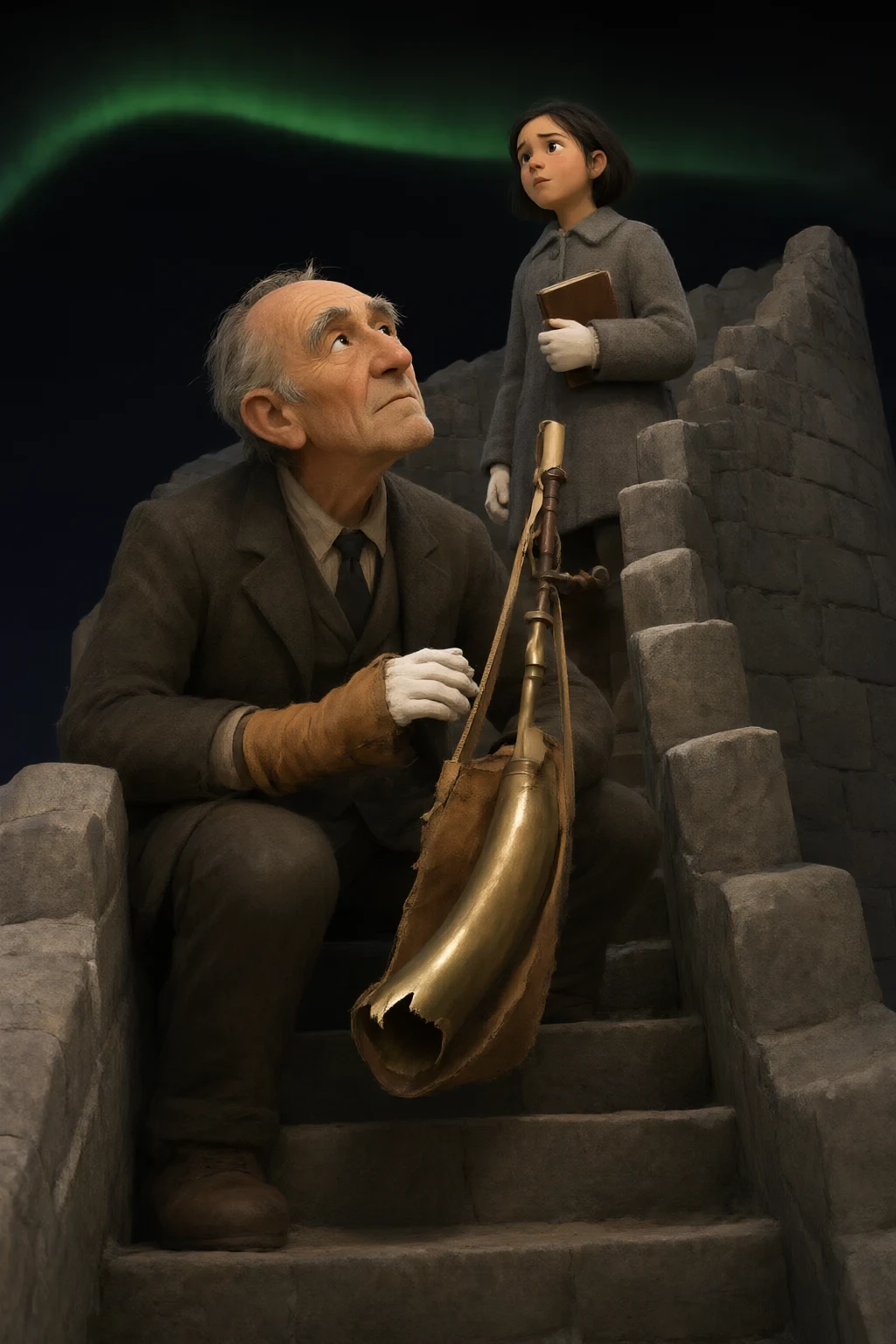
Kell Ostler went up the Gallows Stair in the dark with a food basket on his arm, and he was still going up when the sky behind him went grey. He was fifty-eight and not a tall man. He had been on the stair twice before in his life, both times at nineteen and twenty, and both times running.
He mends harnesses in Sillvane, which has ruined his hands for anything else: the left one stiff in the winter, both of them scarred along the knuckles from thirty years of drawing rawhide through a buckle while something stronger than him pulled the other way. His left glove is badly mended. The thumb-lining always shows, because he cannot get a thumb into a thumb properly and gives up at the third attempt.
The stair goes up in nine flights with a landing at each gap of the wall. Two hundred and forty steps. Every tread has a shallow bowl worn in the middle of it, six hundred years of boots, so a person’s foot finds the same place every time and does not have to think about it. At the top there is one step from which you can see the whole wall of the aurora at once, the green band standing over the valley with Sillvane lying in the fold below it three thousand feet down. Nobody climbs the stair for pleasure.
Kell counted the gaps as he came round the ring, because he was a man who counted things. Nine segments of grey mortared granite, nine metres high. Nine gaps, and three players in them. The ninth gap had been dark for three years. “Kell,” said Maran Ostler. She was at the horn-line with her hand on the third valve, sixty-one years old, and her voice was the sound of somebody talking through a split leather strap. “Maran.” “I have known since the second landing. I can hear your knees.”
He had one thing to say, and it came out wrong. “Maran. Come home.” She played. Not loudly. She went on taking the third the way the wind goes on, and under it she said, “The third is fine,” and he understood that she had not refused him so much as declined to hear him. “You cannot hear me.”
“I can hear you. I am choosing the third.” She lifted her chin at the wall. “Look at the ninth gap. That is a hole in the winter the size of a doorway. If I put my boot over the sill, that hole stops being a hole in my part and starts being a hole in the wall. It leans. The night comes through the lean. And there is nobody on this ring who can take my part who is not sixty-one years old and colder than I am.” “Somebody has to take your part eventually.”
“Yes. Not you, though.” She said it without any weight, which was how she said the worst things. “You had your turn. The ninth is fine.” That was when he made the mistake he had been making for thirty years, without stopping to think about it, the way a man puts his thumb on a sore tooth. “I am sorry — ” “For what.” “For taking the air. For every time I have spoken in your hearing for thirty years. I am sorry. You do not have to — the next year could be — ” “Stop.” He stopped. “Do not do that,” Maran said. “You do not do that.” She was not talking about the third.
He walked down in the dark, which took from dark to dark, and got into Sillvane with his knees gone. Sillvane is two hundred turf-roofed houses in a sheltered fold, with a peat fire burning in every house all year. The bread is dense grey rye that you have to cut with a saw. The bell tower has a bell in it that nobody has been able to tune in six hundred years, because a bell cannot be tuned without an aurora-player to listen to it. He slept four hours on a bench by somebody’s fire and did not take his coat off. Then he got up and made a bigger basket.
Day two. Bread, a hare, and a jar of weather soup wrapped in wool. Sef Anhalt took the basket at the top of the stair, because Sef took everything anybody brought up and could not leave it alone. He re-tied the cord, then the cover, then the wool, then the cord again, said, “Horn-line’s brother takes the air,” which was the nearest thing he had to kindness, and carried it off at a fast walk.
On the second night the wind came up the west with the whistle in it, and Kell sat with his back against nine metres of granite and could not hear the horn at all. Day four. He sat where the stair came out and waited for her. Pell Underhay came down as far as the second landing, which is as far as an apprentice goes. She had a ledger notebook with a broken spine inside her coat, and showed him a column of dates in pencil. “How many days,” he said. “Four days since you came up the stair.”
“Put nine.” She did not write. “Put nine,” he said. “That is not a question. That is a number. Write it down.” “What is the number for that?” “There is no number for that,” Kell said. “That is the whole point. Write the number down.” Day five. The old woman at the chimes. Ysolde Vant was seventy-two years old and the last of the silver-chime keepers. She walked the ring while she played, and her breath went in and out with a dry whistle in it that you could hear from the other side of the shoulder. She spoke the way people read out from a written thing, and she did not stop for anybody.
“And in the deep weeks the mountain is not teaching anything new,” Ysolde said, walking, “it is only saying again what it said when the first nine stood here. And the note it has never once said aloud is nearer tonight than any note it says every night, and that is not a comfort. It is a fact of the weather.” Kell thought she was talking about the wind.
Day six and day seven were for building. He took rawhide up in a roll, ash-wood for the joints, a trace strap off a dead harness, and an awl with a handle he had made himself forty years ago. He worked in the one hour of the change of watch, when there is enough noise to cover a man who does not belong. The thing he was building was a hand.
Not a hand for playing. A harness is a promise you make to a thing that cannot tell you when it is being lied to: the pull will be shared out along the whole line instead of coming down on one place, and the place that does the hardest work will be the one held best. So he made a padded sling of rawhide sewn double at the palm, a lever of ash-wood with three pegged joints, and a bracket to hook over the horn, so the valve rod would work off the end of the lever and Maran’s left hand could lie still in the sling.
Sef Anhalt helped him and could not stop tuning. He put the lever to the horn and moved the peg a sixteenth of an inch, and back, and forward, and listened, and a sixteenth the other way, until the horn could not hear any difference between the hand and the thing standing in for it. “It will take it,” Sef said. “It will not know.” “That is the idea.” “That is not the idea,” Sef said. “The idea is that it is better.”
Day eight. The last fitting, and the collector. Wend Cassock came round the ring with the brass survey lantern on the rail and the folding rule on its cord, and said out loud, in the third person, what was in the room, because she was writing it down. “The brother of the horn-line is bending a rawhide sling over the left hand of the horn-line. The horn-line is permitting it. The brother of the horn-line has not spoken at the change of watch in eight days.” “Thank you,” Kell said. “Do not thank me. I am saying what is in the room.”
Day nine. He put it on her at the change of watch, the way you put on a bridle, from the left, talking the whole time because that is what you do. “Left hand up. Palm to the sky. That is all of it. Nothing pulls.” Maran put her hand in. The lever came down onto the valve rod and the third went on exactly as it had gone on for six hours, and the green band did not change, and the ninth gap stayed dark. Maran stood quite still. “That is a hand,” she said.
“It is a hand that does not get colder.” “That is not nothing.” She flexed her fingers inside the sling. “That is thirty years of somebody mending things, put on my hand. Go away now. The third is mine, and the third is fine.” And then Maran Ostler put her hand into the sling, let go of the valve, and walked backwards away from the horn. The horn went on sounding. That was the thing. The third went on under the wind exactly as it had, and Maran walked backwards away from it with her hand out in a sling of rawhide, like a person carrying something home in a cloth. She got to the sill. Kell said, “Maran — ” And she stepped over it.
The instruments are bound to the mountain, not to the players. A horn will hold the hand that plays it, and it will hold a harness hung on a peg. But for a moment there was no hand of Maran Ostler on the third valve, and the mountain did not know which of its nine she was. She got one step down the stair. Two steps. Pell came out of the ninth gap and said, “Horn-line, the band is going — ” Three. “Four,” said Maran. She said it, and she stopped, because the fourth was not a note.
Over the ninth gap the green band went out. Not thin. Out. A piece of sky the width of a doorway where the wall had been, and behind it was not winter but the other thing, and the wind came through the hole like a long breath taken by somebody with no need of air. Somewhere in the ring a horn sounded the third. Right key, right height, right place. Played by nobody. The third a stranger would play. Kell Ostler was on the stair with his hands on his knees.
Maran Ostler was on the fourth tread of the Gallows Stair, four steps down out of two hundred and forty, a rawhide sling on her hand and the whole black valley in front of her. She could not go down, because the wall needed her and did not have her. She could not go up, because her place had been taken by the wind.
The band stayed out. Pell Underhay got the notebook out of her coat and opened it on her knee and wrote in pencil, in a column, in a shaking hand. “What is the number for that,” she said. Kell did not say anything for a while. There is no number for that. Her column was the only one that was ever going to be right, and it is exactly the wrong shape for this. “Write what happened,” he said. She wrote: FOUR STEPS. NOT BY RIGHT. And then, in the margin, in pencil, because she was fifteen and because it was true: and then the ninth went out.
Wend Cassock stood at the top of the stair with the lantern in her hand and the rule on its cord and did not say anything for a long time. Then she said, “The collector records that at the change of watch on the ninth day, the horn-line of the ninth segment left her instrument and went four steps down the Gallows Stair, and that the ninth segment is now empty.” She dipped the pen.
“The collector does not record what it means. It never has. That is the whole of the office, and it is the only thing in this valley that has never once been wrong.” That night there was a hole in the Standing Chord with nobody standing in it, and above the ninth gap was a black square of sky with the stars in it. The ordinary cold came all the way down to Sillvane, where the peat fires went up their chimneys and the bell in the tower did not ring, because nobody had a way to tune it that night.
Kell sat down on the step above her, which was the fifth, and let the lining of his left thumb hang where it always hung. For a long time neither of them said anything, and he did not apologise, which he had not managed for thirty years. “I have wanted to say one thing for about four steps,” Maran said. “I could not say it at the ring. The third was on, and you were standing there.” “Say it.”
She turned her head. Her hair had gone the colour of frost ash and there was frost ash in it, and her eyes were two hands’ width apart in the green light. “You did not save me,” she said. “I want that in the record. The record will say something else, because it is made of numbers, and the numbers will make it look like you did. But you did not save me. You mended a thing, and then the mountain did the rest, and the mountain was going to do that anyway in about four hundred years, and it happened on a Tuesday.” “The ninth was thin.”
“The ninth was thin. It was thin before you came and it was thin when you left, and the four steps are yours, and the rest of it is not.” “Yes,” said Kell Ostler. She waited for him to finish the sentence for her. He had finished four hundred sentences in his life, and begun every one with an apology. He did not finish it.
So she went on by herself, which she had not done since she was nineteen and appointed. Her voice went out into a night with a hole in the middle of it, and she took her time. “Then we can go down as far as the second landing,” she said, “and I would like that, and I will not get any further than that, and you will have to be the one who turns round, and I am sorry — ” She stopped.
The first apology she had made him in thirty years was the first sentence in her life she had not finished with the name of a note, and she heard herself do it, and she laughed, one short dry sound, like a valve letting go. “The third is fine,” she said. “The third is not fine at all. Look at the sky over my shoulder. It has stars in it in the middle of the winter.” Kell Ostler looked. It did. And below them, three thousand feet down, Sillvane went on with its business in the ordinary cold, and the rail of the Gallows Stair went down from where they sat to the foot of the cut in one long iron line with no join in it.
Pell came down to the fourth step an hour later, having counted every tread twice, and found them sitting four steps apart, neither of them willing to go first, while she thought about what a person is supposed to write in a column when the answer is not a number. She wrote at the bottom of the page, in pencil, small, where the lantern light would not reach: The number for that is two hundred and thirty-six. She had never in her life written down a number that meant a thing was still there.