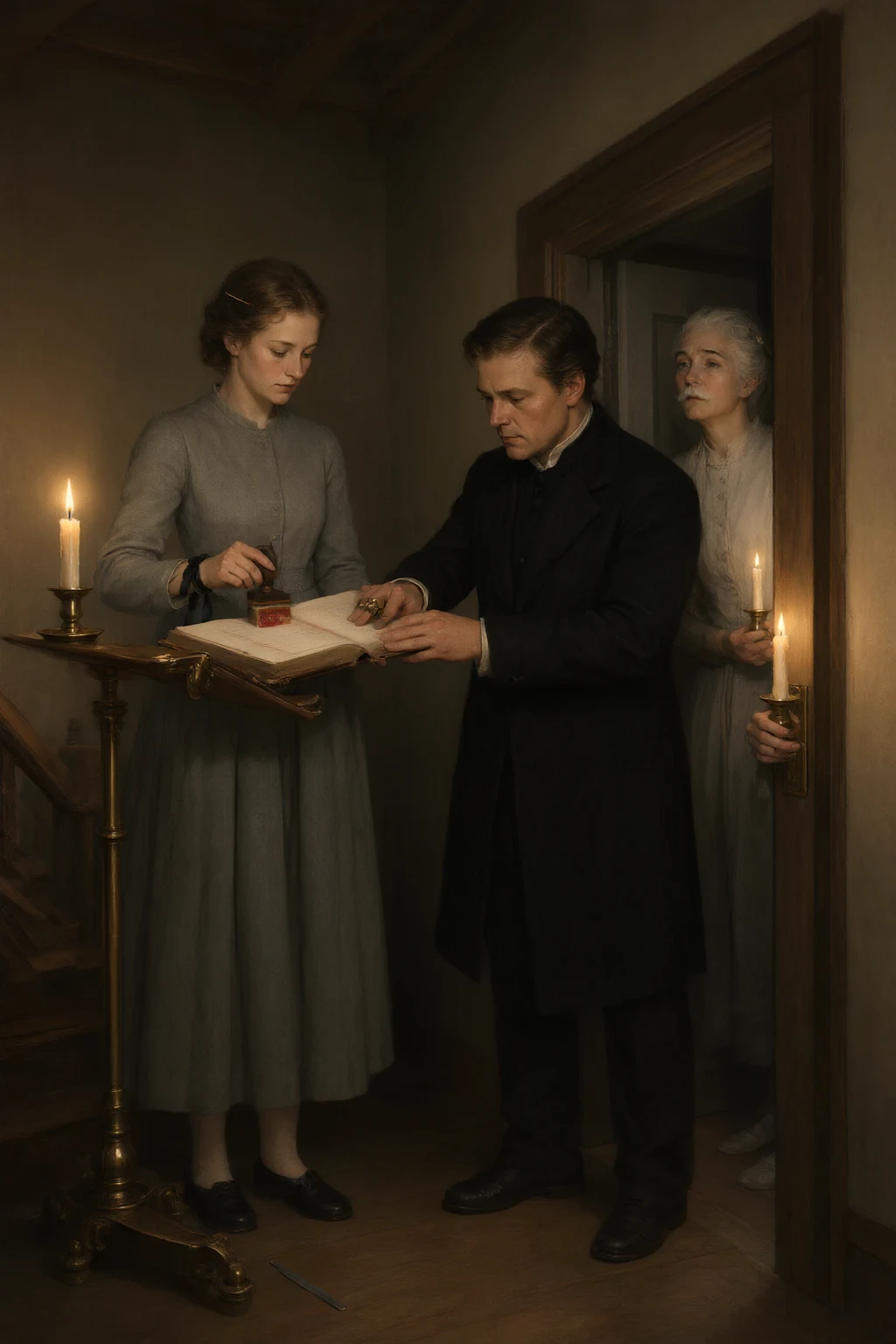
The Ledger Room is eight feet square and deliberately too warm, and the warmth is not a kindness. It is a measurement. A ledger kept in this cathedral's damp grows a page a season, and the book has four hundred and eleven pages and there are no more, so this room has been held at the temperature of a dry mouth for nineteen years and Lida Trask has not once let it lapse. The book lay on the lectern where it always lay, the good way up, the spine to the left, because a book laid the other way puts a thumb-worn edge against the ruled margin and in eleven months you can feel a column going soft under your own handwriting. That was in the standing orders, had been since before her time, and would be in them after.
The remedy is written inside the front cover, and it is written small, and it is written neatly, and it is not secret, and there is a great deal of praying in this world that people do not read it. If the uncounted growth exceeds what the counted structure can hold, then the book cancels. A cancelled column is struck through in ink, its page is stamped CANCELLED in red, the date is entered and initialled, and the salt that column was holding is released back to brine. Cancellations are published in order, one page at a time. The order is the schedule. She came up the sacristy stair at ten past six with the candle already lit, because the stair is dark and because she likes the forty seconds of it in which she is not the Reader.
She is thirty-nine years old. She has been in the book for forty. People find this charming. It is an error of the founding clerk of her own century, who entered a birth in the year before it happened and drew the line round it, and nobody ever went back to correct the line, because the line was not wrong exactly, only ahead of itself, and correcting a birth in this book is a business with a form attached to it, and a form takes a morning. So Lida Trask has never once in her life been a new person to the Ledger. It saw her coming. It has watched her entire life and has never had the pleasure of being surprised by her. The book was open at the front already. She had opened it before bed, at the two pages she had been thinking about, and had closed it again, and had lain in the dark under the choir doing arithmetic she already knew the answer to, which is a thing she allows herself about twice a year.
It was the fourteenth of September, which was a Friday, which meant that four hundred feet above her Verrick was holding its market and the whole of that day's argument was about the freight cage being late again. She could hear none of it. Rock and a hundred and forty rungs is the sort of thickness that keeps a Friday out, and she had never once resented it, and had never once gone up on a Friday. Two cancellations. That was the figure. It had been two cancellations at four o'clock the previous afternoon when Garrick Bole brought the day's tally up on his knee, and it was two cancellations now, and it would be two cancellations at six o'clock this evening, and the number did not care what she thought about it, which was the entire virtue of it.
A cancellation is a small job. It is four marks and a stamp and a reading. The column is struck through with one unbroken line, left to right, because a struck-through line with a gap in it is a blot and a blot is not a cancellation. The stamp goes in the lower margin, angled, the way a stamp goes when it has been in a pocket. The date goes beside it in the Reader's hand, and the Reader's initials go under the date, and the initials are L.T. in a small firm hand, the T with the crossbar too long, which she has never corrected because a page is not a place to improve yourself.
Then the page is read aloud. That is the check, and the check is Hesper's chore, and Hesper is seventeen and has been reading cancelled pages aloud since she was fourteen, because the whole point of a check is that it is done by somebody who was not there when it was decided. Then the salt does what it has been told to do, which is to stop holding that column, and it goes down the columns and into the rock and along the rock to the Wellmouth, and the Wellmouth is a black pool in a chamber under the crossing, and the Wellmouth has a level, and the level is written on the cistern wall in chalk in two hands, the second one belonging to a man dead these fourteen years. On her left wrist, under the cuff, was a black mourning ribbon. She renewed it every twelfth month on the same date, which was the date of the page she cancelled in her twentieth year on her own authority without consulting the schedule, which is the only page in the book that bears her initials twice. The ribbon was not due until the eighteenth. She checked anyway, the way you check a lock you know is bolted.
The stations were not stations. They were four places on the floor of the Growing Gallery where a boot had worn a hollow over a hundred and seventy years of surveyors standing perfectly still while they wrote. The Gallery had been a sacristy once. It was not a room now. It was a corridor of wet white crystal pushing outward in four directions at once, smooth as poured butter, faintly warm to the back of the hand, and humming a fifth above whatever anybody was singing, which was the reason the choir had not slept properly in a year and the reason the whole enterprise smelled, to the initiated, of a tooth. The grit on the floor was the finest thing in the cathedral. It squeaked. Every boot in the building squeaked on it, and the squeak arrived a half-beat before the boot, so that if you stood still in the aisle you heard yourself coming.
Garrick Bole was at the first station with the brass rule flat across the crystal and a notebook propped on his knee, and the brass rule was the reason for the leather finger-cuff on his right forefinger, brass-shod and worn to a shine on the pad, which steadied a hand on a ruled page the way a third leg steadies a table. He was thirty-one. He had been clerk for nine years and he wrote the way other men breathe, in short lines, without lifting. “Two-eight-seven,” he said, before she was in the aisle, because a note arrives before the person in a building made of this stuff and he had long since stopped finding it remarkable. “At the first. Down from three-oh-two on the first of the month.” “That is a quarter-foot in thirteen days.” “Per the twelfth of August, two-ninety-five. Per the twenty-sixth, two-ninety-one. The trend is downward and I would rather it were downward, because the schedule is what it is.” “The schedule is what it is,” Lida agreed. She wrote nothing. The Reader does not write at the stations. The Reader certifies at the end, once, from the whole set of figures, in a hand that does not wobble. Garrick knew this and had known it for nine years and still brought the figures up to her one at a time, because the bringing was the point of him and she had never once discouraged it.
They did the four. It took two hours, three times kneeling, and once the loss of a thumb-nail to a seam in the crystal. At the fourth station the lamp put Garrick's shadow up onto the wall of the Gallery ahead of him, standing in a place he had not reached for another six seconds, and he looked at it the way he always looked at it, which was not at all. At the second station she found the chalk of the previous month still legible, and beside it, in her own hand, four months old, the figure 179. She looked at it a while. It was a good figure. It had been a good figure in a month when she had thought she was managing things. “Not going up,” Garrick said, reading the wall and not her, which was a mercy and was also just how he read walls. “Never going up, that one. It has been a dead station since February.” “It is a dead station.” “Per the twelfth of August it is a dead station. Per the count the Gallery is gaining two thousand two hundred and eighty cubic feet since the last count, and per the standing factor one column holds eleven hundred and forty cubic feet of salt in the state this cathedral keeps it in, and therefore per the count the shortfall is two.” He looked up. “Two, Reader.” “I have it.”
“Nearest quarter-foot. Two thousand two hundred and eighty exactly, because that is what the sum is, and the sum is exact because the four stations are exact. It is not exactly two columns of held salt. It is two columns of held salt plus or minus eleven cubic feet, and the plus or minus is mine, and I have initialled the plus or minus, and if anybody wants the plus or minus gone they may come and take it off me.” Nobody ever comes and takes it off him. Hesper Vail was waiting at the mouth of the Gallery with the second lamp and a wax tablet, and she announced herself before she did anything, as she had been trained to and as she had never once been talked out of. “Hesper has the second lamp and the tablet and the clean cloth,” she said, “and Hesper is not writing anything down, because Hesper is the check and a check does not keep a record.” “That is a very good principle,” Lida said, “and it is also, I am told, a somewhat dangerous one to state in front of a clerk.” Garrick did not look up. “Let her say it. It is correct.”
The Wellmouth was under the crossing and it was the loudest thing in the cathedral, which is a strange thing to say about water that is standing still. Lida went down because the number of cancellations is not finally a number of pages. It is a number of pages and a volume, and the volume goes where the water is, and the water is where a man called Ordin Brack is. He was on the cistern ladder when she came, and he came down after her, and the pale crust of dried pan-mud on both his forearms had been ground into the stone of the step and into his sleeve and would be there at supper. His beard was braided once a year and bound with copper wire and the wire had gone green at the edges. He came down the last four rungs backwards, which is the only way anyone comes down them. “Closer,” he said. “The floor carries.” She came closer. On this floor you do not stand still to be polite; the stone takes a voice and gives it to the whole building, and she had spent nine years learning to say only what she meant to say into a cathedral that repeats things. “I am releasing two columns into you,” she said. “On the fourteenth.”
He turned the tap. It was a quarter turn, and it made the sound the copper always made, a small hard note, and the pool did not visibly do anything at all, which is how you know it is running. The light down here came off the copper and lay on the water in a long amber bar, and the room smelled of a hospital and of eggs, and every footstep on the wet floor carried up into the vaults and came back slightly changed. “Two columns,” he said. “Two columns’ worth of held salt, released to brine. Into your pool.” “How much is two columns.” “Two thousand two hundred and eighty cubic feet.” He nodded, and looked at the chalk on the wall, which is a ladder of figures in two hands going back further than the copper tap has been polished.
“Eleven inches,” he said. “It will come up eleven inches in the next month, and then it will stop, because a pool that is rising stops when it has spent what it was given. Two thousand two hundred and eighty cubic feet in a pool of that shape is eleven inches and a bit, and I have done this calculation before, and I did it the first time badly, in the year the Sacristy was called a sacristy, and I have done it every year since.” He put his thumb on the wall. “Here. I will chalk it before I let it. And when it comes I will let four inches of it down the tap into the pan, because Verrick drinks out of that well, and there are forty-one houses and a bakery, and the bread is not optional.” “Four inches will be argued about for a month.” “It will be argued about for a month and then it will be in the wall and the argument will be about the cage again.” He shut the tap. “You want to know whether three is worse than two.” “Yes.”
“Three is worse than two the way a hole is worse than a nail.” He said it without heat. “Three is two thousand two hundred and eighty and five thousand seven hundred and forty cubic feet, and that is seventeen and a bit inches, and it comes up over the sill, and it comes up the sacristy stair, and it comes into the only dry room in this building, and then there is no book. And then there is no remedy. And then the thing that is growing is a bigger thing than the remedy, and it will not be keeping a total, because there is nothing left to keep a total of.” The pool lay under them, black and clear and entirely still, doing nothing at all, being warm. “No,” Lida said. “Two.” “Two,” said Ordin Brack, and came up the ladder, and did not say anything else about the book, because he had not been asked anything about the book.
The three pages were on the floor of the Ledger Room by ten, laid out in the order of the schedule, which is the order of the bay numbers, and which was not the order in which Lida Trask had privately been thinking of them for two years. “The eligible list is short,” she said, “because a column that is not holding cannot be cancelled. There is nothing to release. That is not a rule, it is arithmetic, and I would like it minuted that it is arithmetic.” “Minuted,” said Garrick, who had a minute book, and did not write it, because she had said it for the room and not for the record. Column one hundred and twenty-two was Ossick Vane, bass, entered 1818, dead since 1841, not amended because there was nobody left who remembered the note, so the note had not been sung since 1841, so the column had been losing its hold since about 1908, and it had the dull white bloom at the base that means a column is doing its own thing. He was not on the list. He could not be. The salt Ossick Vane had been holding was not salt any more; it was the beginning of the aisle that had eaten the aisle.
Column forty-one was Emrys Tace, sixty-three, of Verrick, alto, carried nineteen years, living, holding well, and asking to be let go. She had asked once, in a plain way, at the stalls, and Lida had said she would think about it, and had meant it in the sense of meaning to do nothing. Column ninety-six was Ilde Marrow, forty-seven, Cantrix, carried twenty-two years, living, holding a great deal. Garrick put the two figures down in the order of the schedule and stood up. “Reader,” he said. “I am going to ask you a question and I would like the answer in the book rather than in the room, and if the answer is no, then I will take the no and work inside it, and you may write that down as well.” “Ask.” “Per the schedule, the order is the schedule.” He said it the way he said everything, without quotation marks, because to him quoting and stating are the same act. “The schedule is a fixed sequence of bay numbers. It is not a choice. It has never been a choice. So the question I have is this.” He put one finger on column forty-one and did not look at her. “Why is forty-one on your floor before two hundred and fourteen?” The candle had been burning a long time and there was a bead of it on the lectern that nobody was going to wipe up.
“Because I have been keeping a second list,” Lida said. “You have been keeping a second list.” “For two years. Behind the schedule. Twenty-two pages of my own arithmetic in a hand I do not use in this room, and it is the same eleven hundred and forty factor and the same figures, and the only difference is the order, and the order in the second list is mine.” Hesper Vail had the cloth in her hand and had stopped moving it. “Then the total is the same,” Garrick said. “The total is the same.” “Per the count, the order does not alter the total. Two thousand two hundred and eighty cubic feet is two thousand two hundred and eighty cubic feet however it is arranged, and the shortfall is two, and two has to come out of somewhere, and it is not coming out of Ossick Vane, who is dead and holding nothing.” He took his finger off the page. “So the choice was never arithmetic. The choice has been yours for two years and I have been reading the minutes of a count that was already finished.” “Yes.” “Why?” And she found that she could say it, which she had not expected.
“Because I believed that truth and kindness could be scheduled to be compatible, and because I have never in my life been able to leave a page alone, and because two years ago a woman of sixty-three stood at a rail and told me she was tired and I wrote a list so that somebody else would have to be tired instead.” She looked at the three pages on the floor. “And I want it recorded that I did not do it out of kindness. If it had been kindness I would have asked her.” “No,” Garrick said. “You would not.” “No. I would have kept it and been kind at her privately, as I do.” He nodded, and picked up the third page, which was column two hundred and fourteen, and turned it so that the figure at the foot of it was visible, and put it down again, and did not say a word about it, and that was the moment.
Two thousand two hundred and eighty was the Gallery. Column forty-one was two hundred and eleven. Column two hundred and fourteen was one hundred and sixty-eight, which is a fat number for a column carried by a healthy alto of forty-four who sings her whole shift, and column ninety-six was nine hundred and four, which is a number no one in this building has seen in a working column since the survey of 1881, and it was hers. “I have been shortening my sets,” Lida said, to the candle rather than to Garrick Bole, “for two years, and rationing the others to keep the ledger from noticing, and this is what the ledger thinks about it.” The Gallery hummed a fifth above the room. It had been doing that all morning and she had stopped hearing it somewhere around the second station. “Column ninety-six is called Marrow,” Garrick said, in the voice he used for entering things.
She struck forty-one first, because it was the one Emrys Tace had asked for, and because doing the agreed one first gave her hand the shape of the thing. The ink was the ledger ink, thin, and she used the full nib and did not hesitate, and the line went across the page from the bay number to the note and did not lift, because a line with a lift in it is a blot. The stamp was in the lower margin at the angle a stamp sits at in a pocket. The date went beside it. L.T. went under the date with the T too long. “Emrys Tace is released as of the fourteenth of September,” she said, in the voice used for entries, “and the note of column forty-one goes out of the rotation, and the column is released to brine, and it stands, and it is not entered.” Hesper Vail looked up from the wax tablet. “It is not entered, what?” “Column forty-one,” Lida said. “Column forty-one is not entered,” Hesper said, “and Emrys Tace is sixty-three and she lives at the second house past the bakery in Verrick and she has sung that note for nineteen years and she came down here on Thursdays, and column forty-one is not entered.” “That is correct.” “That is what a check is for,” Hesper said.
“It is exactly what a check is for,” Lida said, “and you have just done it better than the rule requires, and I would like it noted that the rule requires less.” Then ninety-six, and her hand did not want to, and she made it want to by the simple method of not permitting it to do anything else. Bay. Note. HELD BY: ILDE MARROW, CANTRIX, TWENTY-TWO YEARS. She struck the line through the whole of it, bay to note to name, and the name at the end of the line went last. “Column ninety-six is released as of the fourteenth of September,” she said. “The note of column ninety-six goes out of the rotation. The column is released to brine. It stands. It is not entered.” Hesper Vail read the second page aloud, and her voice was not steady, and she read it anyway, and at the end she stopped for a breath and came back in and said the last four words in the present tense because the last four words had been given to her in the present tense and she was seventeen and had not yet found out that you are allowed to do it the other way. Then the two pages went into the wax of the routine, the date went on the wall of the schedule in its smaller neater hand, and the number two went against the fourteenth, and the day's business was over, and there was nothing left in the book except a great deal of it.
They went down at four to see what the release had done, because a cancellation that is not inspected is only a piece of paper. The crossing floor had settled three-eighths of an inch. That is not a large amount. It is the amount a heavy chair makes in a soft room. But the crossing is held level by the salt in eleven columns, and the salt in two of them had just been told to stop, and three-eighths of an inch is the difference between holding a thing and not holding it. Ordin's rule went flat across the stone and Garrick took the figure and Hesper held the lamp low so the light ran along the brass, and Garrick wrote 3/8 on the wall in chalk and set the date beside it, because in ninety years somebody will want to know how much it was and in what month. “Nobody will ever know that was today,” Nissa Ashkel said. Nissa was twenty-two and had a front fall of hair bleached bone-white in a hard fringe, singed, because she slept close to the sunlit shaft at the crossing and had been sleeping eleven hours a day for a year in a bid not to answer a thing she could hear. She said, as she said everything: “— know that was today.” “Sorry?”
“Was today. Know that was today.” She put her thumb under the chalk and looked at the figure. “It is the third one this year. The bloom at the base of thirty-eight came back in March and the two on the north wall of the third bay have been going since Whitsun. Nobody writes those down, because nobody is measuring those, and I have been listening to them for a year and I cannot make myself not, and I have never once said out loud that I can hear them, because if I say it out loud and somebody stands beside and hears it then it is a note sung and witnessed and the book has to pay for it, and the book is out of pages.” “Nissa,” Garrick said. “I am not asking for a page. I am telling you the fact.” She took her thumb off the chalk. “The fact is that we are at three-eighths and this is the first time in my life I have seen the number go the other way, and I would like somebody to write down that I said so.” “Minuted,” said Garrick, and did not write it, and Lida looked at him and he did not look back.
And up in the loft above the crossing, with her hand on the rail and her shadow standing eleven feet ahead of her in the crystal, waiting, Ilde Marrow was asking Garrick Bole whether the cage was running late, which is the only thing she ever asks about the surface, and Garrick said it was, and she said, in the note she had been holding, which was a low and unlovely note and had been her note for six hours, “Then they will be arguing about it,” and then she dropped to a speaking voice, because she had noticed that he was new, and because she was kind, and because a woman who is forty-seven and has sung for twenty-two years can drop to a speaking voice in the space of one breath to be pleasant to a boy, and the whole of what that costs is not written down anywhere except in this room. She sang column ninety-six’s note that night, as she has sung it every night for twenty-two years, and she will not sing it tomorrow, and nobody is going to tell her. Lida Trask went back up the sacristy stair and closed the book.
To close it you have to put your thumb in the gap where the stitch does not lie flat and press, and the sound it makes is a small dry sound, like a knuckle, and she had made it ninety times in nine years and had never once noticed it. Four hundred and eleven pages, one of them forty years old and nineteen minutes older than the woman it described, two of them struck and stamped and initialled and read aloud by a girl of seventeen to prove she had read them. The count was true. The count had been true all afternoon, and it was true now, and the crossing had gone down three-eighths of an inch and would not come back, and there was a tide of water four inches higher in a black pool under the floor that was going to be argued about in a village of forty-one houses for the whole of the coming month. Two pages. It had cost two pages and three-eighths of an inch and one entry in a minute book that nobody would ever read, and the page of column ninety-six was the only one of the two that was not somebody’s own idea. There was no part of the day that was wrong.