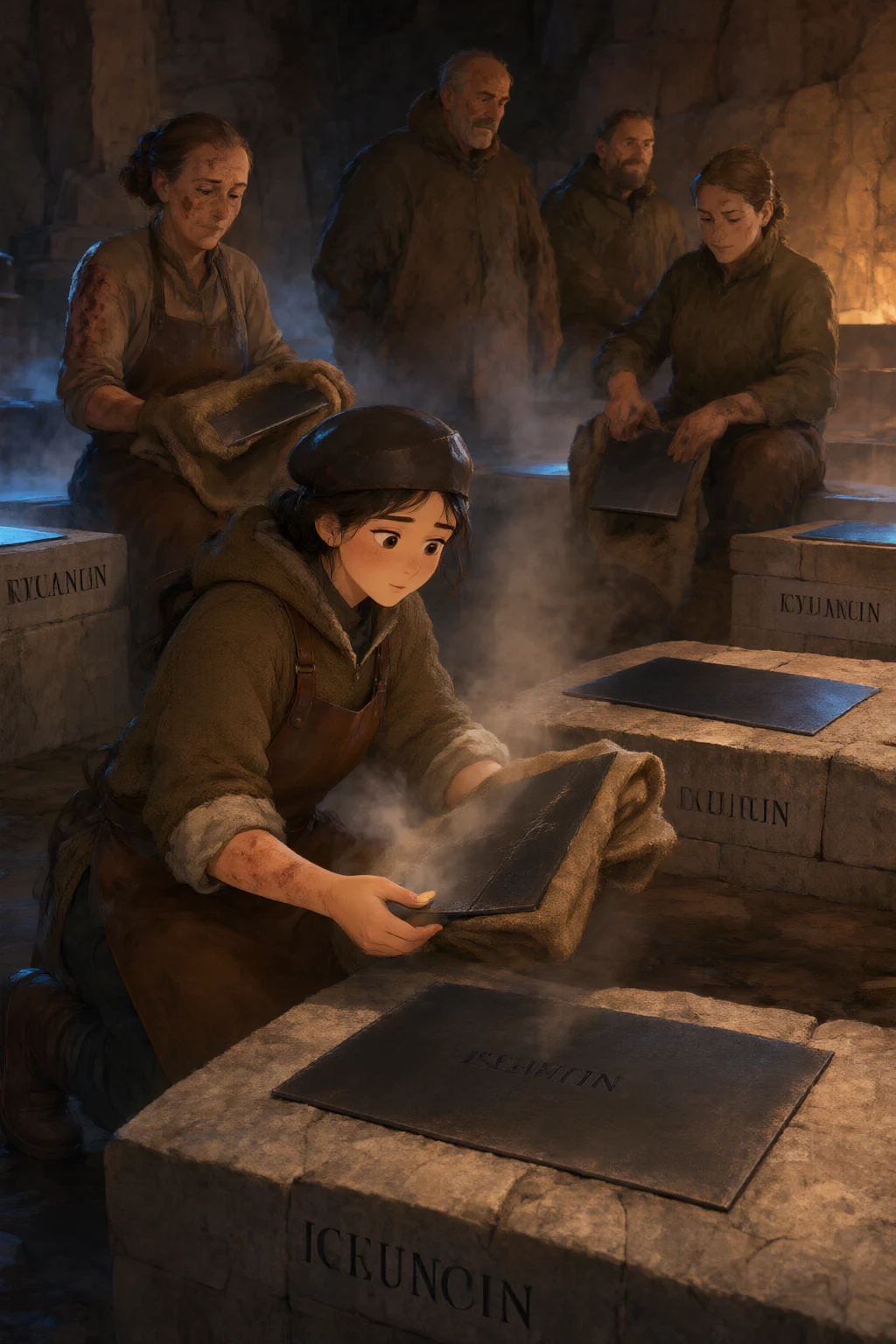
The Voidstone Terrace is eleven stepped benches cut into the mountain, and above every frost-plate is a family name cut in stone. A name against a claim is the oldest thing the guild has. Above the fourth plate on the Halloway line there is one word. HALLOWAY. On the third day of the thaw that autumn, the Halloway plate hissed, the sound a kettle makes four minutes before it boils, coming out of the granite at knee height.
Tamsin Vetch was thirteen, and she was holding the bar, and sweating inside her coat because the iron was trying to climb it. “Off,” said Master Vaunt from the top of the bench. “Both of you. Do not stand in front of that plate to talk.” Out on the step, Tamsin put her hands under her arms, because they had gone the colour of a wet stone. “Cold that is not held is nowhere,” said Ilva Sorne. “A void with a cracked plate bleeds into the hill.”
She was twenty-nine and worked the Iron Row, where the plates were made. Her forearms were burn-scarred, and she held everything cold in oiled wool. “The assay office writes that off as loss, and the loss goes against the last name nearest the plate.” “Which is mine,” said Master Vaunt. “I set the order this morning.” “Number four has held a hundred and ten yards of first grade for eleven years without losing a spoonful,” said Ilva, “and it is making a noise like a kettle. Take it down.”
Master Redlaw looked up from the anvil. He was short and loud, and a remark from him landed like a dropped tool. “Take it down, and who fits the new one?” “You do.” “I have done nine this year. She has done four, and every one is as sound as a bell. I am being accurate, not unkind.” “Then she does it and you hold the light,” said Master Vaunt.
Taking a plate down is a cold job in a warm way people never expect: you drive wedges under the iron until it lifts a finger’s width, then get your fingers under it and lift. It came off with a sound like a boot coming out of deep snow, and it weighed as much as a small boy. Tamsin held it in the wool while Ilva turned it over. “Look at the seat.” The granite was black and wet, and there was a bead of standing water on the low corner that would not freeze.
“Water means the plate is not sitting flat,” said Ilva. “Where it does not sit flat, the charge gets under the edge and works at the iron from underneath, where nobody can see it. That is forty years of a hill breathing.” They laid the face on the anvil block, and Ilva went along it with a bright steel and a bit of chalk, the way you go along a row of teeth.
“There,” she said, at the third course from the bottom. “Hairline. And the fix is not a hole. The fix is the whole face, because you do not fill a seam on a plate. You do not trust it.” “Two days,” she said.
Tamsin Vetch fitted the patch. She cut it out of an offcut with a hot chisel, so that the iron broke and not the edge, and ground the face until it shone. Then she heated it, and not too much, because iron worked too hot is soft and too cold cracks at the edge.
She filed the seat true and blew the dust out with a leather bellows. She laid the patch in, and it went down half a grain and stopped, so she lifted it, took a whisper off the high corner and laid it in again, and this time it went down flush all along: the two of them were one plate with a line in it.
She fixed it with six iron pins, driven hot and peened square, the way the old hands did it. Then she peened the edge with the small-faced hammer and ran oil along the seam, and it went black and wet and stopped weeping. On the second day she set it back into its seat and stood back. The Halloway void did not hiss. The water on the seat had frozen hard, the charge held on, and the whole bench was quiet.
“That is the best seat cut this year,” said Master Redlaw, out loud, in front of the whole Iron Row, which from him was no small thing. “Vaunt, look at that seam.” Master Vaunt put his thumbnail in the line, which is what you do. There was nothing under it but iron. “Eleven years I have been up this hill,” he said, “and I have never seen a patch sit that clean.”
Tamsin stood very still, because she had been in the yard four months and knew the rule: a smith does not argue with a compliment, and does not thank you for one. “There is a sheet for it,” said Master Redlaw. Every plate went into the plate book with the hand that fitted it. A charge follows a hand, not a man, so a bleeding plate is charged to the last hand near it. “Put mine,” said Master Redlaw. “Put yours?”
“Put mine and yours. If the seat holds, no harm done. If it does not, I would rather the eleven marks came to me than to her, and rather still to me than to you, Master Vaunt.” “That is a very large thing to say in front of an apprentice,” said Vaunt. “It is the true thing, and the true thing costs nothing.” And he wrote both their names in the hand column. Tamsin went up the yard and washed her hands, feeling as if something had been put on her that she had not asked to carry.
The first real freeze came on the ninth of Frostmonth, at night. It was a still cold, with the wind down in the valley and the temperature falling a degree an hour.
At some time in the night the Halloway plate went. It made a noise like a bar dropped on stone, and it echoed along the bench, and then the whole line came awake, because that is what a line of plates does. They went off one after another, hissing and steaming, and the granite ran white where the charge came out, and the white went down the cut and ate the path to the yard gate. They were up the hill by the second bell, and Tamsin was with them.
The plate was off its seat. Half of it still hung in the frame. They lifted it clear with the wedges, and it came away whole, with no hiss out of it, because a plate that has let go does not go on letting go.
They took it down on a sledge to the yard, and in the light of the forge Ilva Sorne laid it on the block, looked at the back of it, where the patch was, and turned the plate over. She went along the seam with a bright steel, and then with her thumbnail, and there was nothing under it. The oil had gone hard and black in the line, and the two pieces of iron were as close as two pieces of iron can be. “Your patch is perfect,” she said. “It is not. Look —”
She put a finger on the lower edge of the old iron and turned it a little, and a line opened there like a wet hair. It went up through the whole face and out at the top corner. “That is not a crack,” said Ilva Sorne. “That is a plate.” Nobody said anything.
“Cold shut,” she said. “Look at the grain. That is what a plate looks like when the pour went in too cold and too fast and the iron set before the bubbles got out. A chain of little holes through the metal, sealed over, holding for forty years, and one still night it lets go from the inside out.” She put her hand flat on the old iron. “It was cast in a hurry, in a bad month, by somebody who was not a smith. It has been good iron ever since. It was never good iron. It was iron that agreed to behave.”
The assay office wrote it off the same morning. LOSS. FOUR. HALLOWAY. Recharge, eleven marks. Then the plate book came out, because the assay office never writes off a loss without going to the hand first, and the clerk charged the last two names in the hand column. Master Redlaw sat down on the anvil bench and put his face in his hands. “Eleven marks is not the trouble. The trouble is that I have a boy in the second year. The eleven marks is a year.”
“It is the book,” said Master Vaunt, not looking at anybody. “The last hand near the plate is the hand on the sheet. I have known that since I was twenty-two.” “The hand on the sheet is mine, and it is not mine,” said Redlaw. “That is the whole of it. I did not fit that plate. A girl of thirteen fitted it, and she fitted it better than either of us, and the charge has gone to me because a name is a name and the book does not ask.” “Master Redlaw,” said Tamsin. He looked up.
“It was my fault,” she said. “When you were talking about the sheet, I should have stood up and said that I did the work.” “You should not have said it, because you were right,” said Redlaw. “A compliment is not a bill. Nobody takes a bill for a compliment.” He turned to Vaunt. “Write it true. Put her hand on the sheet and take ours off, and let the loss sit on a plate with a cold shut in it, because that is what the loss is on.”
It took four days to get a new plate poured. Ilva poured it herself on the quarry floor and stood over it in the wind so it would set slow and even. Tamsin set the new plate in the seat and pinned it and peened it and oiled it, and the Halloway void came up charged and stayed quiet, and a hundred and ten yards of first grade went down to the gate on the first sledge of the month with a brass disc on a cord.
On the last day Ilva took a cold chisel and cut one letter into the back of the new plate, on the part that sat against the granite and would never be seen. She cut a T. “That is yours,” she said. “Put it in the book beside your hand, so that if this one ever goes, they will ask the right person. In two years there will be plates of yours on four benches with the mark on them, and whoever comes after will know the seam was done by somebody who could be trusted with a seat.” “It is hidden.” “It is in the seat,” said Ilva Sorne, “which is the only place in this guild that is hidden where it counts.”
Master Redlaw came to her in the yard on the last evening with the plate book under his arm, and opened it on the anvil block. In the hand column, in fresh ink: FITTED, T. VETCH, APPRENTICE, IRON ROW. And opposite, where the charge was entered: ELEVEN MARKS, ENTERED AGAINST THE PLATE, AND NOT AGAINST A HAND. “I wanted you to see it written,” he said, “because a thing that is only said out loud in a yard is a thing that has not happened yet. That is the whole reason for a book.”
“It was a good patch,” said Tamsin. “It was a perfect patch,” said Redlaw, “on a plate with no crack in it that did not deserve it. Do you know how many of those there are, in a guild this old?” “No, Master Redlaw.” “Nor do I,” he said, “and that is the part that should keep a good smith awake. Here, drink that before it goes cold.” It was the hot bitter drink. It tasted of a stove, and it was the best thing a stranger had ever given her. “Go home, girl. Your mother will have the fire out.”
She walked down the terrace in the dark, past eleven benches with eleven names cut in the stone above them, and at bench six she put her hand on the new plate, which was the cold of a river stone and no colder. Under her hand, in the dark, was a T.