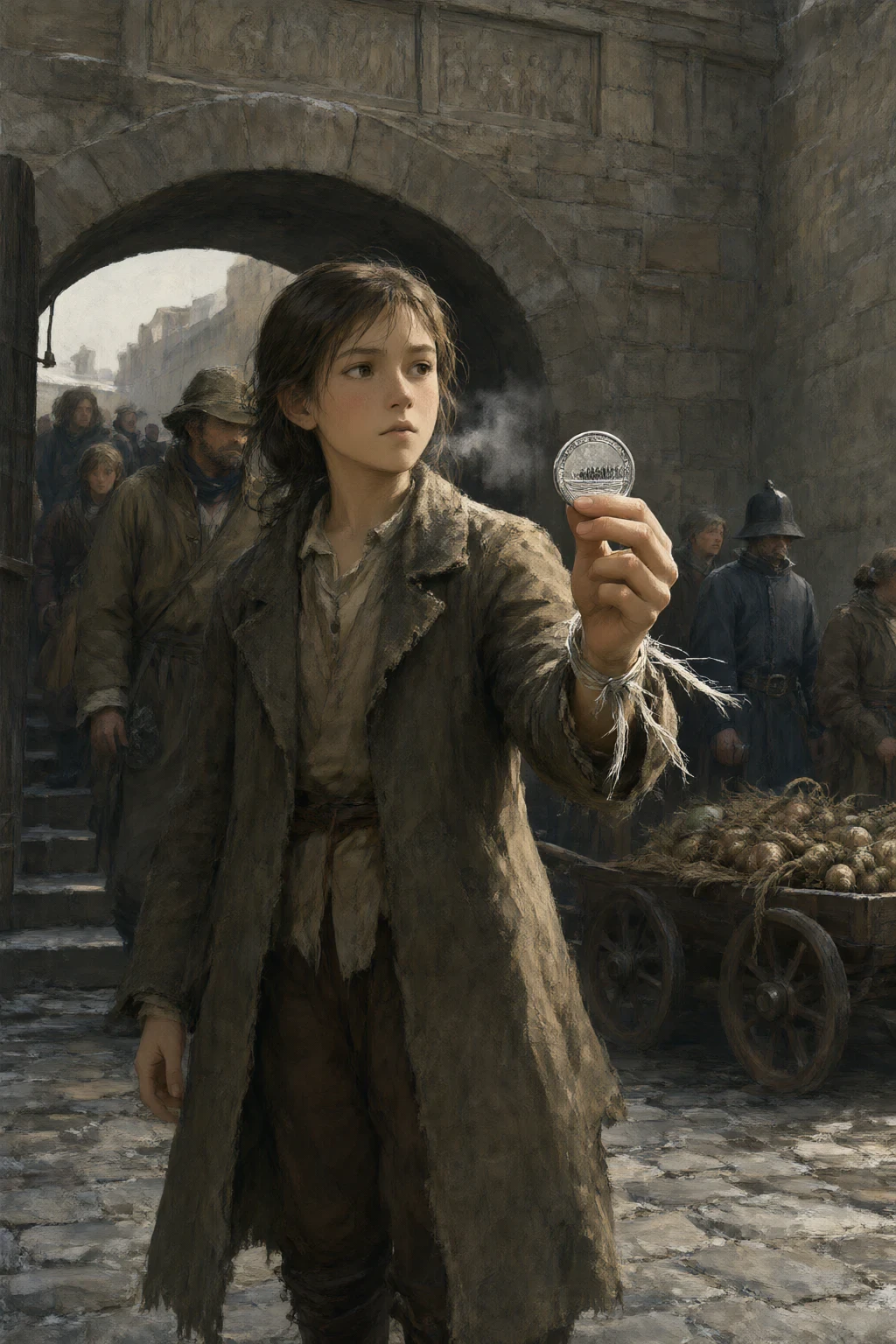
The traveller came in on market day, which is the only loud day in the world, and she stood in the queue at the Upper Gate with her hood down and her hands empty and her face turned away from the guards, which is the one thing at that arch that everybody understands and nobody mentions. Jessa Roke was thirty-one. She sold news for her living, badly, in the way that people do who have noticed that news is the only commodity that gets more valuable the worse you tell it. She had eleven years of it in her, which is eleven years too many, and there was exactly one piece she could not sell. “Sit, there is broth,” said the guard. “Sir,” said Jessa. “That is not mine, that is the Court’s. Do not touch the wall, the wall is the stories, the wall is smooth from being told.”
Red Halloran had ink on the thumb of his right hand the way every guard on that arch had ink on his thumb, and he turned the palm of it up and looked at it, and it was blank, which meant she had nothing, which meant she could not go in. “I have nothing,” said Jessa, agreeing. “That is the first honest thing said at this arch this week. What do you want?” “To hear how the Queen was named.” Halloran looked at her for slightly too long. The queue behind her went on being loud, a man haggling over rope, a dog, a cart of turnips that had come eleven miles and would not go eleven more. “Nobody knows how the Queen was named,” he said. “That is not a thing anybody knows. That is a thing that happened before this arch was an arch.” “My gran stood in this queue,” said Jessa, “the morning the boat came in.”
They let her in because there is no rule against it. The arch is not a rule about what you carry. It is a rule about what you pay with, and she was not paying with anything, and this one is many things but it is not the kind of court that turns away a person with an empty hand. Inside, the palace smelled of cold metal and old paper. The Hall of Telling was pale silvered pine with no corners, and over the middle of it hung a brass lamp the size of a wagon wheel burning one clear steady flame, and below the flame a disc of light lay flat on the boards with a hard edge to it, the way a coin has an edge. A woman stood in the disc. Four people stood at the rim of the light and kept their distance. The woman in the disc was the Queen, and she had asked to be there.
“Say it again,” said Ysandre the Long-Waited, to the traveller. “Say the request again, so that I am answering a request and not a rumour. It is better that way. I have found that everything I have ever said has been a rumour of something I said.” Jessa Roke said it again. Ysandre’s crown was a circlet of hollow gold ringlets, like a circlet of split coins, and her fingertips were pale and translucent enough to read a page through. She lifted one and held it in the lamplight and looked at the little bones inside it, and then she spoke in the formal beautiful cadence she had been taught by people who are dead.
“In the year of the low water, a boat came up under the shelf,” she said, “and there was a child upon the boat, and the Court received the child, and the Court named her, in the Hall, by the whole company, with a candle at the window, and the name was given for the manner of the giving, and it was— well. It was something.” The Hall waited. “It was something,” said the Queen, with enormous dignity, and put her translucent hand flat on the rail. Nobody moved, because a Queen does not lose the end of a sentence, a Queen simply goes on to the next part, and the next part would come. It did not come. The Queen stood in the light with her mouth a little open, and then she said, in a small flat voice, “I have told that one a great many times.”
“Two hundred and eleven, dreadful,” said Tallow Merrick, at the rail, counting as she spoke. “Two hundred and ten, dreadful. It is the same telling it has been since before the flood of the cistern, and by now it is a husk, Your Majesty, and I have had it in the fourth tray since I was thirty-one, and I have never once wanted to look at it.” “There is a story about the boat,” said Jessa Roke. “There are eleven stories about the boat,” said Tallow, “and they are all in the fourth tray, and the fourth tray is a bad year. What is there is the Court’s boat. The Court has a very good boat, and it has had one in every telling in this building since the beginning, and it always has somebody standing up in it.” “The Queen.” “The Queen standing up in it, nine years old, in a wet shift, taking the view.”
“It is not nine years old,” said Jessa Roke. “It is four. I have heard my gran say the number was four, and my gran was not a liar, she was a queue.” “Then your gran was wrong, or your gran is the only person alive who is not, and in nine hundred years one of those has to be true.” Tallow turned to the Keeper’s side of the minting table. “Nobody can coin it. Rule three. A story may be coined once, and this one was coined, and if it was told twice this century the second telling was a husk and the third was water, and we are now at water.” “It was told once,” said Nim Ollowan, from the edge of the light. “Nim has seen the tray. And then— and then it did not get spent.”
Nobody had said that out loud in the Hall before. Grist Bellweather, who had come in from the mill with flour in the creases of his scorched leather apron and both thumbs hooked in his belt, stopped with his hand on the rail. “It did not get spent,” he said. “It did not get spent,” said Tallow slowly, and she went to the door of the Vault, and she came back with a tray, and the tray was the smallest tray in the building. The oldest coin in the Hollow Vault is in the smallest pigeonhole, under the third shelf, and Tallow Merrick has known that for fifty years and has never once put a key in it, because every other pigeonhole in that room is a key she has worn a hole in and the smallest one has no key hanging from her chain at all, and she made the chain herself. The Vault breathed at them when the door opened, a faint chalky breath. The lamps were low. The shelves went up and up into the dome in neat rows, and there were thousands of thin silver coins in the pigeonholes in velvet trays, sorted by size, sorted like bad eggs.
“In five hundred years nobody has ever given the Court anything but husks. Every good coin in this room was minted by somebody who is alive, or by somebody who came in through the gate with a story they had been carrying. Look at how small they are. They get smaller every decade. It is not that we are poor. It is that we have run out of other people.” She set the tray on the table under the Hall lamp, and the coin in it was not like the others. The others were pale, and flat, and worn, and when you tilted them the story-shape went out of them like a face going out of a cloud. This one was the colour of milk. Its edge had never been touched. It was a little thick for a coin and it was the only object in the room that looked as though it had been made this morning.
“Do not touch it yet,” said Tallow. “Nim. Come here. Look at the face, and tell me what you see, and do not tell me what it is supposed to be.” Nim Ollowan came and stood over it. She has a strip of unspun silver thread round her left wrist, frayed at the ends, which she retied while she looked, the way other people blink. “It is a boat,” she said. “It is a boat,” said Tallow. “Turn your head, and do not tell me anything, and look again.”
Nine hundred years of telling had taught the Court to read the shape on the coin as a boat with a queen standing in it taking the view, and that is what every account in the Vault says, and it is a lovely shape and it is nearly the whole of it. The boat is a boat. That part is honest. But the hull of that boat is not planking. It is a line of people, shoulder to shoulder, standing in the rain, and the shape Tallow had read as the boat’s keel for three hundred years is a queue: forty figures, perhaps fifty, in a single rank, all of them facing the same way, all of them waiting. And at the bow, where the water is, there are two pairs of hands, and between them a small figure, and the small figure is being lifted, and being turned.
“Turned,” said Tallow. “She is being turned round. In the oldest telling the Court has, the Queen is handed over. On the coin she is not being handed over. She is being turned so that she can see the line.” “So they showed her the queue,” said Grist. “They showed her the people who were waiting.” Tallow sat down on the edge of the table, which she had never done in the Vault in fifty years. “That is a different picture, and it means a different thing, and the difference is nine hundred years of a Court telling itself a nicer version than the one it minted.”
They went out to the Upper Gate to look for more, because Tallow Merrick did not trust one object, however good. The lintel over the arch is carved with the flat relief of every story the Court has ever been told, and it is worn to smooth illegibility, because that is what happens to a thing that people stop looking at. It is nine hundred years of our own faces going soft as chalk, and there is not one readable inch of it. Except under the arch, at hand height, where nine centuries of north weather have kept the stone wet and frost-nipped and hard as a nail, in the one place the queue shelters a body from the wind. “There,” said Nim.
It was a boat. A small boat with a high prow, seen from the side, low in the water, and the shape of it was the same boat as the coin. The Court had walked under that stone every day of its life and looked at the soft illegible part, because the soft illegible part is where the famous ones are. “Two pieces of evidence,” said Tallow, “in the same shape, made by two different craftsman hands, four hundred years apart. The coin and the stone. The Coin is the Court’s own. The stone is the weather’s. That is not a memory, that is a measurement.”
“All right,” said Jessa Roke. She had not moved from the step of the arch, and her hood was down and the sleet was finding her. “You have found out how she was found. I asked how she was named.” Nobody answered her for a while, because she was right, and because the next part was the part nobody wanted. “She was not named in the Hall,” said Tallow. “No.” “She was named in the mud, at that gate, by the line, before the Court had decided anything, and the Court has spent three hundred years telling itself that the name was given indoors by the wise, and that version is a husk, and it is the only reason there is no coin worth anything left in this building.” “Then who tells it?”
“Nobody can.” Tallow looked at her own hands. “Rule three. That telling was coined on the night and never spent, so it is not closed, it is outstanding, it has been sitting on that table for nine hundred years doing nothing. And rule eight. It is the Queen’s life, she is standing right here awake, and she has not been asked, and a thing minted over the head of a person in this room will not fail politely. It will ring.”
So they asked her, and it went wrong, and the way it went wrong told them what to do. Tallow Merrick, who had signed every mint in this palace for fifty years, put it as squarely as she knew how. “Your Majesty. Who named you?” And the Queen stood up in the disc of light and gave them the finest twenty seconds of oratory the Hall had ever heard, and every word of it was beautiful, and every word of it was the Court’s own account of itself with a hole cut in the middle where she should be, and at the end of it she said, “— and it was given in Latin, and it was— well. It was something.” “Do you know it?” said Jessa Roke. “Do you know what you were called that day?” “I know what I am called.” “That is not the same as knowing what you were called.”
The Hall shifted. It was a small sound, the sound a hundred and forty people make when they all decide at once not to laugh. “Your Majesty,” said Tallow, more gently than she had ever said anything. “Who gave you that name? Not the story. The name.” The Queen stopped. She put one translucent hand up in front of her mouth, and looked at the ring of watchers at the edge of the light, and something went across her face that was the thing you feel when you put your hand in a drawer expecting a key. “I have told that story so many times,” she said, “that I cannot get to the part where it is about me.”
That was when Nim Ollowan said the thing that solved it, and she said it badly, the way she said everything, with one detail too many in it, and the extra detail was the true one. “Nim thinks the Queen does not remember because everybody keeps asking her the same question,” Nim said, “and then— and then the Queen tells the answer to that question, and the answer is the one everybody wanted, and it fits, and it is true, and it is not the Queen’s.” The Hall was quiet. “Then we must not ask the Queen a question she has been asked,” said Tallow. “We must ask her a question she has not been asked,” said Grist Bellweather. “Which is a thing to say. Have you eaten? No. Sit. Sit, there is broth, and then you can be asked something you have not been asked, and it will not fit, and it will be hers.”
They did not ask her anything at all for about an hour. That is the part nobody believes afterwards, and it is the whole of the method. They sat her down. They did not ask her about the boat, or the gate, or the name, or the nine days of rain. Grist brought broth and a heel of bread and would not be talked out of it, and the Queen ate, and Tallow did not count it, and after a while the Queen said, out of nowhere, in a voice with no performance in it at all: “It was cold. I have never once been able to say that in here. Everyone tells it and nobody says that part, and my feet had been wet since the boat, and when they turned me round I could not feel the ground at all, and I have spent nine hundred years in rooms where everybody was looking at me and have never once been able to say that my feet were cold.”
Nobody in the Hall breathed for a while. Tallow Merrick put her hand flat on the table beside the tray, not on the coin, and said, very quietly: “That is hers. The coin has the boat, and the boat is the Court’s. The coin has the line, and the line is the Court’s, because the Court has been telling the line since before the boat. The coin has the hands, and the hands are ours. Three shapes, nine hundred years, and the Queen owns two sentences of it, and both of them are about being cold.” “Then the coin says what her part is,” said Nim. “It says it is short.”
The Queen consented, which nobody in the Hall had expected and everybody in the Hall had been afraid of, and she consented in a sentence that lost its own ending, and she said: “I will tell it if my part is in it and not merely at the front of it, and if the coin is spent and not kept, and I will tell it because it is true, and then it was— well. It was something.” “Spent,” said Tallow. “Spent. Not signed. Signed is what we do to a coin we intend to keep.” Tallow Merrick, who had never in fifty years failed to sign a coin, did not sign this one. She carried it to the sill, held it up to the draught, and it went gold-warm the way a good one does, and she put it down, and took her hand away, and the coin sat on the sill by itself, unbroken, waiting.
The telling was four sentences long, and the Court had three hundred years of its own telling, and it lasted about nine seconds. Ysandre the Long-Waited stood in the disc of light and said: that her name was given her by people who were not the Court, in the mud, at that arch, out loud, all at once, before any of the wise had opened their mouths; that they had been waiting nine days for the boat in the rain, counting the days out loud, four, five, six, up to nine, and had stopped counting on the ninth; and that what the line said was not a Latin word and not a blessing but three plain words in the common tongue, meaning a thing that has no single word in this palace because the palace has never once needed it, and that the three words were the name.
And then rule seven came and took its four seconds, the way it always does, and the true part happened again in her body. The Queen did not scream and she did not sit down. She stood in the light with both hands held out in front of her, and the fingertips, pale and translucent enough to read a page through, went from pale to blue to a colour with no name in the Hall, and the Hall watched the cold of one morning on the mud in 1911 arrive all at once, nine days of it, in a woman of nine hundred years, without a sound, and then it went out of her hands and her hands came back to being her own.
The coin minted. It did not go into the tray. It went straight up, the way the good ones do when they are not being caught, and turned over twice, and came down flat on the deal table with a sound the Hall had not heard in a very long time, and Tallow Merrick put both hands flat on the table on either side of it. “Nine hundred and thirteen,” she said. “One. Nine hundred and thirteen and one, and it is not dull, and I am not going to rate it, because I have never in my life been asked to rate one of those, and I do not know what the word is.”
The coin would not go across the Table’s rim in the Queen’s hand. Of course it would not. It was her own telling, and rule six is the cruellest line in the book, and every teller in the world is their own worst debtor, permanently, forever. “All right,” said Ysandre. “Then it is spent for the Court. On the Long Table. Tonight. And we shall find out what the Court has been buying with the money of its own childhood.” “Your Majesty,” said Tallow, “there is nothing in this palace worth spending the founding story on.” “There is a traveller in the gate arch who has not eaten since morning, whatever morning was,” said the Queen, “and there is a woman who has just told her own life out loud for the first time in three hundred years and can hold nothing at all, and there is a Court of a hundred and forty people who have been eating their own history for ninety years, and I would like one of those three things to be wrong. Have the table laid.”
They laid it for nine, because they always laid it for nine, and only four places were used. Jessa Roke ate bread that had not been ground out of a worn tale, because the coin bought fresh flour, and hot salt broth, and a quantity of vinegar that Tallow entered in the ledger as an extraordinary item, and she ate the way people eat who have been walking since before it was light, and she cried a little, and nobody at that table mentioned it. And the Queen ate too. She ate the same bread and the same broth, off the same cloth, at the same table, and the flour had cost the founding of the palace, and the cost was exact, and nobody was clever enough to have thought of spending it any other way.
Then the Queen stood up, and put her palm flat out on the table, and the fingertips were warm and pink and her own, and she said, in the beautiful voice that loses the end of itself, to a Court that had described her for three hundred years and had never once thought to ask: “Have you eaten? No. Sit. Sit, there is broth. It is not the same broth, and I have been fed on the other one for ninety years, and I would like it recorded, in whatever hand is left, that this is the first true thing anybody in this palace has fed me, and it does not go in the vault, and then it was— well. It was something.”
Marrow was waiting in the arch, because Marrow is always in the arch. “For a woman who sells news,” he said, “you have made a very poor trade. You came in with a true thing and you went out with a true thing, and nobody outside that arch will pay you for either, and there is a man on the road below the shelf who buys other people’s stories for less than they are worth, and he buys them from people who cannot stop talking, and that is a coin in somebody else’s pocket.” Jessa Roke looked down the wet road at the man with the strongbox, who was packing it away, and who had plainly come a long way and waited a long time for nothing at all. “No,” she said. “He buys them from people who cannot stop talking. I have stopped talking. That is what I came up here for.”
She pulled her hood up. The sleet had stopped. Under the arch, at hand height, where the weather had kept it for nine hundred years, there was a small boat with a high prow, and beside it a line of figures in the rain with their shoulders against each other, and a small figure being lifted and turned, and none of them had ever been the Queen standing in the boat taking the view. She went down into the mud. Behind her, the chaff mill made its one noise, distant surf, and the Ash Garden leaves moved in a wind off the water, and the leaves sounded like a room where people were saying nothing at all.