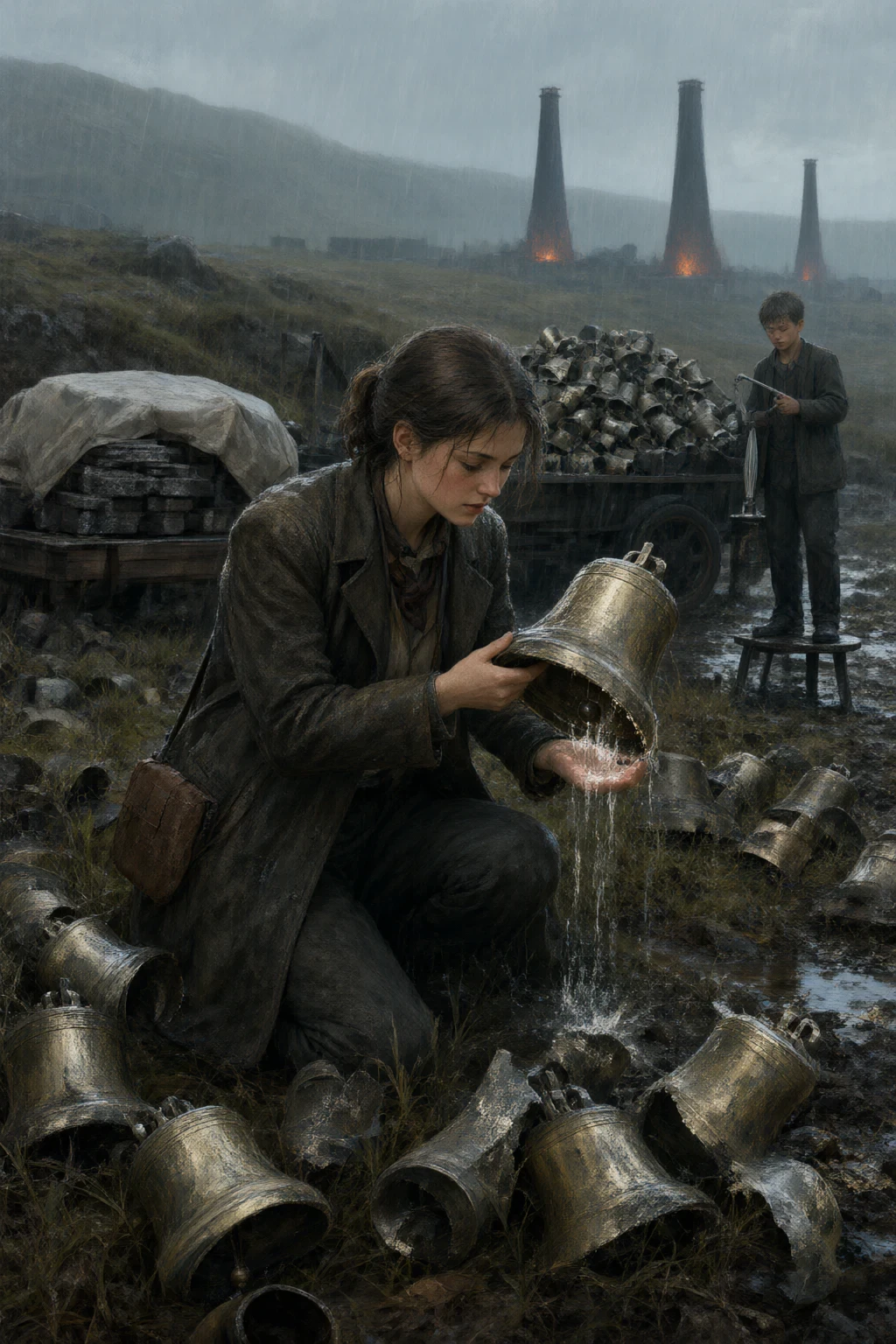
Verity Ash took a ladle-scoop of the foundry’s metal out of the furnace on a Tuesday in the ninth week of November and poured it into a wet assay cup the size of a fist, and the cup cost a shilling, and the metal came up the colour of a new penny and set with a ring round the edge that was not bronze. A bell is copper and tin. The casting book puts the alloy at seventy-seven and twenty-three, and the shed says three parts copper to one part tin, and both are right, and neither of them is the number that matters. The number that matters is lead, and lead is the one that never gets written down. There is a bench assay for it. Melton Ferrow used to do it on the north end of the shed floor with a charcoal stove and a firebrick, and the method is to melt the sample until the tin has come out of it as a grey skin, and then to look at what the skin leaves behind. A good charge leaves the cup clear, the way a bowl of water leaves a penny face up in the bottom. A charge with lead in it leaves a blue. The blue is a bloom, and it comes up underneath the grey like a bruise, and it will not come off. Verity had seen the blue.
“Twelve hundred and falling,” said Nan Ilva behind her, “and it will not do you any good at twelve hundred, because there is no blue at twelve hundred. There is no bell at twelve hundred.” She was not being difficult. She had both sleeves pushed down over the burn-white crescents on her forearms before Verity had asked her anything, which was a thing she did every morning and had stopped noticing, and she said temperature first about everything, a marriage, a funeral, a broken mould, a boy who had stayed too long at the lang bench. “The pour is Thursday,” she said. “Twelve hundred and forty, give or take a ladle.” “Two hours.” “Two hours. The book wants a weight off me for the alloy and I cannot give it one that is worth the paper.” She put her thumb into the cup and turned it so the light from the furnace mouth came across it, and the bruise under the grey skin showed up pale and round, and she did not look at it, because she had seen it before. “Fourteen hundredweight of virgin ingot off the wharf at the lime yard. Nine hundredweight and six pounds of returns. That is what the book says I am running.” “That is what the book says you are running,” Verity agreed. “I want to know what you are actually running, and then I want to write it down.”
Nan Ilva pushed a sleeve up. Then she pushed it back down, which was the answer, and went to the pit, and left Verity with the cup. The parish had asked for it, in writing, in September. The foundry’s office and the counting house had been kept by the same clerk for forty-one years and the clerk had kept them apart, and this was the first time in Verity’s life that anybody had asked a surveyor for anything to do with bells. The request was for a certificate of the weight of metal in the current charge, to be entered in the casting book against the entry for the cast. She had read the request four times looking for the trap and had found only a form letter, and the form letter said that the survey of the valley and the accounts of the foundry had lately been found to disagree, and that the parish did not wish to be surprised a second time. Nobody had told her what the first surprise was. She had assumed it was somebody’s arithmetic, and she had assumed wrong, and it took her until the following March to find out what it actually was.
The returns came in on a Tuesday, at the lime yard, at the hour when the whole town is in one place and the bells cannot be heard over it, which everybody had always assumed was a coincidence. Gethin Bell bought them by weight. It had bought them by weight for a hundred and forty years, from every church in four counties, and the buying was the first business of the market day, done in the rain, at a ring of stone setts, with a steelyard on a three-legged stool and a boy to hold the weights. Broken bells come in for a shilling the hundredweight, less for lead, and anything with an inscription on it less still, because nobody in four counties wants a bell with a saint on it and the foundry’s customers are mostly farms. The parish sold them. That was the part Verity had not known and had no reason to know, because it had been going on for the same hundred and forty years: the churchwardens of Gethin Bell broke their own bells when their bells broke, and carried the pieces down to the lime yard in a cart, and sold them to the foundry, and put the money in the fabric fund, and the foundry bought them because the foundry was the only buyer in four counties and the foundry bought its own metal back.
Both sides of that transaction were honest. She checked. The vestry minute books and the foundry’s day book and the market book and the casting book all carried the same figure on the same Tuesday, in a hand on each side that had carried figures for a generation, and neither side had ever had a reason to ask what the metal was going to be used for, because the answer to that question is always the same: a bell. “How much do they come in wet for?” Verity asked the man on the stool. “Wet?” “The rain. They’ve been lying in that field since they were carried down.” “They come in wet. Everything comes in wet on a Tuesday.” If you want the true weight of a thing you have to dry it. That is not a discovery, it is a Wednesday. What Verity had expected to be a hard sum was going to be a soft one, and she had brought the book of tolerances and the brass rule and a good temper, and she stood in the rain at the edge of the setts and watched a cracked tenor go onto the steelyard and read two hundred and eleven pounds, and thought: that is about five gallons of water, then, and it comes off in the furnace as steam, and it is five gallons that will be entered in the casting book as metal. The boy with the weights was watching her. “Ask them to stack them under the foundry roof,” Verity said. “A week. I will pay for the cart twice.” The boy considered this the way a country considers a suggestion from a stranger. “Four hundred years we have not done that,” he said.
In the counting house, on the north window sill, out of Aldous Crenn’s sight, because the counting house has one north window and the sill belongs to whoever is nearest to it, six returns were dried in the little iron stove for two days and weighed. Verity had chosen them herself from the market book: lot 214, Gethin Bell parish, three pieces; lot 219, Gethin Bell parish, two pieces; lot 231, Nether Corrie chapel, one piece. She had chosen them because the parish lots were the ones she could trace, and because she wanted six, and because six is the smallest number of weights you can average without the answer looking like an accident. The dry weights came out clean, in a column, on the back of a survey sheet with the ruled lines still showing through. Seven in ten. Seven parts of metal in every ten parts of what came off the steelyard, and three parts of standing rain, grass, and the black water that lives in the crown of a cracked bell and never leaves it because there is nowhere for it to go. She sat with that for a while. Seven in ten is not a discovery either. Every founder in England has known it in his fingers for four hundred years and has never had reason to put it in a book, because water is not a thing the book has ever had a column for.
But she had come looking for a number, and this was a number, and it was exact. And she took out the charge for the campaign and the withdrawals for eleven castings and did the sum properly, with the seven in ten on the returns, and it closed. It closed to within two pounds across eleven castings and three months. That was the good news, and she did not believe it for about a day and a half, and the reason she did not believe it was that it accounted for the water and not for the metal, and a foundry that weighs its returns wet is a foundry that is short of metal every single day of its life, and a foundry that is short of metal does not pour short. It pours under. It fills the mould to the chaplet and lets the ladle run dry and calls the last of it the skim, and the skim goes back into the furnace, and the skim is a loss, and a loss goes in the day book as a loss. The book had no losses in it. That was the thing that had been sitting in front of her since the ninth of November, and she had not known it was the thing until the water explained everything else. So: either the losses were real and unrecorded, or the metal was not short. Verity Ash put both hands flat on the sill of the north window, which was her habit, and felt the frame, which told her nothing, and went down to the shed to weigh some bells.
The pattern for a cast is kept in the pattern shop and it is the bell itself, made of pine, in twelve sections, and from it a man can tell you to within a pound and a half what the bell will weigh when it is full of metal. The founders have used the same figure since 1802, and the figure is about nine pounds out in every hundredweight, and everybody knows that, and nobody has ever cared, because a bell that is nine pounds out is a bell you weigh again after it is lifted and out of the sand. This is what Verity did. She took eleven castings out of the last twelve months, out of the pit yard weighbook, and set them against the patterns, and wrote the difference in a column headed with nothing at all, because she did not yet know what the column was for. The first bell of the campaign was a two-hundredweight lamp bell for the workhouse and it was four ounces light, which is nothing, which is the error of the man at the weighbridge, which is Verity herself on the first occasion. The second was three pounds four ounces. The third was nine pounds eleven ounces.
The fourth was twenty-one pounds. The fifth was thirty-four. The sixth was fifty-two. The seventh was seventy-one. The eighth was ninety-six. The ninth was a hundred and eighteen. The tenth was a hundred and forty-three pounds and eight ounces, on a bell of nine hundredweight, and the eleventh was a hundred and seventy-one pounds on the Nether Corrie tenor, and the tenor was the largest bell the foundry had poured in four years and it went into the mould short by more than the whole weight of the smallest bell in the Cloth Hall tower. “It is a curve,” she said, out loud, in an empty shed, to a man racking moulds who did not look up. The curve was not a curve in any way that a curve gets drawn. It was a line, straight as a level, because the alloy does not drift by accident and has no opinion. It goes one way. And it did not flatten. It did not need to flatten, because there were only four more castings in the campaign, and then the furnace would be tapped at the end of the winter, and the residue would be swept into the tap hole and shovelled into the tip, and the next campaign would begin from a full charge of new metal with a full charge of new returns, and the new campaign would have no history in it at all.
What Verity could not get past was not the number. The number was the water, and she could put a pound on it. It was that a thing which had been running for three months unseen could start again on Thursday morning, be a different three months, and run a different line, and be stopped by nothing whatever, the only thing that could stop it being a man deciding to write a line in a book, and no man in Gethin Bell had that for a job.
She did what any surveyor does, which is to make the number say more than it can carry on its own, and then to see what it says when it is made to carry more. The shortfall for each casting, in pounds, went into a second column, and the second column went beside the third, and the third column was the foundry’s own register of bells cracked or broken, by the year and the quarter, with the weight of the pieces as sold at the lime yard on the Tuesday following. Seven pounds four ounces, and lot 214, three pieces, Gethin Bell parish. Twenty-one pounds, and lot 219, two pieces, Gethin Bell parish. Fifty-two pounds, and lot 231, one piece, Nether Corrie chapel. It held. It held the way a good joint holds. Nine of the eleven shortfalls came out of a parish sale to within a pound, and the two that did not came out of a sale at Fennick Bridge that Verity could not trace past the market book, and the two exceptions were themselves the interesting part, because the Fennick Bridge metal had come into the campaign two months earlier than its arithmetic wanted it, and the account book showed a return of it in the middle of the run, and the return was marked, in Aldous Crenn’s careful upright hand, as an error of the weighmaster.
Nobody had stolen anything. That was the part that took her three weeks and two bad nights to accept. Gethin Bell had sold its own dead bells to Gethin Bell, on a Tuesday, in the rain, for the roof of the parish church, and the roof was slate and good and thirty-one years old, and the two ledgers agreed, and both had been kept by men who had wanted them to agree. The bell-metal that came off the market and went into the furnace was Gethin Bell’s own metal: the crowns and soundbows of bells the town had rung and the town had outlived, standing in a wet field with their inscriptions face up in the puddles, sold by weight, wet, by the only buyer there was. And every pound of the shortfall, from the ninth of November to the fourteenth of January, was the rain that had been standing in them.
The register of cracked bells gave her twenty-six between November and the end of March, over four counties, and she was looking for four counties, and that was the whole of the reason the town had got away with it: the metal came from everywhere and the shortage could be looked for everywhere, and a thing that is everywhere is a thing that is nowhere. She did not have four counties. She had one parish, and it was hers, and the ledger in front of her was the ledger of Gethin Bell, and the twenty-six entries had weights against them, and eleven of those weights came back out of the ledger and did not come back out of the world. Eleven bells, six tons and three hundredweight, in four headstocks in four villages, every one of them entered in the casting book as being in service, and every one of them, according to the register, having been broken and carried down to the lime yard and sold by weight to the foundry.
And the twelfth was in the same ledger and the same register, and it was not in the country, and it was four hundredweight and four pounds, and it was cast in 1881, and it was the smallest bell in the Cloth Hall tower, and its purpose in the book was written in the oldest hand she had yet seen in the book, in a word that had been spelled two different ways in two different years and had settled. It read: the school, and the curfewe, and it will not be stopt. “That one will not be stopped,” Verity said to Ebba Roke on the top stair of the Cloth Hall tower, on a Thursday in December, with a lamp. “Say that again.” “I didn’t say anything.” “You did. You said that one will not be stopped. You say what the book says when you read a bell’s line, and you have been standing in this tower every school morning for six years and you have not said that line out loud once, which tells me you have not had it in front of you, which tells me a good deal.”
Ebba Roke was fifteen and had a strip of grey wool wound round her right palm, permanently damp, over a burn she would not show anybody, and she stood on the top stair with her hand on the frame of the belfry door and she did not go in. “I only ring the small one,” she said. “I’m not allowed the other.” “I know which one you’re not allowed.” “I ring the small one at eight and at four, and the big one for the fire, and the middle two for the hours, and the little small one on Sunday.” She heard it as she said it, and stopped, and her face did something Verity had not seen it do. “That’s three and the small one.” “Yes.” “I’ve rung three and the small one every morning since I was nine.” “Go on, then.” Ebba went in.
There are four headstocks in the Cloth Hall belfry, on a modern wheel-and-rope system, with a gudgeon on each and a rope through each and a stay beside each, and the stays were all dressed and the ropes were all sound, and the wheel was greased, and somebody had oiled the stay of the smallest headstock in the last fortnight, which meant somebody had been up here lately doing a thing to it that did not need doing. Ebba put her hand on the rope. She did not ask. She never asks. The headstock swung, and the wheel turned, and the rope came up over the sheave, and the sound that went out into the valley was not nothing and it was not nothing that anybody in Gethin Bell had ever been able to name. It was a wooden note. It was the headstock’s note, and the stay’s, and the note of a wheel on four iron bearings with a four-tonne mass on the end of the rope, and it arrived in the back teeth before it arrived in the ears, and it carried, because the tower is stone and the valley is a limestone gorge and the tower sits two hundred and forty feet above the river, and it carried very well indeed.
Verity had two fingers flat on the sill of the belfry window while it went. She had heard the fire bell from inside the tower and had never once in her life been able to hear it the way the valley hears it, and the difference is not a matter of distance, it is a matter of which room your body is in. The sound went out. It came back off the far slope a half-second later and it was thinner. “It goes down to Corrie,” Ebba said. “Don’t it. It goes all the way down to Corrie.” “It goes to Corrie,” Verity said. “Then they hear it.” “They hear it.” “Then it’s working.” “No,” said Verity Ash. “Nothing is working. That is a sound a rope makes. Forty paces, give or take the wind. Everything you have just heard was made in the last four seconds, and the school has been keeping that hour on it for six years, and the hour is kept, and the children are in the school at eight, and the thing that has been doing the keeping is a length of hemp and four iron bearings.”
It was not the bell that was in the field. Verity established that within the week, and it took a week because a bell that has been down for six years is not where anybody remembers it. It was in the register, in the third week of February six years before, three pieces, Gethin Bell parish, sold at the lime yard, four hundredweight and four pounds. It was in the second week of February, in the parish minute book, in a hand that had kept a minute book for nineteen years, in a sentence that anybody would have thought was about the roof. It was in the casting book as being in service. And the reason it was in the casting book as being in service was not a clerk’s fraud, and it was not four hundred years of conspiracy, and it did not require anybody to be wicked. It required only that a bell had once been rung for a purpose that its flaw did not serve, on a night when it was not wanted and could not be got to stop, and that the ringing had been heard in four villages, and that the four villages could not afterwards remember the sound.
They could all remember that it was wrong. They could remember that something had gone wrong in the tower that night, and that it had gone on, and that it had gone on past the time when the reason for it had gone, and that eventually a rope had been cut, and that a bell had come down, and that the whole valley had heard a sound that had nothing to do with any bell in it. The one name they did not have was the name of the man who had gone up to the tower and put a child on the rope, and the reason they did not have the name was that a rule had been broken, and the town knew that a rule had been broken, and could not remember what it had heard, and could not remember why, and a thing you cannot remember is a thing you cannot be told about, and a thing you cannot be told about is a thing that cannot go in a book.
So it had gone in the other direction. A bell that had been rung for a purpose it did not serve, and broken in the answering, went into the register as metal, and its metal went into the furnace, and the furnace made a bell for the school at Nether Corrie, and the school at Nether Corrie has no bell, and has had none for six years, and the children arrive at eight because the school is a school and schools are open at eight, and the bell is not the reason they come.
She wrote the survey on eleven sheets and it had no words on it. That was not a stylistic decision and it was not a protest. It was that she had spent six weeks with the numbers and the numbers were the finding, and that she was the town’s surveyor and the parish’s Sister-in-law and it was her office to deliver a figure when a figure was what was asked for, and a figure was what was asked for, and there was no question on the table that wanted a yes. Sheet one: the assay, and the blue, and the date. Sheet two: the charge, weighed, fourteen hundredweight of virgin and nine hundredweight and six pounds of returns. Sheets three to five: the drying, six lots, seven in ten, with the two exceptions marked. Sheet six: the eleven castings, the patterns, the pit yard weighbook, the column headed with nothing. Sheet seven: the register of cracked bells, twenty-six, in four counties. Sheet eight: the eleven that were in service, six tons and three hundredweight, with the headstocks named. Sheet nine: the twelfth, the school, the curfewe, four hundredweight and four pounds. Sheet ten was a note of the eleven Thursday markets at which Gethin Bell parish had sold broken metal to Gethin Bell foundry, and the money, and the roof. Sheet eleven was the thing she wanted to be asked for.
It was one line. It read: THE TOWN HAS BEEN MELTING ITSELF INTO ITSELF SINCE THE YEAR EIGHT HUNDRED AND NINETY, AND NOBODY HAS BEEN DOING ANYTHING WRONG. “Eleven sheets,” said Ebba Roke, in the counting house stair, on the last Monday in March. “And not a word on them.” “There’s not a word on them.” “Then what’s the point of the paper?” Verity looked at the girl for a moment. Fifteen, damp palm, a rope burn under a strip of grey wool, and a head that had been counting since she was nine and had counted a hole in the air for six years without once finding it, and she had asked, that morning on the top stair, the single question that a person can ask when the whole of it has gone out of the room. “If I made you a word for it,” Verity said, “I would have made it up, and it would be mine, and there would be a thing in the book that a woman from outside had said about Gethin Bell, and in forty years the clerk would be quoting me, and nobody would ever know there had been a woman.” “So you did the numbers.” “I did the numbers.”
They walked out to the Scrap Field after four o’clock, on the last Monday in March, and it was raining, and it had been raining for eleven years. It is a sloping field west of the foundry and there are four hundred bells in it. Some are whole. Some are in pieces. The oldest are medieval and are in pieces, and they are not recognisable as bells at all, and the place is where a bell goes when it has stopped being one. Verity had stood at the top of that field a hundred times and had never once noticed that it was the quietest place in the parish, and on that Monday she noticed it, and the noticing went into her like cold water. There is no voice here. Not a hum, not a breath, not the drip of a raindrop into a crown. Four hundred bells lying in grass and standing water, inscriptions face up through the puddles, and the field makes no sound whatever, because a bell out of its headstock, in a yard, in the open air, is not a bell. It is a heap of bronze. It cannot be heard at all. And the silence in that field is total, and it is total in a way that only somebody who has stood in a belfry and felt four hundredweight of bronze go out over a valley would be able to account for.
Gethin Bell had been standing at the top of that silence for four hundred years, taking from it, by weight, on a Tuesday. “Eleven thousand gallons,” Verity said. “That is what came off the steelyards last year. Eleven thousand gallons of rain that had been standing in the crowns of our own dead bells, sold to us by the churchwardens, and credited to the alloy, and boiled off in a furnace at twelve hundred degrees, and the difference taken out of the casting book one pound at a time.” “And next Thursday,” said Ebba Roke. “And next Thursday,” said Verity Ash, “is the hundred and seventy-second.”