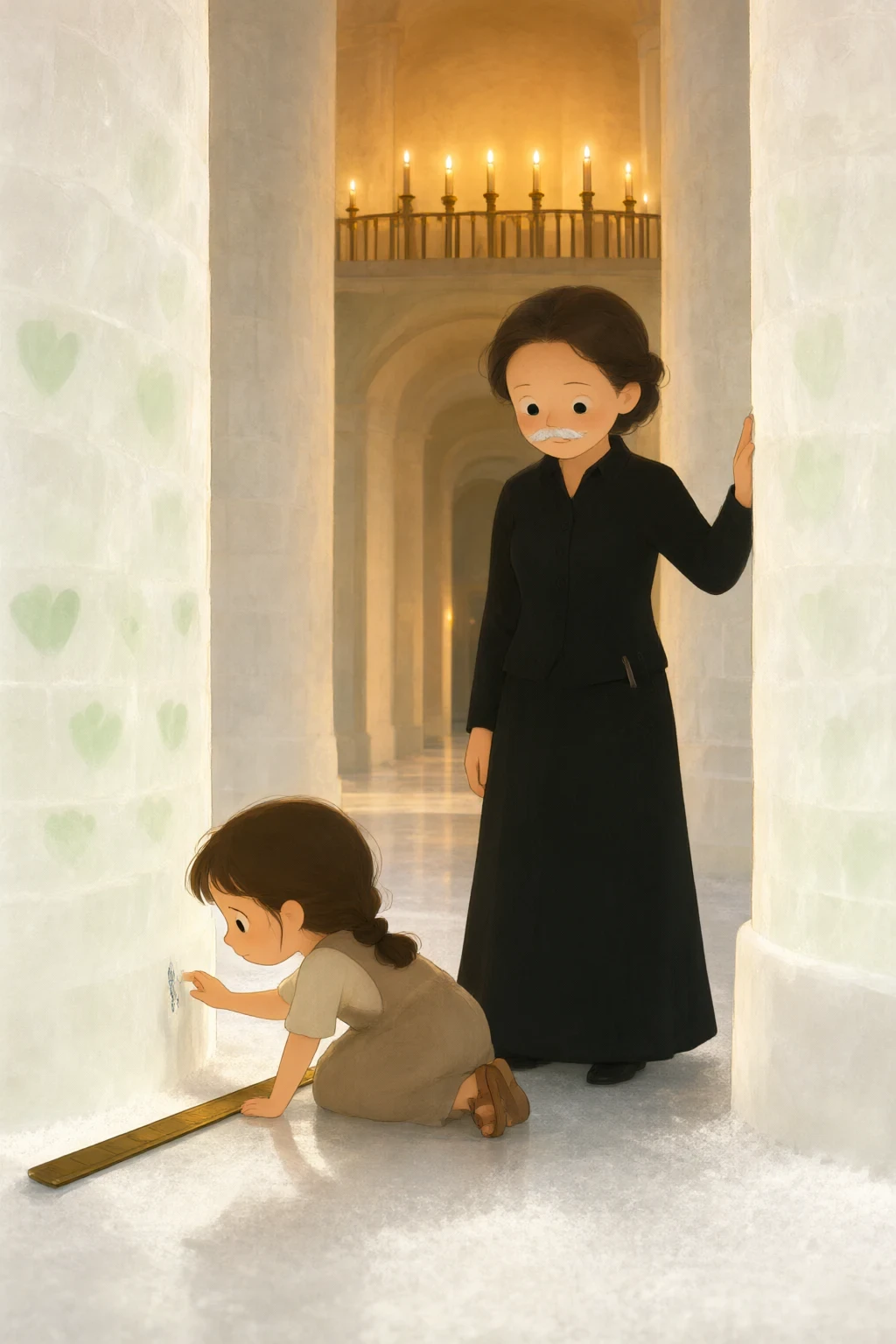
Nessa Lundy had never been under the white before. She was seven, and she lived on a farm up on the Rim, where the ground was hard as a table at noon and soft as a bruise at dusk. She cut salt blocks beside her father with a hooked pole, two small hands, all day. He hummed one note while he worked, the same one over and over, the way a man counts. On Tuesday her auntie Wren took her down, because Tuesday was the day the freight cage was up.
“Don’t let me say a hundred and thirty-eight twice,” said Wren from the ladder ahead. Nessa counted one hundred and forty, both ways. At the bottom the air stood at fifty-one degrees and smelled faintly of eggs, and Nessa looked up and stopped being a person who had finished counting.
The nave went on and on. Columns stood down both sides, and they were not stone. They were white as the top of a milk bottle with a pale green heart in the middle of each one, and forty candles burned along the arcade, and every flame came back out of the crystal a second time, so the whole room glowed from the inside, like something asleep.
Hesper Vail was waiting at the foot of the stairs with a candle in a tin holder. She was seventeen, a brass-tipped hairpin in her hair, and salt in white crescents under both her nails, the kind you get in a swimming pool. “Hesper is going to walk slowly,” Hesper said, “because the grit is loose.” The grit squeaked under every boot like snapped sugar. Nessa’s shadow was not behind her. It was out in the aisle ahead, small and grey, standing there waiting to be introduced.
At the crossing they stopped. Overhead, a railed loft held six choir stalls set in a curve, brass-tipped, worn to a mirror shine at the mouth of each seat. A woman looked down over the rail. She was tall and grey in a black gown, and above her upper lip was a white moustache of salt crust, kept to shape each morning with a small file in her breast pocket. “Marrow,” Hesper said. “This is Nessa.”
Her voice came out as a note, a low one you could feel in your back teeth. “Nessa Lundy, seven, cuts blocks on the Rim. Ilde Marrow, forty-seven. I answer in whatever I am holding, so forgive the way I talk.” Then she dropped into an ordinary speaking voice, which was much kinder, and knelt, so they would be the same height. “Six of us sing,” she said, “and everything in here holds the shape we put on it while we sing. That is the whole job, and it is four hundred years of work.”
Nissa Ashkel met them at the door of the north aisle. She was twenty-two, and the front fall of her hair had gone bone-white in a hard fringe, singed by sleeping too close to a sunlit shaft. She looked like somebody who slept all day and was not rested by it. “This is the bay,” she said. “The bay, the bay, the bay. This is where it does it.”
At the end of the aisle the growing gallery pushed gently outward, smooth and faintly warm, humming the way a fridge hums, but a fifth higher than the choir. Eleven feet of it so far, and a room at the end with a page in it. They did not go to the end. The rule was the rule. Instead Nissa crouched and laid a long brass rule flat across the growth. Beside it, on the stone, was a chalk mark, a little arrow, and a date.
“Last Thursday,” she said. “Half an inch. Four directions at once, every week, same as always. That chalk mark has been coming down this aisle since before I was born.”
And then Nessa heard something under the humming. It came from the sixth column on the left, a sound like a cart with a bad wheel: thin, low, off by a hair. That column had gone cloudy, like a window in an old house, and round its foot a soft white bloom was spreading out into the grit and thickening. Nissa sang. Her note went up the column thin and bright and did not come back. She sang it again, and the column hummed its bad hum underneath her, and the bloom did not stop.
“Spire,” she said. “Spire, spire, spire. That is my order. I set the vertical. It is the easiest thing in this building and I cannot get it right.” “Can I try?” said Nessa. “No one sings in the nave,” said Wren. “Not a child. It is the oldest rule we have.” But the column was still humming, and Nessa’s father’s note was already in her mouth, so she hummed it. Not loud. The note a man counts with, aimed at the cloudy column like a bucket of water at a fire.
The bloom at the foot of the column went hard. It stopped spreading and turned from snow to glass, and the rough circle it had made became a clean square collar, like the other five. The cloudiness went out of the column from the bottom up, and the green heart came back on, like a lamp lit in a room. And the hum under Nissa’s voice came up half a tone, and half a tone again, and arrived at the note she had been trying to make. Nissa Ashkel put both hands over her mouth.
Then the choir came, and they came before their feet did: six notes arriving from six directions through the crystal before one boot had left the crossing. Garrick Bole was among them, with a leather finger-cuff on his right forefinger, brass-shod and worn to a shine. He looked at the column, and then at the wax tablet in his belt.
“Per the count,” he said, “that is column eighty-eight, and per the entry its note was set in eighteen hundred and forty-one, and the page has not been touched since. So either it has gone soft, or a child has just sung something true.” “It is hard,” said Ilde Marrow, in a speaking voice. “Look at the collar. It is as clear as the one on the far wall.”
Garrick put the tablet down. “Then it wants an entry. Per the law, a note is only sung if a living person hears it sung, and a column is only paid for if its note is written in ink by hand with a date.” Four people looked at Nessa. “Hesper heard it,” said Hesper. “Wren heard it, and it is the note Hesper’s father used to hum. I heard it,” said Nissa, who had been singing at the time.
The Ledger Room is eight feet square and much too warm: one candle, one brass-cornered lectern, one stool nobody may sit on. Lida Trask, the Reader, was thirty-nine, and on her left wrist was a black ribbon renewed every twelfth month. She looked at Nessa a while. “You sang a note no choir member sang, at a column owed to nobody, in a nave, with no witness told to be quiet.” “Yes,” said Nessa, because it was true, and because she was seven. “The book has no rule for that.”
“Then make a new line,” said Hesper. “Under the old one. With today’s date.” Hesper said it as if it were the only possible thing to say. Lida Trask took out her pen and wrote on the page of column eighty-eight, under the old line from 1841, in small even ink: Set this day by Nessa Lundy, aged seven, of the Rim, who heard the note the column was asking for and gave it back to it. Witnessed by Wren Lundy, Hesper Vail, Nissa Ashkel, Ilde Marrow and the choir.
Ilde Marrow went down with her, because the stair was narrow. Nessa was holding the brass rule, heavier and warmer than it should have been. “If it is written down, it is real,” she said. “If it is written down, it is paid for,” said Ilde Marrow. “That is a different thing, and it is the better one. A real thing does not need an entry. It needs somebody to stand beside it and say so, and your auntie did that, and the book cannot.”
At the top of the shaft Nessa stopped to count the rungs going up, because her auntie had told her to. There were one hundred and forty. And down in the bay, column eighty-eight stood hard and clear and exactly where it had always been, and the brass rule lay across the crystal with its chalk mark and its little arrow beside it, dated that day in a small careful hand.