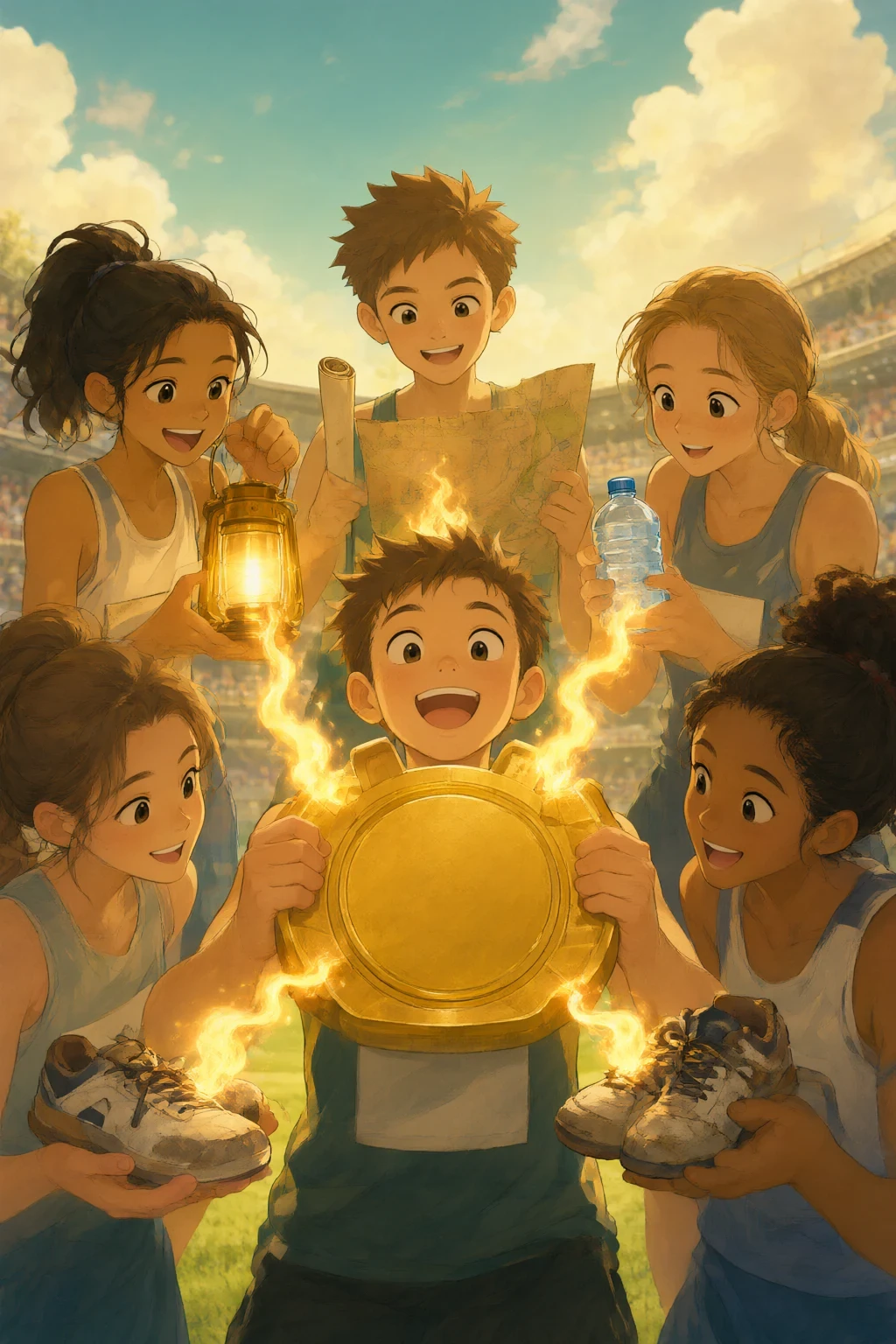
In the kingdom of Bellweather, the relay race ended at the dragon fountain. The first runner, Tamsin, carried a blue lantern through the ivy gates. The second, Puck, crossed the bridge of spoons without dropping the flame. The third, Rell, climbed the tower and rang the bell.
The last runner, Kavi, sprinted along the river stones with the small wooden team badge tucked in her hand, not the silver trophy. The team won by one breath. The queen gave them a silver trophy shaped like a running fox. On its front, a gold plate read: FINEST RUNNER: KAVI.
Kavi cheered with everyone else. Then a little later, when the others were drinking apple juice, she looked at the plate again. Tamsin had carried the flame. Puck had balanced the bridge. Rell had found the hidden stair. Without them, Kavi’s last dash would have been a walk around an empty courtyard.
The royal recorder approached. “You may have the first turn at the parade,” he said. “And the judges will say your name when they praise the team.” Kavi touched the cold fox tail. “They will only say Kavi.” “That is the custom,” he said. “The strongest runner receives the plate.”
Tamsin lowered his lantern. “My mother made this lantern. I carried it through a gate that was too narrow. I nearly put out the flame.” Puck added, “I had to wait while the spoon bridge shook. Kavi was already running ahead.” Rell nodded. “I climbed all those stairs, but the story says ‘Kavi won.’”
Kavi felt the plate grow heavy. “I could say I won alone. People would cheer.” “Would that be true?” Tamsin asked. Kavi looked at the others’ muddy shoes and tired hands. “No.”
The queen’s trumpet sounded. The parade was about to begin. The recorder offered Kavi the plate one more time. She lifted it, but instead of holding it high, she carried it to the trophy table and turned it so everyone could see the back. “There are four names on our team,” she said. “Can we add them?”
The recorder frowned. “The rules name the finest runner.” “Then the rules leave out three people,” Kavi said. “I will not hide that.”
The queen heard them. She was dressed in a cloak stitched with silver bells, and she walked slowly to the table. “A trophy may show what a contest measures,” she said. “It need not show everything a team carries.”
The recorder offered a small tool. Kavi asked the judges for a quiet moment before the parade. The judges agreed, but only if the team could name each part without turning the celebration into a complaint. Kavi stood beside Tamsin. “Tamsin carried the first flame through the ivy gates.”
Tamsin touched the lantern handle. “Puck kept the flame alive across the spoon bridge.” Puck pointed to the sky. “Rell found the tower stair and rang the bell.” Rell looked at Kavi. “Kavi ran the river stones after the bell.”
Each person took a turn describing the part they had done. The details were small and exact: Puck’s shoe slipped and caught itself; Rell’s bell shook the roosting birds; Kavi had to slow down once so the smaller runners could hear the baton call. The recorder listened without interrupting.
The judges carved four names around the rim of the plate. Kavi’s name remained on the front, because she had been the finest runner, but beneath it they added three lines: FIRST FLAME: TAMSIN THE BRIDGE: PUCK THE BELL: RELL THE RIVER: KAVI The words were not as grand as “winner.” They fit exactly, each one equal in size.
When the parade began, Kavi carried the trophy with Tamsin. Puck and Rell walked beside them. The crowd saw four sets of footprints in the dust, not one line behind the others. The queen praised the team by naming all four. Before the next relay, the team met by the dragon fountain.
Tamsin showed Puck how to keep the lantern flame steady, and Rell traced the tower route on the ground with a stick. Kavi offered her plan for the river stones, then listened to the two smaller runners change one bend. The judges had not made the race fair by magic.
They had only made the record wide enough to hold what the runners had done. The next race began under a gray morning sky. There was no rainbow, and no one expected a trophy at the finish. The silver trophy stayed in the team’s equipment basket beside the wooden team badge, the trophy’s four names visible through the woven sides.
At the end of the road, the trophy’s four names caught the light. It felt lighter in four hands than it had in one. Kavi did not give up her name, and she did not ask anyone to give up theirs. Together they carried the trophy until the next relay began.