The Tide Library does not appoint its keepers. It grows them, one step at a time, on a seventh night, and a person who is found to have taken a step they were not looking at is a keeper from the morning, and there is nothing to sign. In three hundred years exactly one appointment has been made any other way, and the record of it is the first page of a book kept in the Quire, and it does not say who was appointed. It says when, and by whose hand, and the hand is the hand that made the book. The House objected to that entry in 1741. The objection is the second page, and it reads: that a record kept by a person who is not known cannot be checked, and a record that cannot be checked is not a record, it is an opinion with a spine on it. The answer is on the third page, in the same hand, and it is one sentence, and the sentence is: then keep a better one. So the House kept a better one. That is the Saltmarsh Book.
The Saltmarsh Book is the record of the wardings. It is kept in the Quire in a plain wooden case, and it is written on paper made out of the cord grass of the salt pans up the coast, which grows where nothing else will and which the pans cut twice a year by hand. The paper is grey brown, fibrous, faintly sweet to the smell, and very tough, and it takes a reed pen, and it lets the ink back out again over about nine years, so that a line written in 1870 is a brown ghost in 1879 and after that not at all. The book is ruled in the House’s hand and there are seven columns, and the columns have not changed since 1631: the day. the shelfmark. the blade. the salt. the cut. the burn. the name. The name is written on a pasted slip, because a name cannot be scraped off the grass without taking the grass with it, and the slip is cut away after the entry is made, and the entry where the name was is left with a shaped hole in it, the way a keyhole is left in a door.
Under the seven columns the House has ruled two more, later, in a smaller hand, and these are not part of the record of the warding. They are part of the record of the record. The eighth column is headed warded by. The ninth is headed count, and it is the count of the Book itself, the running total of the wardings, kept in the corner of every right-hand page in a hand that gets smaller as the numbers get larger, and it is the only figure in the Tide Library that has never been wrong.
The examination for Keeper of the Quire takes three hours. It has taken three hours since the standing order was drawn up, and the standing order is undated, and the oldest copy of it is in the Gallery in a hand the archivist dates to 1611, which is twenty-three years before the building was raised on its stilts. The Library did not write the order. The Library inherited it, the way a house inherits a rule about boots. The order is reciprocal, and the reciprocity is the whole of it. Three readers are put at three tables. At each table the candidate is examined by the reader and the reader is examined by the candidate. Neither may answer from memory. Every question is to be answered by reading aloud from a book in the room, and the book is chosen by the reader. The record of each hour is kept, during that hour, by the person examined at that table, in the reader’s own hand, and is given to that person at the end of the hour and taken from that person at the end of the next. It was not an accident that the person examined keeps the record. It was the point of the arrangement when it was drawn up, and the reason is in a footnote in the Gallery copy, in ink, in a hand that is not the hand of the order: because a record kept by the wielder of the blade is a record that cannot be used against the wielder of the blade.
On the twenty-third of April, 1878, at two o’clock in the afternoon, Perran Hesk conducted the first formal examination in the history of the Tide Library. He was forty-five. He had been a keeper of the Maps Room for eleven weeks and two days, and in those eleven weeks he had lost the sound of the sea. He had given it for the standing orders. To be made a keeper a man reads the whole of the Library’s rules unguarded, in one sitting, in the Spine, and he turns the pages as he goes. There are four hundred and eleven pages in the Quire’s copy and Perran Hesk read all of them on the sixth of February, and on the seventh he came down to breakfast and his sister asked him what he had had for supper on the Tuesday before Easter, and he could tell her, and he could tell her the date of the Tuesday, and he could not for the life of him tell her what she had said to him when she asked. He can still read. He can read everything, at speed, and he can hold a page in his mind. What is gone is the sound of other people’s voices and the shape their mouths made. It took the voices. He has never worked out which part of him it was, and the House has no instrument for finding out, because the House is not interested in what a man gave. The House is interested in the blade.
Table one was the Servery. It is the highest reading room and the only one with no books, and there is a reason for that which is older than the building and which nobody will now say out loud, which is that a room with no pages is a room in which nothing can be taken, and the six people who use it every day of their lives know it without being able to say it, and a man who says it out loud is a man who is asking to be examined. The table is scarred amber oak, eleven feet long, and the six lanterns on the hooks above it are the same lanterns that have been there since the Room was a Room. The kettle sings. On the wall is the slate, and on the slate are the Rules of One, and under them, scratched out in a pen-knife in a black glove eleven weeks before, is the Rule of One, which is not one of the Rules of One and never was: it is the Servery’s own rule, given in 1631 by the third keeper, and it says that only one reader may be in this room at a time.
Marda Seale was sitting at the head of the table when he came up. She is seventy-one and has been in the Servery at four every morning since she was twenty, and she has read the same four volumes of a history of this coast for fifty-one years and is in the third for the ninth time, and she has a stick of red sealing wax in her coat pocket that she has never once been able to explain. She had the Quire’s copy of the rules on the table in front of her, open at page one, and she had put her thumb on the first line. “Sit down,” she said. “You are the candidate and I am the reader and we both know which of us is frightened, so let us not waste an hour on it. Question the first. What is the first rule?” Perran sat down. He had the Servery in his head, and the kettle, and the slate, and the fact of a girl of nine drawing a house on a slate with a pen-knife in February, and no voices at all. “I am not able to tell you,” he said. “That is the finding of the examination, not an evasion of it. There is a defect.” “There is a defect,” Marda Seale agreed. “Read.”
He read. That was the arrangement and there was no way round it, and it took him a quarter of an hour to read the first rule of the Tide Library aloud in a room with no books in it, with a book on the table, and the rule is one sentence long: A borrower gives a part, and takes a book, and gives it back wet. He read it, and then he read the note under it, which is a note in the third keeper’s hand, and then he read the nine footnotes, and the third footnote is the one the Quire has argued about for two hundred and forty-seven years, and it says: the part is not the same as the sum of the part, and a borrower who has given nine may find that what is left will not answer to his own name. “Stop,” said Marda Seale, when he came to the end of the fifth footnote. “That is the rule. You have read the rule. Now the question. Who may change it?” “I cannot remember.” “Then you will read the answer out, and the answer is on the last page, and I have had it in my hand for thirty years and I have never once agreed with it, and I want to see your face when you read it.” She turned the book round. “From the bottom.”
Perran read the last page. It is a single line, and the line is: No keeper changes a rule alone. A rule is changed by two readers, one of whom is not a keeper, and by nobody else, in any hundred years, without a third reader present who objects. “Ah,” said Marda Seale, and she put her thumb on it. “There it is. Say the date at the top of that page.” “It is dated 1631.” “It is dated 1631 because the Rule of One was given in 1631, on a Thursday, at this table, by a woman who was in a hurry.” She took the wax out and turned it over in her fingers, which is what she does with it. “In the spring of that year four readers were in this room at once, because the House was short and the Servery had the only fire in the building, and in one hour four people gave up four things, and the Quire got four scraped spines in a day, which it had not had in nine years. And a keeper came down and scratched a rule on the wall in front of me — I was twenty — and she did not write down why, and I have wanted to know why for fifty-one years.” “Because the rule protects the complete,” said Perran. Marda Seale looked at him for a while.
“Yes,” she said. “Nobody has ever said that to me in fifty-one years. Yes. A reader who is alone cannot be asked to read a second book, and cannot be asked to be a witness, and cannot be asked to give a second thing, because there is nobody in the room to ask him in front of. One at a time. It is the only good thing anybody in this building has ever done for us, and it was done in a hurry, by a woman with a knife, in the year the water came up to the second step.” “Your question,” said Perran. “For the record. What is a reader?” “The record is mine, not yours, and I will write what I like.” She smiled without any harm in it. “But you will read the question out, because the order says so, and the order says so for exactly the reason we have spent an hour establishing. Go on. Next table.”
Table two was the Spine, which is one long cold corridor with a shallow gutter running its whole length, dark walls, hanging storm lanterns, and iron handrails gone orange with rust, and it is the best-smelling room in the building: wet wool, cold iron, old dust, candle smoke. There are no chairs in the Spine. Wray Imbrie stood with his back to the wall in a long dark wool coat with tarnished copper buttons and a long red scarf, and his right cuff was ink to the wrist and had been for years. He is thirty-four. He is the only living reader whose watercopy is complete, which means that everything he ever read himself into is in a book somewhere in this building, and he came here in his twenty-fifth year and read a book to its end in nine years, alone, one reader in a room with no books, in accordance with a rule scratched out eleven weeks before he stopped. “You have the instrument,” he said, before Perran had the satchel off. “Say the term and I will sign.” “That is not the question.”
Perran took out the founding instrument. It is a single sheet of wet paper, kept in a sea chest in the Gallery, dated the eleventh of June, 1702, and it is the founding document of the building: the raising of the house on its eighty-one stilts, the eleven Rooms, the lending of books to any person who asks, and the terms. There is no term in it. There is no term in the 1702 instrument, and none in the 1611 order, and none in four hundred years of the Quire’s minutes. The Keeper of the Quire has stood since the building went up, open-ended, without limit, without a date of ending, and every keeper has served for the rest of their life, which is the point, because the work is not finished while there is anything in the shelves. It came to him in the middle of the sheet and it took a moment, the way it always does. He could not remember the sound of the sea. It had been available to him that morning, in Greyhaven, in the ordinary way, the way a man remembers the road he has walked every day of his life, and it was not there, and in its place was the certainty that something had been there. Eleven weeks. He put a hand on the rail and the iron was cold and orange with rust and did not help.
“Say it,” said Wray Imbrie. “I have lost the sound of the sea.” The Spine was quiet. The gutter went on doing what it does. “That is what I have,” said Wray. “And I have had it nine years, and I have never once said it out loud in this building, and I have just told a stranger in a corridor. Read your question.” “You have a term in your head.” “I have a term in my head because I have counted nine years on it.” “What is it?” Perran Hesk stood in the gutter of the Spine and did the thing that is characteristic of him, which was to take out his pencil and write the term on the back of his own copy of the instrument, where there was no margin, in a small hand, and then to read it back to himself. “Until the Quire is empty,” he said. Wray Imbrie did not answer for some time. “Read that again,” he said. “Until the Quire is empty. It is the only ending this office has that is not a date somebody picks.”
“It is in the Quire’s book on Friday and it is signed and dated and it is in the hand of a man who was examined for this office this afternoon. Say the term and I will sign, and the term is until the Quire is empty, and I have been in the Quire today and it is not going to be empty in my lifetime, and neither of us is going to be here when it is, and that is the whole of the honesty available.” “You understand what you have just done,” said Wray Imbrie. “No,” said Perran Hesk. “I understand that a thing in writing can be changed, and I have understood that all day, and I have understood it since the Servery, and I have written it down.” “Then you are the first thing this building has put in writing that it can break,” said the Borrower Wray Imbrie, “and I have been waiting nine years for somebody to do it, and I am obliged to you, and I will not be in the room when it breaks.”
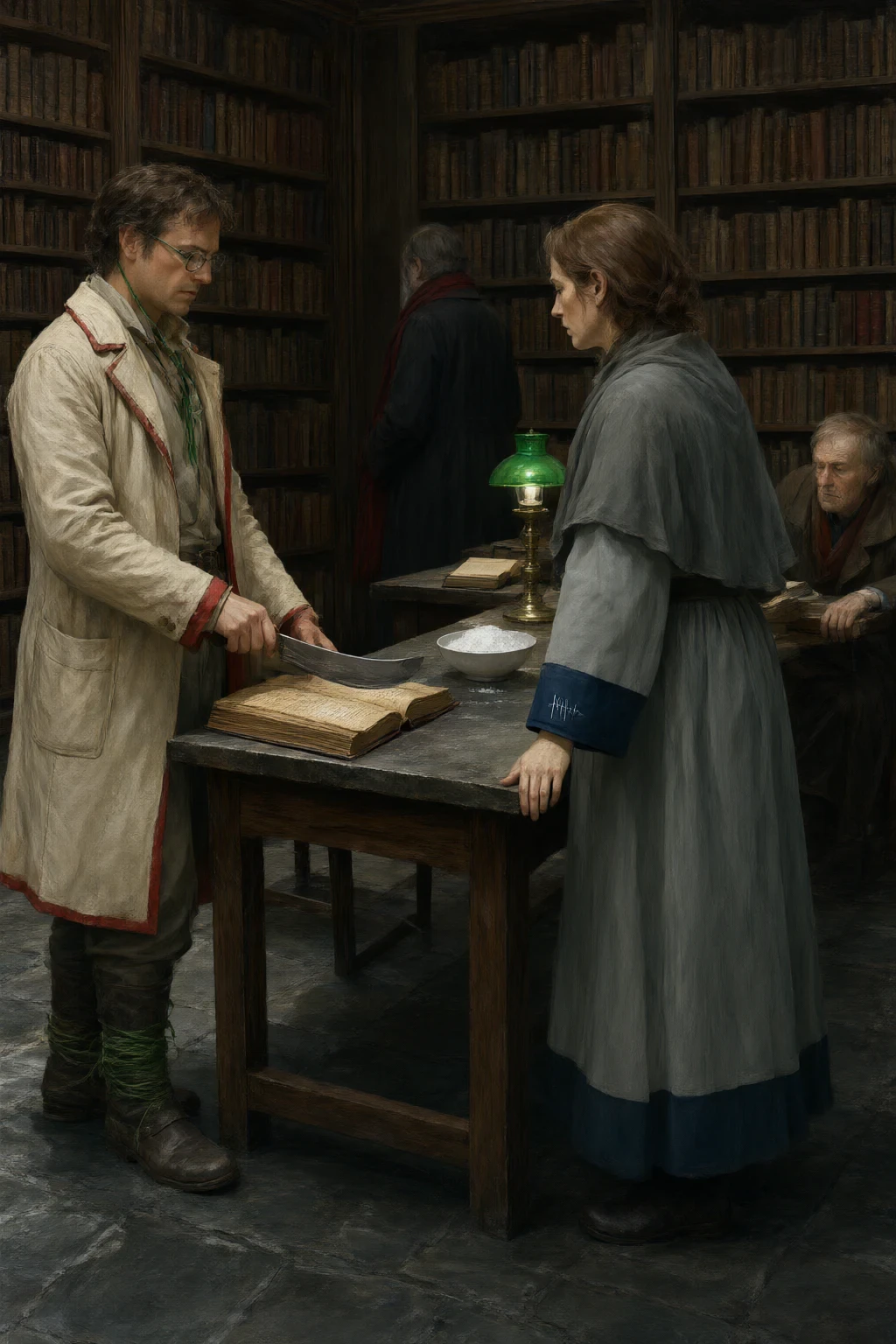
Table three was the Quire, which is behind the Numbers Room and is deliberately unnumbered, and which is the hottest and driest room in the Tide Library and stinks of hot ash and salt. The floor is worn into shallow slate bowls by four hundred years of careful feet. Four hundred scraped spines stand in a long line along the north wall, and they are all exactly the same height and none of them has a name on it, and the scraping has gone through the leather and into the board and left a pale rectangle on each one where the title was, like a bandage on a healing wound. The spindle lamp was burning on the table. It is a green glass lamp and it eats ink, and the heat of it comes up into your face when you lean over a wet page, and the blade on the sill was a curved steel thing with a bone handle worn white, and the white bowl of spilled salt was on the sill beside it. Sister Anwen Tarn was at the table with a book in front of her.
It was not a big book. It was the size of a primer, and it was grey brown, and it had a smell of a sweet field that had been cut twice by hand, and the reeds of the cord grass were in it, lying flat in the sheet like something drowned. “The Saltmarsh Book,” said Perran. “Nothing else would do. Three hours, three tables, three readers, and the record of each hour kept by the person examined.” She moved it a half inch so that it was square to the edge of the table, which is a House habit. “I have kept this book for six years. I took it from a warden who is dead. You are the first person in three hundred years to be examined formally, and the record of it is being kept by me, and I would like you to understand before we begin that I would rather it were being kept by you.” “Your question.” “My question is the last one and it is the only one that matters, and I have never been able to ask it, because nobody has ever been examined here before and there has never been a candidate to ask it to.” She put her cold blue-white hand flat on the closed book. “What is the record for?”
Perran had the answer. He had had it in his hand since the eleventh of March and he had written it on a card in his satchel, and he took the card out, and then he put it back in the satchel, because the order is that every question is answered by reading aloud from a book in the room, and the card was not a book in the room. “So read it out of mine,” said Anwen Tarn, “which is against the order, and which I am going to allow, and you are going to let it stand in the record, because the whole of what happens in this room in the next hour turns on whether you will let a small irregularity stand.” He read it out of the Saltmarsh Book. It took him a while to find the place, and the place was the first page, and the first page is a heading, and under the heading is the purpose of the book, written in a hand of 1631: THAT NO KEEPER MAY ACT WITHOUT THE COUNT. Six words. He read them twice, because the first time he had not believed them, and the second time he understood that he had believed them and had not believed them.
“That is the whole of it,” he said. “Every line in this book exists so that a keeper cannot do a thing to a book and not know that he has done it. The seven columns are not a description of a warding. They are an alibi. The point is not what the blade did. The point is that the number went up, and that the number can be checked, and that if the number is wrong then the person who made it wrong is known.” “Yes,” said Anwen Tarn. “And I have kept it for six years, and the count is one thousand two hundred and eight.” “Sister—” “Ask me the next question. That was mine and it is finished. Ask me the next one.” And Perran, who was the examiner, and who had a question of his own that the order required him to put, put it. “How many have you warded?” She counted.
That is the thing about Sister Anwen Tarn. She counts out loud before she opens a door, and she counts everything she touches, and the count is in chalk on the inside of her left cuff where the dark blue habit cuff turns back, and the count is not of days. Perran had assumed it was of days. It is not of days. It is of wardings, one stroke for each, and there are more than eleven hundred strokes on that cuff in a small tight hand, and the hand has got smaller and smaller as the numbers have got larger, and the last forty strokes are so fine that you would need a glass. “One thousand two hundred and eight,” she said, to the room. “Since the sixth of April, 1861. Nine times the Quire’s line has been broken and the leaf scraped out. I have never written a count I have not seen twice, and there are four lines in this book where I have written one and had to take it out again, and the taking out is in the margin, and the margin is the only honest part of the book.” “Six years,” said Perran. “You are twenty-nine.”
“I began at twenty-three. The warden before me could count to nine hundred and ten and no further, and it was not the counting that stopped her.” Anwen Tarn turned the book and opened it, and the pages went past, and the pages had shaped holes in them where the pasted slips had been cut away, hundreds of them, in a column down the inner margin, like a ladder of small keyholes going down through nine years of the book. “You want to know what I gave, and I will tell you, because you are the first person in three hundred years to be asked a question in this room and I am extremely tired of not being asked anything. Every name in this book is a name of somebody I made blank. And a name written in a record in a building like this one is not a name in a record. It is a part. And it is a part of the person who wrote it as well as of the person it is about, because to write it I had to know it, and to know it I had to have looked at it a long time, and to look at it a long time is to have it.” “The Book is a watercopy,” said Perran Hesk.
Anwen Tarn did not say anything for a moment. The spindle lamp hissed. The blade on the sill was the colour of a wet bone. “Yes,” she said. “Yes. It is a complete one. It has my whole hand in it, every name, in my own writing, in order, for six years, and it does not stop at the names, it goes on into what I did with the blade, and how long it took, and what I said while I was doing it, and I have read that book every day for six years because I keep the record and I open the book to write in it, and every day I open it I turn a page, and I am the second person in this building whose watercopy is complete and the other one is a man in the Spine with a red scarf and he came in this afternoon and said nothing at all about it.” Perran sat down. He had been standing for an hour and a half and he sat down on the edge of the Quire table beside the case of the Saltmarsh Book. “He knew,” he said.
“He has known for two years,” said Anwen Tarn. “He is the only other one. He has never said so to me, and I have never said so to him, and it is the Rule of One, it is only ever the Rule of One, two people in a room with a record and each of them holding everything they have ever given away, and we have kept that rule for nine years by not having a third person in the room. And now there is a third person in the room and he has examined us both and he has not noticed, which is the same as a man not looking at the sea.” The record of the third hour was kept, as the order requires, by the person examined at that table, and it is in Anwen Tarn’s own hand, and it reads: Question of the candidate, put at the second table and answered from the instrument: whether the office carries a term. Answer, that it does not. Candidate’s question, put at the third table and answered from the first page of the Saltmarsh Book: what the record is for. Answer, that no keeper may act without the count. The reader’s question, put at the third table and answered from the same page: what the count is. Answer, that it is one thousand two hundred and eight. The reader states that the count is kept in chalk on her own cuff and that it is a count of wardings and not of days, and that the Saltmarsh Book is a complete watercopy of the reader, made in the reader’s own hand, and has been read daily since the sixth of April, 1861.
Perran read that over Anwen Tarn’s shoulder and understood that he had conducted an examination for the whole of three hours, and had asked three questions, and had been given a complete answer to a question nobody had ever asked in this room, and that the answer had been sitting in front of him on the table for an hour and a half while he read the first page of it out loud to a man who was writing. “Nobody is appointed,” he said. “No,” said Anwen Tarn. “There is no Keeper of the Quire. There has not been one since the twelfth of March, when a warden of fifty-eight put a full page of her own hand into this book as an entry, and was read out, and came up out of it, and died on the Gallery stair on the way up, and I have been alone in here for a year. And the count goes up anyway, because the work does not wait for an appointment, and because I have not the standing to stop it and I am the only one in the building who knows how to do the work.”
The scraping of one thousand two hundred and eight names out of the Saltmarsh Book is not a thing a warden does. It is the Quire’s work. It is the whole of the Quire, and the Quire is the only room in the Tide Library that is not a lending room, and the Quire has had no keeper since the twelfth of March, and Perran Hesk is not a keeper, and he is forty-five and he is a candidate, and if he does it he does it without office and on his own authority, and if it is found out he is finished. He said so. He said it twice, in terms, and Anwen Tarn let him say it twice. Then she said: you are the man who enters things in the schedule. There is no keeper to enter this under. It has been going into a book with a hole in it for a year. And the count is one thousand two hundred and eight and it goes up four or five a month, and I am going to go on doing it, because if I stop the work stops, and the work stopping is worse than anything that can happen to either of us. Perran picked up the blade. “One thing first,” he said. “Before the door. What is your rule?”
“One. Two.” She stopped, and started again. She has one permanently cold blue-white palm and she held it out flat and did not look at it. “Three.” And she did not finish, and the count did not go up to four, and that is the whole of what happened in the Quire of the Tide Library on the twenty-third of April, 1878, and there is no record of it anywhere, because he took the record out with the blade.
The salt goes on the blade, and then the spindle lamp, and the spindle lamp is what does the work, because the heat lifts the ink off a damp leaf the way salt lifts it off a wet shirt. He did it in order, from the back, the way the House does it, and he was slow, because he had never done it, and the smell of the place changed inside a minute from hot ash and salt to hot ash and salt and something else that is not a smell anybody can describe afterwards except by saying that it is the smell of a page that has been true for a long time and is now not. Anwen Tarn stood on the other side of the table and did not help, because the hand that does the scraping is the hand that is being recorded, and the recording had stopped, and she had nowhere to put it. At about the ninth leaf he asked her, without stopping, whether she wanted to read the count out loud one last time before it went, because he had the sense that a thing that is only ever kept in chalk is a thing that a girl of nine could scratch off a wall in a minute, and that she would want to hear a voice do it. “One thousand two hundred and eight,” said Anwen Tarn.
And then the leaves were blank, from the back of the book to the twelfth of March, all of them, and the shaped holes where the name-slips had been cut away went on being shaped holes with nothing in them, which is worse than a whole page, because a whole page is at least a page. The blade went cold. The lamp hissed. The woman put her hand on the table and then took it off again and wiped it on her habit, which is a thing you do with a hand that has been cold for six years and has suddenly got warmer. “Six years,” she said. “Six years and I have it.” She looked at the blank leaves and then at the woman who had come up out of the crawl in February and was asleep in a chair by the Atlas table with a blanket round her and a slate on her knees, and Anwen said, to nobody: “She is going to have to learn the words again. She is going to have to be taught all of it, and there is nothing in this room now that says what it was.” “That is not a reason to have done it.” “No,” said Anwen Tarn. “It is a reason to have wept first. I did not think of it.”
The examination failed, and the failure is in the House’s hand on a slip of saltmarsh paper in a case in the Quire, and the slip says, in full: That the third hour was not kept, there being no record of it, and that an examination which is not kept is not an examination, and that P. Hesk is therefore not appointed, and that the office of Keeper of the Quire is vacant, and that the Saltmarsh Book is incomplete from the twelfth of March, 1878, and will remain so. Anja Roe certified it. She is the senior keeper and it is her hand that certifies an examination, and she came up to the Quire at the seventh hour on the twenty-third of April, and she could not say a word of it aloud, and she wrote the whole certificate standing up in a steady black-letter hand and signed it at the bottom with the mark she has used since the twelfth of February, which is not a signature and is a drawing of a closed door. It is the first thing she has certified since February and the first thing she has signed since the sixth. Niko Sarran carried the ink up and would not go out of the room while she was writing, and when she had done he asked her, in the doorway, whether the examination had gone badly, and she put her gloved hand flat on his chest and pushed him gently back down the step.
The rule went on the Servery slate that night, in chalk, under the scratch-out, in Perran’s hand. It is in two lines and neither of them is longer than a person can hold in their mouth at once: THAT THE COUNT OF WARDINGS IS SPOKEN ALOUD BY THE PERSON WHO KEEPS THE RECORD OF THEM, AND IS WRITTEN DOWN BY NOBODY. AND THAT A RECORD KEPT IN THIS LIBRARY IS KEPT BY THE PERSON IT IS KEPT ABOUT, AND NOT BY THE HOUSE. The Servery holds no books. There is no volume in that room in which a page can be turned, and so there is nothing in the Servery for the Library to take, and a rule scratched on the Servery slate cannot be copied into a book, cannot be cited, and cannot be entered in the schedule; and the slate is the only law in the building that is not in the schedule, and there are four hundred years of things in the schedule. Niko Sarran read it out loud twice, standing up, and then asked the question.
“But who decided that? Because you two did, at a table, on a day — and a decision is a person, and I have seen what a person in a record can do to the person it is about, and if the count is only ever spoken out loud then it is only ever in the heads, and the heads of who? Whose head is it in? Mine? I read in every Room in this building and I have never once been in one with a person and a record, and that was your rule and you took it away before breakfast.” Nobody answered him, which was the correct number. Anwen Tarn was counting to three before she went down the Spine; Wray Imbrie was on the mud Shelf ladder with his back to the room and his coat buttoned; the kettle sang; the girl of nine was asleep on the bench with a slate on her knees and a small square scratched at the tidemark; and the senior keeper of the Tide Library sat with the slate on her knees and a blanket round her shoulders and could not have said it if her life had depended on it. “Ink dries,” said Niko Sarran, to nobody. “Go on.” And on the amber table, face down, where it had lain since the first flood of the year, the small green book lay with its gilt G to the wall, and the room was cold, and it was warm.