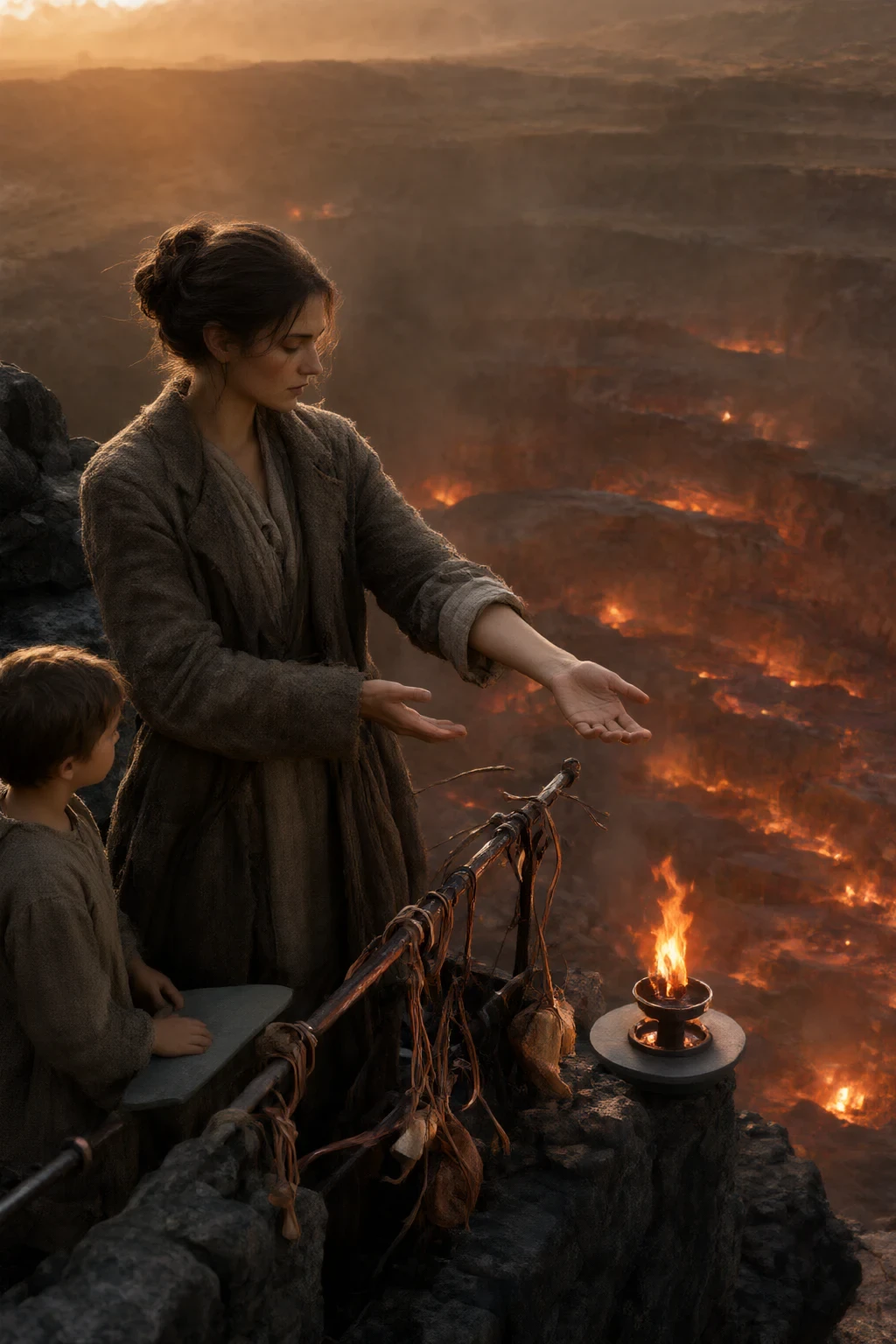
Three years is not long enough to destroy a thing that has been standing for six hundred years, but it is more than long enough to make it look like it was always going to fall, and the caldera in the third warm month of the third year had reached the stage where nobody could remember what the city had looked like when the promises on it were readable. The Measure stood at six hundred and forty measures in a cup graduated to nine thousand. The Table of Diminution stood at two months, having been reduced once in every season by a clerk who did not understand what she was writing and did it faithfully, in the same hand, without comment, exactly as it had been done for nineteen years before her. The number of marks in the chain that could not be read had gone from eleven, when Ashara Venn first began keeping the count in a hand she showed nobody, to a hundred and forty. And five proposals had been made and spent, and the fifth had been agreed to by every city-state without one dissenting, and had been carried out, and had cost the chain the only thing it had left.
The first had been the Thinning, which proposed that fewer oaths be sworn, on the reasonable ground that eleven years of a nine-month ceiling had already thinned them, and the answer was that the number of oaths sworn in the chain had not changed in nineteen years and was four hundred and eleven thousand, and that four hundred and eleven thousand was simply what a chain of eleven thousand households and a great many guilds did, and that you cannot thin a thing that is not fat. The second had been the Levy, which proposed that the wastes be assessed for a contribution of first-fire glass, and the answer had come from the wastes in a form nobody wanted to file: the glass does not occur there, and coal burned in a witness-flame burns hungry, and the chain had learned what hungry meant in the year of the harvest proposal from a ledger page with the names torn out. The third was the Succession, a forty-one-page instrument with a true arithmetic at the front of it, and its arithmetic had been true. The fourth was the Slowing, which proposed that the number of witness-flames be cut by two thirds and the survivors fed at first grade, and the answer was that the outer gates went dark within a month, and that the Slowing had not slowed anything except the arrival of the news. The fifth had been the Re-swearing.
Ashara had designed the Re-swearing herself, in the fourth month of the second year, and she had defended it for eleven months, and she was the only person in the chain who could still say, in the third warm month of the third year, exactly what the error had been, and she said it out loud only once, at a hearing in the House of the Quiet Ledger, and what she said was this. “A covenant is not a document, it is a quantity, and I knew that, and I had said it in a room nineteen days of my life, and then I sat down and designed a ceremony that asked the cup for one thousand one hundred measures on a day when the cup stood at six hundred and forty, because I wanted the whole chain to be in the flame at once. That was not a mistake of arithmetic. A flame asked for more than it has does not go blue and fail. It goes hungry. And a hungry flame leans on whatever is standing nearest it, and on the Re-swearing Day the nearest thing to the flame was every person in the chain, all of them at once. It was a fraction from four hundred and eleven thousand marks, and it was taken in a single afternoon, and the afternoon was warm.”
The Re-swearing took place on the ninth of Highsun, at seven platforms and forty-six relay posts, and it was the largest single act of the covenant in six hundred years, and it worked. That is the part that has to be said plainly and that nobody in the chain can say without a certain kind of laugh afterwards. It worked. The platforms were of dressed basalt with a witness-tray cut into the top and a copper grille over the vent, and the seven of them were built in eleven weeks by masons working under open witness at public expense, and the Chain Causeway was kept clear for two days and lined with lantern-flames at ankle height for eleven miles, and the night before, the children raced the lamps from the bottom up, the way it is done at dusk at Cindergate, and nobody stopped them, and the whole caldera was lit from underneath and looked, for about four hours, like a thing out of a song.
They came. They came on foot and by sledge and, at the ends, on the causeway at night, because the nights were the only cool part. They stood in lines that went round the platforms four times and then went away round the walls of the terrace and down the stair, and the queue at Cindergate on the morning of the ninth was reported at eleven miles by a man who had walked it to check. Four hundred and eleven thousand sworn adults, and every one of them said the words, and the words were not very long, because the point of the Re-swearing was that it was quick: the founding covenant as recited, the party’s own undertaking added, the name, the two strokes, the mark. Two strokes. It took a person about four seconds. Sister-Iven Carshal sat at the Cindergate tray with a slate on her knee and entered four hundred and eleven thousand entries in eleven hours, and by the fourth hour she had stopped writing names and begun writing the words “the founding covenant” down a column, over and over, in a hand that got worse and worse, and the hand on the last line of the last leaf is not the hand on the first.
What nobody knew, and what took eleven days to become a rumour and eleven weeks to become a fact, was that a hungry flame takes what it is nearest and does not give it back. The marks came up on everybody. They came up pale and hard with an ember-coloured core, exactly as a mark should, and the crowd at Cindergate cheered, because watching a person get a brand is the best thing that happens in the caldera, and there had not been one of substance in the chain for nine years. Ashara Venn stood at the second platform for eleven hours and put nine thousand hands to the flame and did not once notice that it had gone the colour it goes when it is lean, which is not a different colour. It is the same colour. That is the whole of the trouble with it. At the fourth hour of the eleventh hour, the cup was read, and the cup stood at nothing, and the man who read it said it out loud twice, to be sure of it, and then put the slate down on the platform and sat on it, which he had never done in forty years of reading that number. Nobody in the chain ever found out what the number was at the moment the drawing stopped, because nobody was measuring. That was the second error and it was Ashara’s and it was smaller and it was the one that cost: you cannot stop drawing by not looking.
The season after the Re-swearing is the part of this that people who were not there get wrong, because there was no day on which anything happened. A mark does not vanish. It blurs. It goes the way a letter goes when somebody has taken a very fine needle to it and gone over it eleven times, and the person wearing it cannot feel it, because a mark is not a pain and never was, and so a man goes on for weeks with a comma on his arm that used to be a promise to come and that is now a smudge he could swear under oath — and could not — that means something. The toll-keeper at the Twelfth-Gate found out on the fourth day of the fourth month, when a carter of the Third refused a toll of eleven measures and the keeper reached for the bar on his forearm, and the bar was there, and it was a bar, and it was a bar the way a word is a word when it has been rubbed out with a thumb. The carter said he had paid. The keeper said the bar said he had paid. The carter said the bar said he had paid. Neither of them was lying, and both of them knew the other was not, and after that neither of them said anything at all, and the carter took his sledge home, and the keeper stood at the Twelfth-Gate for the rest of the day and did not turn anybody, and he has never turned anybody since, and he says that he does not know what he is for.
By the first warm month there were a hundred and forty of them. By the second there were four hundred, and the four hundred were not distributed the way the eleven had been distributed, and that was the thing that frightened the keepers. The eleven had all been at the outer gates, near the dregs-flames, and the four hundred were in the middle of the chain, in the market streets, at the wells, in the queue-lines, everywhere that a person who had been at a platform on the ninth of Highsun would have stood for six hours in the heat. And here is the arithmetic that nobody had thought to do, and that Wren Roke did in a fortnight, sitting on the floor of the House of the Quiet Ledger with a slate and a candle, in the second year of her working as Keeper of the Quiet Ledger, which she had taken at seventy-one because there had been no alternative and not because she had asked:
A mark is blurred by a flame taking from it. On the Re-swearing Day the flame took a fraction from four hundred and eleven thousand marks, and four hundred and eleven thousand marks is nearly everybody. So nearly everybody in the chain was wearing a slightly wrong letter. Four hundred readable marks in the first month is not a catastrophe of four hundred people. It is a catastrophe of four hundred and eleven thousand people, of whom four hundred had happened to need to be read. For three weeks after the ninth of Highsun the chain was the happiest place in the world and nobody knew why. The bell rang more in those three weeks than in the previous three years, because people had been re-sworn and re-reading their own arms and telling their neighbours, and the story that went round the market within a day was that the covenant had been made whole again. The bellows-smith, who had been reading the same number out loud for forty years and had got rather good at it, was asked four times in a morning whether the number was going up. It was not going up. He had not been asked before, because for forty years the answer had been a formality and everybody had known the formality was a formality, and a formality that somebody finally asks about has stopped working.
There was a merchant at the Seventh who took the marks on his own forearms to a lamp in the evening and held them up to a girl of eleven and asked her whether she could read a bar and a hook, and the girl said yes, and he told the story all the way to the Second, and by the second week there were people doing it at the tables in the Ninth Terrace market: holding your arm out in lamplight, in company, and asking somebody your own age to say what the words were. What ended it was not a discovery. Nothing was discovered. It simply stopped, the way a fashion stops, and the marks stayed on, and a good many of them were legible, and a great many were not, and the difference between the two was luck. It is difficult to write about what came next, because nothing came next. That is the thing. Nobody was hurt. Nobody was left without water or a road or a wall. The chain of eleven thousand households went on paying, more or less, and delivering, more or less, and being more or less to one another, and the difference between that season and the season before it was not in the behaviour at all. It was in the paperwork, and the paperwork was everything.
A marriage. A couple at the Ninth Terrace had sworn on the ninth of Highsun, standing at the second platform in the fourth hour, and their mark was the pair of them, one stroke and one hook, and in the second warm month of the second year the hook had gone soft, and a girl was born in the autumn, and there was no mark on either parent that anybody could read. The girl was not less loved. Nerry Voll sat up with the child for nine nights and Osh Lant did the same, and the neighbours brought things, and the room was warm. But when the child had fever in the winter, and Osh Lant had to leave for the Second to fetch a grandmother, the neighbours asked Nerry Voll whether she had any right to send a man out of the house, and she had to stand in her own doorway and say that she had no way at all of showing anybody that she had a right to anything, and that this was because in the fourth hour of the ninth of Highsun she had put her hand in a fire on the second platform and come away with a mark, and that the mark had been the proof, and that the proof had worn off in eleven weeks. Nerry Voll was forty-one. She is alive. She has said since that she would do it again.
A bridge. There is a span at the Fourth where the Chain crosses a fault in the floor, and the repair of it had been sworn in the fourth month of the second year, before the Re-swearing, to a gang of nineteen masons under Kel Rusk, with a hooked stroke of protection and a term of seven months, which was seven months and not two because the work was begun and had a beginning, and the rules do not shorten a thing once it has started. The gang finished the piers in the first warm month and laid four courses of the arch in the second, and in the third the mark on all nineteen arms went unreadable at once, and the gang came off the job, and not one of them was at fault, and the arch stood there half-built over forty feet of fault in the caldera floor with two piers and a third.
It was finished by eleven people at night over eleven nights, unpaid, and it took four times as long as the gang would have taken, and the method was: the work of the day, and then, after the lamps, the same work again, by whoever had come. Dain Callow carried water for it and could not be told anything about it. The mortar is unremarkable and the arch has not moved since and it will not move, because a stone arch does not care, and because there was nothing sworn about it at all, and because nineteen masons had put four courses of it in under a fire and four hundred and eleven thousand other people had put the rest of it in under lamplight, and only one of those two groups was still holding anything. Sister-Iven Carshal died in the ninth month of the second year, at seventy-two, in the archive, at her own table, in the afternoon, with a candle in the wax-tray and the ledger open, and Wren Roke found her, and there was no mark on her at all, because the Watch of the Going does not end, and the bell had been rung for her at the second stroke the following morning by a man who could not hear either of them.
What she left was a sealed instruction of four pages in her own hand, which Wren Roke read in the presence of two keepers and entered in the record, and which does four things. The first is that the name Ivet Carshal, of Cindergate, of the north stair, is entered in the Quiet Ledger as at the date of her death, sixty-one years ago, in the month of Deepcold, of the winter cough, and that the account of her is closed, and that the delay is entered too, with the reason: the name was removed, and the removal was by this hand. The second is that the Table of Diminution is abolished, and that the maximum term of any oath sworn under the founding covenant is unlimited, as it always was, and that the Table is abolished because the founding covenant has no term and never had, and that nineteen years of reductions were made in the belief that a thing with no end needed ending, and that the belief was reasonable and wrong. The third thing is that Wren Roke is to be thanked, which she was not, and which was in the four pages in full, at length, and which is the only occasion in the history of the House of the Quiet Ledger on which the record contains an opinion. The fourth thing is a single line, dated, and it reads: I was wrong about what a record is for.
The last four hundred and one measures were found in the eighth month of the second year, and finding them produced the worst fortnight of Ashara Venn’s working life, because everybody in the chain was convinced that they had been hallucinated, and because everybody in the chain was wrong. The rule is plain and it is in the second book. If any single party withdraws or defaults, the whole instrument loses coherence and the fuel in the bedrock seals itself back into the ground, where it will sit useless for a thousand years. On the eleventh day after the Re-swearing the chain was incoherent. The cup read nothing. The bedrock should have sealed. It did not seal, because one of the nine great oaths was still held, and held properly, and sworn, and paid for, and attested. The Watch of the Going is not sworn by citizens. It is sworn by a bearer, and the bearer is a person, and his mark is not a small oath and was not re-sworn on the ninth of Highsun because he was not on the second platform, because he is deaf and because the bell-house has no queue. Dain Callow held it, and held it still, and the Watch does not require the chain to be coherent, because the Watch is what tells the chain whether it is: a tree does not get to say it does not need the man who is holding it up. So the cup was read in the eighth month of the second year and it stood at four hundred and one, and Ashara Venn went to the House of the Quiet Ledger and told six people, and one of them was a mason of fifty-six, and he asked the only question anybody asked. “What does four hundred and one buy.”
It buys the founding, once over, with sixty-nine measures left over, and that is the answer everybody had for eleven days, and on the twelfth day Kel Rusk said the other thing. “Suppose we do not spend it on people,” he said. He was fifty-six and could not climb in midsummer any more and did not try. He had a beard burnt short on the left side and greying unevenly and a bronze thumb-ring on a leather cord in his pocket that he still did not wear as authority. He had brought a wall-sample with him, about four inches square and eleven courses deep, and he set it on the table in the archive, and then he set a second one beside it, and the two were the same stone and the same mortar and the same lime and the same hand. “This one,” he said, “was laid in the second month of the last year under an oath of warming, of about a month, by me, with nine men, in daylight, in front of a hundred and eleven people, and there is a fire in the tray. It is a fixture. It will be here in a thousand years. Nobody is holding it up. That is what the flame did to it.” “And this one,” said Ashara, “is yours from last winter.”
“This one is mine from last winter,” said Kel Rusk, “and it is good work, and it is better work than the other one, and I would put my name to both. And it is going to come down in about sixty years, and the fire in the tray on the day I laid it would have meant that it did not. That is the whole of what the flame has ever done for anybody in this caldera, and I have been on the wrong end of it for nineteen years because I thought I was building walls. I was branding them.” Nobody in the room said anything for a while. “The rule is in the second book,” he said. “Anything the covenant’s flame touches becomes a fixture, and fixtures outlast the oath. It does not say anything about skin. It never said anything about skin. It says anything, and stone is a thing, and a gate is a thing, and a threshold is a thing, and a road is a thing, and we have been putting the only durable magic in the world into people for six hundred years, on the theory that the people were the point.” Ashara Venn looked at the two blocks of stone for a long time, and then she said, in the council’s grammar, because she could not think of anything else, “Ashara proposes that the last four hundred and one measures be spent on stone.” And the wince did not come, because the room was her own, and everybody in it had been in the room for the fortnight in which the only argument available was whether four hundred and one measures was a number or a rumour, and they had all been waiting eleven days for somebody to say a stupid, cheap, obvious thing.
The nine works took the whole of the second winter and the first of the third year, and they were the dullest public works in the history of the caldera, and they are the reason the caldera is standing. They were specified by Ashara Venn and costed by Kel Rusk in eleven days, and the list is short enough to be read out. The cistern headers and channel of the Ninth Terrace aqueduct, four hundred and forty spans, which had been leaking at the third joint since before the league was constituted. The lintels, sills and thresholds of the seven gate-houses, the gate being a thing. The seat and the two cutwaters of the Fourth span, which had been finished by eleven people at night and deserved better. The Chain Causeway, eleven miles, in eleven sections, the obsidian joints of the Sixth and the Third being re-run where they had opened. The Bonding Stair, nine hundred courses, the rail and every fourth step being reset. The bridge at the Sixth intake. The floor of the market at the Ninth. The bell-house floor. And the last of the last, entered on the list in Kel Rusk’s hand at the bottom of the page with no explanation, which was the whole of the causeway from the Sixth Gate to the Third, eleven miles, in one item.
They were sworn under the Watch of the Going and not under the covenant, because the Watch was the only oath in the chain that was still whole, and the Watch is an oath about a bell and a record and a witness, and the rule in the second book is that anything the covenant’s flame touches becomes a fixture, and the flame on the tray on Thirty-One is fed from the covenant vent, and the keeper on the tray is the Bell-Warden, and Dain Callow made the fires himself, one at a time, in the ordinary course of a working day, and put the first-fire glass into the joints himself, out of a leather bag, with a copper spoon, about an ounce at a time, and worked from the eleventh hour of the night to the fourth, because that is when the stone is coolest and the air will hold. The nine works cost one thousand one hundred and six measures of labour and nobody swore any of it, and Kel Rusk costed the labour himself, in the ordinary way, out of the guild roll, and the costing is the document in this that nobody has ever wanted to look at.
The aqueduct, being the largest, took two hundred and eleven households a fortnight of evening work, which is nine days of wages apiece, and it was allotted in proportion to the guild roll, and the guild roll is a list of people, and the proportion falls hardest on the people with the most hands and the least money. That is the reason the first list of the nine works, when it was read out at the market, produced a silence of about four seconds and then an argument that lasted two hours. The argument was not about the aqueduct. The argument was that the re-swearing had been agreed to by all seven cities and that the aqueduct was being paid for by the poorest people in the chain, and that the four hundred and one measures had been spent on stone that would outlast everybody, which was true and was the point, and that the poorest people in the chain had also been the ones whose marks went unreadable in the fourth month, and that nobody had voted on that either.
“I have laid stone for forty-six years,” said Kel Rusk, when the argument had run out. “I will tell you what it costs. It does not cost glass. Glass is the cheapest thing in it. It costs the men who are not there while the masons are there, and it costs them the evening, and the evening is the only part of the day a man has that is his own. I will put it in the roll in hours and not in measures, because when a thing is put in measures, everybody in the room stops thinking about who is standing where.” He put the roll down. “It is eleven thousand hours. It is a great deal. It is not a fortune. And they did it because the water comes down that aqueduct into the Ninth Terrace and everybody in this city drinks from it, and I do not need a fire to tell anybody that.” Nobody’s skin was in the fire. That is the whole of what was different, and it should be written down in whatever account of this there turns out to be, because it is the only sentence anybody in the caldera can say about the nine works that is not about stone: for one winter, in a caldera of eleven thousand households, not one person put a hand in a witness-flame, and the two largest of the nine works are still standing.
The league reconstituted in the third month of the third year, in the same room, with the same shelves, and it did not call itself the league, because the league had been a device for producing a document and there was no longer a document to produce. What it produced instead was nineteen pages, and the nineteen pages are the Plain Warrant, and the nineteen pages have no flame in them anywhere, and every person in the chain who was asked about it in the first year said the same sentence, which was that it was not a covenant, and which was correct. A warrant is a promise that is written down. It is made out in the open, before two witnesses who are not parties to it, and it is entered by those witnesses in a fair hand, and it is kept in three places, and it is kept for not less than seven years, and it is enforced by a magistrate and two witnesses and nobody else, and there is no mark on anybody, and there is no measure, and the word covenant does not occur in it once. It is Ru Quen’s Article Twelve, lifted out of a forty-one-page instrument that could not be sworn and made into the whole of the world. It is a very boring document. It does one thing. It says that a promise made out loud, in company, before two people who are not in it, and written down by those two people in a fair hand, and kept in three places, has the same force as a promise that has a fire in it, and it says this in eleven sentences, and it says it without any force of its own, and it holds, and it holds because a thing that two people have written down and can be asked about is a thing that a person in a town will not lie about, not because lying is punished but because somebody will be standing there asking. Three articles in the nineteen pages matter more than the other sixteen.
The first admits the wastes as a party in full, on the same footing, at the same weight, on page two, in the ordinary type, where it can be found by anybody who turns to it, and the vote of the wastes village councils is a formality that is recorded anyway. The second is Odo Harrow’s. He had the book read out at the market at Harrowfoot at noon on a fifth day, all nine pages of it, four thousand six hundred and eleven measures of value, none of it collectable, and then he said that the chain could not pay it, and that Harrowfoot would not be paid, and that in place of payment the town would give up its two hundred and eleven years of free passage on the market road, and that the loss to the town would be about a third of everything it had, and that the loss to him personally would be the part of it he had spent twenty years not looking at, which was the part that made him rich. He apologised before he said it. He apologised twice, and the second time a woman at the back of the market said the word out loud, and Odo Harrow said, “Yes,” and went on with it, which is the only recorded instance of that gentleman not apologising.
They put it to the town and the town said yes, in a count of two hundred and eleven against ninety-four, and the ninety-four have never been asked again and are not asked in the nineteen pages, because Ordwin Sparre sat in that room and said, with his silver-scarred neck open at the collar, that a document which compels anybody to be reasonable is a document that will be reopened by the next reasonable person who finds a use for it, and that the ninety-four were entitled to their names and their objection and nothing else, and that this was the entire difference between admission and forgiveness. The third article is Ashara’s, and it is nine lines long, and it is the only thing in the document she wrote herself, and it is Article One, and it comes first. It does not say that the covenant is dissolved. It says that the covenant is spent, and that no oath may be sworn under it, and that the last measure was spent, on the ninth work, on the last day of the first warm month of the third year, at the twelfth hour, by Dain Callow, who put about an ounce of first-fire glass into the last joint of the Chain Causeway and then rang the bell twice for the account, and that the closing of an account is a keeper’s job, and that a keeper’s job does not require anybody to have a mark, and that this is written here so that the person who reads this in two hundred years will not have to find out whether a mark is needed, in order to be told that it is not. A season on, and then another, and the world that is left is not the world anybody voted for and is very close to the world that was there before the founding, which is to say it is a world of small dealings kept by people who know each other, in streets that are paved, under gates that stand, with a bell that is rung.
The Ninth Terrace market still runs on a fifth day, and the Measure is still called at noon from the raised platform at the north end, and the number is nothing, and it is called out anyway, twice, to be sure of it, and the man with the slate is a different man now and he is a bad reader and nobody has corrected him in four years. A swap-stall still runs on the fourth rank of trestles, and it no longer trades in clauses, because there are no clauses, and it trades in time: a year’s labour taken against a year’s labour, in a fair hand, in two witnesses, in three places. The chain runs on the Chain Causeway, and the causeway is in the same place it has been for a thousand years, and eleven miles of it are black basalt with bright black glass in the joints that catches the fissures’ light like a line of dark mirrors, and the couriers run it at night because the nights are cool, and the night relay is worked by boys of nineteen and twenty who are not sworn, and who are given a sealed wax and a rule and a wage, and who keep the rule because their grandfathers kept a longer one.
The bell at Thirty-One is rung for everybody. Dain Callow is twenty-two and has been deaf since he was seventeen and rings for about four hundred and fifty people a year, and the account is closed before the second stroke every time, and the names come in through Wren Roke, who is thirty-one now and has entered, in three years, four thousand and ninety of the three hundred and eleven that were missing, and who has a list of the remaining two hundred and twenty-one that is longer than some of the wards she works in, and who does not lie about the number and has never once been asked to make it smaller. Kel Rusk is fifty-seven and will not climb and is building nothing on anybody’s account except his own account, and he has laid, in the last two years, ninety-one walls that will not be there in fifty years, and he says, when he is asked, that they are the best work he has done, and that the difference between those walls and the other ones is that somebody saw him do them, and that there was no fire, and that he has stopped finding that disappointing.
Ashara Venn is twenty-six. She is not the Keeper of the Measure, because there is no Measure, and she is a keeper, in the sense that the document now uses the word, which is that she is the person who writes down what a bell says. Her mark went out in the first year of the third, and nobody noticed, and she did not tell anybody for two years. A mark goes out when the oath is spent, and the oath was spent, and what she had sworn at fourteen, in a room under the terrace, in front of a fire, with a woman who told her to stop counting the stair: she would come when she was called. She came. She was called. She came for nine years, up and down nine hundred steps, and in the third warm month of the third year somebody was looking for a mark to read in a person who had already done it, and found that there was nothing there to read, and did not need there to be. She has not been able to swear anything since. There is nothing to swear under. She has not wanted to.
A child at the rail of the Bonding Stair, in the autumn, asked her what the marks were. This is what children do at the rail; there is a bread-and-copper-wire economy at the top of that stair and a great deal of standing about, and the rail is warm, and it is warm because the stair is nine hundred shallow basalt steps cut into a face, and the whole of the chain has worked on the fourth step for six hundred years, and the heat of the vent comes up under the stone the way it comes up under everything in the caldera, which is to say from below, always, and not from the sky, which is why nobody who lives in the caldera has ever believed in a cold place. The marks, the child said. The old men have them and the women have them and you can read them, everybody says so, and I cannot read, and I am told they say what a person promised. And she is nine, and she was born in the second year of the third, and there has been nothing to be born into since the ninth of Highsun. Ashara Venn put her hand on the rail, which is warm. “They do say what a person promised,” she said. “That is what they are for. And they are not coming back, and I am sorry.” “Will I have one?”
“No,” said Ashara. “There is nothing to have one of. There is no fire left in the cup. We spent all of it on the aqueduct and the stair and the causeway and the gates, because a thing you put a fire into lasts, and a person does not, and we had it the other way round for six hundred years.” The child thought about that, in the way children do on a warm stair. “So how do you know what people promised,” she said. Ashara Venn looked down nine hundred steps at a city that was lit from underneath and nowhere else, where a man with a slate had said a number out loud twice that morning to be sure of it, and where the fourth step of the Bonding Stair was worn into a saddle shape by six hundred years of people stopping on it, and she took the slate out from under her arm, and she held it where the child could see it, and she said, “Two people write it down, and keep it, and one of them is not you and one of them is not them. That is all. It is much less impressive than a fire and it has held for a year, which is one more year than most things manage.”
She did not say the rest of it, which is that a bell is rung, and an account is closed, and a mason is watched, and a magistrate writes down what a town owes and then does not collect it, and a woman in the wastes has a seat on page two in the ordinary type, and a boy of nineteen runs a relay at night for a wage, and a mason of fifty-seven builds ninety-one walls that will not outlast him because somebody watched him build them. She did not say any of it, because she was on a stair with a child, and the stair was warm, and the child was nine, and there was no hurry. The bell at Thirty-One was rung at the seventh hour for a woman of the ash-pits at the Sixth, and Dain Callow could not hear it, and Wren Roke wrote the name down, and the second stroke closed the account.