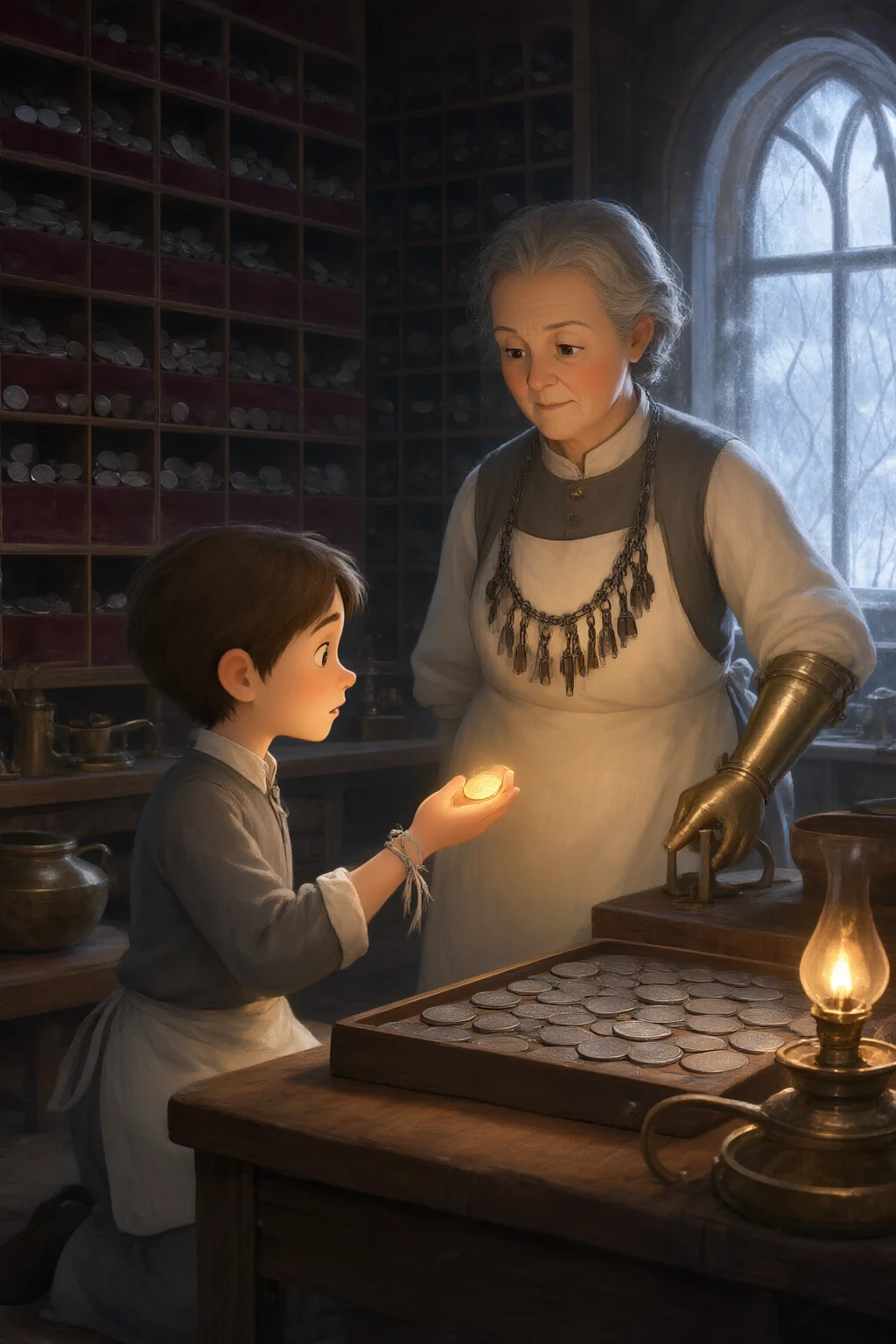
The Hollow Vault held four hundred and ninety-one coins, and Tallow Merrick knew every one of them. She knew the bright ones from the dull and the heavy ones from the light. She counted them before the lamp was lit, and again after it started to gutter. That morning she counted twice, and both times she stopped in the same place. “Four hundred and ninety,” she said. “One short, and I did not lose it. There is chalk across the door, and the chalk is whole.” Nim Ollowan came in with a bowl and a spoon.
“Salt,” she said. “Grist says there is salt.” “Jar is on the table. Take it on the—” She stopped. Beside her signing-slates stood a stone salt jar with a wooden lid, and the lid sat crooked, and out of the jar, where no salt should be, was showing one small bright coin. Nim took it out. It was warm. Not pocket-warm. Lamp-warm, as though it had been sitting in the flame. “Tallow. Look at it. It is the brightest thing in this room.”
Tallow did not look at the coin. She looked at the shelves, and then at a point four inches above Nim’s head. “Salt,” she said. “Put the salt in the bowl and go along.”
The Vault got confused that afternoon. It began with the count. Tallow counted the shelves three ways and every time she came out one short, and not short of a stranger either. Short of the same one, and the numbers kept arguing about it anyway. “Six hundred and two, quite good, that one,” she said, moving a tray. “Four hundred and six, dull. Very dull. Two hundred and eleven, dreadful.” Nim came back at the end of the day and stopped in the doorway. “Tallow. Which one is missing?”
“I do not know. I counted every tray twice, then in a different order, and got the same wrong answer both ways, so the room is right and I am the one that— no. The shelves have never lied to me.” The bright coin was in the tray of husks. Nobody made that mistake. Bright coins went in the bright tray. It was the first rule Tallow ever taught her. “You put it in the wrong tray.” “I put it in the tray where the count works,” said Tallow Merrick.
“It is mine,” she said. “It has been mine since I was thirty-one. It is the first coin this Court ever minted out of a story about somebody who works in this room, and I told it myself.” She had the coin on the sill before she finished the sentence. Cresset Ombre held the sill that night, her brass forearm laid along the frame. “Warm,” Cresset said. “Warm, and true, and it will not go over.”
“It cannot go over for me. A coin of your own telling buys nothing. It will not cross the rim for you, because you would be buying yourself. And it will not cross the rim for anybody else, because they would be buying me.” “Then it is good for nothing.” “It is good for one thing,” said Tallow, and set it in the middle of the tray of husks, very straight. “It is the only money in this palace that is about somebody who cannot be sold.”
“Has anybody ever asked you a question about yourself?” Nim said. It was the wrong question, and it was the right one. Marrow, out at the back of the dark ring, said, “She has been asked. She asks herself. Every morning, in the dark, four hundred and ninety-one times— and that is a coin in somebody else’s pocket.”
“Once,” said Tallow. “The first night. Nobody knows the first night. They made me Keeper in the spring, and I was so frightened I slept in the mill, in the flour, with the cold millstone against my back. I stood in a white sack in front of the Queen and could not breathe for nine whole minutes, and I have never said so to a living soul. That is the coin. A little mill. With a wheel.”
Nim went down to the Vault with a lamp, because it was the only room in the palace where nobody ever asked her anything. Tallow was there, of course. “Will you hear it first?” Nim said. “Before I say it out loud. So that I get it right.” “You cannot coin a story about me while I am standing in the Hall.” “I know. I will ask you, and you will say yes or no, and I will do what you say.”
That was not manners. A story taken from somebody who had not agreed burned, and the mint rang like a struck bell in every room of the palace. Cresset sat on the bottom step. “Cresset hears it. Cresset can contradict it.” So Nim told it, in the plainest words she had. “Tallow Merrick gets up in the dark every morning of her life and counts every coin in this Vault, and she has never once got it wrong. And then—” She stopped. “And then?” said Tallow.
“—and then she does it because a little girl asked her how many there were. Nobody has ever asked you the true part, and the true part is the whole reason for it.” The little girl was called Wren. She lived nine miles down the sea-road in a house with a green door, and she wrote twice a year, and Tallow had not written back in six years, because every letter she could manage was a small kind lie. “Write that down,” she said. “That is the story. Yes. I will stand in it.”
So they went up into the Hall of Telling, and Cresset lit the one flame in the one lamp, and the pale disc of light came down flat on the plank floor, and Nim stood in it, and everybody else stood at the edge in the dark. Tallow stood at the edge with her chain of a hundred little iron keys over her apron, and she nodded once, out loud, for everybody to hear. Nim told it again. She told it the same way, because the same way was the true way.
The brass tray gave one bright ring, and lying in it was a thin silver coin, warm, with a candle burning on its face. And then Nim Ollowan could not breathe. Not a little. Not a gasp. She stood in the middle of the light and could not take in air for nine minutes, because nine minutes was what the truth costs. Her palm blistered. She did not move and she did not sit down. Tallow Merrick stood in the dark and counted. “One,” she said. “Two. Three. Four. Five.” “Six. Seven. Eight. Nine. Ten.”
It was the only thing in the world she could do for anybody, and it turned out to be the thing Nim needed. On the sixteenth breath Nim made a noise like a boat off a shoal, and Cresset caught her and set her down like a sack of flour. “Nine minutes,” said Tallow. “Sixteen breaths. My fault for the counting.”
Cresset put the coin on the sill, and it went over. “It is good coin,” she said. “It is not yours to spend.” “I know,” said Nim. “Only somebody else’s.” So Tallow walked it, slowly, all the way around the forty feet of dark oak, past the bread and the salt and the nine places nobody had used, and set it down in front of the Queen. Ysandre the Long-Waited looked at the coin a long time before she touched it. Her fingertips had gone so pale she could read the print of things through them.
“One more true thing,” she said, in a voice like a very old bell, “in this court, in my own— well. It was something.” And she held the coin out for the bread. Then she ate. Grist brought the stew in himself, and there was one bowl left over, and he carried it down the mill steps and left it where somebody would find it. And in the Vault, Tallow Merrick put the old bright coin into a pigeonhole of its own, in the middle row, where it sat with the rest and got counted like everything else.
The count came to four hundred and ninety-one, and it was right. She shut the door, and Tallow stood in the cold with both hands flat on the table and did not count one single thing at all that night.