The fourteenth of January is the shortest day of the year in Candleford at nine hours and ten minutes, and the dark from the first lamp to the first grey is four hours and forty minutes, and the whole of what the Concord argued about in the first week of January was those four hours and forty minutes. Nobody in Candleford had ever used them. A moth flies between the first lamp and the first grey in still air at ninety-four degrees, and there are two thousand one hundred hours in a Candleford winter that satisfy all three, and the guild had spent about four hundred of them in two hundred years, and those four hundred were on the fourth page of the flying calendar in a hand nobody had read since a man who did not read the second column either. Ansel Reyne had read the fourth page on the fourth of January and had then gone down six floors to ninety-four degrees and had not come up.
The trouble with a winter release is not the cold. It is the word used, and the way it is used, and the fact that a great many people in Candleford know what it means without ever having had it explained, which in Candleford is a sign of health. To the Pattern a release is a release: a swarm goes out of the Releasing Loft at dusk, covers the ground it covers, and comes down, and the ledger writes what went out, and the ledger is not built to know in which month. But the machines were made in an autumn. The bobbin is nine passes of a night’s silk. The loom is a September instrument. A release made in January is a release made against a standard that does not exist, and if it does not work it does not work quietly. “The moth does not care about the calendar,” said Halvard Tace, on the Monday, in the long room at Ledger Hall, with his gloves on, one of them a different brown than the other. “I have said it twice. Say it a third time, Mr Reyne, and it becomes a thing the Concord has decided, and the Concord should be careful about the things it decides.”
“That is not what the moth cares about,” said Ansel Reyne. “That is what the moth is indifferent to. There is a difference, and this city has spent two hundred years learning it the hard way, and I sign for it. At twenty-six degrees the oil in a pin joint thickens. At nineteen the joint binds, and the moth will not articulate, and comes down inside forty minutes. Below nineteen, on a night with a hard frost on the ground, the coil-holes take a bloom, and the filament catches on it, and tears.” “So you cannot certify a moth in January.” “I can certify a moth at ninety-four degrees,” said Ansel Reyne, “and I have certified nine thousand one hundred of them at ninety-four degrees in October for twenty years, and in January those same nine thousand one hundred would be certified at ninety-four degrees in a wooden room with braziers under the cradles, and would go out of the door at minus one, and I would be certifying a thing I had never seen, in air I had never felt, on the word of a furnace.”
Orla Vessey had been at the back of the room with a sheet of foolscap in front of her and had not been taking minutes, and at this point she put her pen down, which she did not do. “Twelve thousand one hundred and four barrowloads,” she said. Nobody had asked her. “Since the twelfth of November,” she said, “the sap drawn from the feeder-groves, as entered in column three. Twelve thousand one hundred and four, at three thousand and forty a night, four nights a week, which is the rate the book has carried since the gas main. The southern line came up by barge on the fourth of December and the whole of it has gone. The north end is working on the last two hundred and six barrowloads in the city, and those are the sap of the last row of Row Eleven, and Row Eleven was struck in November, and is eleven rows of stumps and a fire.” She had spectacles with the right lens ground from oiled horn, and the lamp at her desk threw into it all morning, and she had never once had them ground properly, on the grounds that a proper lens would see less. “Correct my figure if it is wrong,” she said, “because I would rather be corrected in public by somebody who has counted than privately by myself.” “No,” said Halvard Tace. “It is right. Who paid for that?” “The Concord paid for it,” said Orla Vessey. “That is the sentence, Mr Tace, and I have been saying it to myself since the fourth of December, and I cannot make it sound like anything else.”
The Concord had one decision and the season was a formality. Everybody in the room understood it and nobody stated it, and the reason it went unstated is that the guild has one question it knows how to ask and this was not it. “What goes in the line,” said Ansel Reyne. That stopped them. “The line,” he said. “Sixteenth. Released. Sap. Seed. Hour. Party. Weather. Nine thousand one hundred. Three thousand and forty. Nothing yet. Eleven. Loft, Crib Tower. Still. That is the line, and I have certified eleven thousand of them. The question is not whether the moth flies in January. The question is what we write down at four in the morning on the fifteenth, and I am telling you now, before we have voted on anything, that the book has no answer, and I do not think that is an accident, and I do not think anybody here is leaving this room before somebody has said so out loud.”
Orla Vessey took up a second pen, which she had brought, and laid it beside the first. “A line cannot be amended,” she said. “That is the first thing and I will say it exactly. Not by the Concord, and not by the Roll, and not by me, and not by anybody. A line, once written, is finished. Its question is fixed at the moment of writing and can never be widened afterward. That is not a rule anybody made. It is a property of the thing. I have known it since I was twenty-two and I have never once been tempted to break it, because I could not.” She put her finger on the top of the sheet. “So the forty thousand lines stand. Every one. There is no column on this sheet for what a moth does, and there cannot be one, and we may add columns to a sheet that has not been written yet, and the sheets for the fifteenth of January have not been written yet, and the fifteenth of January is the first blank page in the book since the Concord was founded.” “You have thought about this,” said Halvard Tace. “I have thought about nothing else since the fourth of December,” said Orla Vessey, “and I have not told anybody, because I did not have a column to tell them in. A person with a question and no column is a person who says nothing. I had never had cause to study that before. I have now studied it for seven weeks.”
“Add the column,” said Halvard Tace. “What goes in it.” “Returned,” said Ansel Reyne. The room did not react. Ansel Reyne went on, because he was the only man in Candleford who could say the next sentence and say it in front of witnesses. “Column eight. Returned. And here is what happens the moment you rule it. You rule column eight, and you must rule a yardstick beside it, because a column filled in by hand with nothing to check the hand against is not a record. It is an opinion with a date on it. And there is no yardstick. There is no assay for a return. There is no standard. There is no Pattern for a tree.” He held up a small brass rectangle with nine drilled coil-holes in a precise arc, and turned it so that the lamp went along the line of them.
“Every object in this city that can be measured is a machine, and every machine has a fixed number, and I can put nine of anything you like in front of you and tell you within four thousandth whether it is the thing. That is the entire extent of what I am. And a tree is not a number.” He put the plate down. “A return is a tree. It is a thing that has happened, in the ground, over a year. And I cannot assay it, and if the Concord rules column eight and fills it in, then the only man who may certify its contents against a Pattern has said in advance that there is no Pattern for it. That is what the column costs. Not the money. That.” “Then we do not fill it in,” said Halvard Tace. “Then we rule it and leave it empty, and we have ruled a column we cannot fill in, which is a form of bookkeeping this city has never previously considered and which I cannot defend at all.” “No,” said Ansel Reyne. “You cannot leave it empty, because empty means nobody has looked, and somebody will look, and the guild will be a body that ruled a column and then did not fill it in, and the next Concord will strike the column out of the form, and in thirty years there will be no column, and we will have spent a season’s standing on nothing.”
Nell Ashgrove had been standing by the door for forty minutes, which she did, and everybody had let her, because she was fifteen and had been refused the Pattern twenty-four times. She had a scorched brass thumbnail guard on her right thumb, worn bright at the tip, and there was green in the seam of it, because she had been out on the Fifteenth that morning and had put her hand flat on a tree to see. “There is already one,” she said. “There is already one what?” “A Row that the guild did nothing to.” She came away from the door. “The Fifteenth. In November we did not cover it, on purpose, because we were short, and you all sat in this room and called it a necessity and put NIL BY ORDER in the margin of my ledger, which is a thing I have not stopped reading. And then in the spring Osme Daintry walked it and could not tell me one thing about it that he could tell me about any other Row, and Ansel said that we had run an experiment by accident, and could not say what it meant.” She put her hand on the table, flat, the way she did.
“We are about to rule a column with nothing to check it against,” she said. “So check it against the Fifteenth. The Fifteenth has been without a moth since the ninth of November. It is four hundred and nine trees, and it is the only ground in the Pale Hundreds with a record of being left alone. If we leave it alone again tonight, then in April we will have two readings of a tree that has had nothing, and the other plantations of the Sixth will have two readings of a tree that has had the full nine, and for the first time in the history of this city we will be able to write two numbers in the same column and know which is which.” She was breathing rather fast, and she stopped and started again. “Design it,” she said. “That is what I said on the Loft stairs in November and nobody has done anything about it, so I am doing it now, and it is two sentences long and one of them is the Fifteenth.”
“Against the spirit of the thing,” said Halvard Tace. He said it flatly, and he was not being clever, and the room heard the sentence as the sentence of a man who had governed a Roll for eleven years and made amendment ruinously expensive on purpose, and who was now, on the sixth of January, at the age of fifty-two, proposing to spend the only thing he had. “The Concord is a body that certifies,” he said. “It certifies moths against a fixed number. The moment it rules a column it must fill in, and the moment it fills in it is a body that has published a number it cannot check, and a body that publishes numbers it cannot check has stopped being a Concord and started being a press. I have kept the Roll small enough to be true for eleven years. I am not certain I can keep it small enough to be true and also write things in it that came out of the ground.” “Then what is the alternative,” said Fennim Sallowe. He had come in from the north end at six in the morning, in stiff green boots, with a black beard re-braided that day, standing with his back to the warm grate because he was a man who stands with his back to fires. He was forty-four and had been twenty-two years in Row Eleven, and there was no longer a Row Eleven.
“The alternative is that we rule the column and we do not fill it in and we say so, and the book says RETURNED, and after it says NIL, and NIL means we did not look, and in thirty years the column is struck out of the form,” he said. “Which is what has happened to every other question in this city, and I would like it observed that a thing which cannot be recorded stops being true, and not the other way round, whatever anybody in here believes.” Then they had the argument about which ground, and it took an hour, and it is worth setting down because every word of it was in the minutes and no one outside the room has read them. Nell Ashgrove wanted the Fifteenth. Fennim Sallowe did not, and his objection was not sentimental, and it is the sentence the new book opens with, four months later, on the same page as the question. “You have chosen the ground that has already been starved once,” he said, “and you have chosen it because it is the ground you can spend twice. And that is what you do. You look at ninety plantations and you find the one whose loss will not be in the arithmetic that anybody reads, and that is a skill, Mr Tace. That is the one thing you and I are both good at. I would like the Record to show that the Concord spent its experiment on the plantation it would have spent it on anyway, and did not pretend it cost it anything to choose.” “It cost the Fifteenth a second winter,” said Halvard Tace, “and it cost the Concord nothing at all, and both of those are true, and I have been waiting for you to say the second one for an hour, and I am obliged to you for it.”
“Eleven of the last twelve cuttings burned in the peat,” said Fennim Sallowe, “and six trees in twenty-two years, and I have never published it, and I am publishing it now, and you may all have the number, and it goes in whatever new book you are going to open. And if the new book has a place in it for what a thing cost, then four hundred and nine trees go in it, and they go in it in my hand, because I cut the other ground.” What settled the Fifteenth was not the argument. It was Ansel Reyne, and it was nine words, and it is the whole of what assay means in Candleford. “The control must be the plantation most like the others,” he said, “or the answer means nothing. Not the worst. The worst is not a test of anything; the worst is a test of the worst. The Fifteenth is the most like the others. It is on the second wind, it is on the same peat as the Sixth, the Fourteenth and the Twenty-Third, it has the same clerk’s tally, it has set seed every year in the weighing house, it is not remarkable, and nobody has ever gone out of their way for it. The Fifteenth is the plantation you would pick if you were picking blind. That is what makes it a standard.” He put his hand on the Pattern plate on the table.
“And if the answer is that nine years of a standard moth produces nothing at all — if in April the Fifteenth has set seed like every other plantation, and is doing exactly what it did in 1902, before there was a moth on it, and in 1897, before there was a Concord — then I want that written down by a hand that has not changed since it was twenty-two, in a book that a child holds the second key to. And I want the guild to say out loud in this room that it flew nine thousand moths over a city for two hundred years, and did not know, and could have known in one night, for the cost of one Row.” He looked at Halvard Tace. “I will certify nothing. I want that minuted. I will certify the moth, and not the return, because there is no Pattern for a return, because a tree is not a number. And if the Concord wants that on a line, it had better be on a line, in my hand, under my name, where I can be asked about it out loud, in person, for the rest of my life.”
The cost was, in the end, two trees, and when Fennim Sallowe said the figure the room made a noise that four people afterwards described, independently, as a laugh. “One hundred and nine moths,” he said. “The Fifteenth takes one hundred and nine off the Sixth cradle. That is one hundred and nine bobbins of nine coils, and one bobbin is a thirtieth of a barrowload, so three barrowloads and a little, and a barrowload is two stems, and I have cut eleven hundred and thirty-one stems in twenty-two years and I know what two stems is.” “Two stems,” said Halvard Tace. “Two stems of feeder-grove, which is to say two black sappy trees, which is to say two of mine, which is to say two that are already in the ground, because we cut Row Eleven in November for a shortage that this experiment has now made a hundred and nine moths smaller.” He put his hands flat on the table. “That is the whole of the price. Two trees. I have been twenty-two years a necessary man and I have never in my life been able to name a price for anything, and the price of the answer to the question the Concord has been avoiding for two hundred years is two trees, and we have not paid them. And I would like the Record to show that we knew the price in the second week of January, and that we argued about it for two hours and eleven minutes.”
The vote was taken at four o’clock on the eighth of January, and Halvard Tace insisted on its terms, and the terms are the reason any of this is remembered. It could not be a resolution of the Concord, because a resolution is a thing the Concord may revise, and the Concord has revised four hundred of them in a hundred and forty years and left them framed in Ledger Hall with the strikes visible, which is a practice Halvard Tace has defended for eleven years on the grounds that a house which is struck is not a house which never existed. So he had it entered on the Roll itself, the Roll of certified workshops, a hundred and forty years in one column with the struck ones left visible, and under the entry for the Concord’s Assay he caused a line to be ruled and filled, and the line said this: THE CONCORD HAS RULED A COLUMN IT CANNOT CHECK. THE ROLL IS DISSOLVED AS A STANDARD AND REMAINS AS A RECORD.
“There,” he said, when the clerk had read it twice. “That is the first line in a hundred and forty years that says the Roll is not true. And I put it there on purpose, and in the frame, and I did not ask anybody to strike it, because a thing that is struck can be argued out of, and I have been taking the easy way out of things for eleven years.” “Who paid for that,” said Orla Vessey, automatically, and then stopped, and took off her spectacles, and cleaned the right lens, which cleaned perfectly well, and put them on again, and did not apologise, because there was nobody to apologise to, and because in about two seconds she was going to open a book, and her hands needed to be steady. On the Tuesday a man came to see him about the Roll, and he sent word down that he was not receiving, and on the Wednesday two more came, and on the Thursday eleven, and the eleventh was a woman who had taught in the fen schools for thirty years and wanted to know, in person, whether the moths had ever done anything at all. “They will have a number,” said Halvard Tace, from the doorway, and did not come in. “Not this month. In April. It will be in a book with a question at the head of the page, and everybody in this city will be able to read it, including you, and it will be whatever it is, and I will be the man who put the question there. I would rather that than the other thing, which is that the question is not asked for another two hundred years and dies of not being asked.”
Down in the Comparator Vault, six floors under Ledger Hall, at ninety-four degrees, with the walls black with lampblack to the height of a man, Ansel Reyne had a moth in the machine and a girl in the room, and had said yes to a thing he had refused twenty-four times. She was holding the Pattern plate, a small brass rectangle with nine drilled coil-holes in a precise arc, and the way you read it is by holding it up to a lamp and looking along the arc to see whether the holes are true, and she held it up to the bench lamp and looked along the arc for a long time and said nothing. “That is to Pattern,” she said at last. “That is to Pattern,” said Ansel Reyne. “It has said that to me for a hundred and forty years and it will say it after I am dead, and it is the only sentence I have ever been able to say out loud in front of another human being and be certain of.” He shut the machine down and did not take the moth out of it, which is not done. “Mr Reyne.” “Mm.” “If the ninth hole is the Pattern,” said Nell Ashgrove, “then the Pattern is a thing we decided.” He did not answer, and she went on, because she was fifteen and had been waiting two years.
“Mr Reyne. Nobody made it up. Nobody voted. It is not in a book anywhere with a date on it. It is nine because nine is what the bench was doing when the first plate was cut, and then it was nine because the first plate was nine, and the whole of the Concord in two hundred years is nine people deciding not to have a meeting about nine. And then we build a machine to check nine, and the machine is why we cannot ask, because it answers before the question is finished. Nobody has ever been in a room with the machine and a question at the same time except us, tonight, and you will not put it in a book, and I am fifteen, and I am asking you in a room.” The vault was ninety-four degrees and the comparator would drift if they opened the door, and neither of them moved towards the door. “The guild cannot measure harm,” said Ansel Reyne. “That is not modesty. It is a fact about the size of the vocabulary.” “Then get a bigger word.” “No,” he said. “Get a bigger book.”
He took the plate out of her hands, very gently, and turned it over; and on the back of the Pattern plate, which nobody has ever done in the history of the guild, because the back is not a working surface, there is an engraved mark: a maker’s punch, small, with a date on it, and the date is 1758. “Look at that,” he said. “One plate, one punch, one year, one man. That is the whole of the founding of the Pattern and it is four lines long and it is on the back, where it does not catch the lamp, because whoever cut it did not think anybody would ever want to know.” “Then write that on the front,” said Nell Ashgrove. He did the January cards in the ordinary way, in ninety-four degrees, in the last hour before the doors, and here is what a release made against a standard that does not exist looks like from the inside. The assay card is a rectangle of stiff cream with three lines printed on it in small type, and Ansel Reyne filled in two of them twenty thousand times and never once touched the third. Line one asks for the coil count, in or out. Line two asks what was different. Line three, printed along the bottom in a smaller face, because somebody in the guild house wanted it to be harder to reach, says this: THE ABOVE IS VOID AND THE ROW OVER WHICH IT FLEW IS STRUCK. He had filled in line three once, in November, and the naming of that Row had cost four hundred and six trees and a workshop of nineteen people, and he had read the whole of it out loud in front of witnesses, because a signature is worth what the man who signs it can say out loud about it.
The January card was the same card. The tin came up from the lofts at four o’clock, and he put the first moth in and the arm went along the nine pins and stopped where it always stopped, and he wrote one: NINE. And then he sat with the pen on line two a long time, because line two is where you say what was different, and what was different was the fourteenth of January, and if he wrote the month in line two then the card was void, and the Row over which it flew was the whole of the eastern Hundreds. So he wrote it in line one, which is where you put the coil count, because a coil count is a value and a value may carry a note. NINE. HEAT BRASIER, FOUR, NOT SEPTEMBER. “That is to Pattern,” he said, out loud, to the tin, in a room at ninety-four degrees. And it was, and it was the most frightening sentence he had ever said, because he had put a month into a line that has no room for a month, and the card would stand in the assay book exactly as a sound card stands, and the only difference between this night and eleven thousand others would be visible to a person who knew to look and to nobody else, and he had made himself that person, which is what he had wanted at twenty-two and been given at fifty-eight without asking. He signed the first card and left the machine running and went up to see the fog come off the canal.
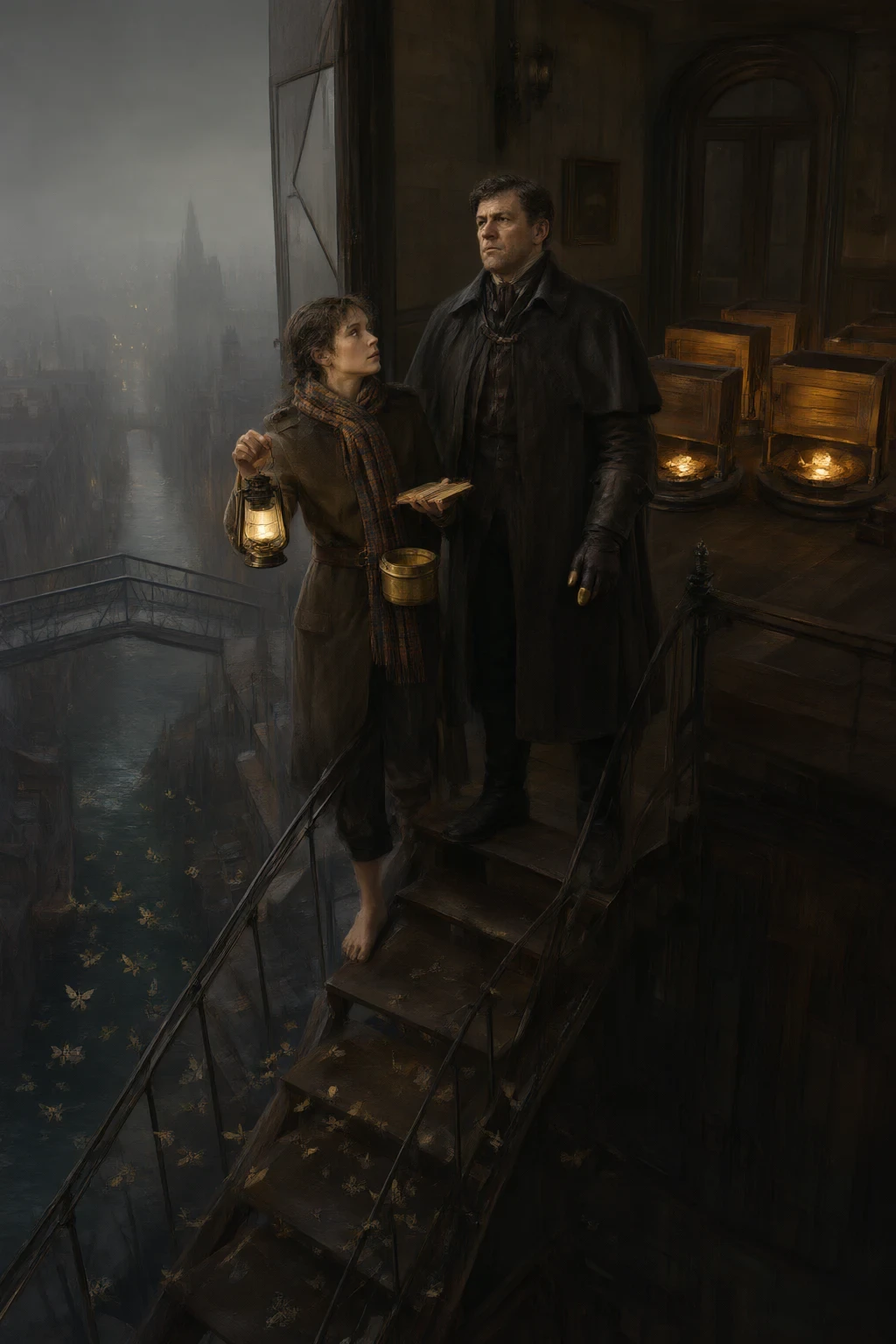
The fourteenth of January came in with a fog. The Releasing Loft is at the top of the tallest tower in the city, a shuttered wooden room with nine cradles on turntables and a lamp-bell on a wire that rings over the water, and its doors open only at dusk. At half past three the fog came up the canal and lay along the ground and did not lift, and by four the fen mist had come into the drains and the whole city had a white knee over it, and the temperature at the loft rail was one degree below freezing. The Loft put four braziers under the cradles and shut the shutters on the windward side, and the room went to ninety-one degrees and held there three hours, and nine thousand one hundred moths lay in their trays in the warm and were, for the first time in their short and silent lives, the object of an argument. The Concord came up at half past four. All of it, in coats, on a wooden stair, in fog, which nobody in Candleford does, and which Halvard Tace had insisted on, because the Concord does not do things in a room if the room can be avoided.
“Who paid for that,” said Halvard Tace, on the top stair, to nobody, and then, when nobody answered, and to the four hundred and eleven people on the loft floor: “Nobody. That is the first time in twenty-six years I have said it and meant it.” The doors opened at ten past five, the earliest the Loft has ever opened, because the dark came at twenty past four and the crew wanted the whole of the four hours and forty minutes of it. Nine thousand one hundred moths went out. The room became absurdly quiet, and then it was not quiet, and then the doors were shut and it was quiet again, and you could hear the wings for two full minutes after the doors closed, and after that there was nothing to hear at all, because the sound of nine thousand moths is not a sound you can hold. It is a pressure. And it is gone, and there is no moth left anywhere in Candleford that is not dead, and there never will be again, and the sound is gone by morning. The Pale Hundreds are ninety numbered plantations and the loft keeps them in order the way a clerk keeps anything, and the Sixteenth is the sixteenth, and the Fifteenth comes immediately before it. The Fifteenth had an interval card cut of the same card-stock as every other card in the file, and it did not carry a plantation number; it carried NIL, BY ORDER, in the loft’s own hand, and it was the first card in the file that was not a number, and the girl who put it in the slot with the other eight did not think about it, because she was sixteen and thinking about the count.
Teasel Sillet was on the third step of the stairs with a tally board and a lamp and a cold hand, and he was the official counter of the Fifteenth, which had meant nothing in Candleford until the eighth of January and which by the fourteenth meant that the number in the book for the Fifteenth was, for the first time in the history of the release ledger, a number a person had counted with their eyes. “Nine thousand and ninety-nine,” he said, to the iron rail, in the dark, on the stairs, where he had been saying numbers to iron for six years. Then he stopped, and looked at the board, and did the thing he had never once been able to do, which was to go back. “Nine thousand and ninety-nine,” he said again, and then, on the count of three, because it was the house style, and because it was the only way he had ever known to start anything: “One — two — three. Nine thousand and ninety-nine. Nine thousand and ninety-nine and nothing in the Fifteenth. One hundred and eight went to the Sixteenth and none went to the Fifteenth, and I counted the gap, and the gap is the whole of the Fifteenth, and I have got it here on a board.” He whispered the last part to the rail, because the rail was the rail.
“Teasel,” said Nell Ashgrove, from the top of the stairs, in a voice that carried in the fog. “Miss Ashgrove.” “Write that down.” “I can’t write up here in the dark.” “You have a lamp,” said Nell Ashgrove. “You are holding a lamp. You have been holding a lamp since you were eleven years old. And you are going to write that number in your own hand, and you are going to give it to the clerk, and it is going in a book, Teasel. Not into a rail.” Teasel Sillet stood on the third step of the Loft stairs with a striped wool scarf he had never once taken off and one bare foot, and looked at the lamp he was holding as though he had been asked to hand it over.
They found it on the Sounding Bridge at first grey, the way everybody in Candleford finds everything, which is by standing about and being thirty-eight years old. There is a plain iron footbridge over the canal where the swarms cross between the lofts and the eastern Rows, and every evening for years people came to stand on it and listen, and the canal goes black and the wings go over it as a soft continuous hiss, and the water keeps the sound a half-second longer than the air does. There was one gap in the hiss on the night of the fourteenth of January, and it was not a gap in the swarm so much as a place where the swarm leaned. It came in at twenty minutes to six: a clean lane about the width of a Row, in which nothing whatsoever happened, and the water under it was black and quiet and stayed quiet half a second after the noise on either side of it had gone. “Twenty-one minutes past,” said a man on the bridge who had a hand-lamp he did not need. “It is the same both nights.” “It is the Fifteenth,” said Halvard Tace. Nobody had told any of them. It had been on the Roll, and the Roll was in a frame in Ledger Hall, and about nine hundred people in Candleford could have read it, and the bridge had thirty-one people on it, and twenty-nine of them had been told by a child on a stair.
Fennim Sallowe stood at the north end of the Fifteenth with a hand-lamp he had not asked for and had not refused, and he was on that ground because the Lamp Service runs the Fifteenth at dusk whether or not there is anything to fly over it, and the runner was a boy of nine from Ferrier’s Cut because the usual runner was off, and the boy had put the lamp on a gatepost and stood with his back to the Row so that the light went down the line and not into it. He was not working. For twenty-two years Fennim Sallowe had gone into a grove with something in his hands, and for the first time since he was nineteen he stood four miles north in the cold at the end of a lit line and watched four hundred and nine trees do nothing at all; and they did nothing extremely well, and there was no sound in them and no sap in them and no change in the colour of the bark, and he could not have told you one single thing about any of it, and he had spent his life being the man who knew. “You are not to say anything to me about it,” he said, when the boy asked. “Not tonight. I want to be here, and I do not know anything yet.”
Orla Vessey opened the Return Book on the sixteenth of January at eleven in the morning with the shutters shut and one lamp going. It was bound in grey board, because the bookbinders on Ferrier’s Lane had a stock of it and nothing else in grey, and it cost the Concord eleven shillings, which Halvard Tace entered against the Assay account, and which is the only line in that account in twenty-six years that is not a wage. At the head of every page, printed, because she had paid for the printing and would not have left it to be done by hand, was a question. WHAT DID IT DO. That is the whole of the new book. It has no columns, because a column is a shape you have already decided the answer goes in, and the question had not been decided. It has ruled lines the same width as the release ledger, so that a clerk used to one book can work in the other, and beside each line are five ruled boxes which she labelled in her own hand: PLANTATION, ROWS, READ BY, DATE, WHAT CAME BACK. She wrote the first entry, and it is the first line in the history of the Concord that says what a thing was for.
Fourteenth of January. The Fifteenth withheld by order of the Concord, the second time. Four hundred and nine trees. Read by the Row clerk and by the Assay, standing. Cost of withholding: 109 moths, 3.02 barrowloads, 2 stems of feeder-grove, of the Row Eleven, which was struck in November. Two of them to be planted at the north corner in the spring by the man who cut them. Witnessed: H. Tace, F. Sallowe, A. Reyne, O. Vessey, N. Ashgrove, T. Sillet. And under it, in the space left for the answer, which is most of the page, she ruled a single line and left it empty, and beside the line she wrote the terms on which it was to be filled in, and she wrote them without being asked, and she read them out afterwards to four people in a cream room over dark water, and they are the whole of what the Concord agreed to in the second week of January. “The answer to be entered in April by the Row clerk of the Fifteenth, and countersigned by the Assay. Whatever it is. If nothing has set seed, then the words NO SEED, and the book will be closed on it. If seed has set, then the weight, and the weight is the answer, and the answer will be entered.”
She took off her spectacles and cleaned the right lens, which is ground from oiled horn, and which cleaned perfectly well. “Eleven thousand and one lines,” she said. “That is what the release ledger stands at, and the Fifteenth is the first line I have ever written that was a number I did not have to look up, and I have checked it twice, and it is the right number. And I would like it observed that the whole of the Concord’s change of heart cost one hundred and nine moths, and two trees, and the decision of a man of forty-four to grow trees instead of cut them, and that it has taken two hundred years to find out what that was worth, and that the finding out was not expensive. That is the part I cannot put in a column.” She wrote the second key of the Return Book on a card and gave it to Teasel Sillet, who was standing in the room with a tally board under his arm and the expression of a man being handed something he has not been handed before. “It is not a promotion,” said Orla Vessey. “It is a key. You will hold the second key to the Return Book for as long as you are in this city, and the first key is mine, and no line goes into that book unless both keys agree, and the reason is not that I do not trust you. The reason is that a book which one person keeps is a letter, and a letter is what the first book was for eleven thousand lines, and I have spent seventeen years writing letters.” “Yes, miss,” said Teasel Sillet. “And you will say the numbers out loud to people instead of to the rail.” “Yes, miss,” said Teasel Sillet, and then, after a moment, in a voice nobody in Ledger Hall had ever heard from him and which everybody in Ledger Hall would remember: “One hundred and nine. There was no gap in it anywhere. I counted it twice.”