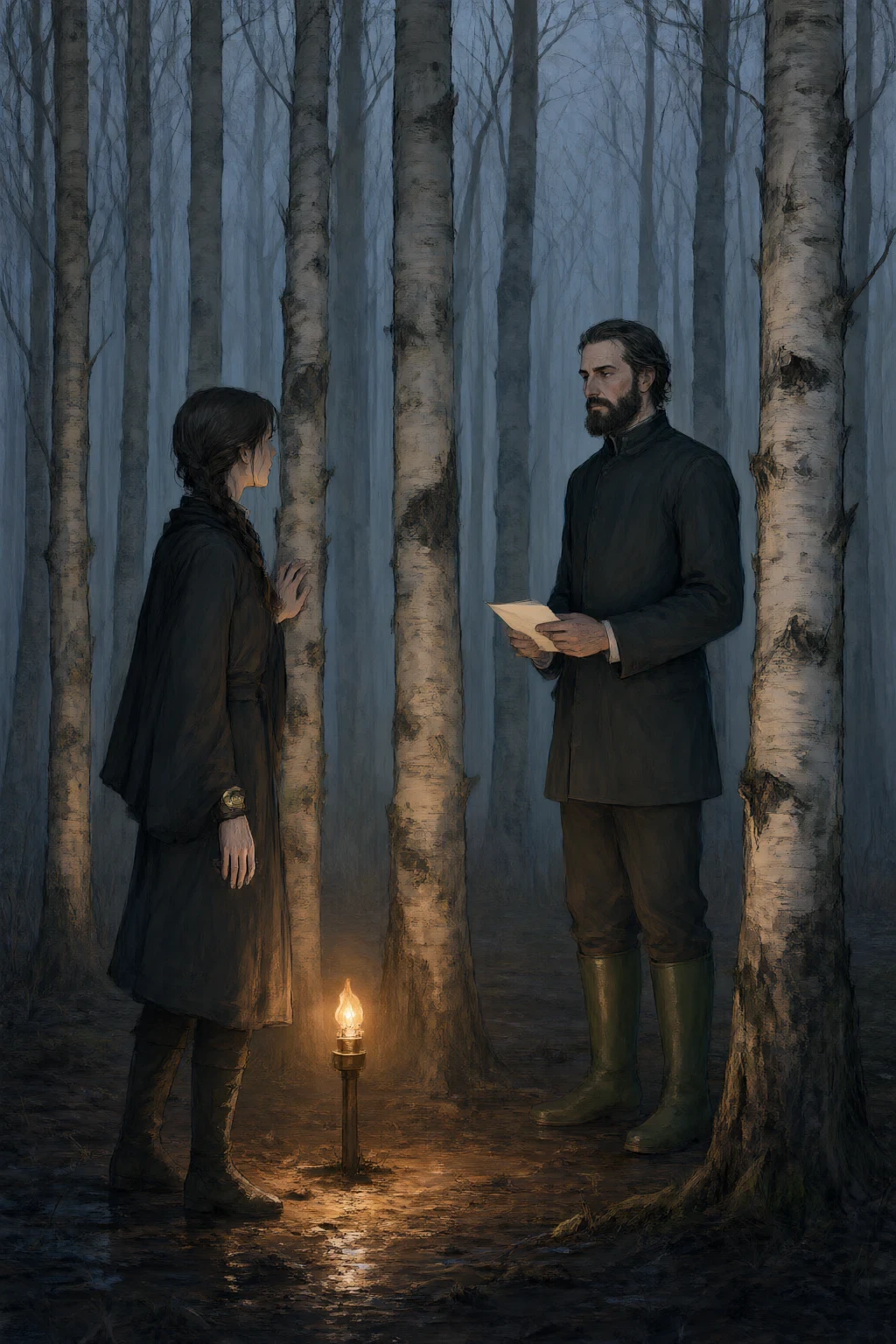
The two plates lay side by side on the Comparator Vault bench for eleven weeks, and every night Ansel Reyne looked at them both before he started, and every night they were the same width and neither of them was the Pattern. The old one he had measured against since he was twenty-eight: a brass rectangle, nine coil-holes in a fine arc, gone the colour of a thumbprint at one end. The new one the Concord had cut in the spring and sent out to every certified house, wrapped in oiled paper with its assay stamp, drilled to one and a half coil-widths a hole instead of one. Nine holes of one and a half was thirteen and a half coils of flight in a night’s work instead of nine. Thirty-nine faults in the first week. A hundred and twelve in the second.
The houses had split without anybody ordering them to. Sparrowe and Dint, Marrow and Vell, the big houses with forty hands each, had taken the new plate and were building to it, because the new plate was the Concord’s plate and the Concord certified against its own. The small ones — eleven houses of them, the ones with four hands and a boy — had kept the old plate, because their plates were older than some of their benches and their grandfathers had measured to them. Both groups were right. That was the whole of the difficulty, and it sat on the bench in brass and would not move.
Halvard Tace came down on the fourth Tuesday with a leather case and black kid gloves, the right one cut from a different and browner leather, and he took the gloves off before he opened the case, which Ansel had never seen him do. “Who paid for that?” he said. Nobody had said anything. Ansel put the lens down. “Thirty-seven today,” he said. “All plate width. All the same.” “I know what they are.” Tace laid a single sheet of cream paper on the bench and turned it to face him. “I want you to read this properly, and then I want you to say no, and then we will both go home.” Ansel did not touch the sheet. “That is a Concord paper.”
“It is a paper about a Concord decision, which is not the same thing, and if you were twenty I should enjoy watching you enjoy the distinction.” Tace sat down on the end of the bench, which no factor had ever done in that room. “Read the arithmetic. Not the argument. The arithmetic. You are the only man in Candleford who has spent thirty years being asked what a number means.”
The arithmetic was four lines long and it was sound. Nine thousand moths went out over the fen every night at dusk, and had for as long as the ledger ran, and the number was not going to change. Coverage was simply how much ground a night touched, and ground was the product of moths and range, and range was coils. Nine thousand moths at nine coils was eighty-one thousand coils of ground, and the Returns for the last three autumns said the seed harvest was a record, and the seed office had its barrels counted by a man who did not drink.
The new plate gives thirteen and a half. Nine thousand at thirteen and a half is a hundred and twenty-one thousand five hundred, and a hundred and twenty-one thousand five hundred against eighty-one thousand is not a marginal gain. It is one and a half times over. The forest has never put out a leaf in living memory, and it has never set seed like this either, and this is the first proposal in forty years that says so out loud. “I can certify that plate,” Tace said. “Tomorrow. One line in the Assay book and every house in Candleford is building to a standard instead of a rumour.” “What is in it for you?”
“For me it is a workshop inspection that stops being necessary, which saves me a clerk and costs me a fee. I do not get a monument.” He put one finger on the sheet. “For the Assay, it is the Comparator. A new machine cut to the new plate, so that you do not spend your nights deciding which of two pieces of brass is the truth. Two hundred a year to hold your vault at ninety-four degrees, which is the whole of your running cost and which you have not had since I was thirty. And a fee to every house that must be re-plated, which is eleven small houses and two hundred and thirty hands, and every one of those hands is somebody’s whole winter.” Ansel looked at the sheet for a long time. The vault was eighty-eight degrees and he was aware of it in his collar. “That arithmetic is correct,” he said. “It is correct.” “It is also the best arithmetic anybody has put in front of me in thirty years, and I have been waiting for it.”
Nell Ashgrove came down at eight with a crate and a lamp and a bad temper, because the houses had split and the wrapping bench was doing double, and she had been doing the arithmetic herself for eleven days on the backs of release orders, in pencil, and had got to the third line of it and stopped. “Sit down,” said Ansel. She sat on the crate. “The wide wing needs more filament,” she said. “Nine holes at one and a half is thirteen and a half coils. Every moth carries thirteen and a half instead of nine, so thirteen and a half thousand coils of silk a night instead of nine thousand.” “That is right.” “And the silk is made out of the moths. The filament is spun from the ash of spent moths. Nine thousand moths burned gives you nine thousand moths’ worth of silk. You cannot get thirteen and a half thousand out of nine thousand. It is ash. It is one moth, one moth’s worth.”
The vault was very quiet. “So the Concord has to release thirteen and a half thousand a night,” she said. “And then it is a real gain, and the sap goes up by half again, and everything is honest.” “That is what I said to Mr Tace.” “No, it is not.” She looked up. “You said the Concord has to release thirteen and a half thousand, and they will, and the ledger will write it every night, exactly, and the Returns will say the seed doubled. But you have to go and ask the sap house, because thirteen and a half thousand moths a night is thirteen and a half thousand moths’ worth of ash a night, and ash is spun with sap out of a living tree, and the sap house is two miles from here and it keeps a book.” “Miss Ashgrove —”
“Row Eleven,” said Nell. “Twenty-two acres. Twenty-two years of one cutting a year, which is a parcel of trees that size at the rotation the Concord calls sustainable, and Fennim Sallowe told me the number on a stair, and he tells me numbers the way he apologises, which is twice.” Ansel put both hands flat on the bench. “Then the wide wing doubles the seed and brings the fellings a third sooner.” “It does not bring them a third sooner,” said Nell. “One and a half is not two. It is a third sooner, every year, forever, and a third of a grove is not a third of a grove, it is a different grove by the time the sap house has re-planted what is left of the old one. It is the end of Row Eleven inside nine years and I have done the sum twice on the backs of release orders and I would do it a third time if you let me.”
Fennim Sallowe came up the tower at nine with a folded order in his coat, and he apologised to the doorframe on the way past, which he did, and which had stopped being strange to Nell six months ago and had started being the saddest thing she knew. “There,” he said, and put the order on the table. “Fennim Sallowe, I’m sorry. Twenty-two years on this row and I cannot refuse a second cutting, and this is the second cutting, and it is for the wide wing.” Ansel read it. Two columns. The first said what the Concord wanted. The second said how much sap it would take, and the second column was four hundredweight heavier than the last one, and beside it in Tace’s brown hand was a single tick.
“That is more sap than the grove makes in a year,” Fennim said. “I know because I have bled it. So either the Concord is wrong about the ash, or the spinning house is wrong about the spin, or I have been wrong for twenty-two years. I have thought about that on the walk in and I would like somebody to tell me it is the third thing.” “It is not the third thing,” said Ansel. Fennim nodded, as though he had hoped otherwise, and he put his hand flat on the order the way a man puts a hand on a horse. “Then be careful what you sign down there, Mr Reyne, because a half again is not a great deal to a man with a pen, and it is a great deal to me with a saw. I’m sorry. It is a poor place for a man to be right in.”
Ansel went out to Row Eleven the next morning, which he had not done in nineteen years, and which cost him two hours in the fen mist and a pair of good boots. Twenty-two acres of black sappy trees in straight lines on peat, with the cut faces of last winter still white and wet and slowly ambering where the air had not got to them. The whole grove smelled like a cut apple and a hot lamp. The sap line ran away under the grass in buried lead pipe, and where it came up to a board there was a tally board, and on the back of the tally board, in pencil, in a hand that had been going for twenty-two years, somebody had kept the only count in Candleford that anybody had ever wanted. Fennim stood in front of it with his back to them, apologising to a trunk. “Fennim.”
“I’m sorry,” said Fennim Sallowe, to the tree, and then, turning round, “I’m sorry,” to Ansel — and it was not clear which of the two he had meant, and after twenty-two years it was probably not clear to Fennim either. “That board is not the Concord’s. It is yours.” “It is mine.” “Then nobody has ever audited it.” “No, Mr Reyne. Nobody has ever audited it, and that is the only reason it is any use to anybody.” He wiped his thumb down his coat. “I have wanted this grove to have been worth the felling for twenty-two years. That is all I have ever wanted. I have never once wanted it not to have been.” Nell was further down the row already with her palms flat on the bark, reading the trees the way other people read a page. “Four hundred and six standing trunks in this row,” she said, coming back. “The Concord’s assessor book says four hundred and nine.” “Three?”
“Three were not worth standing. A linnet went through the middle of one in the gale of ninety-one, and a man took a panel out of the good of it, and the book still counts him.” Fennim shrugged. “The Concord counts a dead tree for a year and a half.” “Then the Concord’s book is wrong by three and yours is right,” said Ansel, “and both of those statements are true, and I have been standing under lines for nineteen years without ever once being in a position to see the difference.” “On the count of three,” said Nell, and counted to two, and then said, “Sorry. It is a habit.”
Ansel did not sign it. That was not because the arithmetic was wrong. He went over it eleven more times in the nine days that followed, in the vault, on the backs of assay sheets, with the two plates on the bench, and it was correct every time, and he could have said so in front of the Concord without a tremor. He knew the shape of the thing that was coming, because he had been the man who signed a line in a fog about a fault in a tin, and because eleven thousand lines of his own were in the glazed presses over his head with his name at the foot of every one of them. Here was the whole of it, and it took him nine days and not nine minutes.
Coverage was moths times coils. Nobody had ever written down how far a moth got, because a release line records a number released, an hour, a party, and a mark for the weather, and every one of those four is exact, and the question on the line is fixed the day the line is written and cannot be widened afterward. So the ledger would record thirteen and a half thousand released a night, and would go on recording it faithfully into the next century, and it would be true. The Returns would record the seed. The seed office counted barrels, and the barrels would double, and the barrels were real barrels, and the seed office was not lying, and had never lied.
And the second column would record the sap, in hundredweight, in a different book, kept in a different room, by a different office, copied out each year by a clerk who had been copying it out for seventeen years without once being asked what the second column was a second of. Nobody had to lie. That was the discovery, and it was the reason it had taken nine days and not nine minutes. Every number in Candleford was true. Two numbers were true, and they had never once been held in the same hand at the same time. The only way the wide wing improved the ledger was by moving the cost of it into a column that no instrument in the city was pointed at.
He told Halvard Tace in the factor’s office on a Thursday, standing, with his collar buttoned to the throat in midsummer. “No,” he said. Tace did not look up for a moment. Then he did, and his face did not change at all, which Ansel had not expected and afterwards thought the worst of. “Who paid for that?” “That is not fair.” “No. I am the factor of the Concord, it is a Thursday, and you have declined a decision that will be made in nineteen days anyway.” He set down his pen. “Say the rest of it. You have clearly thought about it more than once.”
“The rest of it is that the seed and the sap are in two books and no instrument in this city holds both. If I certify the wide plate, the Concord will release thirteen and a half thousand a night, and every one of those lines will be true, and the Returns will double, and in nine years Row Eleven will not exist, and the person who will have done that is a man in a warm room writing a word on a brass rectangle.” “You could be wrong about the nine years.” “I could be. Fennim Sallowe could not be. He has been counting for twenty-two years on the back of a tally board, and he has never shown it to anybody, and he showed it to me.” Tace sat back.
“Then take the money,” he said. “Take the machine, take the two hundred a year, take the re-plating fee for the eleven small houses, and let the second column go on being somebody else’s arithmetic. You will be right in nine years and dead in thirty, and the Concord is not offering to fund your conscience, Mr Reyne, it is offering to fund the Assay. Refusing it does not keep a single tree alive. It keeps you warm.” That was true as well. It was true the way a rule is true.
The first night after the refusal, the release came up four hundred moths short, and Teasel Sillet stood on the Sounding Bridge and knew it before anybody in the city did. Nine hundred and forty had gone over the Loft for eleven years. That night it was five hundred and thirty-one, and Teasel counted them on the bridge, and counted them again coming back, and came up the stair of the Releasing Loft whispering both numbers to the iron rail as he passed it, so that the numbers would be somewhere. Nell found him at the third landing, doing it again, to be certain. “Five hundred and thirty-one,” he said. “That is short.” “That is short,” said Teasel. “But I have counted it three times and it is five hundred and thirty-one every time, and I do not know how to make it be nine hundred and forty, and that is the part nobody is going to like.”
The Assay dried up inside a month, and it dried up quietly. The eleven small houses were not re-plated, because there was no money to re-plate them, and the two hundred and thirty hands went on building to a plate the Concord would not certify and the Assay would not condemn, and the moths came down to the vault in tins and went up again uncertified, and by the middle of Sleet the vault was seventy-six degrees at midnight and the comparator had begun to drift the way a thing drifts when nobody has the money to keep it warm. On the ninth of Frost a man of sixty came down the six flights with a tin under his arm and a four-inch plate wrapped in a cloth, and stood in the vault doorway in the cold and would not come any further in. “Old plate,” he said. “Cray and Nevin, Fishgate Row. Certified 1877. I have built to it every year of my life and my father before me.”
“Put it on the bench.” “If I put it on the bench it comes out a fault,” said the man, “and if I take it away I have flown nothing and fed nothing, and either way I go home and shut up.” He set the tin down very gently. “I have forty moths in there and a boy at home who is better at this than I am. Tell me which of the two things you are, Mr Reyne, and I will go and be the other one.” Ansel measured what he could and refused the rest, and wrote a line for each refusal, and the lines went up the wire to the Releasing Loft and into the glazed presses over the canal, and the city read the weather and went to bed.
On the fourth of Frost the Concord posted a notice at the Releasing Loft and at the foot of the stair to the Assay, on cream paper, in the brown hand: THE ASSAY WILL BE RE-APPOINTED IN SPRING. APPLICATIONS TO THE FACTOR’S OFFICE. Nobody was blamed. There was no column in which blame could be put, and so what had happened to Ansel Reyne was that he would in six months be a man who had held a post the Concord intended to fill by advertisement.
On the last clear night before the notice went up, he sat at the Assay bench at two in the morning with five hundred and thirty-one moths certified and one line left to write, and he did what he had never once done in thirty years, which was to read the line before he signed it. Five hundred and thirty-one released. The hour. The party: the Releasing Loft, Sallowe district. The mark for the weather: clear, still, no fly after first grey. And under the fourth, in the same ruled line, in the same ink, a fifth space he had filled with a tick eleven thousand times without once knowing what the space was for.
He put the pen down and went up six floors and knocked on the door of Ledger Hall. The clerk on the second desk had gone home. The one who had not was Orla Vessey, thirty-nine years old, in spectacles of which the right lens was ground from oiled horn, and she did not look up, and she said: “Two hundred and eleven. You signed one hundred and ninety-four on the eleventh, and I have not had the correcting pen out for you in some weeks.” “One hundred and ninety-four,” said Ansel Reyne. She wrote it. Then she waited, because she was a woman who let a silence finish. “I want the Returns,” he said. “The Concord’s annual Returns for the Sallow district. As many as you have.” “That is eleven folios and they are not lent.” “Orla.”
She looked at him over the horn lens, and after a moment she got up and brought eleven folios off a high press and set them on the desk in a stack, and squared the edges, because she squared things. He opened the top one. Plantation, seed, sap, three columns ruled side by side on one printed page, the sap column in a fainter ink because it was a different clerk’s work. He read across. “There,” he said. “That is the second column. What is it a count of?” “It is hundredweight of sap bled from the feeder-groves, drawn against the plantation, for the year.” “Draw against.” “That is the form the word takes.” He stood at that desk a long time with his collar buttoned in midsummer and the pale crescent under his jaw that nobody in Candleford had ever been permitted to see, reading down a column he had known existed for thirty years. Then he said, “Who paid for that?”
He had not meant to say it. It had simply been in the room, because of course it had. Orla Vessey looked at him for a moment with her pen in her hand, and did not answer, and did not go back to work, and neither did he. Outside, over the canal, on the plain iron footbridge, two hundred thousand small wings went over in a soft continuous hiss, and the water kept the sound a half-second longer than the air did, and a woman at a desk four hundred yards up the hall stopped writing for as long as it lasted, and then wrote the next figure in a hand that had not changed since she was twenty-two.