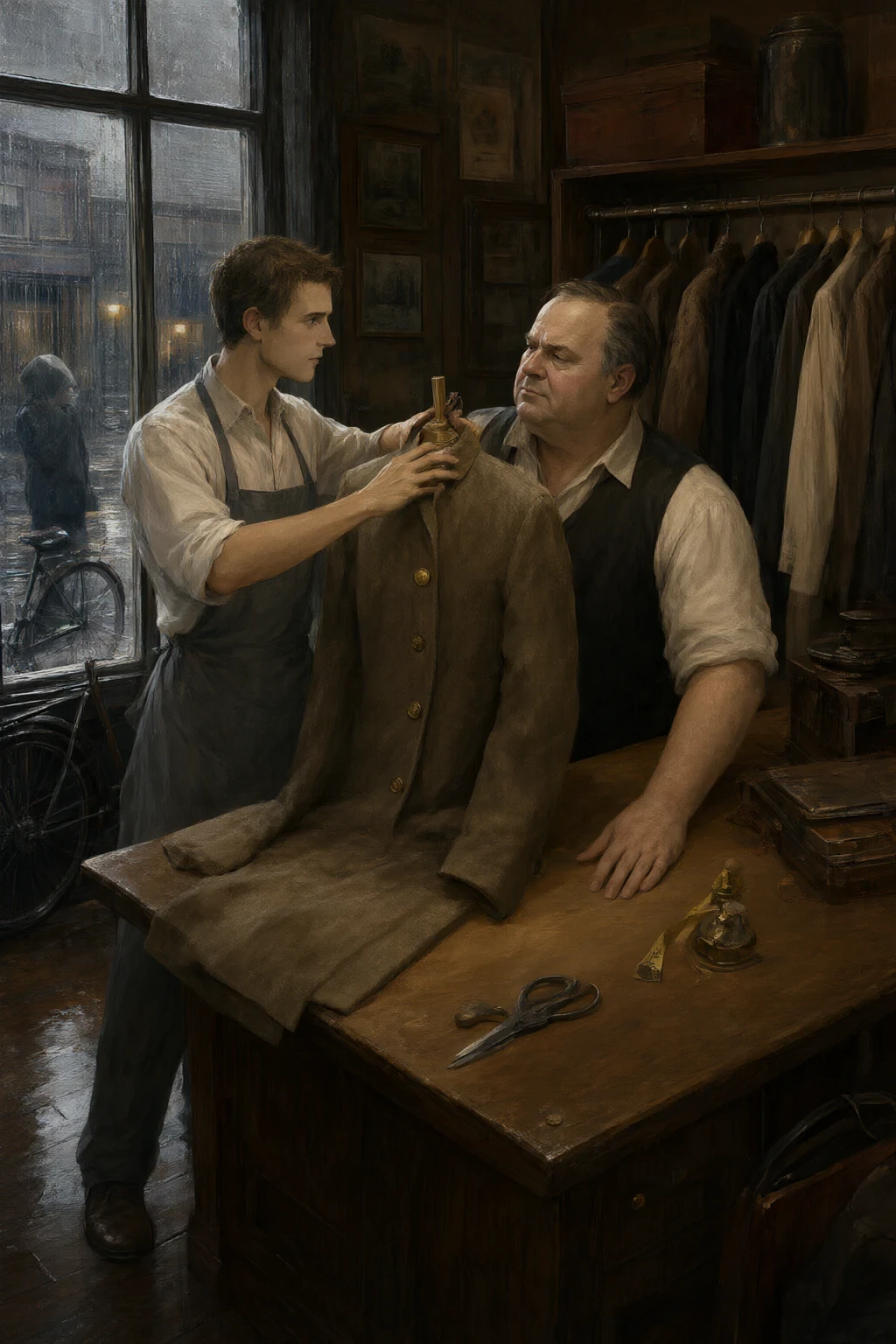
The collar went at the second button in the January of that year, and it was the fourth time in twelve months, and the man who came to the shop for it was the guild’s commoner, and he had been the guild’s commoner for eleven years. The shop on Weir Lane had a man in it who had been cutting in the town for twenty-two years, and the commoner had been to four of them in a year, and the man on Weir Lane knew the other three by what they said about them, and he took the coat off the hook and put it on the stand and looked at the collar for a while without touching it. “It’s the collar,” he said. “Yes,” said the commoner. “It’s the collar again.” “It has been the collar four times.” “Yes,” said the man on Weir Lane. “It has.”
The collar was not a bad collar. That is the part that everybody in the town found hardest afterwards. It was eleven inches round at the neck and it had been let out at the seam twice and once at the shoulder, and the wool was good, and the coat was a Great Hall coat of the guild’s own, bought in 1882, eleven years ago, when the commoner took the office, and it had outlasted two tailors’ apprenticeships, a change of government at the capital, and three of the four men who had put their hands on it. What was wrong with it was that it was not a size. “It doesn’t fit you,” said the man on Weir Lane. “It fits me.”
“It fits you in the body and it is not your size in the neck, and it has not been your size in the neck for four alterations, and I am the fourth man in this town to have had it brought in for the same fault, and I will tell you what the other three said to me about the other two, because they say it, and they say it to my face, over my own counter, and none of them ever said why.” He put his hand flat on the coat. “A collar is cut to a neck. That is the whole of my trade. I have got a rule with a number in it, and I do not have a number for you, and I have had a slip from the guildhall four times in a year, and on the slip there is a seal and a number, and the number is not a neck.” It was then, at the counter, on a Tuesday in January, with the rain coming across the shoulder of the hill and the boy from the dye yards going past with a hood up, that Vaughn Ostry asked the question he had not asked in eleven years, and he asked it about a collar, and it was a mistake of a question, and it turned out to be the right one. “What is missing?” he said. The man on Weir Lane stopped what he was doing. “Off the coat?” he said. “Nothing is missing off that coat. Look at it.” “It has been altered four times.”
“It has been let out four times, which is not the same as being altered, and there is a difference, and I have never had anybody argue the difference with me before.” He turned the coat round on the stand. “The cloth is right. Eleven yards of good wool off the downland, worked close, and the shoulder is sound and the hem is sound and the pocket bags are there. There is nothing off it.” “Then what is missing?” The man on Weir Lane put the chalk down. “The name,” he said. The guild met on the Friday, and the guildhall is cold on the north side, and the commoner hung the coat on the hook by the door before he came in, because he has hung it on that hook since 1882 and it is the first thing anybody does in that room and nobody has ever asked him to do it. The clerk’s minute of that Friday reads: The commoner, present. The question of the alteration of the coat of the commoner was raised. The seal was produced. The minute does not state the name of the commoner, for the reason given at item four.
The reason given at item four is that no name can be written in this room about this coat, and it is not a guild rule and it was never minuted as a rule, and it is simply how the room has worked for eleven years, and nobody in the room can remember deciding it, and Corin Slee said the thing that everybody was thinking and that nobody had said. “I cannot point at him,” he said. Vaughn Ostry was sitting at the table with his hands on it, six feet from a man with a brass stamp on a lanyard. “No,” he said. “Go on.”
“You have been in that chair for four minutes and there is no way of saying that man to the man sitting next to you about you, and if I say your name now you are going to find out whether it matters, and I am not prepared to find out on a Friday with nine people in the room.” He squared the edge of the minute against the edge of the table, because he aligned things before he looked at them. “And I am not prepared to ask you to find out either, because you have worn that coat for eleven years and whatever is in it has been keeping you warm at the same rate, and there is no hurry in it.” “There is a great deal of hurry in it,” said the commoner. “The collar will not go over my neck.” The rest of the Friday went on. The guild had a water rate, and a water rate is the one business in Sparable that nobody has ever made interesting, and it was disposed of in twenty minutes, and the hand bell was rung at four, and the hall went on being a hall.
It is worth saying, because it is the part of the rule that frightens people, and because it is the reason the question took a fortnight and not a morning, that the city does not change. A person who has been made unmentioned is not naked and is not ruined and is not on a list anywhere; he is simply a man who cannot be pointed at, and everyone carries on exactly as they are, and the town went on saying his name that day, and says it still, in the market, in the dye yards, in the yard of the Warp House, and in his own kitchen, and not one of those is in the guildhall, which is nine feet higher than the market and has its own set of rules, which are not written down, and which there are nine people alive who know are there.
The alteration book is in the second drawer of the guildhall desk, and it is not a bound book; it is a sheaf, because the guild has never had four alterations of one coat before and has never had cause to bind anything. The three other tailors were written to on the Monday and three of them came, and one sent a boy, and the boy brought the slip and could not stay. There were four slips on the table by four o’clock, and they are four pieces of good paper about the size of a postcard, and every one of them carries the guild’s seal and the number 214 and the words let out, collar, seal, and not one of them carries a name, because a name on a slip about a collar is a name on a description of a garment, and there was no guild clerk in 1882 stupid enough to put one there and there has not been one since.
“Two hundred and fourteen,” said the tailor on Coal Hill, who had been cutting in the town for thirty-one years and who had come in on his own time. “I have had your two hundred and fourteen four times since October and I have a number for it and I have had it three times, and I will tell you the honest thing about a number, which is that a number is a hook to hang a thing on and it is not a thing. I cannot cut a collar off two hundred and fourteen. I have been cutting a collar off a man in a sealed envelope for four months.” “You could have written to the guild.”
“I could have written to the guild,” said the tailor on Coal Hill, “and I did not, and I want that set down, and I do not want it thought that I sat on it out of spite. I did not write because there was nothing to write. I have got a rule with numbers in it and I do not keep a book of names, because a tailor does not keep a book of names; a tailor keeps a book of numbers, and a number is the whole of what a tailor is given. And I want you to understand that this is the first time in my working life that I have wanted anything else, and I have wanted it since October.” Nobody had asked him why, and that was the sentence that went round the room afterwards, and it went round it twice, from two different people, in two different words.
The commission book has a line in it for the third of March, 1882, and the line is the ninth of the page, and the columns are ruled, and every column on that page is filled except three. The goods column says: a coat, of wool, for the commoner. The of-what column says: forty and thirty-eight, undyed ground. The in-the-negative column has a single line in it, in the clerk’s hand of that year, and the line reads: with no particulars of the collar, at the neck. The guild’s own negative could not say what was in that collar, because a negative that states what a garment has left out is a description of the garment, and a description in this town is the end of the garment. So the clerk of 1882 wrote the only line that was safe, which is a refusal to give particulars, and a refusal to give particulars is not an instruction to anybody, and a form with no instruction on it is not a commission. The weaver column is empty. The buyer column is empty. The threads column has a dash, because it was not a commission of two.
“It is a good form,” said Corin Slee, reading it out. “It is in the negative, all the way down, as far as a refusal and no further, and the refusal is a refusal to say anything at all. Whoever wrote that knew exactly what he was doing and he wrote it in a clerk’s hand and he dated it and he ruled the line under it.” “It is my coat,” said the commoner. “It is your coat, and it was ordered in the negative, and there is no maker on it.” “There has to be a maker on it.” “There does not,” said Corin Slee. “That is the thing you have not been told, and I have been putting it off for four days because I did not want to say it in that room. A commission is a contract between two people and this town honours a contract only when it is written in the negative, and this one is written in the negative and says nothing, and a contract that says nothing has been made with nobody. The clerk did the only thing that could be done with a form like that, and he did it properly: the maker’s name off, the buyer’s name off, and a dash in the thread column, because there was no thread to cut. And that is why no man in this guildhall has ever been able to say out loud whose coat is on that hook. It is not a mystery. It is a form that had nowhere else to go.”
The shed’s day-book settled the rest in eleven minutes, and the shed’s day-book is a large ruled book kept on a shelf by the door, and it is kept by weight and not by name, because the shed is paid by the pound and the pound does not care. The eleventh of March, 1882: from the seventh loom, twelve yards, sold to the guild, four pounds ten. The price is in the book and the buyer is in the book and the loom is in the book, and the book does not say what the loom did that day, and cannot, and was never asked to. The seventh loom belongs to Old Mab Ostry, who is seventy-one, and who has been at that loom for forty-nine years, and who came into the shed on the Monday morning at the time she has come into it every working day since 1844 and counted the looms by touch on the way to hers. Nobody in Sparable had to be told. The town has eleven looms and one of them has had the same woman at it for half a century, and it was not a matter of deduction. It was a matter of the whole town looking at the same page at the same minute.
They went to the shed on the Thursday, because the Warp House admits visitors on Thursdays and gives them three minutes, and the guild admitted itself as a body of six, and three minutes is three minutes whether you are one person or six. One of the six was Lysa Ferrant, who was seventeen and who was there because a negative schedule has to be read by somebody who was brought up on negatives, and who stood in the dark at the end of the row with her hands behind her back in the attitude of a child at an inspection, and turned a finished bolt face down on the cloth beam before she looked at it, and looked at it, and turned it back.
The shed is long and low and shuttered and the looms stand in a dry dark in a row going away from the door, and the warp threads are under tension like a held breath, and a person is paid there to look at nothing for eight hours a day, and when six people come in the door the whole room changes temperature. Old Mab Ostry did not stop working, and she knew who was behind her without turning round, because there is one weaver in this shed who counts looms by touch and can count a room by its noise. “You have come about the coat,” she said. “We have come about the coat,” said Corin Slee, and got out the commission form, and then did not put it in front of her, and stood holding it. “You have got a sheet in your hand.” “I have.”
“Then you have not got three minutes,” said Old Mab Ostry, “because a sheet is a description and I will tell you what a sheet does in this town and you know it better than I do, and I have had fifty years of it and you have had eleven weeks. You can ask me one thing and I will answer it the way I answer everything, and the way I answer everything is that I say what I left out and I say nothing else, and I have been doing that since before you were in short coats.” “We have four minutes’ worth of question and three minutes’ worth of room,” said Corin Slee. “Ask.” He asked her what she had left out of the commoner’s coat.
She did not turn round. She kept both hands on the cloth, and the shed was quiet in the way a shed is quiet, and the boy at the door of the Warp House put his head in and took it out again. “His name,” said Old Mab Ostry. Nothing happened. The six of them stood in the dry dark with the looms going away from them into the dark, and one of them said afterwards that for a quarter of a minute nobody breathed, and the weaver on the fourth loom went on working, and Old Mab Ostry went on working, and the light through the shutter-slats moved the length of a hand along the floor and stopped. Corin Slee put the commission form back in his coat. “It did not do it,” he said. “It did not do it here,” said the commoner.
“It did not do it here because she said the thing and not the description of the thing, and I want that written down before anybody in this shed forms a different opinion in the next four minutes.” He was talking faster than he talked. “A description supplies it. A description of the garment says what the garment has not got, in the words that belong to the garment. She said four words about a man. That is a fact about a man and not a particular of a coat, and there is a difference, and the difference is in item four and it is the only distinction this guild has ever had to make and I have never had to make it before.” “That is your opinion,” said the weaver on the ninth loom, from the dark. “It is my opinion and I am the assay clerk and I am going to write it in the minute as my opinion, in those words, and the guild can rule on it or not rule on it, and I will still have written it down.” They ruled on it on the Monday, and the ruling is two sentences, and the second one is the important one. Ruled: that a description of a garment supplies the thing the garment has left out, and that the saying of a name is not a description of a garment, and that a document which describes a garment and names the person wearing it does supply it, and does so whether the two are on one page or on two.
The second sentence was carried by two hundred years of custom rather than by argument, and the custom is this: in a weaving town the name goes with the cloth. Every commission book, every assay sheet, every alteration slip, every receipt and every warranty in the county has the name of the wearer in it along with the number of the garment, because that is how a person keeps track of a coat. And so, to omit a name from a cloth, the omission has to go the whole way, out of the collar and out of the paper, and it cannot be argued back in from the collar, because the paper is the part of it that everybody would read. That is the sentence at the heart of eleven years of this town’s paperwork, and it was in the minute, and when Corin Slee read it out the commoner sat with his hands on the table and looked at the wall for some time.
The guild put a second question the same afternoon, and Corin Slee had the answer ready, which is his habit. Had a gap been made? A gap is what is left when an omission has been found out and the thing cannot go back into the cloth. Nothing had gone back and nothing had been left empty. The coat was on its hook, the collar was still not his size, and the omission was in the cloth where it had been since the seventh loom in March of 1882, and a discovery is not a change. The minute says that no change has been made, and the Mending House was written to, and the four people there replied in four lines that there was nothing for them to do and that they were glad of it. “Then the slips are the collar,” he said.
“The slips are the collar,” said Corin Slee. “A slip from a tailor says alter the collar of the coat of and then it has to have a name in the place of the coat’s owner, and if it has a name in it, the name of the wearer is joined to a description of his garment on a piece of paper with his neck on it. So the guild has been sending out a sealed slip with a number on it for eleven years, and the number is the coat number out of the inventory, and it is not a neck, and no tailor in this town can turn a coat number into a neck, and so four of them have guessed.” “Three-eighths of an inch,” said the commoner. “The last one was three-eighths and it went the wrong way.” “Then the fifth man guessed wrong and had to do it twice,” said Corin Slee, “and that is why you have been in this shop four times in a year and why you are not the right size in the neck, and I am sorry to tell you that the collar of that coat is not a size and never was.”
The fifth alteration was done in the second week of February, and it is the first alteration to that coat in eleven years that is on a piece of paper with a name on it, and the name on it is the name of the man on Weir Lane, and he wrote it himself at the bottom where a tailor writes his name. The order was a single line and Corin Slee wrote it and read it out twice before it went. The collar is to be made to the cloth. No measurement of the wearer is to be taken. The garment is to be altered in the neck seam only, to the width of the cloth as it hangs, and the cloth is not to be strained to fit a person. “It is a mad order,” said the man on Weir Lane, when it was brought in. “I have never had one like it. You cannot make a collar to a coat.”
“You can make a collar to a coat,” said the commoner, “because the coat has got one, and because a coat is a thing that exists, and because the only person in this town who is not allowed to be measured for it is me, and I have been getting collars wrong for eleven years through no fault of the tailor.” The coat came back on the second Friday with the collar a half-inch wider at the back than at the front, which is a thing a tailor can do and which is correct, and the commoner put it on, and it fastened, and the two buttons at the neck went into their buttonholes without any assistance whatever, and he stood in the middle of the guildhall on a Friday afternoon in February and buttoned and unbuttoned a coat four times while six people watched him do it, and nobody said anything, and one of them left the room.
The name went into the wage book on the second of March, and Corin Slee did that as well, and it is the smallest thing in this account and it is the one that changed the most. The wage book is ruled in columns and the columns are week, amount, paid to, witness, and the paid-to column for eleven years has a line ruled straight through it, from end to end, and beside the line the same figure, four pounds a week, in a clerk’s hand, and a W in the witness column every Thursday, because a wage has to be witnessed whether or not it can be entered.
He ruled a new line. He wrote the name in it, and the name went in as a name and not as an entry, and the sum was the same, and the witness initialed it, and then he did four other things before he went home, because the moment a man has a name on a page four hundred other pages become possible: a receipt the commoner could keep, a season ticket, an entry in the guild’s own insurance, which has been paying a premium for eleven years on a policy that could never be proved. “It is a receipt,” he said, and put it on the table face up, and it was a piece of paper the size of a playing card with a name on it and a date and a stamp, and the commoner looked at it for a second and then put it in his breast pocket and buttoned the pocket, which was the coat’s fault and not his.
The money for the commission was a harder piece of arithmetic and it took the guild three weeks. There was no commission. That is what the commission book says, in three empty columns, and a commission that has been made and cannot be recorded as made has not been made, and the guild’s own rule is that a thing that is not in the book has not been done. So the coat was bought off the seventh loom in March of 1882 for four pounds ten, and it was bought as goods, and goods are sold by weight, and the shed weighed it and took the money and the price is in the day-book and the price is the whole of what that bolt ever earned.
And a buyer cannot receive a decision. A commission is two people agreeing that a thing will be left out, and each of them holds a thread, and the buyer may stop the weaver and the weaver may stop the buyer, and the buyer may say what it is to be and where it is to go. Nobody may buy one off a loom. That is not in the orders; there is no order about it, because it never occurred to anybody that a thing left out on purpose could come into a town by way of a market. But the guild does not care how a thing arrived. The omission is in the cloth. The cloth is on a man. That is a decision, and somebody made it, and the guild had been wearing it for eleven years without knowing whose it was, and it had cost the guild four pounds ten and no commission at all.
So the guild resolved, on the fourth of March, that a sum of eleven pounds be paid as a commission on the seventh loom, for a decision of which no particulars are recorded, and the money was taken to the shed in a canvas bag on the Thursday and put into a hand at the seventh loom, and the day-book has an entry against the seventh loom for the seventh of March, 1894, in the sum of eleven pounds, and against goods it says commission, not stated, and against received it says received, because that is the word the shed uses when money has changed hands, and the shed has never had cause to doubt the word in fifty years. Nobody saw her take it. The shed does not see anybody take anything, because a weaver is not to be watched, and that is also in the orders.
What Corin Slee did on the last Friday of that March has never been minuted, and it is in the file, and it is the last thing in the file. He wrote out eleven sheets of the same paper, and on each he ruled a line, and on each line he wrote the date and the number of the seventh loom and nothing else, and then he went round the eleven looms and put one sheet on each bench, face down, and he said to each weaver the same thing, which was that the guild is not asking anybody anything, and that a sheet is a form, and that a form may be filled in or not, and that a sheet which is not filled in may be put in the stove or taken home, and that the guild will not know which, and that the guild does not want to know which. Then he came back to the assay room and sat down and put the stove in front of the fire and the ten sheets in it, one at a time, and they went up in about four minutes, and the tenth one was the last one in, and the bench of the seventh loom was the only bench in the shed with nothing on it at eleven o’clock that night. The file says: ten of the eleven sheets were returned to the stove. The eleventh was not returned. It is not in the file.
The coat is still on the hook by the door of the guildhall on a Friday, and the number on the alteration slip is the coat number out of the inventory, and the inventory has forty-one coats in it and one of them has a number with nothing at all against it, and the difference between that one and the other forty is a difference nobody has ever been able to state, and the assay clerk stamps about four hundred bolts a year and has not been able to think of one instrument in this town that could tell him which of them he has done that to. There is a green ribbon on a child’s wrist at the north window of the Great Hall every Thursday afternoon, and a child of nine, and she looks at the whole of everything, and Corin Slee stamps about four hundred bolts a year and has got quite used to not asking.