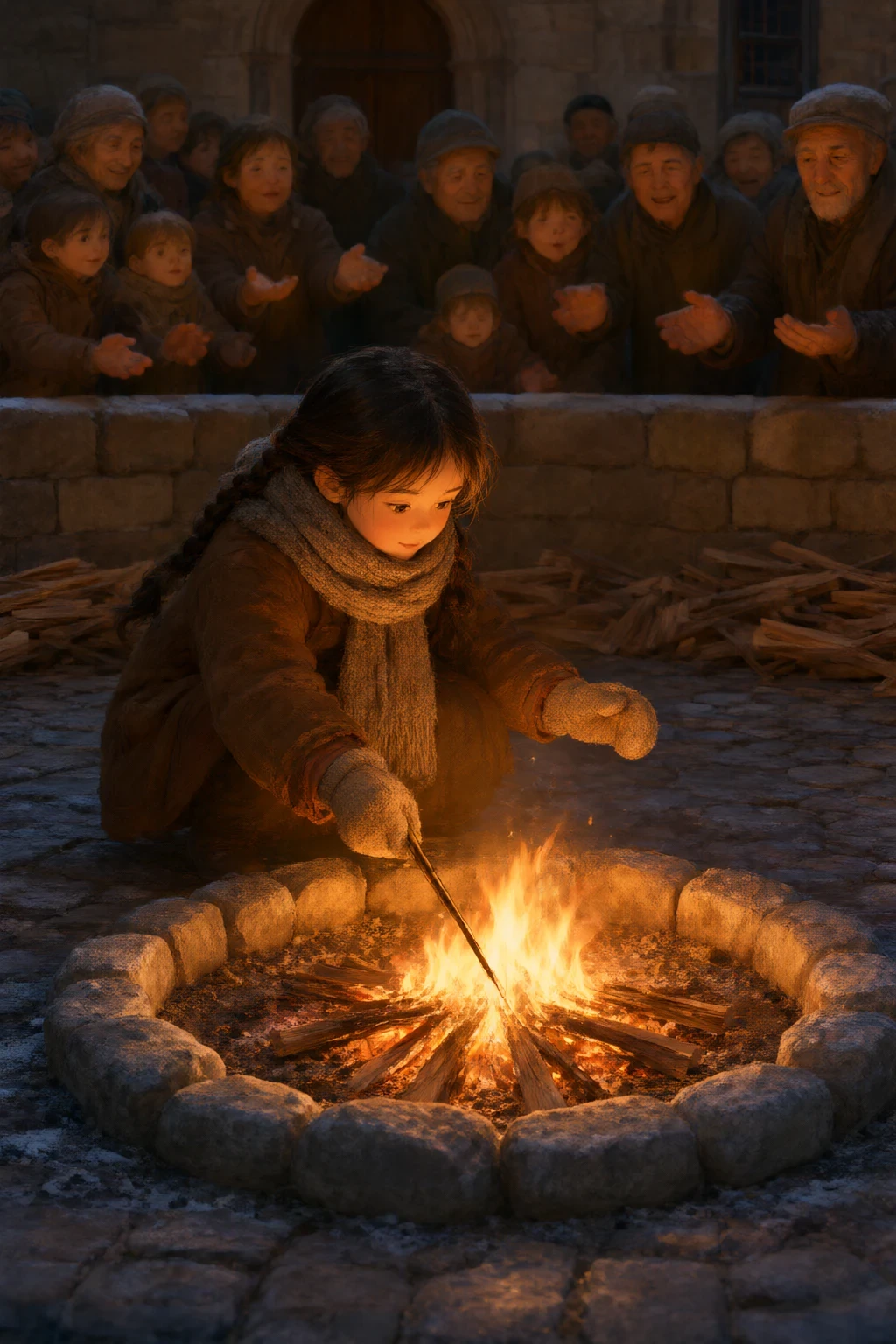
It was the coldest night of the year, and the square in front of the church was full of people who had nowhere warmer to be. They had come to see the new year in. None of them had brought anything to burn. Sigrid was eight. She had a box of matches and a grandmother who said she could sell the matches or light the matches, but not give them away. "Why can I not give them away?" said Sigrid. "Because you will come home with an empty box," said her grandmother, "and a cold nose, and the cold will be exactly as cold as it was when you started."
Sigrid stood in the square and watched the people. That was a thing she was good at. Everybody had their hands inside their sleeves. The carter had tucked the reins under his coat and was holding the whip by the wrong end, because his fingers would not work. The woman with the pram had stopped crying and had begun to shake instead, which is worse. The boy from the boat had a blanket over his head and his shoulders and not his feet. Nobody was cold because they wanted to be. They were cold because that is all the warmth there was to have. Sigrid struck a match.
It made a small warm room about four inches wide. The little girl in front of her held her hands over it and opened her mouth, the way you do, and for four seconds the girl had a fire. Then the match was ash, and the little girl took her hands out of the air and put them back in her sleeves.
Sigrid went to the carter. "You have got no straw," she said. "I have no straw," he agreed. "You have a cart." "I have a cart." "Then the cart is straw," said Sigrid, "and you have a fire, and all you are short of is a box of matches and somebody to show you the way to do it, which is four o'clock at night and nobody will teach you for free." The carter looked at the matches in her hand.
"I have eleven," she said. "I will show you once. You give them out. You do not have to buy them, and I do not want your money, and I want you to watch, because after tonight everybody on this square is going to be cold and short of matches and it does not have to be that way."
So she taught the carter four things, and the carter taught the next man, and the next man taught the next, and this is all it takes. One: you cannot light a fire with a log. You start with a fist of dry grass and you build a bird's nest of it in the middle, and you let the flame get a hold before you give it anything else.
Two: sticks go in smallest first. A big log on a little fire does not feed it. It sits on top and smothers it, and you end up with a black box and a lot of smoke and no fire at all. Three: put a ring of stones round the middle, because a fire is a good deal lazier than people think and given half a chance it will get out and lie down in the grass. Four: build it on the side away from the wind, so the wind has to go over the fire to reach it and gets warm on the way.
It took the carter eleven minutes to get a fire the size of a hat. "Eleven minutes," he said, "and I have been standing here for an hour." "Now do it again," said Sigrid, "and do not tell anybody how. I want you to be the one who knows."
The timber yard at the end of the street gave away its offcuts, all of them, because the yardman could not sell wood in a frost. Men brought barrows of it out of the dark and stacked it in a long windrow along the south side, where the wall would hold the heat in. Women brought the ends of Christmas candles, out of the puddings. A man who sold straw brought a cart of it and dumped it and went home.
Sigrid ran up and down the windrow all night, giving out the rules, and the rules were the same four rules and there were not enough of her to say them to everyone. So she taught them to four people instead of saying them to forty, and it worked the same, because that is how a thing like this works. One person who knows is worth twenty people who are cold. There were nine fires on the south side by midnight, and the smallest of them was the size of a hat, and the biggest was in the middle, and the middle one was Sigrid's.
She built the middle fire herself, in a ring of iron from an old gate. Grass, then kindling, then the offcuts, then only then the two long pieces she had gone into the timber yard and asked for by name, which were the pieces everyone else had been using to whack each other in the back. She had laid them across the top like a roof so the sparks came down in the middle instead of going up the chimney of the crowd.
Somebody gave her a dog. Somebody else gave her a pot of something. A man she had never seen before put his coat round her shoulders and would not take it back, and Sigrid let him do it, because it was a big coat and she was eight and there were nine fires to look after.
At midnight the bell rang, and the crowd shouted, and Sigrid fed the middle fire one more piece because a fire on a birthday is a fire that has done something. Then she bent down and blew on the base of it, the way you do, and the flame came up and turned orange at the bottom, and eleven men watching her learned how to do that as well.
The crowd went home by degrees. The fires got smaller because the crowd was the fuel on a night like that, and by three o'clock there was a ring of grey ash and one hot middle. Sigrid swept a flowerpot out of the flower bed with the frost on it. She filled it with ash from the middle of the fire, and stirred two live red bits down into the ash, and put the lid on it, and set it on the sill inside the church gate where the old watchman could see it from the path.
It was grey outside and going to be grey for another two hours, and then the mill wheel would start, and the first cart would come through the gate, and the driver would lift the lid on a pot of ash with two live embers in it, and would know exactly what to do with them, because everybody in that town had been taught four things by a fire in a square.
Sigrid went home with cold hands and a box with eleven matches still in it, and she put them back on the shelf in the kitchen where they had started, because eleven is a good number to have in a house, and somebody would be cold again by Thursday.