Thirteen hundred, and falling, and the seventh mould had been in the sand for nine days by the time anybody thought to go and look at the ledger. The seventh mould was not the problem. The seventh mould was a river bell, cut by a woman of twenty-two with a burn on the inside of her right wrist in the shape of a sand cake, and the flaw in it was a seam she had cut to carry a voice over distance, and she had cut it in September, and it was a good seam, and the ladder of grey and green flames on the pattern was a ladder of grey and green flames and any moulder in the shed would have known it by heart. The problem was the entry after it.
Nan Ilva came down the pit stair at eight in the morning with her sleeves pushed down over her wrists and a sheet of paper in her hand, and she said the temperature before she said anything else, which was how she had said it every day for nineteen years and would say it on the day they close the place. “Eight hundred and forty, and the pit is banked, and I am going to ask you a question and I would like the answer to be arithmetic.” “Ask it.” “The alloy account for the first nine months of nineteen seventy-one shows nine casts of bell-metal and eight sales.” She put the sheet on the desk, squared to the edge, because she squared everything. “Nine hundred and forty pounds of metal went into the ground and eight bells came out of it. The auditors want the ninth in the book before the thirtieth, and I have been sitting in that room for two days trying to find a word.”
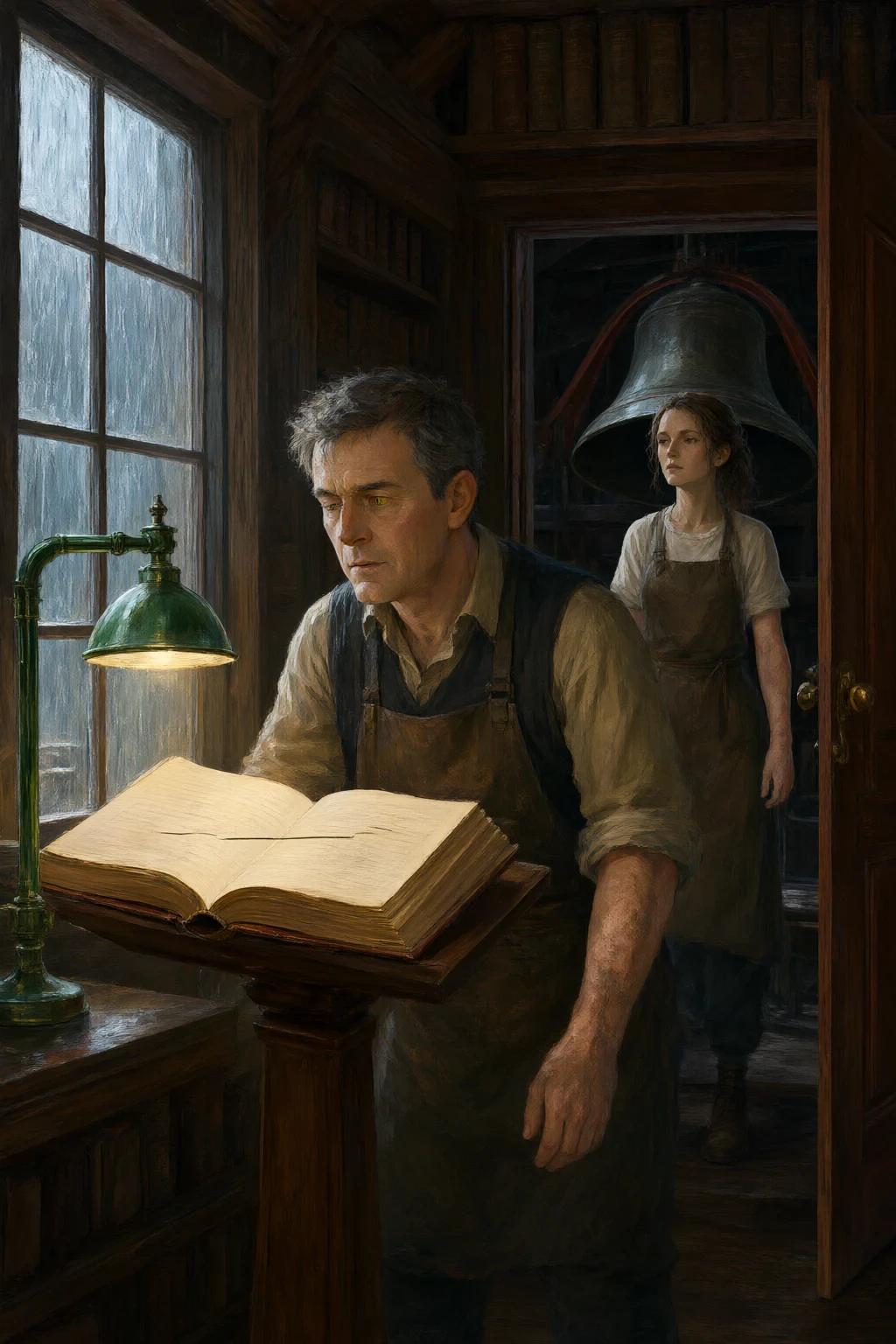
Aldous Crenn put the green brass reading arm a little higher and looked at her with the eye that worked. “Defect,” he said. Nan Ilva did not sit down. “Say the rest of it.” “The book says, in the hand of Ferrow—” He stopped. He always stopped there. The sentence had a shape and he had spent forty-one years letting other people finish it, because a sentence finished by somebody else is a sentence you can quote.
The book lived on a lectern at the north window of the counting house because it was too old to be carried by one person, and Aldous opened it to the leaves for the last week of September in 1971 and put his face close and read around the yellow with the good one. The entry for the twenty-second of September was in his own hand. He knew it was his own hand because he had signed off a page every week since he was twenty-one, and the entry for the twenty-second said, in a flat careful way, that the moulds were four to twelve, the alloy was good, and the pour went at four in the afternoon. The entry for the twenty-ninth was not there.
The ruling ran straight through. He turned the page back and forward and the ruling ran straight through both times, and the date came, and the next date came, and between them there was a gap in the fact of entry rather than a gap in the paper. “No line,” he said. “No line.” “That is not the same as a blank line. A blank line is a decision. A missing line is an omission.” “It is the same to an auditor,” said Nan Ilva, “and it is the same to the alloy account, and it is not the same to the book. The book has never had a missing line in it in four hundred years. That is not a boast. That is the mechanism. If the book can have a hole in it, then the book can lose nine bells and still be a book.”
Odo Marrack came down from the top house in the afternoon with his black felt hat on and his left hand held the way it had been held since 1971, two fingers short at the second knuckle and the ring finger curled, so that it looked like a glove somebody had begun to take off. He was sixty-seven. He had been at the ladle for thirty-one years and had not poured since the winter of the eighties, and he had told the story of his two given flaws to so many people over so many years that the story had grown a third one he had never cast, and the third one was the one people asked about.
“I am not going to say this is advice, but,” he said, sitting down without being asked, “a thing that is only talked about gets bigger, and a thing that is written down can be read, and I have been waiting thirty years for a man with a green arm on his desk to write one down so that I could stop telling it at market.” Aldous pushed the book round. “There is no line to write on.” “Then rule one,” said Odo. “You are the clerk. Rule a line. Put nine on it and put the date and let the auditors have their page.” “They will want a word.”
“They will want a word because a word is what a page is for,” said Odo, “and you have spent your life in a town that thinks a page without a word is a mistake, and I have spent my life at a ladle in a town that does not, and one of us is going to be wrong about that and it is not going to be me, because I have already been wrong twice and it cost me this.” He put his bad hand flat on the table, palm up, like a man showing what he had.
Tamsin Lowe asked the question she already knew the answer to, in the shed, on the lang bench, with the sand going cold in the frame and the wired glass overhead gone the colour of weak tea. “So which is it meant to be?” she said. “If I am not to write a word, am I to write a purpose? Because a bell wants one. If somebody hangs that ninth casting one day and there is no purpose on it, then whatever hand is on the rope decides what it is, and a thing that is decided by a hand is not a bell, it is an opinion with a crown on it.” Nan did not look up from the pattern she was correcting. “You have cut a seam that carries a voice over distance,” she said. “That is a purpose. You chose it. The metal will do exactly that and nothing else for as long as it hangs.” “But I chose it because I liked it.”
“Everybody in this shed chose something because they liked it. That is not a confession. Liking a thing is the only honest reason there is to give a bell its whole life.” She pushed her sleeves down. “The question you are actually asking is whether you may go down into that pit and see the nine. You may not.” “Until when?” “Until the alloy account closes,” said Nan Ilva, “or until I have decided, and I have not decided, and I am telling you the temperature rather than the reason, which is a courtesy, and take it as one.”
They dug on the Monday because Nan Ilva decided they would, and the deciding cost more than the digging. The water tanks had to be full before the pit was opened, which is a day of somebody's cartage and a great deal of complaint. The coal contract for the middle three weeks of the month went to a house in Sikehead that had held it for eleven years and lost it in an afternoon. The school, the bakery and the laundry were all under their quiet contracts, and a casting day that becomes a digging day is not quiet, it is a different kind of loud, and the laundry wrote to ask. The pit itself is two storeys of brick throat cut into the hillside and it is the hottest place in four counties, and you cannot dig a floor that has been fired forty times without opening everything the floor has been keeping.
Verity Ash came and measured it, because she came and measured things now, and she stood on the stair landing with two fingers on the wall and said that the pit had a draught in it at a height of nine feet that moved the flame nine inches to the left, and gave or take the compass, and that was the only good news of the week. “You will want a figure,” she told Aldous, “and I am telling you in advance that there will not be one. I have measured what can be measured down there. I have not measured what you are actually asking about.” “Then say what you are actually asking about.”
“You want to know what they are. And I am telling you now that what they are is not a number. I have been asked this year how far a bell carries and how many houses it reaches, and both of those are things I could put in a book. Nobody has ever asked me to write down what a bell is.”
They found the first one at four feet, lying on its side in burnt sand and cinder, exactly where a mould goes when the sand around it is dug out and the mould is not built to be dug out. Tamsin put her hand in and touched the shoulder. “It is warm,” she said. “It is not warm,” said Verity. “It is fifty feet from a furnace mouth. It is warm the way a wall is warm.” “It is warm where the flaw is.” That was the moment, and it lasted about a second and a half, and eleven people were on that stair and only one of them noticed what had just been decided. Aldous Crenn wrote it down in the pit book in pencil, the way he wrote everything that was not the book: MOULD SEVEN. FLANK. HEAT, LOCAL. NO FIGURE TAKEN.
Mould seven was a copy. That was the whole crime, and it had taken nine days in 1971 to arrive at, and it was not a crime anybody could have been hanged for. Tamsin had the sand print on the bench in front of her by the Wednesday and she was the one who said it out loud, because she was twenty-two and had spent eleven years learning to read a pattern the way other people read a face. “It is the 1881 fire pattern,” she said. “The seam in the shoulder, three inches, laid in from the outside at the same rake. Somebody cut this mould off the old one. Somebody had the old one on the bench to copy.” The shed went very quiet in a way the shed did not often go quiet, because a hundred people were in it. “Why would anybody copy a flaw?” Ebba Roke said. She was there because she was always there.
“Because a flaw is a decision,” said Nan Ilva, “and a decision takes a day and a good light and an argument, and copying takes a quarter of an hour and nobody has to lose an argument in front of anybody. Nine bells, one seam, one purpose, shipped to four counties by the crate. That is not a foundry. That is a laundry.” “Was that the strike about?” said Verity. “No,” said Odo Marrack, from the top of the stair, where he had been standing the whole time with his hat on. “The strike was about the ninth.”
He told it then, and he told it well, because he had told it a hundred times and the telling had worn it smooth. The men came off the lang bench at ten past eleven on the twenty-ninth of September, 1971, nine of them, and did not argue with anybody. They walked out through the coke yard and up the hill and stood in the wet outside the Cloth Hall, and they stood there, and the founders went on pouring, because a founder cannot argue a man out of a flaw but a founder can certainly be told that the mould is his own and the alloy is his own and the pour is at four.
The metal was in the ladle at eleven forty. The ladle stood at the furnace lip on the chain, and the stream came through the pipe in the wall, and the furnace breathed, and the pourer held it and it went into mould seven and the mould filled, and the men stood in the rain above the town and the mould filled anyway. “It went in because a founder does not pour a hole,” Odo said. “That is the whole of the law and it has been the law since before I came. You do not put hot metal in a thing that has no purpose because you are angry. You put it in and you write a word and you own the word.” “So the bell was cast,” said Tamsin.
“The bell was cast and the word was never written. Because the men who knew what the word was stood in the rain and would not come back up and say it, and because I would not come down and say it, and because there was nobody else.” He turned his bad hand over. “I have two fingers short because I came down the gantry in the wrong weather with a ladle chain in my left hand. The town says it was the chain. It was not the chain. It was standing in a shed for four hours on the twenty-ninth of September deciding whether a thing I had put my name to was a decision or a copy, and I have never been certain, and I have been certain enough to be the kind of man who pours.”
They were nine. They lay in the sand of the pit floor, side by side, in a row, in the order they had been moulded, and the ninth was nearest the wall and the most complete, and the eight before it were a different matter. The eight were struck cold. That is what a founder calls metal that has been interrupted: the pour started and did not finish, and where the metal stopped running and froze there is a dull cold shut in the metal like a bruise under a thumb, and it goes round the casting at a different height every time, and a bell with a cold shut is not a bell, it is a lump with an opinion about bells. Mould seven was the only whole one. Odo stood over it for a long time. Verity put two fingers on the bronze where he told her to, low down on the flank, and got nothing, and moved them, and got nothing, and said so.
“There is no figure,” she said. “I have the temperature of the hand and I have the pressure of the hand and I have no figure at all. It is a dead thump. You can feel it through the frame and you cannot hear it.” “Then it is a defect,” said Aldous, from the top of the stair, and everybody turned round, because he had said the word on the Monday to Nan Ilva and had not said it since. “It is a bell with no purpose,” said Nan. “It is a bell with a purpose that was never written,” said Aldous, “and those are the same sentence with a lawyer in it, and I have been the lawyer for forty-one years and I am telling you that they are not the same, and that I know they are not the same, and that I cannot show you the difference in ink.”
They carried mould seven up the pit stair on a board with four men on the corners, because the casting floor is not for lifting, and they set it mouth-up in the shed on two oak timbers, and the town came and looked at it, because a bell on timbers in a shed is a thing you cannot be talked out of. Verity measured the seam. It was three inches, laid in from the outside, dull red where the file had opened the metal and nobody had polished it back, which was the fashion of the last fifty years and would not be again. “Three inches, give or take the sixteenth,” she said. “And there is a cold shut in it as well, because the men were off the bench at eleven forty and the pour was late.” “Then it is two flaws,” said Tamsin. “A seam and a shut. Rule two says one capacity. So the seam is not a capacity, it is only a mark.”
Nan Ilva looked at her for a while with the particular expression of a woman doing a heat calculation on a person. “No,” she said. “When a flaw is given instead of cut, the given flaw takes the bell, and the cut flaw stays in the metal as a dead seam, and a dead seam is a thing that any founder can read from the outside for the next two hundred years, and they will read it as what you cut, because there is nothing else on the bell to read. The town will believe that bell was cut to carry a voice over distance. It will be the only thing anybody knows about it. That is what a dead seam is. It is a bell with a lie written across its face in the one alphabet everybody can see.” Nobody said anything. Ebba Roke was on a mould half-buried in the sand at the far end of the shed, sitting on her heels with the grey wool round her palm, and she was, as usual, saying what she was hearing.
Aldous Crenn did not write the word. He went at it in the ordinary way, which is to say that he went at it by looking for a precedent, and he found one within nine minutes, because he had been looking for one for two days and he knew the book better than a man knows the inside of his own coat. The entry for the eighteenth of November in the year the recast happened is one line, and it is in a hand from before his time, and it says what the law has always said, which is that a bell which has been melted is not a bell, and the metal is weighed, and the metal is entered against the account, and the bell is not entered at all. “There,” he said, and turned the book round so that Nan Ilva could see it, and his hand was not quite steady, and he put his good eye to it.
“Then the ninth of September is a bell which has not been hung, and has not been a bell, and the metal is weighed, and the metal goes in against the account, and the bell does not go in at all.” “That is precedent,” said Nan. “It is precedent and it is a hundred and twenty years old and it was written by a man who had never heard of a moulder's strike and would not have understood one.” He put both hands flat on the desk. “I am going to rule a line for the twenty-ninth of September in nineteen seventy-one, and I am going to rule it through, once, diagonally, the way a man rules through an entry he is not willing to strike out, and I am going to put the date and the count and nothing else, and then I am going to put my name under it, which I have not done in eleven years and do not intend to do again.”
“Why not?” said Tamsin. “Why will you not name a purpose? It is four words. I will cut you a seam you could hang.” “No,” said Aldous. “Because the moment I put a word on that line, the word becomes the bell, for good, and it is a word nobody in this room chose, and I have spent forty-one years refusing to write down decisions that other people had not made, and I am not going to start on the worst night of the whole business.”
The line is in the book. It is the ninth of September, 1971, and a number, and a stroke through the whole of it, and under the stroke, in a hand that is small and very steady because he has written every day of his working life and he is good at it, four initials and a date. Above it there is a line for the twenty-second, saying the moulds were four to twelve and the alloy was good and the pour went at four. Below it there is a line for the sixth of October, saying the moulds were one to three and the alloy was good and the pour went at half past ten. And between them, going up the spine of the book, forty years of Gethin Bell, there is one ruled line with a stroke through it, and anybody can see it from the doorway, and it will be as legible in two hundred years as any page in the volume.
They asked Odo Marrack, in the end, whether it worked. They asked him in the shed on the Thursday, with the bell still on its timbers and the rain going sideways off the moor into the gutter, and Verity Ash asked him, because Verity had not been in the shed in 1971 and was the only person in the room qualified to be told the truth by somebody who was. He was ready. He had been ready for thirty years. He had the story of the two given flaws polished to a shine and the third one standing behind them like a man in a doorway, and he told the first, and he told the second, and then he stopped and looked at the ceiling. “No third one,” he said. Odo Marrack looked at the bell on the timbers for a while.
“There is no third one,” he said. “There are two, and the ninth of September, and I have been carrying the ninth of September about this town since the year I lost the fingers, and it came out of me one Tuesday at the lime yard in front of nineteen people, and it has been in nineteen mouths ever since, and the reason it grew is that it was the only version where I did not do it alone.” Verity wrote that down too, at the bottom of the page, with the date, and the initials, and did not rule it through, because it was not a bell and it was not the book and she had been told by a man with a grey ring on his right hand that a thing which is only talked about gets bigger.
The pit book, for the record, says of the ninth of September, 1971: the men came off the bench at ten past eleven. The metal went in at eleven forty because a founder does not pour a hole. The word was not written. The bell is not a bell until it is hung and named, and it was not hung and it was not named, and it is standing in the Long Shed on two oak timbers, and it will stay there, and the shed will be shut over it at the end of the working day, and the town has agreed that it will not be hung.