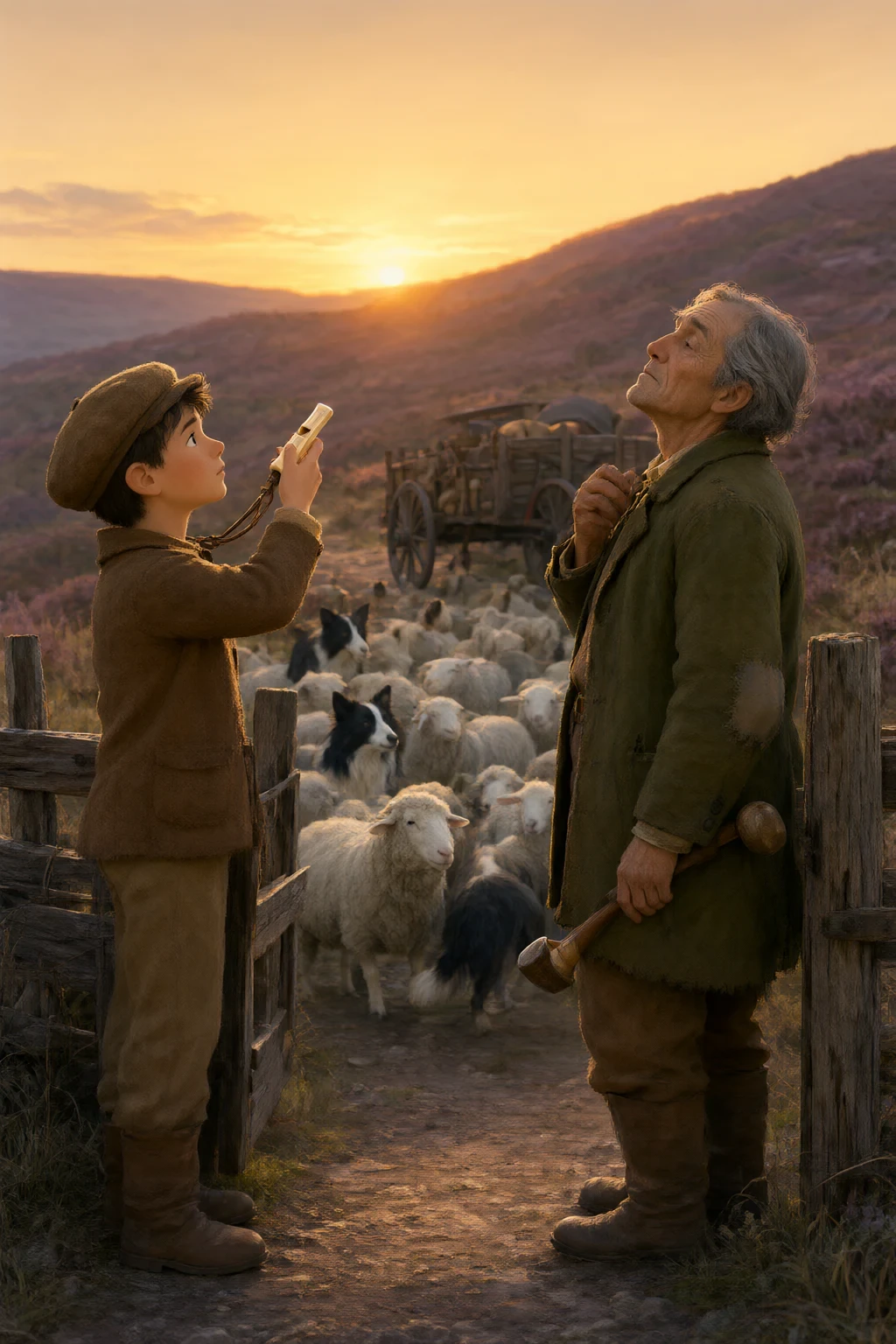
Rook was twelve, and his work was forty ewes, one dog, and a fold at Harehow with two gates, one of which had a wedge that had been missing since the spring. In the winter he carved a whistle out of a bone. Every household on the hill kept bones for the broth, and the best one comes out of the pot as clean as a peeled stick, and a boy with a knife can hollow that in an evening. His note was long and thin and carried a long way, which is not what a whistle in a hill country is for.
"You have made a foghorn," said the shepherd Kellow, the only man up there who ever said anything about anything, and who had, in Rook's opinion, a store of remarks saved up for the wrong moments. "It carries," said Rook. "You want a bell for that. A whistle is for a person. You want it to say something to one person at a time."
Rook hung it on a leather cord under his shirt anyway, and it was there on the September morning when the lorry came up the drove road and the driver shouted at him to hold the gate open, and Rook held it open, and the lorry went through, and the dog went out of his head for ninety seconds and chased it, and that was how the top gate came open.
The ewes were gone. Not far. Two hundred yards, and a wire, and a drover's hurdle, and eleven other men with other flocks, all on the same low ground by the Harrow beck, all shouting at each other, and the sheep mixed into one large grey mass with a dog on each side of it pretending to be the one in charge.
The fair at Harrow was on the Tuesday. The drover was a big man called Yen Arder, who was not unpleasant, and who said exactly what a man says when he has found a convenient arrangement: his flock had come down off the high ground with a flock of ewes that were not his, a shepherd boy had taken charge of them in the dark, and one of the two counts must be short. "I am not short," said Rook, which was true, and beside the truth. "You may be short by a doorpost," said Yen Arder. "Everything is short by a doorpost on a morning like this."
He had saved eleven weeks, and he was not going to buy a flock he did not have. So he went and found Master Oved, who played a pipe at the Harrow fair for a copper a night, who was blind, and who was the only man in that field Rook had ever felt able to stand still beside. "Will you listen to something for me," said Rook, "and tell me whether you can hear it before I can." "Everything is before you," said Master Oved, pleasantly.
They did it that evening behind the shoemaker's booth, which smelled of glue and tar, and it was the best hour of Rook's year.
The whistle knew three voices. It gave a thin note at the buckle of Yen's belt pouch when Yen said he was not short, which was the note Rook had heard at home over a nicked bucket. It gave a fat lazy note when Yen's man said that nobody could count at night, friend, which was a true sentence and a dirty one, and Rook's heart went hot, because the whistle did not care about true or dirty. It cared about whether a man was saying what he was doing.
And the third thing: the whistle would not sound for Master Oved at all, and Master Oved could hear a room from the doorway. "Forty-one," Oved said. "Forty."
"Forty-one. Your dog is at the hurdle, not the sheep, and he is doing the thing with his nails. That is one animal making a noise that is not his job, and you are listening to the ewes, and a ewe that is being pushed sounds different from a ewe that is standing still." He turned his head, so that Rook understood the gesture was aimed at the field. "And the drover's flock is faster than yours. Not a little. They have been walking since noon, and they are tired in a way yours is not." "How do you know they have been walking?" "Because they are blowing," said Oved.
The fair court met at the cross under the same elm where it had met for a hundred years: three housewives with an appetite for finishing things, a bailiff with a cold, and a man who wrote. The bailiff said what he always said, that the truth had better be short, and then discovered it could not be. Yen Arder said the ewes came down off the high ground in the night, mixed with his, that a boy had taken charge of his property in the dark, and that he was willing to be paid for the trouble.
Rook said the ewes were in his fold the night before and out of it the next morning, and that his top gate had been open when the lorry came through, and that the wedge for it had been in his pocket since the spring because he had never had a second one made, and that he was making no claim on anybody for that now. "Your dog," said the bailiff. "That is the whole matter, then."
"That is the whole matter," said Rook. "And I am not saying the drover is a thief. I am saying his man counted the flock by sound at dusk and picked up a sound that was not his, and a tired man's flock sounds like another man's flock, and that is how it happened, and I do not think he meant it." There was a silence. Yen Arder looked at him. "I did not," Yen said. The bailiff looked at the pipe-player. "You have not come before me," he said.
"Twice," said Oved. "In the winter of the bad road, and in the year of the flood. Both times a man of this hillside was owed something and did not get it, and both times it was folded in a flock." He set the pipe on his knee. "Both times a boy came and asked me what I could hear. I would advise the town that a boy who asks is worth two hundred witnesses."
Yen Arder's man was called Kessick, he was fifteen, and he was not the sort of person anybody looks at twice, and he stood up before he had been asked to. The three lambs. That was all of it. He had driven three of the ewes' lambs out over the wall on the Thursday and sold them at the bottom of the market on the Friday for sixpence apiece, because he owed three shillings for his passage, and the drover had counted the money out on his palm, and a boy of fifteen in a strange county will sign whatever is put in front of him.
The fair court let him finish. The bailiff did not shout, and Rook was disappointed by that, and then ashamed of being disappointed. "You were owed three shillings and you took eighteen," the bailiff said. "That is a bad bargain, not a bad boy. It is a different thing, and you will be made to learn the difference, and it will take longer than a year."
The ewes were recounted at the low gate in the dark, by two men walking the wall with a lantern and a tally, and there were forty, and the tally cut into the gatepost said forty, and Rook set to work on the new notches with a chisel in the frost. Yen Arder paid the three shillings and made Kessick work the drover's book for a year, which is the best use anybody has ever found for a boy who has learned what sixpence will not buy.
The whistle went on the leather cord over Rook's shoulder, and then it went inside the fold door, on a nail by the tally post, where the shepherd can reach it in the dark. Kessick came up the hill in the spring with a bundle and no plan at all, and asked Oved whether a blind man who counted sheep by ear might want a boy to count for him, so he could be told the number instead of the sound.
Oved thought about it. "I have not needed a count in nine years," he said. "I can count. That is not the gift. The gift is that when I say forty, a man who is lying knows I have said it, and a man who is telling the truth knows it as well, and both go home and behave accordingly." He put his hand out. "A boy, then, on two conditions. You count out loud so I can check you, and you never let a man tell you a number without hearing the flock."
In the autumn, at the Harrow fair, Oved set up his stall and played, and men stood and threw a copper and listened, and Rook stood beside him with a tally board, calling the count out loud in a boy's flat voice, and Kessick wrote it down. In his shirt the whistle had not made a sound all day. It only needed, it seemed, to be near somebody who was owed something, and then to be asked.