The Mule Yard at the Shrine of the Second Water had four animals in it and one man who was not sleeping. Brother Seat lay on his left side, because his left shoulder sat an inch higher than his right. Under his head was a linden tally-stick, and he had counted the notches on it this morning, and last night, and in four other places on the mountain, and had got the same answer every time, which he had not believed. Ansel Dun was sitting up against the trough with his fingers in the straw, all five of them, of both hands, which is a thing Ansel did when he was pleased and also when he was frightened and could not always tell which. He was fifteen, and four days up the stairs, and he had not been down once. “You’re up,” Ansel said. “I am up.” “It’s the second hour.” “It is.”
“I counted the bundles,” he said, fast, the way a person says a thing they have been holding. “In the cold room under the top shrine. I couldn’t sleep, so I asked, and the sister let me, and I read the top ones with my thumb. Nineteen. Then nine, counting the same one. I have not been able to do it a third time.” Brother Seat turned his head. In the dark the face was all cheek and no eyes. “What bundles?” “The tally bundles. The ones by year, tied with waxed twine, on a shelf, and there are more of them than anybody tells you.” He pulled his hands out of the straw. “Nineteen on the very top one, and a longer stick than the others. And then nine, counting the same one. I have been lying here working out which of those is a true number.”
The Registrar came over the ridge in one long unbroken push, the way it came every night of the year, and the canvas above them breathed out and took in. “Are you saying that to me on purpose,” Brother Seat said, “or are you saying it because it happened to you?” Ansel was quiet, which was unusual. “I don’t know,” he said. “Yes, right, yes. I don’t know.”
The stairs above the Second Water go in one long push of six hundred and then two hundred flat. That morning Brother Seat had no rhythm. Ansel came beside him, talked for three hundred steps, and then stopped and stayed stopped, which Brother Seat liked him for. The Copy-Desk was the one warm room on the mountain, and it was warm the way a cellar is warm: evenly, with no sun in it anywhere. It smelled of ink and tallow and old sheepskin. A slate shelf of ledgers ran one wall, and there was a lectern, three stools, and a crooked stove flue. Marda Osk was at the lectern, her coat still clean at the shoulder, which nobody else on the pass could say after a summer. She read her own expression before she spoke, which Brother Seat decided he liked about her. “Sit down, both of you. Not that stool, it is the wrong height for you, use the bench. What can I do for you?”
“I want the year,” Brother Seat said. The stove ticked. A boot scraped. “The year,” Marda Osk said. “Say the rest of it, please, so that I write down the rest of it correctly.” He had prepared it. He had prepared it for ten years, in a room like this one, in a hundred different orders. “I swore at this shrine nine years of labour to the pass, in the month of the second thaw. I have done the nine years. I want the year. I want to be told what year this ends in, so that I can count the days to it myself, without a keeper having to be in a room when I do it.” He had laid it down flat, the way a man lays a stone down flat. Marda Osk wrote nothing, which he noticed and did not comment on. “Before I look in anything, may I ask you a question, so that I answer the right one? Do you have the tally-stick?”
“I have a stick,” Brother Seat said. “I took it out of the reliquary in the spring and I have carried it down and up ever since and I have not been able to make it do anything.” “Then let us look at the stick first,” she said. “Before the book. If we open the book first we will only see what we expect.”
Tovan Rell came in at noon, which was not a courtesy. He came when the light on the lectern was straight, and the light was straight here only between the eleventh hour and the first. Both his cuffs were inked to the elbow, and he carried a magnifying glass in a chamois loop at his belt that he had not needed in years. “Warden,” said Marda Osk. “Clerk.” He looked at Brother Seat. “You have come about a stick.” Brother Seat had not used the word. “Show me,” Tovan Rell said. He took it, and did not turn it over, and looked at neither end. He set his thumbnail in the first notch and drew it down the face, counting by touch, the way a man counts a tally he has counted for fifty years. He went the whole length and stopped. “Once more,” he said. He did it again. “Nine,” he said. “Nine, if I have it right, and I have had it right a great many times.”
“Nine,” said Marda Osk, writing. “Brother Seat has sworn nine years of labour. That agrees with the stick.” “It agrees with the stick,” said Tovan Rell. “It does not agree with anything else, and I want that distinction made now, because you are about to go looking for it.” He turned the stick over on the lectern. “Where did you take this out of?” “The reliquary. The top bundle. In the spring.” “Which bundle in the top bundle?” Brother Seat had thought about that for a long time. “They are tied by year,” he said. “I have been going through them, on and off, in the cold hours, when there is nothing to do and the light is the same every day. I take a bundle off the shelf and I read the notches and I put it back. I have done the top of them four times.”
Tovan Rell laid the stick down very carefully, the way a man lays down something that has stopped being a stick and become a piece of evidence. “Clerk,” he said, “fetch the shelf. All of it. And the day-books. And understand that the older hand is not what you will be looking at first, so begin at the end and come backwards.” He turned back to Brother Seat. “There are eleven thousand sticks in that cell,” he said, “and a name and a term against every one of them on that wall.” He held the stick edge-on so the notches showed as a comb of thin shadow. “They have never agreed. A stick has notches and no name. A book has a name and a number. Nothing in six hundred years of this pass says which number belongs to which name.” He set it down. “You have been pulling sticks out of bundles by feel, in the dark, four times over. And a bundle is by year, and a year is not a name. You may be holding a stranger’s term and have no way on this mountain to know whose it is.”
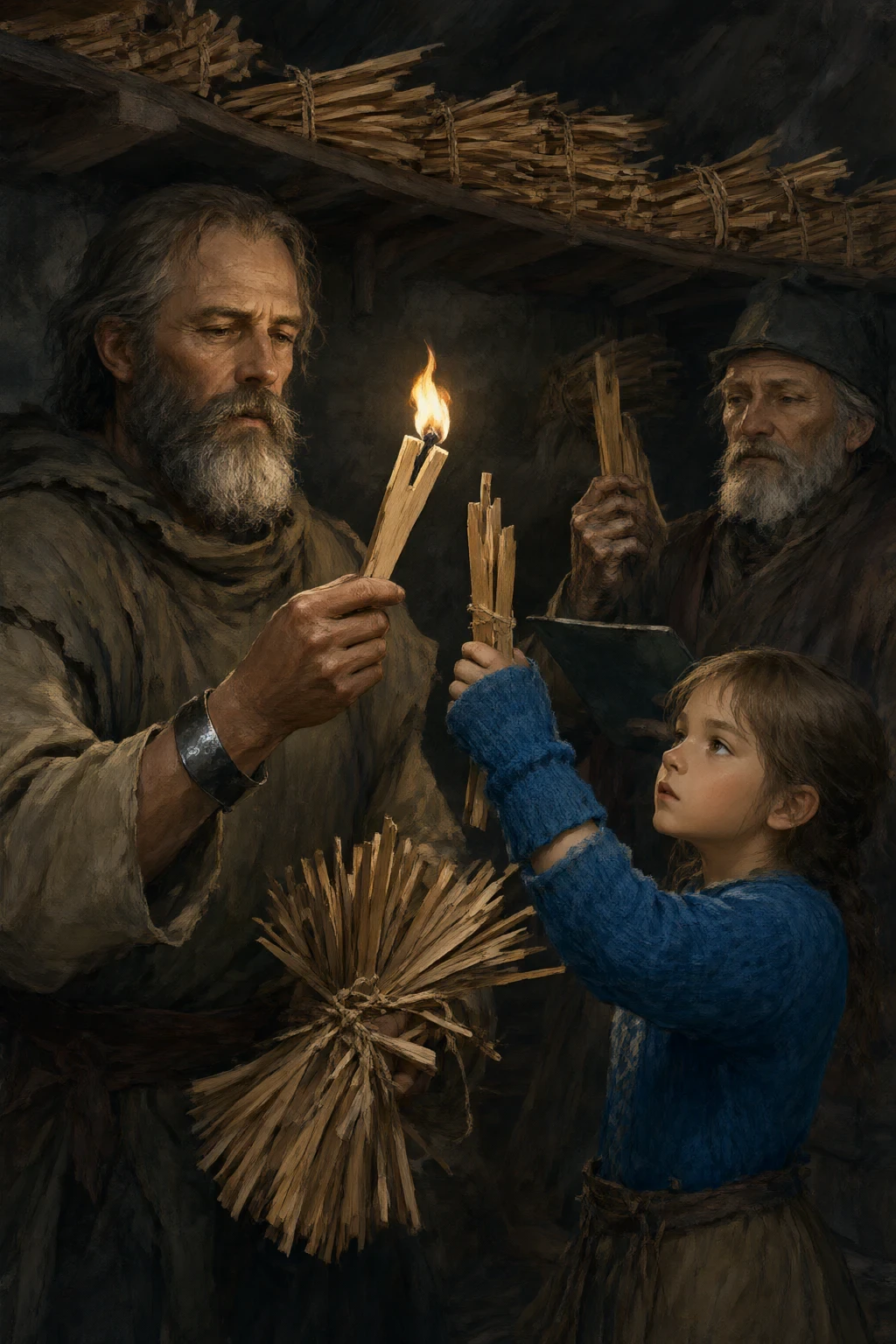
The reliquary is a cell cut into the rock beneath the top shrine, with no window and none since it was cut, and it is the driest place on the mountain and about as warm as the inside of a hat. Het Kalder went down with them because she was the only one who would fit, and because Ilse Merrow had said the girl might count and nobody was to tell her she was too small for it. She was nine, with a knitted blue fingerless glove on her left hand and no use for it, and her hair in a plait she had done the whole length of it herself that morning. “I am going to hold the bundle,” she said, “and I am going to put the lamp on the shelf, and I am going to say the numbers out loud, because Mother says a number said out loud is a different animal from a number thought about.”
The lamp went on the shelf. Het put her thumb in the first notch of the first stick and drew it down the face, and Brother Seat watched her and understood that the boy in the mule yard had been doing precisely this, alone, at night. “Seventeen,” she said. “Eighteen. Nineteen.” She stopped. “This one has nineteen,” she said. “And it is a longer stick than the others, and there are two more at the end with no notches at all on them, only a burn.” “Read the whole bundle,” Tovan Rell said. She read it. Seventeen bundles came off that shelf in the hour and a half before the light went, and Marda Osk wrote the numbers in a column, and Tovan Rell did not look at the ledger at all. He watched the child’s hands.
“You have found it,” he said at last. “Nineteen, and then nothing, and then the year turns. That is the year somebody on this pass swore a term of nineteen years. It is the longest term in living memory, and it is not in the Register, because a term of nineteen is not a thing you trust to a fair round hand.”
The day-books are kept in a press behind the lectern, forty-one of them, one for a year, and they are the ugly cousins of the Register: scribbled, blotted, unruled, and full of things a keeper writes at midnight that will not go into the fair hand. Tovan Rell found the year in eleven minutes. Marda Osk found the entry in forty. It was on the left-hand page for the year of the long wet summer, in a clear upright hand that was not the fair round hand. He read it out with his finger on the page, and his voice went flat, which Brother Seat had not heard from him before and would think about for years after. “Nineteen years of labour to the pass, sworn by a mason out of the Vell mouth, called Odd Rennick, at the second thaw, witnessed. Nine notches to be cut. Signed, the keeper, and attested by the warden’s man.” He lifted his finger off the page.
“That is the nineteen,” he said. “It is not yours.” “Then it is not mine,” said Brother Seat. “It is not yours. Now let us do this three times, slowly, because I have been wrong in public once and I do not intend to be wrong in public twice. Clerk, look at the day-book again and tell me what is written, word for word, and do not read it kindly.” “Nineteen years of labour to the pass, sworn by a mason out of the Vell mouth, called Odd Rennick, at the second thaw, witnessed. Nine notches to be cut.” “Again.” The same. “Again, and this time read the number of notches and not the number of years.” “Nine notches to be cut.” “Then Odd Rennick was owed nineteen years and was given nine notches.”
“Nine notches is all the wood there is,” said Tovan Rell. “A stick is a running length, not a tally. A man is cut one notch a year until the wood is used up, and then a new stick is begun and tied into the same bundle. That is not a fault. That is how it has always been done, and the mason, if he is alive, has nine small bundles.” He laid the magnifying glass on the table and left it there, which Brother Seat understood to mean the reading was finished.
Marda Osk asked the question, and read it back to herself, which she did before every question she had ever put to anybody on this mountain. “May I put it plainly, so that I cannot soften it: do you wish to know the year, or do you wish to be free?” “I wish to know the year.” “That is not an answer to what I asked.” “It is the only one I have.” She looked at him a moment longer than a clerk needs to, and then went and got the bundle-shelf list, which is a slate tablet with the years cut into it.
The counting took the rest of the day and most of the evening. The bundles run back in single years to the retaining wall at the Second Water and then in fives, tied with a different twine. Ansel counted aloud from the doorway and Marda Osk wrote. Tovan Rell counted a second time, independently, on a slate of his own, and the two columns agreed until they reached the forty-ninth, and then they did not agree, because there was no forty-ninth bundle counting back. “There is a year here with no bundle in it,” said Marda Osk.
“There is a year with no bundle and no day-book either,” said Tovan Rell. “The year of the great thaw took the stores and the roof and half the shrine, and what was not burned was carried down and never came back up. That keeper kept his record on the back of the reverend’s marriage lines and carried it in his coat, and it is in a chest in the top room that has not been opened since before I came to this pass.” Nobody said anything for a while. The lamp guttered and steadied. “So the count is short by one year,” said Marda Osk.
“Short by one year where a year matters,” said Tovan Rell. “And I am not going to close the hole, because to close it I must read a date in the older hand, and I will not do that again while there is anybody living who can be taught to do it in my place. There is nobody. I am sixty-eight.” He put the slate down. “I will tell you what I think, with the words attached. If I have it right, and if I have it right, then you swore in the fifty-first year back and not the fiftieth, and your nine years ran out in the second thaw of last spring.” The lamp ticked. “Which means I am out of term,” said Brother Seat. He said it the way a man says a number he has had in his mouth for ten years and has never once let out. “If I have it right,” said Tovan Rell.
They went up to the Copy-Desk because Brother Seat wanted to be standing in the room when he heard the rest of it, and Marda Osk made him a cup of the bitter root tea without being asked, which he noted and did not thank her for. “What happens to me if that is right,” he said, “and the year is out, and the term is finished?” “May I restate your question so that I answer the one you are asking. You are asking whether, if the arithmetic is correct, the mountain must already have released you.” “Yes.”
“It does not work that way, and I am sorry, because I would like it to.” She set the cup down. “A term ends at its appointed time, without ceremony, and nobody is forgiven. That part is simple, and it is the only mercy in the system. What I cannot do is tell you that a term has ended. I can tell you what is written. The one instrument in this pass that can read a body is a keeper opening a door from the inside, and a keeper opens a door for a person whose term she can read, and I have not got a reading.” Ilse Merrow had come in without either of them hearing her, which was a keeper’s trick and not a trick at all, only a great many years of not being startled. She turned her whole body to face whoever was speaking. There was a white streak in her hair that had arrived in one night nineteen years ago and had not grown since.
“Brother Seat,” she said, “I could open the door.” He looked at her. “I could, and you would walk down the hill in the morning a man with nothing on him. And I am not going to, because your term is not read as ended, and the reading is nine years, and the nine years are the ones you did, and if I open a door on a maybe then every soul on this pass learns that doors are a thing you can ask about.” He put his hands flat on the table. The left one sat higher than the right. “And the year is the year,” he said. “And the year is the year,” said Ilse Merrow, and turned to the fire.
Ansel walked him down to the Second Water, which was four thousand feet and took them until the light went entirely and then some. They did not talk about the stick. Ansel had understood by then, in his own slow way, that the only sensible thing to say about a stick that belonged to a dead man was nothing. At the top of the retaining wall the boy stopped and looked up at the Ninth Step, a single small flame in a deep stone doorway with a very large sky behind it. “If you are out of term,” he said, “then you could just go down. You would not have to be released. You would just be a man walking down.” “Yes,” said Brother Seat. “So why are you not?” The wind came over the ridge in one long push and neither of them leaned into it.
“Because a man who is out of term and does not know it is still in it,” he said. “He has been told there is a door, and I am not the kind of man who walks down a hill on the word of an arithmetic.” He shifted the bundle under his arm. It had exactly nine notches in it and none of them were his. “There is a year in that chest in the top room. One day somebody will open it, and on that day I will come back up the stairs, a very old man, and somebody will read me a date.” Ansel said, “I could carry the lamp for you.” “You will do a great many things,” said Brother Seat. “Go to sleep, boy.”
He went down into the mule yard and lay down on his left side on the straw with the cloth bundle under his head, and the four animals breathed at the wall, and the Registrar came over the ridge in one long unbroken push and did not stop for anybody all night. Somewhere above him, in a chest in a top room, a year was folded in a coat.