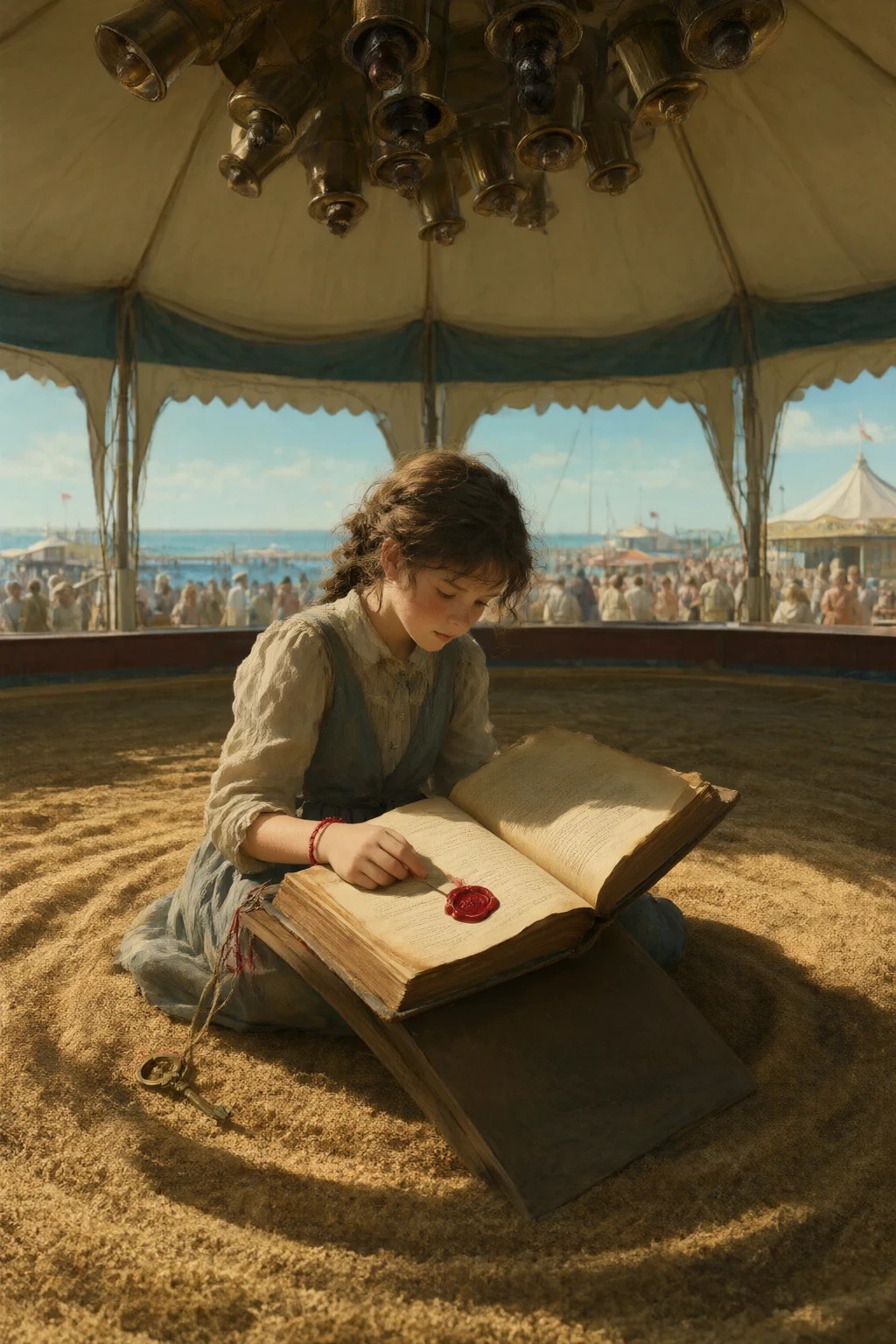
Saltcombe in the third week of July is a smell before it is a place: tar, hot canvas, salt, ice, and the low hot rot of a canvas roof that has been up in the sun for two days. The Gilded Menagerie had come in on the Tuesday and by the Thursday the pier was a forest of shafts and guy-ropes and the sea was doing the thing it does at the end of a long wall, working at the chalk all night in a rhythm you could set a clock by. The horses were out of the shafts and sweating in the shade. Eight of the wagons stood nose to tail along the quay, which is where they always stand, because the pier is where they unload, and Saltcombe is a terminus, and in a terminus even a circus comes to a stop. The tent was up by Wednesday night. The corona was lit. And the corona was dying. The sixth jet had sooted dark by half past eight, and by eleven it was the second, and by midnight the guttering shadow of the whole brass corona walked around the ring at the top of its arc, low and quick, the way it does when the mains are starved, and the whole company knew the sound it made, which is a soft descending hiss like a kettle giving up.
“They’ve throttled the harbour main,” said the two lanternists, from the Lantern Works, over the noise, which is louder than the band. “It’s the pier gas. The company draws off the same. There’s a valve at the head of the quay and it’s shut to a quarter and we are not the harbour company.” “It was the ninth in April,” said August Vane. “It was the fourth in June.” “Go and shout at a harbour board,” said the second lanternist, “and I will hold the pressure up with both hands.” And under the canvas the Big Top did the thing that a Big Top does at Saltcombe in July, which is that it breathes. The whole sixty feet of it lifts on the sea breeze coming over the wall and settles again, so that the ring-pole shadows on the inside wall rise together and fall together, and the whole tent is a lung, and there is no way to be in one and not know it. The towns had stopped posting the bills. That was the thing nobody would say at breakfast and everybody said at the show. It had started at the Ring Taste in the spring and gone the length of the Salt Line ahead of them like weather, town by town, chalk town by chalk town, and by the time the menagerie came off the Harrow neck into the high summer there were four towns on the road that had not put a bill up since Michaelmas, and one of them had nailed its own back to the board to cover the last one. It was not the money. The gate at Saltcombe on the first night had been nine hundred and forty, which was a good night, and the second had been eleven hundred, and the first was the night the Corona went.
It was Nine Elms, and then it was the next town after Nine Elms, and then it was the one after that. Word goes up a road faster than a circus. A man in a chalk town will tell you a thing happened at a show two hundred miles off, and he will tell you it accurately, and the thing he will tell you is that they had to put three men in the ring to hold a lion down, which is not what happened, and that the little one in the paper wings went up on the tightrope and would not come down, which is not what happened either, but it has been what everybody has been told ever since, and it is not their fault, and it is not true, and it has put the walls up in six towns between here and the winter. Odette Vrain had gone out with the bill posters twice and had been told, politely, in a doorway, at a farm gate, and in a draper’s shop in front of eleven people, that the town was not posting the show this season. “Do this. Now. Again,” she said, on the wagon step, with the handbill rolled in her fist. “You are standing in your own doorway.” “I am,” said the farmer. “I am just not standing in it for you.” The summer had been long and it had been thin.
There is a way a show season goes when the towns stop putting up the bills, and it is not that the money stops, it is that the money goes thin and then goes slow. The clowns walked the road house to house at nine in the morning and came back at two with the handbill unrolled, because a chalk town will sell a show on the square that it will not put on a board. The band tuned in the square and eight hundred people decided they would come, and then four hundred came, and the gate for June was the worst in nine years and everybody knew the figure and nobody said it. The Lantern Works had not been properly mended since the second winter at Harrow’s Landing, when the company had voted, in effect, to lose the tin off the north side of the Packing Shed rather than lose a zinc pail. The sixth jet had sooted in April. The guttering shadow that goes round the top of the ring when the pressure is low had been part of the show for a season and a half, and the house had got used to it, and the clowns called it the old lady, and the old lady had walked round the ring at the wrong moment in three shows in June and once, memorably, in the middle of the clown’s inspection mallet.
The Director announced it on the Friday, in the ring, at four o’clock, in daylight, with two men raking the sawdust into a rosette behind her and the tent full of nothing. “Closing gala,” she said. “Saturday. One show. The whole company, the whole book, read out.” “Read out,” said Odette. “Every contract in the Ledger that is in force, and every name in it, and the date of every entry, from the beginning of the run to the end. It will take an hour. It will be the best thing that has ever happened in this tent. I want the house on its feet before the second page.” Nobody spoke for a moment. Then the ring got very quiet in the way a ring does, which is a different quiet from the house, and August Vane understood that he had about four seconds to say something and that whatever he said would be billed. “Aunt. A hundred years of contracts read aloud, and the whole company standing in the ring while it happens, and eight hundred people in the seats.” “Yes.” “That is not a gala. That is a court.” “That is a gala,” said Imogen Vane, “that is a court, and that is a reading, and I have known since the February of last winter that I was going to do it, and if I am going to be read at in my own tent by my own nephew then I had rather it was in front of the house.”
Then the Bookkeeper had to stand up, and it took him a long time to stand up, because he does everything at the speed of a column being ruled. “Strictly speaking,” he said, and stopped, and took the shell lens off and cleaned it on his cuff and put it on again, and everything he looked at came to him faintly amber. “Strictly speaking, the reading of a contract in this tent takes effect where a paying member of the public is close enough to hear the words. That is a benefit. Everybody in this company has understood that for thirty-one years as a protection and it is a protection and it is the truest thing ever said about it.” “Yes, Mr Quill,” said the Director. “But I am obliged to read the other half of it aloud as well, tonight, because I have been asked to read it aloud, and I have not refused a superior in thirty years and I do not intend to start in July.” He turned the lens so that the amber went off the ring. “A contract read aloud where it was not meant to be read is a Break.” The tent did not make a sound. The sawdust was raked into a rosette and the two men stood with their rakes.
“A Break does not stop anything,” said Halloran Quill. “It accelerates. It goes one degree further, in the night, and it takes the Signer’s nearest living relative with it, at one degree removed, in the same night. That is clause eight. It has happened twice in the history of this circus. Both times it was legal. Both times it was an accident of wording.” “Which page,” said Odette, “was not meant to be read.” “There is one,” said Quill. He did not say any more about it, then or afterwards, and Nell Ferrule, who was in the third row of the cage wagon with the docket board on her knees, wrote down the word one, and ruled a line under it, and did not sleep that night, and has never been able to say why. And that night, at two in the morning, in the Paper Caravan, the Bookkeeper took the first volume out of the case and did what he had done perhaps four times in thirty years, which was to open it at the back and look at the page that is sewn in, and to be told again by the sight of it that he could not read it.
It was sewn in at the binding in green thread, and it had been sewn in by somebody who did not want it taken out, and the paper had gone brown at the edges, and the ink had gone the colour of weak tea, and the line across the top of it was the only line on the page in a hand that was not his own. One signature. And under the signature, the words, which he could read, because the words are in the hand of the family accounts and every clerk in the Vane firm wrote them the same way for a hundred years, and the words are: in consideration of the Show. That is the whole of the oldest page in the book. He had known that since 1893. He had never been able to see the signature, because the page does not lie flat, and the page cannot be made to lie flat, because it is sewn in, and he had said so twice in thirty years to two people, and both times the answer had been, that is a formality, Halloran, and he had gone back to his column. “That is a formality,” said Halloran Quill to the empty caravan, at two in the morning, at a seaside terminus, in the eleventh year of the century, with a case open on his knees and the green curtain over the one window. Then he shut the case and turned the key and hung the key on the nail, and did not sleep, and has never been able to explain to anybody, including himself, why he was the one who let the other two happen.
“In six years I have been waiting for this,” said Odette Vrain, “and I have got it in the worst possible way, and I want that on the record before Saturday, because afterwards everybody is going to say it was my idea.” “It is not my idea,” said the Director. “It is exactly my idea. It is my idea with the ringmaster’s coat on.” Odette had the scarlet-and-gold across her arm and the crop behind her back where it always lived. “Do you know what a public reading is? It is not a performance. It is a witnessing. Every word read in front of paying witnesses goes into a room, and the room is in it, and the room remembers. That is the whole of the law. That is why you have to have a farmer in the ring. And it does not follow — it does not follow in the least — that a room can only ever witness what somebody else puts in front of it.” “That is a lawyer’s dream,” said the Director. “It is a riding dream,” said Odette. “You do not get a horse by explaining him to the crowd. You get a horse by standing in the middle of the ring and letting the crowd see what he does, in the place where they can see it.”
Mateo Brill had been in the Widow’s Pew all afternoon, which is where he goes, and which is a green bench wagon with the curtains shut, and where nobody asks him anything. August found him there at six with the lamp out. “I want the lion on Saturday night,” said Mateo. He said it in the Mmm way, only he did not say Mmm first, which is how August knew it had cost him something. “You have the voice.” “I have the voice until the next renewal. My fourth is due in the autumn.” Mateo was working the rope through his belt again, thirty years of the same small motion. “I would like one act on my feet with words in it, in front of that house, before the fourth takes it. Once. And I have not asked anybody for it in eleven years, and I am asking you now, and I would rather you did not make a thing of it.” “I am not making a thing of it.” “You are standing there making a thing of it.” “Saturday,” said August Vane. “Third act. And you may have the whole of it, and I will ring it myself, and I will say the billing out loud, in the third person, so that the whole house hears what it is being sold.”
Mateo looked at him for a while. In the winter the company had voted, in effect, to lose the tin off the north side of the Packing Shed and to sleep nineteen in a shed built for nine, and he had been the one who argued for it, and the reason he had argued for it was this, and neither of them was going to say so on a summer evening. “Third act,” said Mateo Brill. Nell Ferrule found the struck name on the Friday night, in the booth, with the flap down and the shutter over, in the light of a hand-lamp, in the clause book. The Ledger does not live in the clause book. The Ledger lives in the Paper Caravan in eleven hundred cedar cases, and nobody but the Bookkeeper and the Director ever opens the current run, and the current run is not allowed out of the wagon, because visitors leave their matches at the door. But the clause book in a ticket booth holds a hundred years of the run in a small pressed hand, in the order the pages were entered, in a duplicate hand, because the duplicate hand is the one the tent is read out of, and the tent has to be read out of something that is not the original. She cannot read a contract. She has never been able to read a contract. She has known this since she was ten and it is the single most useful thing about her, because what she reads is not words but the shapes of words, and a hundred years of the run in duplicate hand is the most legible thing she has ever had her hands on.
Tomas Ferrule is struck through in red, in fresh ink, four lines down from the top of a page dated the eleventh of October, 1895, and the red is not the red of the surrounding entries, and the stroke is a single confident line from the top of the T to below the baseline of the surname, in a hand that is not the Bookkeeper’s hand and is not the Director’s, and which she has seen exactly twice before in eleven hundred pages. She sat with her finger on it and the count went out of her head, and then came back, going past ten the way it does. Seven, eight, nine, ten, eleven, twelve, thirteen, fourteen, fifteen, sixteen, seventeen, eighteen, nineteen, twenty, twenty-one. Tomas Ferrule was struck from the Ledger in the spring of the year she was ten. She was told it was a mistake. She was told by a woman in a wagon with a green curtain, at eleven o’clock at night, in a voice that went out like a lamp, and she had spent three years since then learning a trade by the shapes of letters so that she could find a page with a name on it that everybody in the company had been paid to stop looking for. A name struck from the Ledger is a name nobody is looking for. A name struck from the Ledger is a Break.
The Scented Row is six barred wagons in a crooked line and it is the only place in this circus where nobody performs. It smells of straw and oiled iron and every animal at once. On the Friday night after the announcement, four of them were sitting on the boards with the doors open and the sea coming up under the wagons, and the lanternists had gone home, and the corona was out, and the tent was a shape on the hill. “I don’t know how to do the fourth act on Saturday,” Junie Sparrow said. “I mean I know how to do it. I mean I have known how to do it since I was eight. I mean my hands have known how to do it and I have not.” She put her boots up on the shelf. “Is it fine? Is it fine?” Nobody answered, because there was no answer, and because she had not really been asking. “I’ve had the one,” she said, to the ceiling. “And the next one is the one where you go quick, and then the one after that.” She turned her head round to Nell, who was sitting with her back against the barred door and her knees up. “Nell. What happens to you on Saturday?” “My name gets read out.”
“That’s not a thing that happens. That’s a thing that happens to other people.” Junie sat up. “Is it fine? Is it fine? Nell, is it fine?” “It is fine,” said Nell Ferrule. She had a length of red thread knotted round her left wrist, knotted over and over so many times that it had made a small hard cuff, and she put her thumb over it the way she had been putting her thumb over it for three years, and she said, “It is fine,” and then she said, a great deal more quietly, to the inside of the barred door, “It is not the name that is the thing, Junie. It is the red.” Junie Sparrow did not understand that on the Friday night, or on the Saturday, or for some months. But she has never once since asked Nell Ferrule whether it is fine, and the company has a fairly clear idea why, and nobody has ever said so.
The decision was not made on the Friday and it had been made in February. That was the thing that the company found hardest, afterwards. There was no vote, and no argument, and no scene in the Widow’s Pew with the lamp out. The Director had decided in the winter, at a zinc pail, over a bucket, and the only part of the decision that was still open was whether anybody was going to say so out loud, and on the Friday afternoon at five o’clock, on the boards, in daylight, before the rakes came out, the whole company was in the ring, and August Vane said it. “Nineteen of us read out tomorrow,” he said. “And there is one page in that book that nobody was ever meant to hear, and if it is read it is a Break, and a Break takes the Signer’s nearest living relative at one degree removed in the same night. That is the whole of the risk. I am not going to stand here and pretend there is a version of this where I do not know that.” “Then do not do it,” said Junie Sparrow, who had her hand up. “Junie,” said the Director. “If nobody ever reads a page that was not meant to be read, then the only person in England who decides what was meant to be read is me, and I have been that person for thirty-one years, and I would like to be that person for about four more hours, if it is all the same to everybody.” “Four hours,” said August. “Four hours,” said the Director. “Then we go on the road in the morning and that is the end of the season and I will never call another show in a ring, and the lot of you can go to Harrow’s Landing and be warm.”
Saturday. She started it at eight, in daylight, with the tent three-quarters full, because a summer gala at a seaside terminus is not a night show and everybody knew it and came in the shirts they had on. She started it herself. She said the first word, which was the year, and she said the year the way you say the year of a marriage. “Nineteen hundred and four,” said Imogen Vane. “The run begins with the family accounts, which are not contracts, and which nobody has ever wanted to hear, and which are the reason there is a book at all. You will forgive me. There are eleven hundred cases and I have read them all and I am not going to pretend to you tonight that the early ones are interesting.” Then she gave the book to the Bookkeeper, and the Bookkeeper read for four minutes and then put his hand flat on the page and stopped, and August saw the old man’s hand shaking under the green baize light, and understood that the fine hand had gone. “Nell,” said Halloran Quill. And a fox in a booth walked out into the middle of a tent with a docket board under her arm.
There were no notes, because Nell Ferrule could not have made notes. She stood with the duplicate run open on a reading slope at the edge of the ring, with a string line to hold the page, and the corona turning above her and the sixth jet gone black, and she read. She read the names. That was the job, and the job had been given to her because the Bookkeeper could read anything and could not see fine, and the Director would not do it, and August could not be trusted with a page, and Odette was up. “Vane, Imogen. Renewal, first. The eleventh of October, 1895. Keepsake, a zinc pail.” There was a noise from the house that was not a laugh and was not applause and was the noise eight hundred people make when they are all surprised at once and have agreed not to say so. “Brill, Mateo. The same date. Renewal, first, second and third, at eleven years, and at nineteen, and at twenty-six. Keepsake, a rope’s end.” Mmm, said Mateo, from the dark.
The house began to understand what it was looking at somewhere around the eleventh page, and it did it the way a house does everything, all at once and without saying so. The third page went by in silence. The seventh went by in silence. By the eleventh there were people in the front three rows sitting forward, and by the fifteenth there was a noise at the back that the ringmaster could hear over the corona, which is a noise a house makes when it has realised that a thing which is very private has been put where it can be seen, and is being extremely well behaved about it. It was a warm afternoon in July. The tent had the bruised teal light inside it that a tent has from the outside, and the gas came up warm off the brass, and the sawdust rosette went grey where the rakes had been over it too often, and the sea worked at the wall, and a girl of thirteen read out a hundred years of the private arrangements of six hundred and forty people to a house that had paid at the door, and did not put a single thing down.
The pressure fell twice in that hour. The first time the whole corona dipped together and the top of the canvas came down about a foot and the ring-pole shadows shortened on the wall, and the two lanternists could be heard through the canvas swearing at a valve, and the sixth jet came back for about nine minutes and then went again. The second time, the guttering shadow came down off the top of the ring and stood on the boards for eleven seconds, and August Vane counted them, because he could not stop counting anything that night, and it was the only part of the hour in front of the house that was even nearly a show. “Ferrule, Tomas. The same date. Struck from the run, in red, the fourth of April of the year after.” And she said it in the voice she used for the prices at the window, and the tent went on being a tent, and the count went past ten and past twenty and past thirty, and she read on, and the corona hissed, and the guttering shadow walked the top of the ring, and the tent breathed.
Nobody in that tent knew what they were looking at, and the only two people in it who did were standing at opposite ends of the ring, and neither of them spoke. Because a Break is not a moment. A Break is a night, and it arrives the way weather arrives at a coast: there is a pressure that has been building all summer and then there is a change in the wind, and no single person can point at the minute. The corona’s shadow came down off the top of the ring and stood on the boards, and the sixth jet — the one that had been dark since half past eight — came back. That was the whole of the visible part, and it was visible to everybody, and it looked, in the gaslight, exactly like a trick, and the whole house said so, and laughed, and the band played eight bars, because the band always plays eight bars, and then Imogen Vane said, “Thank you,” and the shadow went on walking.
The struck name was where it had to be. It was in the book in red, in a confident hand, in front of a paying public, in a tent with a green baize light on it, and a name struck from the Ledger in a room that heard it is a name that is being looked for. That is not an opinion. That is a reading of the wording, and the wording was read out, and the room was in it, and the room remembered. Somewhere on the Salt Line, three hundred miles back down the road, in the front room of a shut public house with a zinc pail on a nail in the porch, a woman who had been nineteen at a taproom table put down a cup she was not drinking from. And in the ring, at the reading slope, a girl of thirteen in a booth girl’s jacket with a knotted cuff of red thread on her left wrist looked at the next line and could not see it, because her eyes had gone, and she put her hand flat on the page to hold the place, which is what you do, and read on.
Odette saw Mateo go down. Not fall. He went down the way a man goes down when the thing that has been holding him up for eleven years is taken out from under him and replaced, in the same instant, with a heavier thing. He was on one knee on the sawdust in the middle of the ring with his hand at his belt, and his mouth was open, and he was making a noise, and there was nothing in it. She got to him in four seconds. She got the collar of the tailcoat and she got him onto the rosette, trampled flat, and she put her own hand on the back of his neck, and she said, out loud, in the voice she used under stress, which is a voice like a hand on a horse’s jaw: “Down. Down. Do this. Now. Stay down. Stay down and I have got you.” And she looked up, from the floor, at the ring, at the whole of the company standing in a line along the barrier, and she said, “Everybody stay exactly where you are. Do not move. Do this. Now. Listen to me.” Nobody moved.
Nobody in that tent moved except the man on the boards, and it was not until the reading had gone on for another three-quarters of an hour that anybody understood the scale of what had happened, because Junie Sparrow had grown a second feather behind her left ear, black-tipped, and had not noticed and had been preening it since the sixth page, and Mateo had lost the voice, and the strongman had lost the two teeth he had been keeping since his father’s time and nobody could remember when, and it had all happened in a room with eight hundred people in it, while a girl read out the price of admission. Then Mateo Brill stood up off the boards and walked out into the ring, and did not say anything, and the man at the reading slope went on reading. It was the single worst-managed moment of the evening and it is the reason that four towns that had stopped putting up the bills began, slowly, over the following year, to put them up again. August Vane got in front of him at the barrier and said, out loud, in the voice, “Mateo Brill. The lion. Third act, as billed. Stand back.” The house did not make a noise, because a girl of thirteen was reading a list of names at the edge of the ring and eight hundred people in a tent in July in the afternoon do not clap over a girl reading a list of names, and the lion act went on in a silence that no audience in the history of the Gilded Menagerie has ever sat through.
It was a bad lion. It had always been a bad lion. It walked, and it stopped, and it looked at a trainer who was not there any more, and it got the old thing right, the thing it has always got right, the head sideways, the mouth open, the six seconds in which a lion will decide a thing, and Mateo Brill stood in the middle of the ring with his eyes on it and did not make a sound of any kind. And then it was over, and there was no applause, because there could not be, and he walked out of the ring with his hands at his sides and the tail through the back of his belt, and Odette Vrain took his arm on the boards and said, “That was eleven minutes. I timed it. Nobody claps. That is the price of doing it inside a reading.” “Mmm,” said Mateo Brill, who could not hear himself, and who was not complaining, and who has never once, in any company, in any wagon, said anything at all about it.
The last page was sewn in. It is sewn in at the binding, in green thread, at the back of the first volume, and it has been sewn in since before any of them were born, and it is the oldest page in the current run and the only page in eleven hundred cases that is not loose, and Halloran Quill had been asked about it twice in thirty years and had answered both times that it would not lie flat. It lay flat that night. It lay flat because a girl had worked a page all the way to the back over three hours in the light of a gas corona, and had found the green thread with her thumbnail, and had cut it with a paper knife she carried in the docket board, because a page that is sewn shut is a page somebody has sewn shut. It came out into the light and it was in a hand that Nell Ferrule had never seen in eleven hundred pages of duplicate, and it was not a large hand, and it was not quick. “There is one signature,” she said, “at the top.”
She looked at it for some time. The tent breathed. The guttering shadow came down off the top of the ring, and the house made the noise it makes, and she read the name out, because that was the job, and she had been given it, and she did it. “Vane, Imogen,” said Nell Ferrule. “The eleventh of October, 1895. Consideration, in consideration of the Show. Term, thirty-one years. No renewal. No further term. And beneath it, in the same hand, in a line that had been folded and unfolded so many times that it had gone through: that the circus will go on, and the Signer will not leave the ring.” There were nine hundred people in that tent and the sea was working at the wall and the corona hissed, and for about four seconds the whole of Saltcombe made no sound at all. Then Imogen Vane took one step. That was all. She took one step, out of the place where she had been standing since the reading began, into the middle of the ring, and the eight hundred gazes and the tent itself went round with her, and the ring-pole shadows came down the wall on thirty feet of iron and the sawdust was flat where Mateo had gone down on it, and she had not been in the middle of a ring in thirty-one years.
Nobody in that tent had ever been told what she was billed as, because the Director is not billed as anything, and there is no animal on her nameplate, because the nameplate on the seventh barred wagon says only THE DIRECTOR, and there has always been a joke about that among the clowns, and the joke was the wrong one. Mateo Brill, on the boards, with no voice at all, put his hand out sideways, flat, at the height of a horse’s nose, and held it there. She looked at it. “A tortoise,” said Imogen Vane, answering a question that had been standing in that company for thirty-one years and had been asked out loud, twice, in her hearing, by two clerks who had both left. “It was judged once, in 1895, and never judged again, and it has never been in a bill because there has never been a moment in my life when I could afford to look like what I am.”
They went on the road at four in the morning, which is the hour the Gilded Menagerie has gone on the road since 1893, and the whole of it went down off the pier and up the quay and out onto the chalk in the dark with the corona still lit, one lit hill moving under the stars, and the road saw it pass. Nothing was undone. That is the part that is hard, and that everybody in that company has had to make their peace with in the six weeks since, in kitchens and in wagons and in the yard at Harrow’s Landing. The four renewals stand. The Ledger stands. Eleven hundred cases of paper stand in a black varnished wagon with one window, and the Bookkeeper is in it, and he is fifty-nine, and he is the whole of the machine, and the machine is exactly where it was on Tuesday. Mateo Brill has no voice and is the best lion on the Salt Line. Junie Sparrow has two more renewals of feathers to lose and no idea of how many she has. The strongman has lost the two teeth and gained, in exchange, something the men in the cages cannot explain, and does not go into the water troughs any more. The Director has one degree more of what she has always been, and steps now, sometimes, when nobody is looking, and does not go far. And the pail is full every morning, and Barnaby Hallam drinks out of it, and the four renewals of Barnaby Hallam are three, and the fourth will never be entered, and the zinc pail on a nail in the yard at Harrow’s Landing is the smallest page in eleven hundred cases and the only one anybody has ever kept.
But this is what happened on the boards, and the company is careful about it, and they will tell it, because they are a company and that is what they are for. Nine hundred people had been in that tent, and every one of them had paid, and under the law of this circus a paying public in the room is what makes a thing a contract at all, and the whole thirty-one years of the Gilded Menagerie had been built on a woman working a room. The company had read a hundred years of signatures out loud, in a tent, to a house, and the last thing in the book was the oldest, and the oldest was the woman who had called the show, and the consideration was a Show, and the Show had been given, that night, for nothing, at four o’clock in the afternoon, in daylight, to a summer house in shirtsleeves.
They had not needed a farmer in the ring that night. They had needed nine hundred of them, and they had them, and the people who had them were a ticket girl of thirteen with red thread on her wrist, a bookkeeper of fifty-nine with one lens of shell, a man with no voice on his knees in the sawdust, a bareback rider in a scarlet coat, a child of ten who had a second feather behind her ear and had not noticed, and a boy of thirty-four in an oiled black hat with a worn brass band, who was still standing in the middle of the ring when the rest of them had gone, with the plume of his ringmaster’s coat unstrung and standing up behind him in the flat light, not because he was performing, and not because anybody was watching, and not for any reason at all that he could have put into a sentence. “I have been billed,” said August Vane, to an empty ring, in the voice, and then, with a certain amount of effort, in the other one, “for thirty-one years. I have never once been billed correctly. I have a coat with a bird’s tail on it and I have always thought it was the fashion.” He looked at the sawdust, which was flat. “I am a peacock,” said August Vane, “and I have been one since I was nineteen, and I signed for it in a tent in front of a farmer, and I have never once said so, and I should have said so, and I am saying it now, at four o’clock in the morning, to nobody.” And then the Big Top breathed, the way it does, the whole sixty feet of it lifting and settling on the sea breeze, and the ring-pole shadows rose and fell together on the inside wall, and the gas corona turned on its forty-one jets, one of them sooted dark, a permanent guttering shadow walking around the ring, and the tent went on being a tent, and the road came up under the wheels, and the Salt Line saw it pass.