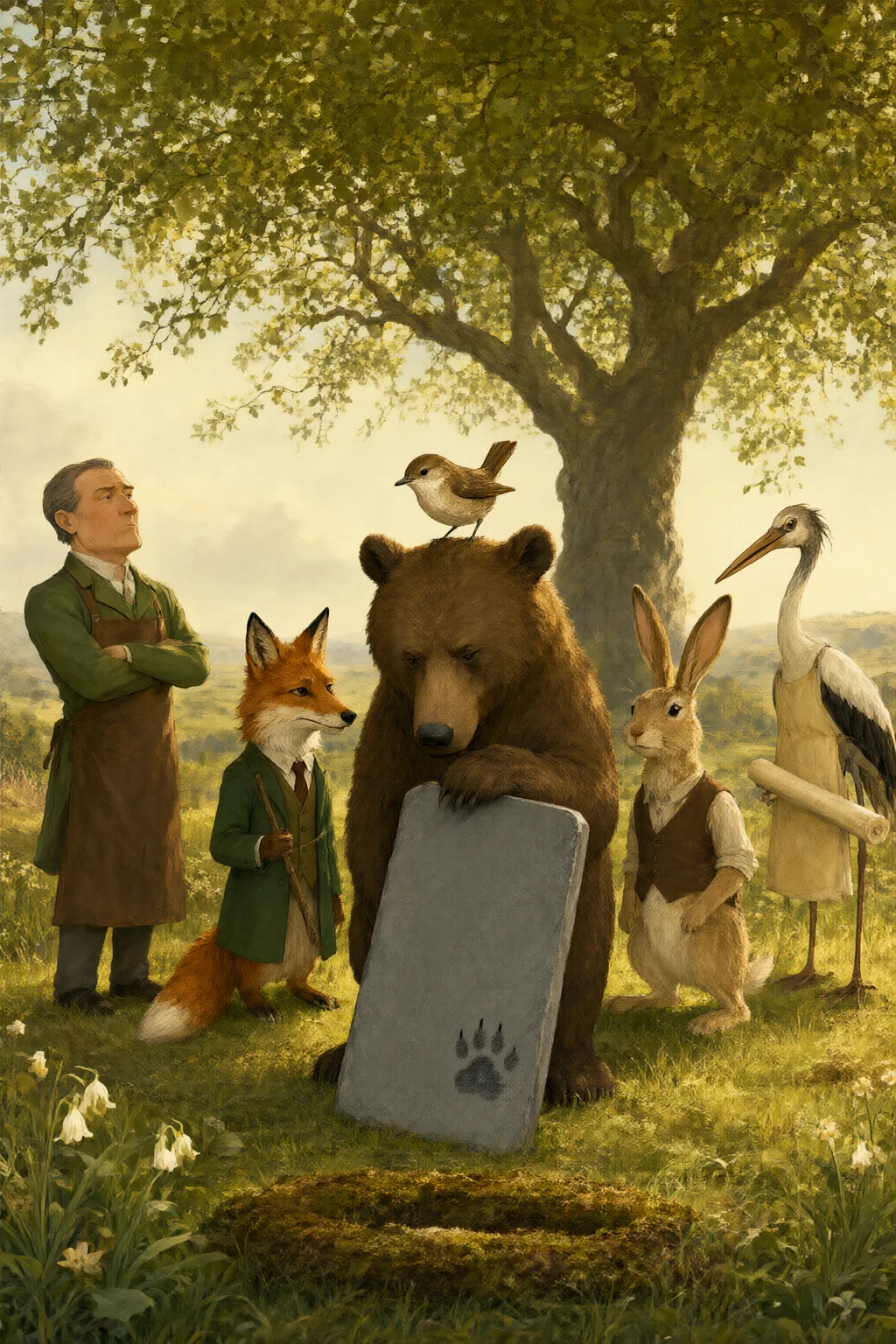
The tailor's name was Master Anselm Baumann, and on the ninth of March he came back from the market to find that a bear had been in his kitchen. He said it first to the wall, and then to the empty pot. The pot was a good pot. His mother had had it. It sat on the hearth with a wooden spoon beside it and about two fingers of barley porridge in the bottom, which is what is left when a hungry thing has eaten in a pot and tipped the rest out so that it looks deliberate. There were pawprints on the flour bin, and there was the mark of a shoulder on the doorframe where the door had gone in and been glad about it. "Master Anselm," said his daughter, "the wood is cold. Nobody has been in here since the market bell." "Then where is my porridge." "Gone." "That is what I said."
There was a wren in the thorn hedge at the end of the yard. This was not unusual. The wren had been in that hedge for four years, since the spring it had arrived on the north wind with a leaf in its beak and no history anybody could vouch for. The wren built behind the third rosebush from the kitchen door, low, in the crook where two thorns made a hood. The hedge belonged to Master Anselm, who trimmed it every year at the end of February with shears he did not sharpen, and who had never once thought about the wren, because a wren is four inches long and a hedge is nine feet, and a man does not think about four inches inside nine feet.
But the wren thought about the hedge. It thought about it constantly, the way a man thinks about a room he pays for. It had a nest. It had a run. It had, since the second year, a debt: Master Anselm put a rind of cheese on the kitchen sill every Friday, and the wren took it, and neither of them ever mentioned it, and the arrangement was more stable than most of the ones in this story. On the ninth of March the wren was in the pear tree above the gate, and it had been in the kitchen, and it had seen the bear. It had been in the kitchen because the kitchen door was propped, which Master Anselm did every market day, and because the wren is a bird that goes where the grain is. It had been on the flour bin when the door went. And it had seen everything, from about four inches above the floor, which is the best seat in the house.
Master Anselm was not a man to bear a grudge. He was a man to bear a grievance, and to have it settled, and to have it settled in front of people. The valley had a court. Not the town court, which sat four days' walk away and cost more than the pot; the wild court of Hohenmoos, which sat twice a year at the lime tree on the moor, in the open, and which nobody had ever been able to explain to a townsman but which everybody in the valley understood perfectly. Its rule was old and it had two halves. Whoever holds a hearth, a den, or a nest within the bounds of the forest has a voice. And the judge is not appointed. The judge is drawn by lot, from among the voices, before anything is said. "By lot," said Master Anselm. "By lot," said the fox, who was the court's clerk, and who had brought the summons, and who was enjoying himself enormously.
The court sat at the lime tree on the moor on the fourteenth of March, and it was crowded, because the story had got about. The hare took the clerk's place on the clerk's left. The stork stood behind, holding the roll of birch bark on which the judgment would be cut. The owl sat on a lower branch and said nothing for two hours, which the hare reported afterwards as evidence of calm. The bear came at noon, which was late, and sat down where the shade was. The fox read the charge. "Master Anselm Baumann of the town of Hohenmoos, tailor, having found his kitchen door broken and his mother's pot scraped and about two fingers of barley porridge gone, does charge the bear, of the den under the beech on this moor, with the eating of one pot of porridge, and asks for the pot."
"That is the whole of it?" said the owl. "That is the whole of it." "How much was the pot?" "I have it here." The fox held up a paper. "Nine pfennig. My master has had it valued, because he cannot in fairness ask a neighbour for a pot he has not had valued, and if the pot is worth more than nine pfennig then the pot is not at issue and the porridge is, and that is a different case and I have come back." The hare laughed. The stork adjusted his grip on the birch bark. "Right," said the fox. "Where is the judge?"
The lot was drawn with a hazel stick from a bowl, and the hare drew it out and read it twice and then a third time, because he wanted to be certain, and then he said, in the voice of a man who has checked and cannot get another result: "The bear." "Well," said the bear. "No, not you," said the hare. "The bird." There was a silence on the moor of a kind that people remember for a long time. The judge was in the pear tree over the gate of the tailor's yard, and had been for some time, and came down onto the bear's head, sat there, and said: "I heard my name." "Master Anselm Baumann has charged you with the eating of one pot of porridge," said the fox, with tremendous dignity. "I did not eat the pot," said the wren. "You scraped it."
"I scraped the pot. There is a difference and it is the whole of this case, and I will not let anybody hurry me through it." The hare lay down in the grass. The stork put the bark down and sat on it. Master Anselm, who had walked four hours to see justice done and had not expected a bird, said, "Well. I am here. I have the pot at home and the two fingers of porridge in it, and I would like to go home." "Wait," said the wren. "First the animal speaks. The bear may speak."
The bear stood up, and the court could see that he was a bear, and the court could also see that he was embarrassed. "I did it," he said. "You did not do that," said the wren. "You did the porridge. Did you do the pot?" "No." "Did you break the door?" "No. The door was propped. I have watched it. It is propped every market day. I came on a non-market day and it was propped anyway, and I have thought about that a great deal this week and I cannot make it come out right." "Did you knock the flour bin?" "Yes." "Why?" "Because it was in the way." "And the shoulder on the doorframe?" The bear looked at the frame. "I went through quickly. There is a mark. I am sorry for the mark."
Master Anselm looked at the mark, and then at the bear, and said, "That is my father's doorframe." "Yes." "I would like it mended." "I would like to mend it," said the bear, "and I do not know how. I have watched your house for a year. I did not know until the third week that the porridge is in the pot on the hearth, and I have thought about that too."
"Then the charge stands," said the fox, with relief. "It does not stand," said the wren. "That is not my job. My job is to find out what happened. Master Anselm, how much barley went into that pot?" "A great deal. It is the family's pot and it is barley and it is a Friday." "How much did the bear leave?" "Two fingers." "How much did the bear take?" "Most of it."
"Then the bear owes you most of a pot of barley porridge, and you cannot have it, because it is inside him." The wren turned around on the bear's head. "Nobody in this court can give a man back his porridge. That is the first fact. The second fact is that a man who is owed porridge and cannot have porridge is owed a thing instead, and that there is a law about that, and the law says: what the thing is must be named by the man who is owed." The hare sat up. Nobody had expected the hare to sit up. "I have a wheel of cheese," said the bear.
They went quiet on the moor, and the owl shifted on the branch, which for an owl is a shout. "Say that again," said the wren. "I have a wheel of cheese. In the den. Under a stone. I have had it since the first snow and I have not wanted it, because I am not a cheese animal, I am a bear, and I have been keeping it because a bear in a den in January needs something." "Then you have stolen it," said the fox. "I have taken it," said the bear. "From where?" "From the cheese stall," said the wren. The court looked at the bear. The bear did not look at anybody.
"I took it on the eleventh of January," said the bear, "at night, from Otmar Schreiber's stall under the town wall, and I did it in a straight line and I did not break anything, and I have thought about it every day since, and I took it because I saw it and it was uncovered, and I am not going to sit here and call that a crime, and I am not going to call it not one either." "It is yours to answer," said the wren, "and you have answered, and the answer is better than the one you came with."
Otmar Schreiber was not in the court. Nobody had gone for him. The hare went for him, at a dead run, and came back in the space of a quarter of an hour with a very angry small man and a leather strap he did not use. "This is my father's cheese," said Otmar Schreiber. "That is the Emmental. That is not a pot." "It is not a pot," the wren agreed. "It is a wheel. A wheel takes a summer and a field and the daughters of this town." "It does." "Then what is the ruling of the court, because I have come four miles for a ruling and not for a bird's opinion of my father's cheese?"
The wren straightened up on the bear's head. What followed took a long time and is the part of this story that the people of the valley repeated to each other for years. "The ruling of the court is this," said the wren. "First: the porridge is gone and cannot be returned, and Master Anselm Baumann is not owed porridge, because a debt in porridge is not a debt, it is a memory. Second: the pot was not broken, and Master Anselm's own door was propped, and the bear has said so before anybody asked him to, and that is worth something in this court although it is not worth a pot. Third: the wheel of Emmental cheese is a thing that can be bought." "It can be bought," said Otmar Schreiber, immediately.
"It can be bought, and it can be given, and it can be eaten by nine families, which is what it was made for, and it can be divided, and it does not have to live in a den under a stone. Therefore the bear is ordered to pay a wheel of cheese, in money, at the market, in front of witnesses, on a market day, and not to pay it out of what he has stolen, because the man who pays with stolen coin has not paid." The bear said, "I have three silver pfennig."
"You have three silver pfennig," said the wren, "and Otmar Schreiber's stall, and I will not have a case that ends because a poor man has no money. The bear will have the court's purse, which is the money of the fines, and there has not been a fine in this valley for six years, so the bear will have the whole of it."
They did it on the twenty-eighth of March, at the market, in front of the church, at the hour when the fish were selling. The bear walked on his hind legs up the length of the market street, with the hare walking beside him carrying the court's purse, and the crowd going quiet in front of him and talking again behind him, which is what a crowd does. He bought one wheel of Emmental from Otmar Schreiber's stall. He paid for it in full, in coin, and he did not haggled, and the haggling was so conspicuous that Otmar Schreiber told two people about it afterward. The wren sat on his shoulder the whole way down the street and did not say a word, which is how it came about that the bear remembered it.
At the tailor's door the bear said, "I have mended the frame. I could not do it with nails. I put the doorframe back on with a wedge and a stone and it is not beautiful." Master Anselm went and looked at the frame. "It holds," he said. "It holds in a wind," said the bear. "I have not been here in a wind. If you would let me come back after a wind, I would know." "You may come back after a wind," said Master Anselm Baumann, who was a tailor and not a fool, "and you may come back in any weather, and there is a pot on that hearth on Fridays, and it is barley, and I have never once set it out for a bear. Do you understand what I have just said to you." "I understand it," said the bear.
The judgment was cut on a slate, because the court owned one slate and the stork did not trust himself with birch bark. Master Anselm's daughter cut it, because she could write, and the wren, who cannot write and never claimed to, sat on the table and dictated the whole of it, and when she came to the last line she stopped. "That is enough." "It is one line short." "It is one line short on purpose. Leave the date for her." The bear witnessed it. He had no way to sign, so the daughter took a charcoal stick and he put one paw in the soot bowl and put it on the slate, and the print came out grey and enormous and completely unmistakable, and it took three wipes with a wet cloth to get off her fingers afterwards.
She hung the slate on the kitchen wall by the door, where the pot hangs, and wrote the date under the paw, because the wren had told her to. That is the whole of the judgment. It is still in the tailor's kitchen, on the wall by the door where the pot hangs, and the date under the paw is the ninth of April, and the ink has gone brown because the kitchen is damp and the slate is old. The wren is in the hedge, in the crook behind the third rosebush, where it has been every year since the spring it arrived on the north wind with a leaf in its beak and no history anybody could vouch for.
Master Anselm puts a rind on the sill on Fridays, and the bear comes on Fridays and stands in the yard and waits to be let in, and neither of them has ever once mentioned that he is a bear, and the wren watches the two of them from the pear tree over the gate, and says nothing at all, because it is a very small bird and there is a great deal happening.