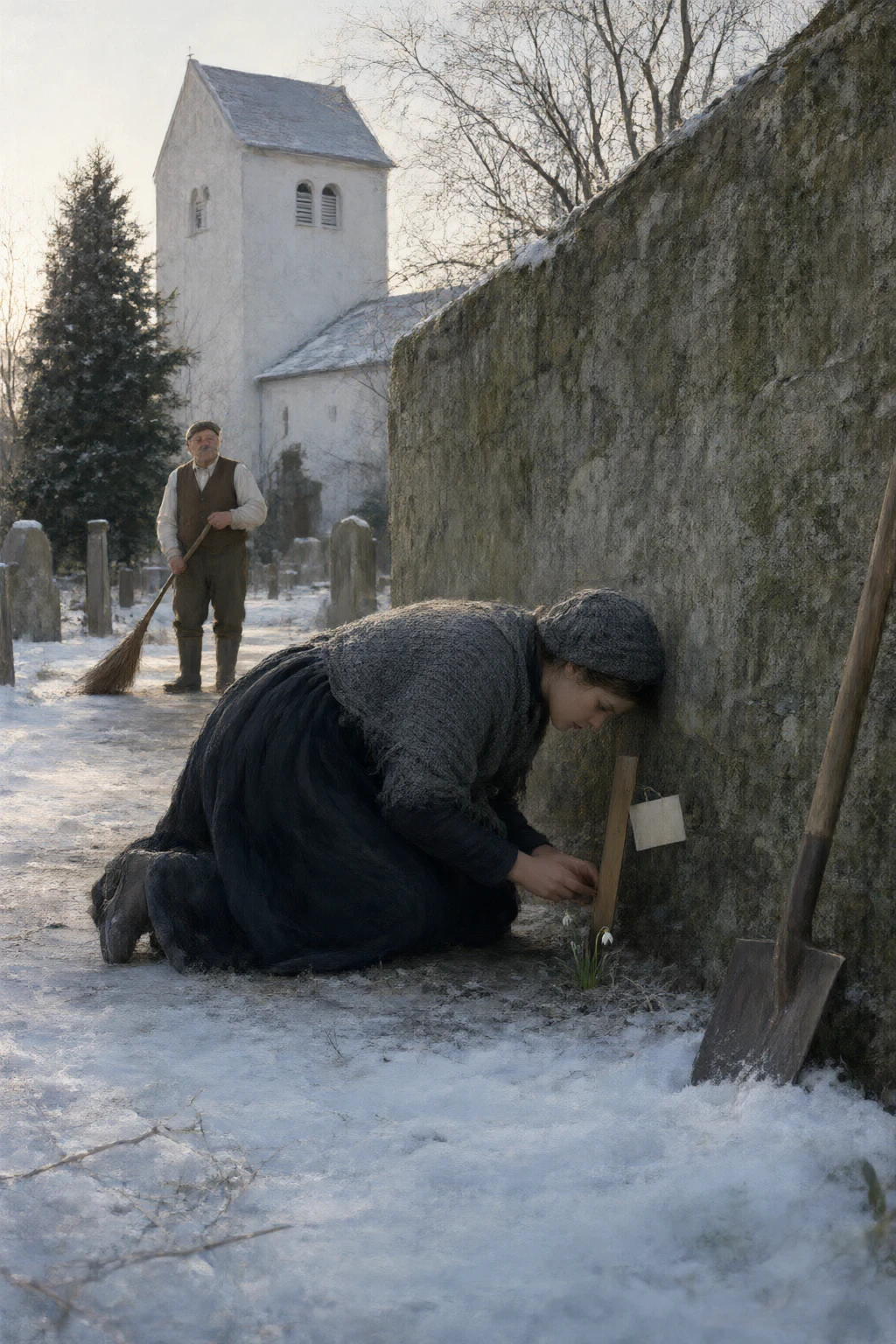
The sneklokke at the east wall of Ulslev churchyard came out on the fourth of February, and by the ninth it had been looked at by most of the parish. There is not much to see, and everybody came. A woman walked over from Bredvad, which is eleven verst and a ferry, in order to stand in front of a small white flower for two minutes and say that she had seen it, and go home. The sexton, who had swept the wall every Sunday for twenty-six years and knew exactly which stones it grew out of, showed people the place. The school children were brought in a procession on the Friday, in their coats, singing a song about winter that had nothing to do with the flower.
And on the Saturday, at nine in the morning, Anders Bjerre came out of the vestry door with his book under his arm, and stood in front of the wall a while, and wrote in it, and went back in, because he was seventy-one and it was nine degrees below freezing and the book had to be kept at a temperature that a man of seventy-one can keep. He was the organist. He had been the organist for forty-one years, and the parish had let him keep the flower's book for thirty-one of them, which was a longer tenure than most curates, and the arrangement had been made in an afternoon in 1898 and never written down anywhere except in a sentence at the head of the first page, where it said: The book is kept by the organist, and the book is the parish's.
The book was a quarto with a green cloth spine. It began in 1841, because the first entry had been made by a schoolmaster who had noticed the flower in a bad year and had then kept at it, and it had one line for every year since, in the same hand until 1867 and a different one after, and then a third, and then a fourth. Beside each line was the date of the first flowering, and beside that, for a good many years, a second date, and beside that a short remark in the margin. The remark was nearly always the same word. Normal.
Mette Rask was twenty-one and had been the parish schoolmistress for five weeks. She had been appointed in January by a committee of four men and a woman who had met eleven times about it, and the appointment had been for one year, renewable, and attached to a duty that nobody had thought to raise with her, because it was not a duty anybody had raised with anybody for thirty-one years. It was this: that the book be kept. "You will do the book," the chairman had said, "whenever there is anything to do to the book," and had then asked her about the reading of the children, which was the real subject of the meeting.
Her predecessor had held the school for forty years and had lived above the schoolhouse and had done the thing she was now doing, which was teach four classes in one room and keep the door shut against the weather. Mette Rask had a certificate, eleven years in schools in two other parishes, and a letter from a family in the capital who thought she had made a mistake. The fifth week she copied the book fair, in order to have a fair copy, because the original was in the vestry and damp and because in her first fortnight she had found a loose leaf in it and had put it back in the wrong place and had spent an evening of genuine terror working out where it went.
There were eighty-four lines to copy. She did them in the evenings, after the children, in a room in the rectory with a lamp and a bad chair, and she copied the dates and the second dates and the remarks exactly, including the spelling, and when she had finished she read the whole thing through, because a fair copy is not a fair copy until it has been read. It took her three evenings to see what was wrong with it, and she could not afterwards remember which evening it was.
The remark was always the same word, and that was the first thing. Not always normal, but the alternatives were early, late, and as in 1878. The first entry of 1841 said the twelfth of February. The entry of 1900 said the twenty-eighth of February. The entry of 1929 said the second of March. Every year in the book the date was somewhere in the last ten days of February or the first week of March, and once, in 1889, it was the nineteenth of March, and the remark beside that one said, in a hand that had gone shaky, the worst year. And the second date, the one in the right-hand column, which was the date of the first flowering at the churchyard wall in the neighbouring parish of Bredvad, moved in exactly the same way, and always within two days of the first.
Mette Rask had lived in the parish five weeks. She went and stood at the wall in the snow on the following Saturday with the fair copy under her arm, and she looked at the flower, which was there, and small, and had a bud beside it that would open in a week, and she counted back through her copy. Then she went to the rectory library and took down the almanac, which the parish had received one copy of, every year, for as long as anyone could remember, and which printed in its last pages the mean dates for the district: the mean date of the first flowering at the coast, the mean date inland, the mean date of the last frost, each with a number beside it, and a line under it saying that the means were computed over the years and were not to be used as a rule but as a scale. The mean date of the first flowering on this coast was the third of March.
The book said the first of March, 1929, and the ninth of March, 1919, and the fourth of March in 1909, and the twenty-eighth of February in 1900. Every line of it, from 1841 onward, was inside nine days of the mean. The book was not a record of a coast. It was a record of a coast as a man had decided it should be.
She sat with that for a fortnight before she did anything with it, which she was later able to describe, accurately and without pride, as the only sensible thing she did. The first thing she tried was that the book was right and the almanac was wrong, which is what the sexton said when she told him, and which is what the parish apothecary said when she told him, and which was in fact the first thing the priest said too, in a tone she did not care for at all. The second thing she tried was that the churchyard wall had changed, which was not so far from the truth. The wall had been repointed in 1911, and the bush of sneklokke that grew out of the mortar at the third stone from the corner had been lifted, split and replanted when the pointing was done, and it had flowered that year, nine days later than every other year, which somebody at the time had entered as late.
She went and got the pointing account. The mason had priced nine days for the wall and had charged for eight. The bush, she found in a copy of the parish minute that the priest let her have without comment, had been moved on the fourth of March, and the entry in the book for that year said the tenth of March, with the remark late. So the book had been right, in the one year anybody had ever thought to ask, and it had been right about a wall that had been repointed, and a bush lifted out of the mortar and put back in the wrong week, and a mason who had charged for eight of the nine days he had priced. She had been looking for a change in the wall. There was no change in the wall. There was a change in the person, and it was the reason nobody had ever looked at the wall at all.
And having found one correction that was legitimate, she went looking for the rest of them, and this is the part of the story that nobody who has not done it can be made to understand: it is almost impossible not to go on once you have started, and it is a great deal worse than a job, because there is no end of it while the person who did the wrong thing is still alive and standing in front of you in the vestry every Sunday being pleasant about the harmonium.
Anders Bjerre had corrected 1862, 1871, 1877, 1884, 1890, 1893, 1902 and 1906, and then he had stopped correcting, in the sense that anyone means it, and gone on writing. In 1862 the original entry had been the thirty-first of January, and the copy said the fourth of February, and the margin said the copyist is wrong, I have seen the flower. In 1871 the original was the nineteenth of February and the copy said the first of March. In 1906 the original was the eleventh of February and the copy said the sixth of March. She found them because the two hands in the book are not the two hands she had assumed. The corrections are in a different ink from the entries they correct, and a different ink from the entries of the year they were made, and after 1898 — and this was the part she had to sit down for — the entries themselves are in the correcting ink, and the original entry is gone.
Not crossed out. Gone. Thirty-one years of the book, from 1898, contained no uncorrected line at all. And the originals she was able to recover, from the tower chest, in the two lowest decades, told a different story from the one the book had been telling since 1898: 1898, the nineteenth of February; 1906, the eleventh; 1919, the twenty-second; 1929, the fourteenth. Earlier every decade, in a country where the calendar said March, except once, in 1913, when the flower came on the second of March and the entry said so and added that it was a warm year. She asked the vestry's old sexton, who was Bjerre's brother-in-law, whether the original book was still in the parish.
It was, he said, in the tower chest, behind the psalter books, and he would not fetch it, and he said, standing in the doorway with his hand on the frame, that Anders had been a good man and that the book had kept the parish in good order for thirty-one years, and that there was a thing about being told what to write down that she would learn when she was older.
The priest was cautious, and cautiousness at that stage of her life looked to her like cowardice, and she had the sense later to be glad of it. "Anders Bjerre was the organist of this parish for forty-one years," he said, "and he has just died, and if it is said of him in a newspaper that he falsified a parish record for thirty years then it will be said in this parish for a hundred years, and it will be said that the parish cannot be trusted, and the first thing anybody will do with a parish that cannot be trusted is not to believe the next thing anybody says about the parish, which will be true." "Who should I tell?" "The agricultural adviser. He is a sensible man and he will be sympathetic, and he has a column in Vestkysten that he writes himself." "He has a column about drainage." "He has a column, which is what I mean."
What she did in the end, in the four weeks before the thaw, was the dullest possible thing, and it is the reason the entry of the following spring is believed and the entry of 1929 is not. She went to the mill at Bredvad and read the miller's ice book. A water mill has to record when the race freezes and when it opens, because the miller has to know how many days of grinding he has lost, and because in those years a miller who wanted to be thought careful kept two books, the grinding book and the ice book, and the ice book was the duller and so the truer. Bredvad's ice book went back to 1871. In 1871 the race had opened on the second of March. In 1881, the twenty-sixth of February. In 1901, the twelfth. In 1921, the ninth.
Then she walked to the coast station and read the station master's log, which was kept for the coastguard and which recorded, in a column headed with a word that meant ice, the first day of the year on which the point at Bredvad was free of ice. It went back to 1903, because the station had burned in 1901 and the older volumes had been thrown away, which is the kind of thing that happens to the older volumes. And then she copied out of the tower chest, by candle, in two evenings, the original entries of 1898 to 1929, in the hand of a man who had been dead thirty-one years, and set them beside the fair copy, and the two books did not agree about a single year.
The night before the meeting she could not sleep, and went down to the rectory library and took down the collected tales, and read one of them again with a pencil in her hand. The snowdrop in it was a person. She came up through the snow in a wood and found a woodmouse, and told the mouse where she had been, and told her about the sun and the south and the ground that smelled of something sweet, and the palms, and the swans coming down in a line, and the roses against a wall, and a wedding she was to attend at which the only one who was not to be married was the echo. And the mouse listened politely, and at the end of it said that he did not understand one word, and meant it kindly, and she forgave him, because she had been talking to a mouse.
Then a stork came and carried her north, and put her into the ground under the snow, in a hole in the snow, and she was grateful for it, and she slept, and in the spring she came up first and alone, before anybody else, and that was the whole of her good fortune and the whole of her story. Ulslev had been telling that story every Christmas for fifty years. Mette Rask had played the swans herself, at eleven, in a dress made out of a tablecloth, and had known for some time that nobody in the parish could say what any of it meant, and that the boy who was the mouse said his four lines at the wall and enjoyed himself enormously. She copied the tale into the back of the fair copy of the book, without a word of comment, so that whoever came after her would have the story as well as the figures, and the dates of the two.
The parish met in March in the schoolhouse, with sixty-one people in a room built for forty, and the business of the parish was discussed first, as it always was, for an hour and ten minutes: the wall, the bus, a boundary hedge, the organ fund. The book was taken up at nine o'clock, because the chairman had put it eleventh, and it took fifty minutes, and what emerged from it was not what she had expected, and she wrote that down at the time, in a letter to her sister, because she could not think what else to do with it. Nobody in that room cared about the dates.
That is the thing she could not get over for years. There had been a woman near the back who had understood, entirely and without being told, that the book had been corrected, and who had said so, and there had been a man who had asked whether the corrections had affected the poor relief, and there had been four or five people who plainly thought it a dreadful scandal, and forty people who thought about the wall and the bus and the bus's new time. "What does it matter?" said a man in the third row, to the room. "The book's forty years. I've had a boat on this coast for forty years and I can tell you the water's not what it was. Everybody knows the water's not what it was." "Yes," said Mette Rask. "That is exactly what I am saying. I am not saying anything has gone wrong. I am saying that when it goes wrong the book is supposed to be able to say so, and it can't, and the next person will have nothing." "And who is the next person?" "That is what I am asking."
The agricultural adviser was a sensible man and he was sympathetic, and he wrote his column, and Vestkysten printed it, and it was two paragraphs, and the second paragraph got the number wrong, and printed the interval as forty years when it was thirty-one, and printed the word erfundet, forged, where the adviser had written beriget, corrected, and would not be responsible for the difference. So the parish learned about the book from a newspaper that had got it slightly wrong, which is how most of the world learns things, and which Mette Rask decided, in the end, not to be sorry about, because the paragraph was enough to make the next man's handwriting legible to a stranger. The priest read it in the vestry, and put it down, and said that it was a great pity that Anders Bjerre had not had another year in which to explain himself, and Mette Rask said that he had had thirty-one, and the priest said, "Yes," and they both sat with that for a while.
The new book had a rule at the head of the first page, and the rule was in a different ink from the entries because it had been written in a later year, and the rule read: What is written here is written as it was seen. Nothing in this book is to be corrected. If an entry is believed to be wrong, write the true date beside it, in a new hand, and do not erase. The old book was put in an envelope, and the envelope was sealed, and the seal was the parish's, and the envelope was put in the tower chest behind the psalter books, and the vestry minute for the fifth of April records the sealing, and the minute does not say what is in the envelope, and there is a good deal in the vestry minutes that does not say what is in the envelope.
The only other change was that the almanac's dates were copied in beside the parish's, in a second column, from that year on, so that anybody coming after her would have both, and would not have to decide which one to believe before deciding who to ask. She stayed a third year and then she did not stay a fourth, and the book went to the man who took the school, who was twenty-four, and who was careful, and who kept it for nine years and then gave it to a woman, and the woman kept it.
On the second of February, in her third year, which was three years after the flower came out three weeks early on a wall that everyone in the parish had come to look at, Mette Rask went down to the east wall at half past eight in the morning with the book, a pencil, a wooden ruler, and a paper tag. The flower was there. It was earlier again. She wrote the date in, and then the mean from the almanac, and then she pushed the ruler into the frozen ground beside the plant until it stood two inches proud, and tied the tag to it, and wrote on the tag the two figures, the one she had seen and the one the almanac printed, and the gap between them.
Twenty-nine days. The parish's own copy had put the wall inside a week of the almanac for eighty-four years, and the copy had been wrong about every one of the last thirty-one, and the truth had been sitting in the tower chest behind the psalter books the whole time, in a hand nobody had been able to read. Now both numbers were in the book, side by side, in two hands, uncorrected. The sexton came down the path at nine to sweep, because he was eighty-one and the wall was his wall, and he looked at the tag for a while. "They'll think it's a grave," he said. "That is a thing I have thought about," said Mette Rask, "and I have decided that if it is a grave, then it is a very well-documented one, and nobody has to take my word for it."