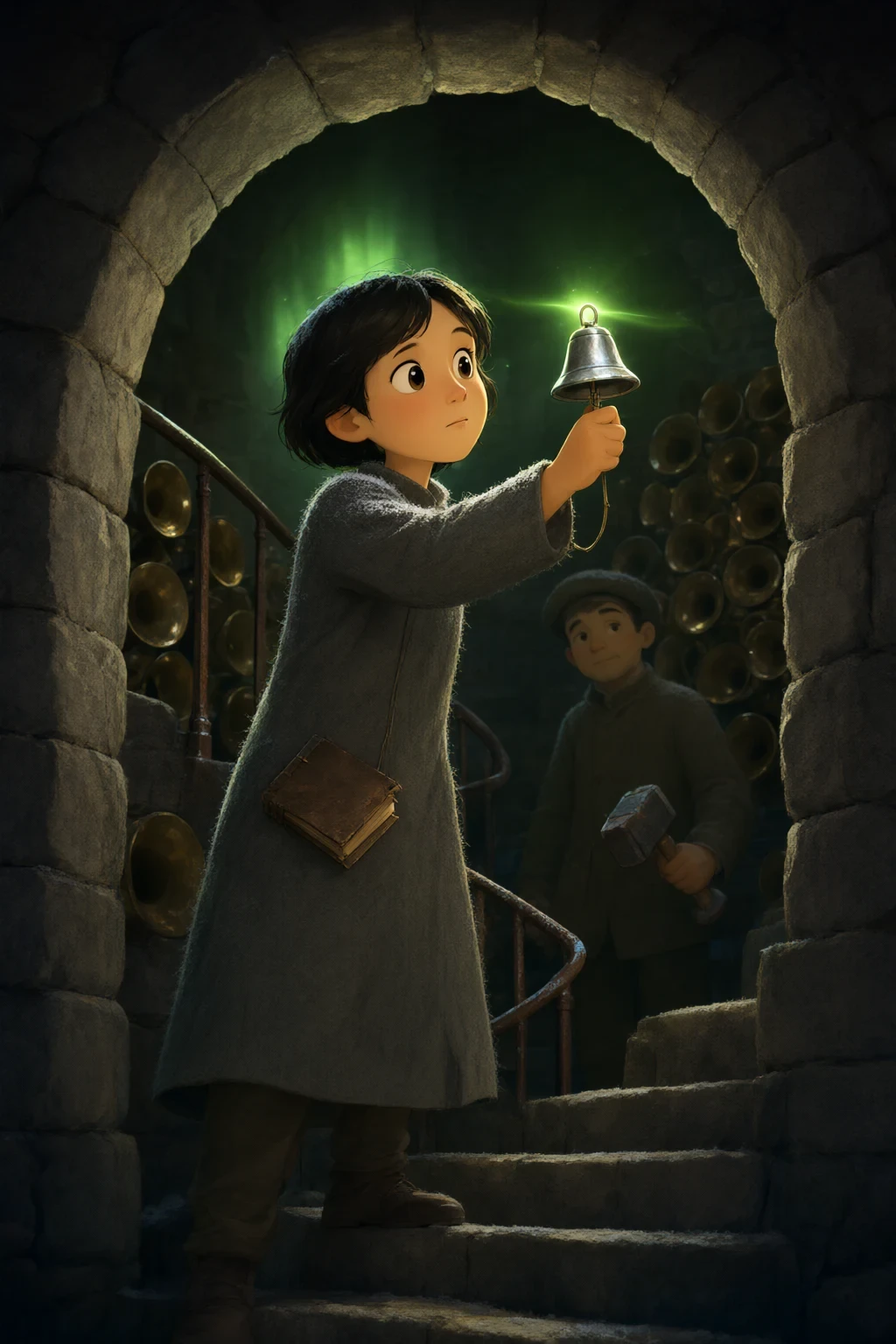
The small silver bell lived in a box on the third shelf of the maintenance store. Pell went to get it before the change of watch. She was fifteen years old, and the youngest player on the ring, and everybody had told her for two years how lucky she was. The bell was as big as two fists. That was all of it. Small. Sef Anhalt stood in the doorway with his padded hammer under his arm. He never called anybody by their name. He called them by what they played. “Small-bell. You have it, or you have not.”
“I have it.” “Then lift.” She put her fingers into the silver crown and pulled. Nothing. She got both arms under it and hauled until her teeth showed. The bell came up the width of a thumbnail and stopped, as though a nail had been hammered through the shelf and into the bell. Her arms began to shake. The bell did not move. “Stop pulling,” Sef said. “You are pulling. You have to ask.” “How do you ask a bell?” “You sing it.”
Everybody in Sillvane knew the words of the Standing Chord. They sang it indoors, quietly, and never at night. The chord was already up on the ring, nine parts of it, low as a floor under the wind. Pell opened her mouth under it and put her own small voice in the middle. At first nothing happened.
Then the bell got warm. Not hot. Warm, the way a cup is warm when it has been full. The silver looked grey and stayed grey, but when she looked again there was a line of green light around the crown, thin as a thread. “The bell does not care how big you are,” Sef said. “It cares whether you turn up.” Pell took a breath to start the next line and ran out of it, and the green line went out, and the bell came down onto the shelf with a sound like a lid coming off a pot.
She pulled it up again. Sang. It came up. Sang. Stopped. Down. “There,” said Sef, pleased. “Now you know the whole of it.” “The whole of it is that I cannot breathe.” “The whole of it is that you cannot breathe and stop. Hold it.”
Maran Ostler was at the horn-line with her hand on the third valve. She was sixty-one years old. Her left hand was white to the second knuckle, the colour of the frost ash that blows across the shoulder and stings the eyes. She wore a mitten with the thumb cut off so she could work the valve, and the cut thumb had frayed into grey wool. “The small bell is going down,” Sef said. He was already walking away down the row of horns. “I can see that,” said Maran. “To Wend’s bench. At the foot of the stair.”
“Then it can go down slowly. Everything on this ring goes down slowly, and the reason is upstairs.” Maran lifted her chin at the sky. “Watch the curtain.” Above the wall, the aurora hung in one long unbroken band, green at the bottom and cold blue at the top. Where the chord was full the band was wide and steady. Where the chord was thin the band went pale, and the wind came through.
Maran let the third go, to take a breath, and in the space where the third had been, the sky above the stair rail went thin as wet paper. The wind came through it. Pell felt it on her face. Maran put the third back, and the band filled in, and the wind stopped. “The stair is two hundred and forty steps,” Pell said. “It is,” said Maran. “Go down one at a time. Do not think about the two hundred and forty. Think about the next one. The third is fine.”
The Gallows Stair comes out of the rock at the ninth gap of the wall and goes down. Each tread has a shallow bowl worn in the middle of it, worn by six hundred years of boots, so that everybody’s foot finds the same place. The rail is a single iron line the whole length of the cut, from the top step to the bottom, and it has no join in it anywhere. Pell got nine steps.
On the ninth she had to breathe, and the bell went down onto the stone, and far above her a strip of the sky went pale and thin, and the wind slid through the stair and up the inside of her sleeves. She started the chord again from the top.
By the fortieth step her voice had gone thin. By the ninetieth she had stopped sitting down. She stood on every step, one foot in the worn bowl, one hand on the cold rail, and she sang her way down the way you would walk on a narrow ledge above a long fall.
The sky above her was the exact shape of her voice. Where she was loud the green band was wide. Where her voice went thin for a breath the band pinched, and the wind found the gap and laid a cold hand on the top of her head. Forty steps. Thirty. Twenty. Then she would hear Maran, a long way up, take the third, and the band would widen behind the wall, and there would be room to breathe for as long as the note lasted. Ten. Nine. Eight.
Maran said one word, all the way down, so that it came up to her and not out to the sky. “Four.” That meant the fourth. The fourth was the one Maran had been holding for six hours. The band went wide as a door. Pell sang eleven steps on the fourth, and the wind did not touch her once.
The bottom of the stair is the Windward Yard: a broad gravel shelf with hitching posts round it and stone fire-pits, where the market days happen, and where once every ninth day it is normal to say out loud anything at all you like about the ring. Pell stood at the foot of the two hundred and forty steps with the small silver bell in her arms. Her legs were shaking. Her throat was like a scraped road. Wend Cassock was at her bench with the brass survey lantern hooked on the rail and the folding rule on its cord.
“Collector,” Pell said. “I brought the small bell.” “Nobody has moved that bell in thirty-one years,” Wend said. “The last hand that held it was a player whose whole part was that bell, and she was stilled. That is the number.” “What is the number for the stair?”
“The stair is not a number. The stair is a stair.” Wend wrote for a while, then said it out loud, flat, because she was writing it down. “The collector records that the small bell was brought down the Gallows Stair by the ninth player, alone, and that it did not once go out of her hand and did not once leave the chord.” “It was on the steps the whole way. That is not true.”
“It was on the steps the whole way. Your hands moved. I said what I said.” Wend dipped the pen. “And the number for the whole thing is one bell. One bell is a ninth of the wall. A wall is only as good as its smallest part.” Pell thought about that for a while. Then the wind came down off the rock and pushed at her back, the way it had been pushing for two days, and the bell was heavy.
Heavy, when it should have been nothing. Heavy, because it was not the silver that was heavy. It was the nine parts, and every hour of the chord, and the whole cold width of the Longest Night, all of it folded into a thing small enough to lift off a shelf by asking it nicely in a steady voice. “It is not that heavy,” she said. “No,” said Wend. “It never was.”
Above them, on the black slab, the wall of nine segments stood in the dark with its narrow gaps, and inside it nine brass horns and nine sets of silver chimes and the black iron throat of the bass organ and the old heartwood drums were holding one long green line across the sky. The smallest of them was on Wend’s bench. It would be strung again by morning, and it would be back on the shelf by the change of watch. And it would weigh the same.