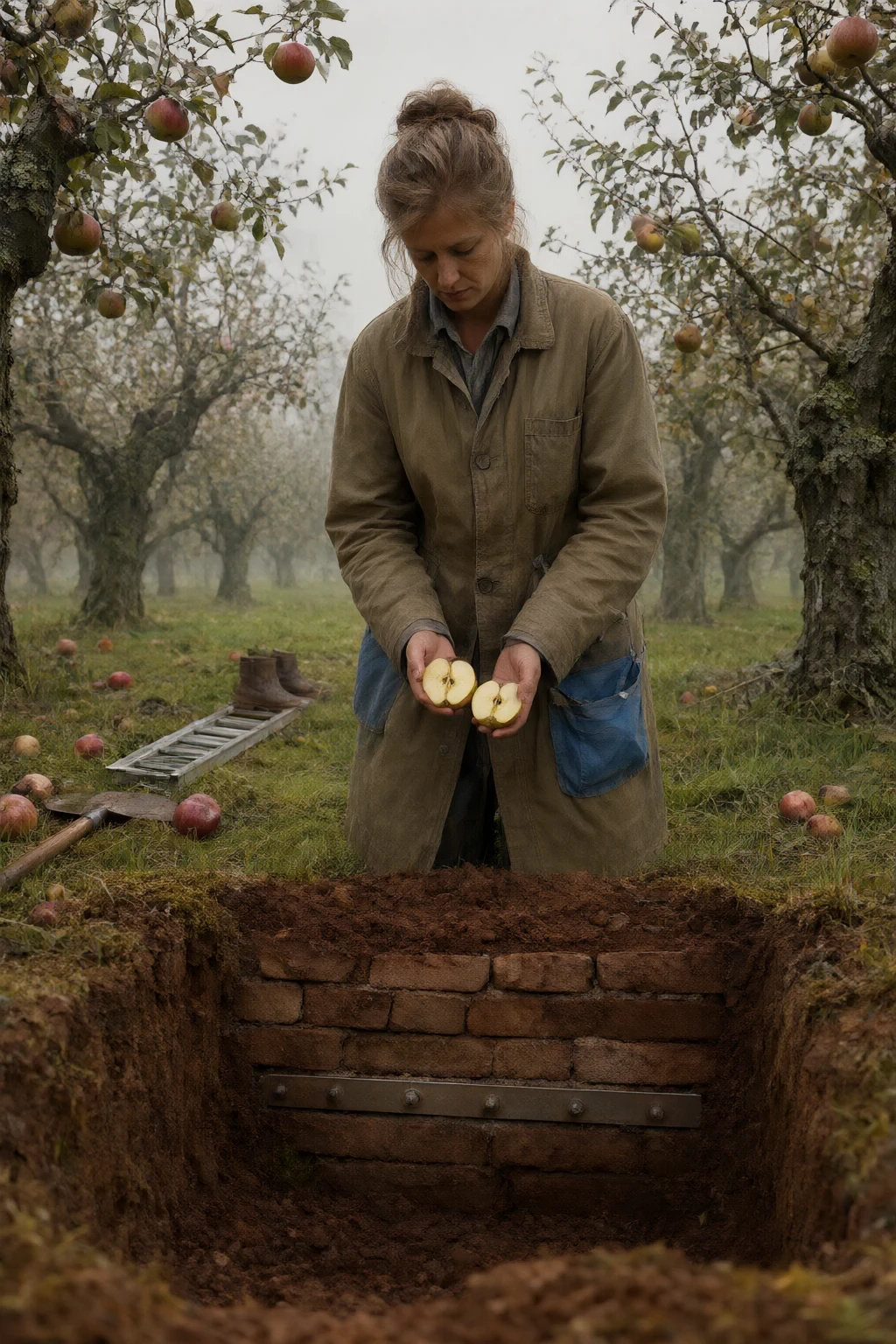
Constance Harrow bought a shilling’s worth of windfalls off a woman with a docket-book in April, in the back room of her shop in the county town, between a framed print of a river crossing nobody could name and a pile of catalogues she did not intend to sell. The woman had come in out of the rain with a canvas trade coat on, the pocket mended inside-out in a different blue, and she had set the sack down on the counter and untied it and not said a word, and Constance Harrow is fifty-one and has been buying things she cannot use for thirty years, and she knows the difference between a person selling and a person disposing. She put her hand in the sack and brought one up and looked at it and then did not eat it, which is what anybody who has handled fruit for three decades does, and she put it on the counter instead, and she said: “Eleven.” “You and me,” said the woman, “we both know what this fruit is worth.” “That is not what I said. I said eleven. Your variety carries five and has carried five since the handbook was printed. I have sold fruit in this town for thirty years and I have never once had one of yours over seven.”
“You will not sell mine,” the woman said. “That is the reason you are holding it and not eating it, and it is a shilling, and it is the cheapest thing you have ever been given and you will sell it for a great deal more than a shilling, and you and me, we both know that.” “What is it.” “A place,” the woman said, and picked up her docket-book, which had not left her left hand. “Dated the ninth, docket 4,006. I do not forge the docket. The docket is the true one. I am telling you plainly and without anything else that the docket is the true one, because a docket is a parentage and I have never in my life made a false parentage, and everything you are about to write on that card is a parentage, and you may put it down in front of me.” Then she went out into the rain and Constance Harrow stood in her shop with a shilling’s worth of windfall apples from a district forty miles off, and cut one of them with a penknife on the sill of the window, and looked at the section of it for a long time, because she has a map shop and she knows what a place tastes like even when she has never been there, and this one was not on anything she had ever hung on a wall. She wrote the card. She wrote it in her own printed hand on her own printed paper, which is a thing she has done four hundred times, and she gave it a number of her own, because her own number was the only number in the room that had ever been applied to the thing. Harrow 226.
The card came back to the Rootwork by a slow road, because cards do. It went first to the county record office at Midsomer, which is a room above a bank, where the officer is obliged to refer any question of provenance in an agricultural district to the district’s own keeper, and he did so in the ordinary course, in an envelope, on the sixteenth of May. It reached the packing shed on the first of June, and it was addressed to the keeper personally, and Ottiline Vrey read it standing up, in the yard, in flat light, and read it twice, and then went and sat down on the crate under the awning where the market is held on Thursdays. The card said, and Constance Harrow had had it engraved, which added forty-one pounds to the printing and which she considered the best money she had spent in the decade:
The undersigned is the proprietor of this establishment and deals in printed maps and antiquarian papers. On the ninth day of April 1893 the undersigned purchased of a woman giving the name of Ostler a quantity of windfall fruit of the orchard kind, of a variety unknown to me, bearing eleven carpels in section, a number not proper to the variety. Upon section the same, the fruit describes a location which I am unable to reconcile with the plan of the district from which it is said to come, or with any plan of that district, public or otherwise in my possession. I do not ask that you should tell me where it grew. I ask only whether the district holds an entry of a graft to which no address is attached, and if so whether the entry was made in the ordinary course, and by whose hand. Ottiline Vrey read that sentence eleven times over two days and could not decide which of the three things in it frightened her, and they were, in order: the eleven carpels, the phrase the fruit describes a location, and the word hand. “A hand,” she said, on the Thursday, to two people who had come to find out whether it was a hand that wanted something. “Not a column. Not a graft number. A hand. She is not asking us what grew. She is asking us who did it.”
The district replied by the third of July, which is inside the quarter, and the reply took eleven days and passed through nine hands, and four of those hands changed something in it. It began, in the fair copy, in a young hand that had been a careful hand a year ago, with the words: The register has no column for what a fruit says. That was struck out on the fourth of June by a pencil and rewritten. The rewrite was struck out on the ninth and rewritten again. The third sentence was struck out on the eleventh of June by the keeper herself, in ink, and what she put in its place was: The district is not able, at this date, to answer your question, and does not propose to answer it by supposing an answer. That one went. That one was allowed to stand, and it is the reason the rest of what happened was slow.
They found the false hand in August, and not in the reply. There were four thousand one hundred and eighteen dockets, and they were in a canvas trade coat’s inside pocket, and Mirren Ostley brought them to the Register Room herself on the second of August, and set them on the table, and sat down. “You will want to look at them,” she said. “You and me, we both know what you are looking for. I have brought all of them because if you look at four thousand of them and find one, you will look for the rest for a year, and I would rather you had the whole book than a piece of it, and that is the only kindness in this room.” Ivet Roke counted them over two days. She is seventeen now and she is still not permitted to open a ledger alone, and she was, by then, the only person in the district who could read the docket hand of a dead clerk. The dockets were nearly right, and that was the whole of the finding. The docket hand of the district is not a good hand. It is small, level, hurried, eleven people have written it since 1861, and every one of them has made the same four mistakes, because they were all taught by the same man, and the mistakes are a crossed t, an open four, a long s, and a comma set too high. Mirren Ostley’s hand made all four. It made three exactly and the fourth nearly, and the fourth was the long s, and the long s in her hand is not a long s, it is a long s that has been practised. “You taught yourself the hand,” Ivet Roke said, on the second afternoon, “off the form.”
“I taught myself the hand off the form,” Mirren Ostley said. “In 1889. I sat in a room in the county town for six weeks and I did nothing else. And I will tell you what I got out of it, since you are asking me and I would rather answer than be found out. I got out of it that a person can be a better forger by never once trying to be a better person, because a clerk does not look at a docket. A clerk looks at the docket number, and the docket number is in my own hand, and the docket number is a parentage, and the parentage is the true one, and it is the only thing on the paper that this district requires to be true.” “The parentage is the false one,” Ottiline Vrey said. “The parentage is false,” said Mirren Ostley, “and the graft is true, and the fruit is true, and I have never in this district or any other put anything in the ground that was not what I said it was, and if you cannot find that distinction, madam, then you have not been listening, because that distinction is the only reason I am not a person you need to be frightened of.”
The graft was not the problem. That was the first thing the district understood, and by the time they had understood it they had a great deal to do. Mirren Ostley had sold, in two seasons, four hundred and six fruits. Every one of them was genuine. She had a scion of the Cold Graft, which is a scion of a tree of no known stock, kept in leaf in a walled corner plot and bearing nothing, and she had worked it onto nine roots she had bought cheap, and it had taken on nine of them, and the fruit of every one of them described a location the district could not put on a plan. Which is the whole of the opportunity, and it is not a small one: in this district a fruit is a location, and a buyer who can taste a fruit knows where it grew, and the district cannot sell its ground twice, because the second sale would be a disclosure of the first. Except that it can, if the ground is on nobody’s plan. The Middle Orchard is on nobody’s plan. It is a strip between the two families’ blocks where no seedling was ever put and where a dozen unlisted trees grow of unknown age and nobody’s parentage, and the district’s own answer, printed in the handbook since 1802, is that unlisted trees bear unlisted fruit, and that unlisted fruit is nobody’s property until it is picked and sold. Mirren Ostley had been selling other people’s ground for two seasons, and the fruit had been true, and the paper had been false, and the two halves of that sentence were in the same hand on the same card. And then somebody in the county town had been able to read it.
They did not find the blank for four days, and they found it because a boy would not stop walking. Hollis Bray is fifteen and he holds a ladder for a living, and he has been permitted since the winter to walk the Middle Orchard with a tape and a fair book, because there is nobody else in two families who can do it, and he did it because on the sixteenth of August he took a short cut through the ring of the old posts and put his hand in the ground where a post should have been and there was no post. The posts had rotted through at the base. They had rotted through in a ring, at a regular spacing, eleven feet, and they had been set long enough ago that a person could put an arm to the shoulder into the holes, and the holes held water, and there were twelve of them, and they made a ring about a yard across, and the strip of unlisted ground on which the whole middle block stands is eighteen feet wide, and the ring is not in the middle of the strip. It is centred on one tree. Not the oldest of the dozen, which is the one at the ditch, fifty feet to the north. It is centred on an ordinary tree in ordinary leaf that had never borne a fruit anybody had ever wanted. “The ninth of them,” Sennet Bray said. “Count them along from the ditch. That is the ninth, and it is a Fenrow seedling, and it is the only tree in this district I have never had a word about, and I have had words from people who have never seen it.”
The fruit came off it on the nineteenth of August and it was thin and sour and it described nothing. They cut it in the Register Room under the bulb and four people tasted it and not one of them could put a name to it, and that is not a matter of opinion, it is a matter of the district’s one universal gift, which is that any person at all can hold a fruit of this ground and know where it grew. It was the one thing in the valley that nobody had ever been able to lie about. “The rest of the ring,” Ivet Roke said. She had gone out on the Friday and come back on the Saturday with a basket and a private tally in chalk on the side of it that nobody else in the district can read, and she had cut one fruit from each of the eleven other trees in the ring and had numbered them in the order the trees stand, and she set them on the table in a line. “I have marked them for what they are,” she said. “Nine of the twelve taste of nothing at all. Two of them taste of something, and neither of us can place it, and it is a low wet place, and I have not got a name for it. And this one, the one at the south side, tastes of the Middle Orchard exactly as it did last year. And this one tastes of the Middle Orchard less than it did last year.” “How much less.” “I have got it here,” Ivet Roke said, “because I compared it in September and in March, and the difference is a thing you can feel with two fingers and not a thing you can write a number for. It is going.” “Going where.” “That is not the question,” Ivet Roke said, with the flatness of a person who has spent two days being frightened. “The question is what is going.”
Nobody in the district had a rule for this, because the rule existed and nobody had ever had to use it. There are four things you can do to a graft in this district and each of them has a price. You can graft it and enter it, and it holds for the life of the tree and costs both trees their own memory of their own ground. You can graft it and not enter it, and it holds for a growing number of years and then comes apart in a single night. You can cut a graft that was never entered, and the ground loses the address for good. Or you can write a descent into the register that is not true, and the ground loses the address just the same. A blank is what the district calls it. There are three known blanks in a hundred and eleven years, two in the Fenrows and one at the packing shed, and all three are the same shape: a ring of trees about a yard across in which nothing describes anything, and a slow spoiling outward, and no repair. It is not that the ground has been ruined. It is that the ground has been left out.
And on the nineteenth day of August, 1893, there were four, and the fourth was in the strip between the two families, and it was spreading at the rate of about a foot a season, and behind it the Middle Orchard trees were giving up one part in a hundred of themselves every year, and the two families were eating the fruit off those trees, and the fruit was still perfectly good. “What did she do,” Marren Ashlock said. He had come out of the house for the first time in three days, and looked at the ring of holes, and had not gone near them. “There are nine grafts and eight of them are the Cold Graft scion on bought roots and eight of them are honest. One of them is a false descent. Which one.” “Her dockets name the source of every scion,” Ottiline Vrey said. “Nine dockets for nine grafts, in April and May of last year, and the ninth docket is dated the eleventh of May and it names the scion as the ninth tree of this ring.”
“Then somebody in this district wrote down that the ninth tree of this ring was a scion of the Fenrow ninth row, third, or of the Ward nineteen, or of a Cold Graft that is nobody’s. One of those three is not true. The false one is a false descent, because the scion did not come off the tree it says it came off.” “And who wrote it down.” The room looked at Ivet Roke, and Ivet Roke did not look at anybody. “I did,” she said. “On the eleventh of May last year, in the ordinary course, in the yard, under the awning, on a Thursday. He put the docket on the crate and the number was in his own hand and it was 4,006, and I entered it against the number, and I checked the number and the date, and I checked that the docket and the register were in two different hands, which is the check, because a clerk’s hand and a buyer’s hand must not agree.” “Did you check the tree.” “No,” said Ivet Roke. “Why not.” “Because the register has no column for the tree,” Ivet Roke said. “It has the day, and the scion and whence, and the stock and whence, and the root as known, and the union, and the hand, and the docket. The whence is a place, and a place is a word, and the word is on the docket, and the docket is the buyer’s, and I have never been asked to go and look at a tree to see whether the word on a docket is the truth about it, because that is what this district does not do, and I did it correctly, and I would like it written down that I did it correctly.”
They dug. It took a fortnight of argument before anybody put a spade in, and the argument was not about the science. It was about a strip of eighteen feet of ground eleven yards long, in a district with two surveys and a hundred and one years of a ditch, and there is no column anywhere in either of them for the Middle Orchard, because it belongs to nobody, and to open it is to admit that a thing has been done to it, and the thing was done by a person who was sold it, and the person who was sold it stands in the yard every Thursday with a docket-book. The district held a Sitting of the Standing in the schoolroom on the twenty-eighth of August, and Amos Trewin came out from the county town for the last time, and it took two hours and eleven minutes, and the vote was four to nothing with Sennet Bray abstaining, and Mirren Ostley waiting in the yard in the rain. The two families dug together. That was the condition the Ashlocks and the Brays arrived at separately and did not discuss, and the condition is the whole of what happened: a hole may be opened in this ground only by people who both claim part of it and both deny all of it. They took the Middle Orchard out on the second of September. There were nine of them, in the rain, with four spades and a crowbar, and Dellory Fenn came with his folding rule and did not open it, and Ottiline Vrey came in a coat over a coat with a lamp in a tin, because the pit went down in a day.
The first three feet were gravel. The next two were loam, and dark, and full of root, and the root of the ninth tree came up out of the side of the pit like a hand with the fingers bent, because a root that has been in ground like that for ninety years does not come up straight, and they had to cut it, and the cut face of a root in this district shows what it has been drinking, and it showed nine feet of flagged brick and mortar and a wet joint and the pale lace of a lime floor. Then brick. Then, at six feet, flags. The corridor runs under the packing shed and comes out from beneath it, and it has always been known to three people that the floor of the packing shed runs over a flagged cellar corridor, and it has never been mapped, because there is nothing on the plans above it. That is the whole of the district’s account of it. It goes somewhere. It is not on the survey. Everybody has agreed for a century to walk on it and not to think about it. It is dry.
That was the first thing that frightened them, and the first thing that made Hollis Bray stop talking, and he was not talking for eleven days, which nobody who knew him believed at the time. The water in this district sits forty feet down, and the ruins under it have never been dry in living memory, and the pipe-gallery sings in wet seasons along the whole bend, and this corridor had a flag floor and lime-laid walls and no water in it at all, and the lime was sound, and there was not one green streak on the walls. “It is sealed above us,” Dellory Fenn said. “That is all that is. Put a roof on a wet place for a thousand years and it goes dry and stays dry. There is nothing here. Do not make more than that.” “There is something here,” Ivet Roke said, and she was kneeling on the flags with her hand flat, and her hand had not stopped moving since she got down there.
The lead came up out of the mortar at the north end, and it was a strip a foot wide and a quarter of an inch thick, run flush into the joint, the way a man runs a line he intends to keep. Along it, at intervals of three feet, there were studs. They were lead, the size of a thimble, and they were set into the strip and stamped with a steel punch, and the stamps were numerals, and the numerals ran in order. One. Two. Three. Four. Five. Six. Seven. Eight. Nine. Ten. Eleven. Twelve. Thirteen. Fourteen. Fifteen. Sixteen. Seventeen. Eighteen. Nineteen. Twenty. Twenty-one. They laid the folding rule along the strip and Dellory Fenn read it, and it was eighty-four feet from the first stud to the twenty-first, at an interval of four feet, and the whole of it was exact. “There is no such thing in this district,” Dellory Fenn said. “Not in the district, not in the county, not in two hundred years of anything either of them has written down. It is not a distance and it is not a date. It is a count of studs, cut into metal, in a place with no name, and somebody cut twenty-one of them with a steel punch and counted them as they went, and that is a thing a person does when the paper is going.” “It is a traverse,” Ede Salter said.
She had not come to dig. She came on the fourth day, with a brass book and an oilskin sleeve and a right index finger that does not bend, and she came because a row of lead in mortar is a survey and she could not stay in the county town. “Four feet,” she said. “Three-foot intervals, four-foot bays. Those are the bays of a theodolite on a hundred-foot chain with a hundred-foot staff. I have used nothing else since 1861. And the first stud is number one and not number zero, which means it is not a whole station, it is the start of a count, and whoever set it was measuring forward and counting and had not yet got far enough to want a figure.” “Measure forward to where.” “To the last one that is there,” said Ede Salter.
The twenty-second stud is set into the mortar four feet behind the last numbered stud, out of line, so that the strip does not run through it but stops short and starts again, and the lead is continuous beneath it, and it is stamped, and the stamp is a circle with a hole punched in the middle of it, which is not a numeral and is not a letter and is not a mark that any of the nine people in that corridor had seen before or since. It is under the ninth tree of the ring. The centre of the ring is eleven feet from it, and the twelfth hole is inside the circle, and the wood in it is not rotted, it is gone, and it is a socket, and it is the size of that stud. They stood round it for a long time. Above them, eight feet of wet loam and gravel and brick, and one hundred and eleven acres of fruiting orchard, and a hundred years of two families being correct at the same time about ground counted in lead since before either of them was a name. “Eleven feet,” Marren Ashlock said. “And the interval in the strip is four feet. It is not the same number.”
“No,” said Ede Salter. “But it is the same number. Two measurements, both of them exact, one of them in the ground and one of it in the air, and they are not the same length, and the difference between them is the thing this district has been arguing about for a century, and I have been standing over it.” He took the plumb bob out of his chest pocket on its leather cord, and hung it above the twenty-second stud, and stood with his hand on the cord and waited for the ground to settle, because that is what a plumb bob is for, and he stood there a long time with the bob swinging a half inch either side of a lead stud that had not moved since before the district was surveyed. The ground did not settle. It had settled a long time ago. It was not going to settle now.
Beyond the twenty-second stud the floor changes. The lead stops and does not come back. The brick beyond is in a different bond, later and rougher, laid without courses, and there is no lead in it, and it is the work of people who had come after and had not been told, or had been told and had not cared, because the thing they were building over was shut. But it was not shut with the later work. Under the later work, where the lead stops, there is a plug. It is not a door. It is a hand’s breadth of lead tube run into the mortar at floor level, rising at an angle out through the brick and up, and going up under the packing shed, and it is capped at the top with a disc of lead turned down over the end, and it is not a drain, because it goes up. “Nothing comes down it,” Dellory Fenn said. “It has been going up since the day it was set, and it has had nowhere to arrive, and it has been arriving in the packing shed for the length of time that this district has been a district.”
The packing shed floor is a plank floor on joists over the flagged corridor, and on the third of September at noon, with nine people in the yard, they took up eleven square feet of boards in the middle of the floor, over the scales, over where the market is held on Thursdays, and put them back at four o’clock with a new board across the gap and a shim under the low corner, so that the barrow went over it and nobody would know for a season. What came up through the boards in the packing shed was cold air. Not water. Air, moving slowly, from under the shed, out of the shed, in a district where the air under a shed does not move at all, and Dellory Fenn held a paper docket over the seam and it drew itself to the boards, and then held it over the other side of the shed and it drew itself the other way, and the corridor under the packing shed is breathing, and has been breathing, and the district has been working above it for a hundred and one years, on Thursdays, in the wet, with a crate and an awning. Nobody said anything about that for a year.
The second of October is the day a district decides what it is going to write down, and this district wrote for nine days, and the two families did not speak to each other for the whole of the nine days, and then spoke on the ninth. The useful thing to do was to file nothing. There is no law. The thing that was done was done to a strip of ground belonging to nobody by a person who bought it from thirteen people who could not read what they sold. A blank is not a crime; a blank is a scar in a thing that was never on a map, and the district’s own position, printed in the handbook, is that the unlisted ground does not come back. Every one of the three known blanks was left. Not one has ever been dug, and the Standing has never once in a hundred and one years authorised the opening of ground that neither survey holds, and the reason is that if you open it and find a thing, then the district has found something, and a district that has found a thing has to say where it put it.
The honest thing to do was to file all of it. Four thousand one hundred and eighteen dockets, of which four thousand one hundred and nine are false descents and nine are true, and one register blank, and one corridor, and twenty-one studs, and one unmarked stamp, and a lead tube that has been breathing under a shed for a thousand years. The honest thing to do was impossible, and the keeper of the Grafting Register put it in a sentence on the third day and read it out to the two families in the yard, under the awning, where the market is held. “A blank is a silence,” she said. “That is what it is. The rule does not destroy a place. The rule takes it out of the record, and the record is all the record there is, and so it is as if it were destroyed, and it is not, it is there, and there is a great deal of it under this shed, and the reason we could not read it is that we have never in a hundred and one years had a book that was the right shape.” “That is the first true thing anybody has said about the register in my time,” said Marren Ashlock. “It is the first true thing anybody has said about the register in my time,” said Ottiline Vrey, “and it is not a compliment to the register. A descent-book cannot hold a finding. It is built to hold a father, and if you ask it for anything else it will give you the father, and the father will look like the answer. That is not a fault. That is a book doing the only thing it was made to do, and every one of us in this district has spent our lives complaining that it will not do the other thing, and we have never once asked whether the other thing was wanted.”
They filed it in three parts, and the three parts are the whole of the argument, and every clerk in the county could tell you which part they would have thrown away. The first part was the four thousand one hundred and eighteen dockets. The register enters descent, so a false descent can be entered. On the eleventh of October, docket 4,006 and its companions were read in the yard under the awning, one at a time, over two days, with Mirren Ostley standing on the other side of the crate from the book, correcting. The entry for the ninth says: parentage stated on the docket is not true. The scion was not of this tree. The union was made. The scion was of the tree in the walled plot at the Cold Graft, of no known stock. That is a complete and accurate and checkable record. It does not say where the fruit is from. It does not say where anything is from. It says a man lied about a father in a district where the book of fathers is the only book, and it says it in the district’s own hand, with a number out of the district’s own series, and it is the only time in a hundred and one years that a descent in this district has been found to be false, and it may be entered at the request of the person it convicts, and it was, and his name is in it.
The second part was the keyring, and it was Sennet Bray’s, and it nearly did not happen. She is fifty-two. She has not signed anything since 1861, when her husband died and there was a document, and she has said so out loud on Thursdays for thirty years, and it has become the kind of thing a district says about itself, the way it says the juice in the Bellhouse cellar tastes wrong and is drunk anyway. She was asked, on the sixth of October, to sign the second part of the filing, which is the description of the ground, and she refused in eleven words, and the boy waited with the pen. “Who takes the statement,” said Ottiline Vrey, after a while. “Nobody. I said. There is nobody to take it, because I will not give it.” “I am not asking you to give it. I am asking who is to take it. It is a different question and you have answered the one that is easier.” The yard was very quiet in the way a yard is when forty feet of muddy ground has been dug out of the middle of it. A crow was somewhere over the packing shed.
“There is a book in this district,” Sennet Bray said. “There is a book of the district, in a room, on a stand, and the district is in it, and things go in it, and the things that go in it are not about a person. There are eleven keys and one of them has never turned a lock, and it has been on a bootlace round my neck since 1861 because I was twenty-nine and did not know what to do with it, and there is a line for a thing like that, because a key is a thing and not a person.” “A keyring?” “A keyring,” said Sennet Bray, “and no name on the line, because a name is a person, and you will write the eleven, and the year, and that one of the eleven has never turned a lock, and every one of those is a fact about an object, and that is how you will get it in without a person.” They got it in. It is entry 4,341, and it is the only entry in eleven volumes of the Grafting Register that describes a keyring, and the district will still be arguing about it in forty years, and nobody will ever be able to say it was sentimental.
The third part was the corridor, and it took the longest, and it is the part they are still arguing about, and it is the reason anybody still talks about the summer of 1893. Two schools. The first said that the district had found a buried structure of unknown date and unknown authorship, and that a structure is a structure, and that it must be entered in the district record, and that the record has eleven volumes of descent and no volume of anything else, and that the correct action was a second book. The second said the corridor was older than anything else in the district and that nobody in the district had put it there, and that it was not theirs to describe, and that a description of a thing you did not make is a claim on it. They argued for nine years, in three Sittings, over four hundred pages of minute, and the argument is still the loudest thing in the district’s winter. In 1902 the district had eleven volumes of descent and a second book with a hundred and forty pages in it and no column for a finding in either, and the second book’s first page is headed: of things found in ground not entered in the first book, and its first entry reads:
Under the ninth tree of the ring in the Middle Orchard, at six feet, a strip of lead in mortar, one foot wide, with twenty-one studs numbered in sequence, and a twenty-second stud unnumbered, out of line, stamped with a circle. The lead stops. Beyond it, brick of a later and rougher bond. Above the lead, a lead tube rising, capped, sealed. The corridor is dry. The air in the packing shed moves. Nothing in the district book can be compared with any of this. We do not know what any of it is for. It is entered here because it was found, and because the first book has no column for it, and because the second book was made for the purpose of having one. And the second book has been open every day since, and nobody has ever entered a second thing in it, and the district knows by now that it is not empty, and that the first book cannot be used to check it, and that this is not a failure of the arrangement, and that the arrangement is the only arrangement anybody has ever had, and that the fact of it, in a cold whitewashed room under a bare bulb, is the reason the district will be able to say, in two hundred years, exactly what it knows and exactly what it has only ever been told.
Nobody had asked Mirren Ostley to stay. She stayed for four years and then went off to the coast with the money, and on the morning she left she brought the last of the dockets to the Register Room and put them on the crate, four thousand one hundred and nine of them, and said nothing about it, and Ottiline Vrey counted them over two days, and entered the last one, and put the number first when she was asked what she intended to do about the fourth thousand one hundred and tenth. It is a thing this district will argue about. It is a thing this district is arguing about now. The honest thing and the useful thing came apart somewhere around the second of October in 1893, in a yard, in the wet, in front of a crate, and they have not been the same since, and the district has two books, and under the heading of the second one there is a single entry, and the entry is true, and the entry cannot be checked, and it was filed anyway, which is the only thing the district has ever done that its own century of argument did not require.