There is a number that has been sitting at the bottom of Pell Underhay’s ledger since the fourth month of the winter, under a line, in a small even hand, and it is the sum of fourteen hours a night multiplied by four players multiplied by four winters, which is the number of hours the four of them have between them, and which is more than they have. She had looked at it for a long time without doing anything with it. Then she started a different sum, in the margin, and that one was worse. The margin sum was for one player, and it asked what four winters of one player’s hours come to at the end, and the answer was not the same shape as the other one, because the other one is four people sharing and this one is a person alone, and alone is where an answer gets to be a length of time.
The rule about a player who is played too long past their span is one line long and she had it by heart before she could read. A player who plays too long grows still, and a still player is not mourned. A still player is removed from the roll. She had wanted a number for her mother for two years and now she had two, and the worse of the two was a shape rather than a figure. Her mother had been removed from the roll. Pell knew what the roll looked like with a name gone out of it. She had seen it. Six hundred years of names in a column, and then a gap, and then the next name, and nothing in the gap at all, not a dash, not a date, nothing, as though the person had been a misprint. Underhay, Aldis. Then a space. Then someone else. “What is the number for that,” she said, out loud, to the drum.
Ysolde Vant had been hearing the ninth segment’s silence for eleven years and had never once said so, and the reason she had never said so was that she had no proof and no words, and because the sound was one she had asked for. It came in the deep months, in the last hour before the Held came up, in the two hours that belonged now to the striker. It was underneath the Underheld, under the mountain’s own note, and it was not a note at all. It was the sound of a chord with nobody in it. Eight parts. The same eight parts. The Low, the Middle and the High, the three chimes, the bass and the two under-struck voices that the wall was made of. And played perfectly, and played without any cost to anybody, and played by nothing, and going on, night after night, in a room under the ninth segment where there was a mark in the floor for every one of the eight and a ninth mark that was warm. Ysolde had tried to walk to it four times in eleven years. She had got as far as the middle of the ninth segment with her hand out, and the sound had gone, every time, the way a dream goes when you are somebody who has to be awake.
On the night of the second change of watch in the ninth month, the small-bell held the drum and did not sing the Underheld. She sang nothing. She held the silence that belonged where her note went, for the length of nine strokes of the count, and her hands were on the hide and the hide was over the split, and nobody was in the ninth segment to see. It is the ninth clause, and it is the reason the ring has a Ninth at all. The wall is tuned in nine parts. Eight of them are played. The ninth is a silence, and the ring was built to hold that silence, and for six hundred years the ninth part has been the one part of the Standing Chord that nobody fills.
And the ninth part is a place. It is a mark cut in the flagstones at the centre of the ring, a foot across, with the eight other marks round it, and no one has stood in it since the builders went up the Gallows Stair and did not come back. The mountain does not get angry. It keeps the shape of a break. And when a second silence is played where a silence is already kept, the mountain has one place it knows the shape of, and it makes the silence into a room. The flagstone under the ninth mark lifted a finger’s width and stopped.
Maran had the Low and heard nothing, because the drum’s place in the ring had been silent for four months and a silence there was nothing new. Sef had the Underheld in the ninth segment and heard something, and what he heard was the ninth mark of the floor becoming an edge, and he was across the ring in six steps with his hand on her shoulder before her hand had left the hide. “Small-bell.” “It’s open,” she said. “It is not for you.” “It is nine inches deep and it is going down.” “It is not for you,” Sef said, “and you know the ninth clause better than any of us because you have written it out eleven times, and there is no version of tonight in which a person goes down there.” “I know what is down there.” “You know what Ysolde Vant has told a lamp-keeper’s child about a room that sings.” He had his hand on her coat at the collar. “Ysolde. Chime-keeper. Come and look at your mark.”
They came out of the Bass Mouth together at the fourth hour, and the shaft had been easier to climb than it had any business being, and Ysolde said, without stopping and without hurrying and in the voice she used for the written things, that she had been trying to get to that room since her fifty-sixth year, and that she was going now for herself, and that the small-bell could be told the truth about that afterwards or not at all. “It does not forgive you for being the reason,” Sef said. “No,” said Ysolde. “It keeps the shape of the break. If I did not go down, the break would be the shape of me, and I would spend the rest of my life being a woman who let a child of fifteen go into the mountain alone to be kind to her.”
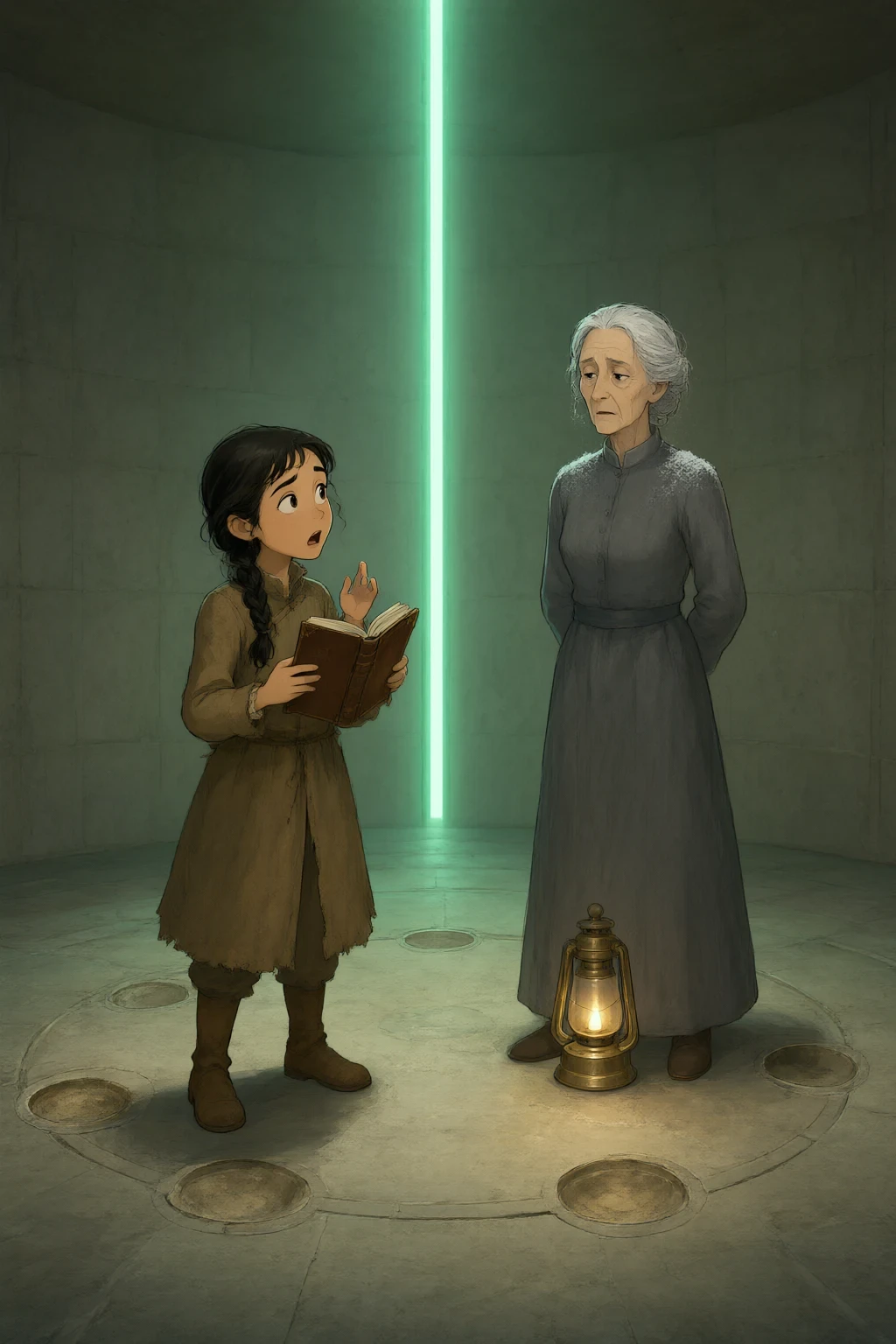
The hole in the floor was a shaft cut square, and it was nine inches across at the lip and it went down into rock. Pell went first, because she was the one who had opened it, and Ysolde went second with a length of lamp cord over her shoulder and Wend Cassock holding the other end of it and narrating in a whisper, in the third person, that the small-bell was descending, that the oldest of the ring was descending behind her, that the cord was eleven fathoms and there was more of it, and that the collector was recording the hour. The first eight fathoms were ordinary mountain. Then the walls changed. The stone went from grey granite to something smooth and pale and cold, worked by no tool anybody could have made, and the cord stopped needing to be pulled because there was nothing left to climb down. They were standing on a floor.
It was the coldest place Pell had ever been, and it was absolutely silent, and it held a single note. The note was the whole chord. All eight parts at once, and every one of them true, and none of them sharp by a half tone, and it was not loud. It was the loudest thing she had ever heard. It went on without any player in it. It had no cost. It had no cold in it anywhere. And the room was round, and the walls of it were the Underheld, and on the floor in a circle were nine marks.
Eight of them were worn. That was the part Pell could not look away from. The marks were cut in stone, and they were worn into shallow bowls in exactly the way the treads of the Gallows Stair were worn into shallow bowls in the middle, and there had never been a foot on them. They were worn by a sound. Six hundred years of the ring standing in a ring, and the ring’s own weight, taken out of the floor by the wall, which is what the Underheld does and always did. She got up and walked the circle. The floor gave under her feet the way flagstone gives, and the note did not change as she moved, because it was not coming from any of the nine places but from all of them at once, and from the walls, and from underneath the marks themselves.
So she said something out loud, to find out. She said the words of the Standing Chord, the six words everyone in Sillvane knows and sings indoors and never at night, and the room took them and gave them back so that every word was ringing off three walls at once, and she could not tell any more which of the three was her own. It repeated what she brought. It had no voice of its own and made no sound she had not put into it, and if she had come down that shaft saying nothing she would have been standing in a silent chamber holding a single note for ever with no company whatsoever. The ninth mark was not worn. It was clean-cut, sharp-edged, and it was warm, and standing on it was not possible because the air above it was moving. “It is a place,” Pell said. “It is a place for a person.” “It is a place,” Ysolde said. Her voice went round the room and came back thinner. “The builders left it. The founding clause says the ninth part is kept for the one who comes without being called, and that no one has ever come, and the ring has been waiting six hundred years with a warm mark in the floor and nobody in it.” “Then somebody should come.”
The room furnished itself with her voice. She had said somebody should come and the room gave it back to her, and not as an echo. It gave it back as a bell. Every word she had ever spoken was in there, all of them, the ones from Sillvane and the ones from the ring, and the ones she had said to her mother’s bed in the last month of her mother’s playing, and they were all ringing off the walls, and the ringing of them was not fading, because nothing in that room faded. “What is the number for that,” she said, to the number under the line in her ledger, and the room said it back to her, every figure of it, exactly, the fourteen and the four and the four and the sum with the line drawn under it. And then it said the other one. The one in the margin. The one about her mother.
It said it in her own voice, and it was her own voice, and the room did not have her mother in it anywhere. It had the shape of a silence. It had a mark in a roll where a name had been taken out, and it had the cold place where a person who played too long had gone still, and it had no daughter in it and no voice at all, and the difference between those two things was the whole of what the mountain keeps. Pell sat down on one of the eight worn marks and put her face in her hands and stayed like that a long time.
Then the ninth mark said something, and it did not say it in a voice. The note in the room changed. It did not get louder and it did not get softer. One of the eight parts came out of it, the way a voice comes out of a crowd, and the part it came out of was the part the drum had been, and the part that had been hers, and what came out of it was her. Not a sound. A shape. A girl of fifteen standing in the ninth mark with her hand on a drum that was not there, holding the Underheld in her throat, and it was her, and it was the exact note, and it was playing the whole of it perfectly, and it did not cost her anything, and it would not cost her anything for as long as she stood there.
The room wanted the ninth place filled. That was all it had ever wanted and it wanted it the way a held note wants to be resolved, patiently, without any threat, for six hundred years. And it showed her what would happen, because rooms do not lie, they only repeat, and it repeated the truth in the plainest words it had. If the ninth place were filled, the ring would be nine. The wall would be whole in a way it had not been since the builders left. The chord would be played from underneath, by the mountain, all eight parts and the ninth, and it would be played without cold and without cost and without a single person being thinner in the morning than they were the night before.
And the players would not be needed. Not dismissed. Not stilled. The roll would be closed, in the ordinary way, at the end of a winter, and their names would be left in, because they had served, and there would be nobody to take them out again, and there would be no more nights on the ring for anybody, because the ring would not require it. You would never be relieved, because there would be nothing to relieve you from. You would never be the charity. You would be the ninth, and the ninth does not get up and go to the market.
She stood in it for nine counts of the drum and it was the best thing that had ever happened to her. That was the part she could not put down afterwards. Not the cold, and not the silence, and not the ring of her own voice going on off the walls forever. It was that for nine counts she was not the small-bell, and not the girl who had been given a chair after her mother was taken out of a roll, and not the charity. She was the ninth. She was the one the founders had left the warm mark for. Nothing she had done since she was thirteen was a debt. It was a waiting. “Ninth,” said the mark. It did not use her voice. It used hers from the well in her throat, from the place under the words, and it said the word the way a foundation stone says a name.
Ysolde Vant was standing on the second worn mark with her hands behind her back and the lamp cord going up out of the shaft behind her, and she had not moved since they came down. She spoke in the voice she used for the written things, and she did not stop for breath, because she could not, because the room took a silence as a place to keep a note in, and a pause in her recitation would have put a note into the ninth mark and made the thing that was standing in it permanent. “According to the founding clause, as it is kept in the ninth segment and as it has been read at the change of every watch for six hundred years,” she said, “the ninth part is kept for the one who comes without being called, and the ninth part is not given, and the ninth part is not taken, and the ninth part is not filled by appointment, and the ninth part is not filled by grief, and the ninth part is not filled by a person who is owed something.” And in the cold, on the ninth mark, the small-bell began to get up.
The room is made where a rule is broken, and a room is not a thing the mountain can argue with, because the mountain is the one that made it. It is a broken rule, held still, the way a held note is held. So the thing that puts you in a room is also the only thing that can take you out, and it can only do that with the rule. Ysolde Vant was the ring’s memory. She had been the ring’s memory for eleven years and had walked the parts of it in order every night since the frost in her lungs, out of a book that was not written down, and there was no clause she did not have.
“The ninth part is not filled by appointment,” she said again, and the room rang it off the walls, and it was true, and the room could not refuse a true thing, and the mark under the small-bell’s boots began to cool from the outside in, like a hearth going out. “It was not called,” Pell said. She said it standing up, with her hands at her sides, to the smooth cold wall, and she said it in the plainest words she had. “It was not called. My mother was stilled and it was taken out of the roll and there was a gap, and they put me in the gap, and I have been here two years telling myself it was a calling and it was not a calling, it was a chair. That is the true thing. That is the whole of the true thing, and you can have it, and I am not sorry for it, and I do not want to be the ninth.”
The room did not put the note back. It could not. A player who lies to the ring is heard by the ring, and the ring makes no distinction between a lie and a wrong note, and this was a room, which was a lie the mountain was holding still; and the whole of what Pell had just said was true, and so the room had nothing to hold her with, and the ninth mark went cold all the way down like a stone going wet, and the shape of her that had been playing the drum part underneath it stopped, in the middle of a note, with no end to it. It pushed her out. There is no gentle way to say what that is. Nine fathoms of cold came up the shaft and took hold of her and put her out of it the way you take a splinter out, fast, and she came through the hole in the ninth mark onto the flagstones of the ring with her shoulder against the stone and no sound in her at all.
Wend Cassock had the cord. She had been holding it for the whole of it and she had not moved, and when the small-bell came out of the floor she narrated it in a whisper, in the third person, because that is how she worked, and her whisper was shaking. “Four seventeen,” she said. “The small-bell is out. The oldest of the ring has not come up. The cord is slack. Eleven fathoms of cord and it is going slack and the collector is holding all of it.” The oldest of the ring came up at four thirty-one, on her own, with the lamp still burning, and sat down on the ninth mark with her back against the roll box, which is where she always sat, and put her hands in her lap, and did not look at anybody.
Pell found the book in the inside of her coat, where it had always been, with the broken spine and the grey board and the elastic round it twice. Every page was blank. Not one column. Not the dates. Not the sum with the line under it. Not the two true notes ruled side by side, and not the heading at the top of the last clean page with a name in it that was nobody’s. The pencil marks were gone out of the paper and the paper was paper. She turned it over. She turned it back. She put her thumbnail on the corner of a page and made a small black mark in the margin, and it stayed. “Room takes what you came with,” Ysolde said. “It took the arithmetic.” “It took what you came with,” said Ysolde, “and I came with a listening.”
For eleven years there had been a sound in the rock under the ninth segment, the sound of a chord with no players in it, true in every part, going on forever, and Ysolde Vant had lain awake on the black slab with frost ash in her eyebrows and let it come up through the floor into the bones of her, and it had been the nearest thing to the thing the mountain had been teaching her whether she asked for it or not, and she had wanted it, and she had wanted it the way a woman who is seventy-two wants a thing. She put her hand flat on the floor of the ninth segment now, on the flagstone, which was ordinary stone, which was cold, which was nothing at all. “It’s gone,” she said. “Yes.”
“Good,” said Ysolde Vant, in the voice she used for the written things, and did not say anything else, and her breath went in and out and made its dry sound, and the small-bell sat on the floor beside her and did not tell her that she was sorry, because the small-bell had been fifteen for long enough to know what sorry was worth on that mountain. What was left of the night went on being played, because it had to, and the wall was thinner than it had been in the spring, and nobody said the word drum again. Sef noticed it at the change of the third watch and made nobody else notice it, which took him the whole of an hour. The ninth segment had a sound in it. Not a note, and not a note missing, and not anything that any of the eight parts was making. It was the sound of a room that had been closed properly, at the far end of a shaft, on the far side of a door, which should not have been audible from the mouth of the shaft and was. It was quieter than the smallest of the small bells.
He did not tell the others. He put his hand flat on the stone of the wall at shoulder height, the way you would on a door in Sillvane, and the stone was neither warm nor cold, and it was exactly nine inches across, and it was a line, and it went from the flagstones to the top of the segment in one unbroken stroke. Then he took his hand off it and went back to the two hours and did not tune it, which for him was the hardest work of that winter. Near the grey hour Wend Cassock took out the roll and turned to the last page and read out what she had written there eleven weeks before, which was not a record of anything, because nothing had happened yet. It was four lines of her own hand, in the flat declarative voice she used for facts, and it said what would happen, and in what order, and it was in the past tense throughout.
The collector read it to herself once. Then she took out a knife, the small one she cut her bread with, and cut the leaf out along the stitching, and folded it in four, and put it in her coat on the other side from the roll. “It was written down wrong,” she said, when the small-bell looked at her. “That is all. I have written it down wrong, and there is no need for it in the book, and the book is a record and not a second opinion.” There is a door in the ninth segment now, and it is not a hole. It is nine inches across and it is flush, and the stone of it is the same smooth pale cold as the room, and it goes down nine fathoms to a floor with nine marks in it, eight of them worn, and the ninth one clean and cold and empty. It will be there when all four of them are dead. That is what a room is. The chord keeps the shape of the break and does not give it back. It is a single unbroken line of green from the flagstones to the ceiling, in a wall that is otherwise nine metres of grey mortared granite, and it is the only straight line in the ring that anyone made on purpose.
Pell is the only one who can open it, and not with her hands. A room is furnished with the ringing of your own voice if you speak in one, and a true thing spoken in it is a key, and she knows that now and cannot unlearn it, and there are four people left on this mountain and three of them have no idea, and she is not going to tell them, because being the one who can open a door in the wall is not the same as being the ring’s equal, and she has learned that this winter, and she is fifteen, and it may take her the rest of her life to finish learning it.
She opened the notebook every night of the rest of that month and wrote the date at the top of a clean page, because the date was the only number she still had, and under the date she wrote what had happened and what it had cost, in a small even hand, and she did not divide it into columns, because a column is a way of making people into rows, and she had tried it, and it had come out the same for all four, and that had been the whole of the answer and she had not been able to hold it. And once, near the end, when the four of them were in the ninth segment and the two lines stood over the range outside, one green and one cold and both of them thin, Ysolde Vant said, in her written voice, going steadily on without stopping:
“The mountain has heard you decide, small-bell, and it does not take back what it has been given, and it does not forget a bill. Everything the ring has ever taken has been taken in years, and it does not care how old you are, and it has just been told that there is a person on this rock who has more years in hand than anyone else standing here, and it will come for them, and it will not come with a warning, and there is exactly one thing it will not accept, and you know what it is, and I am not going to say it for you.” Pell did not answer. She looked at the single unbroken line of green in the wall of the ninth segment, from the flagstones to the ceiling, and it was not broken anywhere at all.