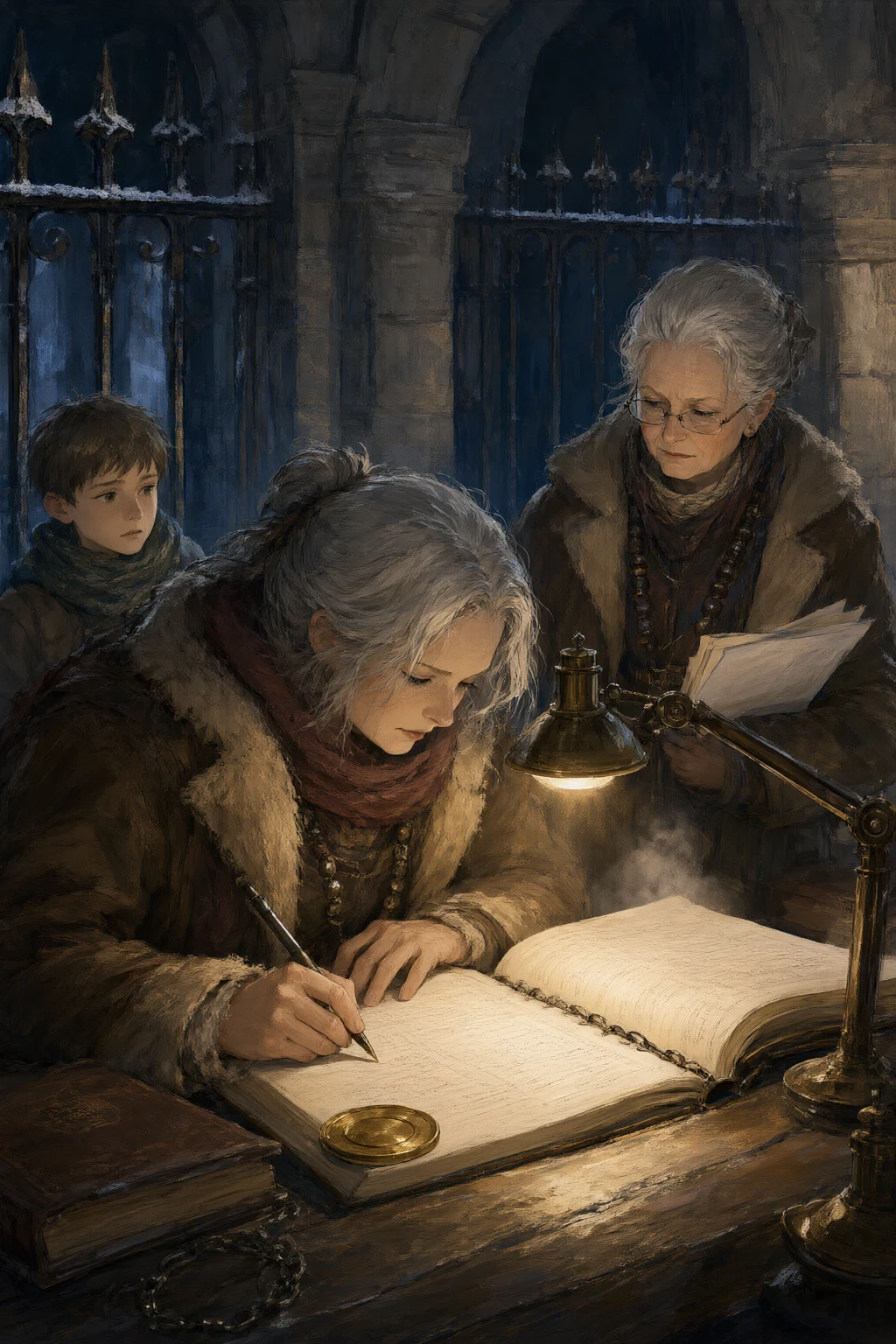
The roll was sixty-three lines long and it came to Halla Rimewright on the first Monday of February in a folded sheet of oiled paper with a nail through the top corner, and she carried it to the alcove under her coat and put it flat on the long table beside the Book, where it lay all day like something that had been waiting for her.
She was forty-seven, and had been at that desk twenty-two years, and in that time the Book had recorded every degree and every grade of the Coldmark terrace to two decimal places and had never once recorded a reason for anything. There are two columns and both of them are for numbers. The heading over the second one says GRADE, and under the heading there is nothing at all, not a ruled line, not a small print. That is deliberate, and the argument that always comes is not about the rule. It is about whether the rule is a good one, and the guild has never found a way to have that argument, because a good rule needs a place to be written down.
Grades are first, second, third and outturn. People who are new to the Coldmark take them for qualities. They are not qualities. A grade is a position in a line, and the line says who gets the first of the crop and who gets what is left. The office is held at minus nine from Michaelmas to Candlemas, and the Book lies chained to a frame in a railed alcove with a lamp on a swing-arm over each page and a brass assay disc in the gutter of the leaf like a paperweight. The roll is what the desk works from and the Book is the fair copy, and at the end of the season the roll goes down to the Frostgate and comes back clipped together, because that is how a seller proves what was done to his barrow.
Halla turned the roll over. The back was blank. On the front, in a hand that was not hers and never had been, sixty-three lines: an account, a ground, a name cut into the lintel over the frost-plate, and the number of yards that account expects to be served in a season. She did the sum, because she always does the sum, and because the sum is the one thing on the sheet that cannot be argued with. Five thousand two hundred and forty yards. The crop last year came up at three thousand nine hundred and six. The Book forecasts four thousand one hundred and eighty for this season, which is the best in living memory and has been the standing forecast since the first leaf, which is a thing the Coldmark stopped noticing forty years ago.
So the roll asked for five thousand two hundred and forty and the hill was going to produce four thousand one hundred and eighty, if the Book was right. The difference was a thousand and sixty yards of cold that somebody was not going to get, and the way the Coldmark decided who did not get it was that the line went on paper, and the Book did not care. A queue has to be longer than the crop. Halla had known that since she was twenty-five and had never said it out loud, because saying it is the same as saying that the order of the line is a decision, and a decision needs a reason. She unhooked her pen from its cord and squared the roll on the table, and went to find out what the first line said.
The first line said FELT ROW, and under it four names, and after the names a ground: eleven hundred yards of drill on the Fell block, and beside that a figure of three hundred and ten yards expected. Three hundred and ten yards, said Halla aloud, to nobody, in a room at minus nine that does not carry sound. Three hundred and ten yards is more than the whole of Rime Barrow Nine came up last year, and Barrow Nine is what is left after the named accounts have been served, so the account at the head of the line was nearly twice the size of the reserve. It had been first for sixty-one years, and Halla knew that because the Book had never once had anything else in that cell, and because she had found the founding roll in a press under the alcove window, with Fell Row at the head of it in a brown ink gone the colour of weak tea. The first rule she was reminded of every year, and had never had to be reminded of until somebody asked her, was that nobody moves up. You do not improve into first grade. The line only shortens at the bottom, and it only ever shortens because somebody is struck.
Bram Ostmark came down on the Wednesday with the last season's fair copy under his arm and a grievance in his mouth, which is how Bram comes anywhere. “The Ostmark line was first-degree cold,” he said. “Eleven degrees better than anything on the Sorne line. It should be first grade.” “One hundred and nineteen,” said Halla, “against the Sorne line at one hundred and eight. That is a difference of eleven degrees, and the Book has it, and you may read it any day through the rail.” “Then it is in the wrong column.” “It is in the column it goes in.” Bram put the fair copy down on the rail, which he was not supposed to do, and flattened it with a palm that had the scoring of salt-frost all over it, like a rope burn.
“Fell Row has been first since before the water came down off the shoulder,” he said. “Fell Row is four people and a dog. The Ostmark line is nine. My cold is better than theirs.” “It is,” said Halla, “and it will be served second, and the difference between first and second in a bad year is the difference between a whorl in your stones and a flat white field, and I cannot put that in the Book either, because it is not a degree. It is a consequence.” “Then whose decision is it.” “Mine,” said Halla. “The cell says F and I put the F there. That is the honest answer and you may take it or leave it.”
Bram took it. He was thirty-four, and had a fur-seam across his right eyebrow healed white, and he answered questions with measurements, and when he had nothing measured to say he gave the number of the thing itself, which that day was nine: the number of people on the Ostmark line, and not an answer to her question at all. At the rail there was a boy who had been there for the whole of it. Coen Halloway was twelve, with a wool scarf wound twice and tucked so long that the end of it had to be stepped on, and chapped lips, and he read numbers aloud to himself in the corridor in a voice so soft that clerks pretended not to hear it. “Three hundred and ten,” said the boy, under his breath. “That is more than Barrow Nine.” Then, after a moment: “The Ostmark line is nine. Fell Row is four.” “Those are not the same column,” said Halla, without turning round, “and I would rather you did not put them in.”
The strike is the only door. She had that from Sura Vane on the second afternoon, when Sura came to the alcove with the winter's pension schedule in a bundle, and one hand permanently inside her coat because of an old plate burn, and reading spectacles pushed up on a broad beaded cord. “You want to know how somebody moves up,” said Sura. “Nineteenth of November, nineteen fifty-one, Widder Sorne, struck, residence. Fourth of February, nineteen fifty-eight, the Halloway widow, struck, default. Twenty-second of October, nineteen sixty-four, the Felt Row child, struck, minority.” “That is three in eleven years.” “That is three in eleven years, because I looked. In twenty-two years at that desk you have struck three accounts, and you told me about two of them at the time.” Halla put the pen down. “I remember the Sorne one. Nineteen fifty-one. Residence.” “Yes.” “The other two I do not remember.”
“No,” said Sura, “and I would think very carefully before you tell the committee you cannot remember your own hand.” A strike is entered in the row of the account struck, with a date and a word, and the roll then closes upward by one. Residence means the account has no house. Default means it did not take its yard. Minority means it has nobody of age on it. There is no fourth word, and that absence is the most powerful thing about the whole arrangement, because every situation that is not one of those three has to be fitted into one of them, and the fitter is always the clerk. A widow who cannot afford the standing cold for a year is in default. A house that has moved down to the valley is in residence. A guild that wants a yard from a household with an old man and a boy can call it minority, and minority is only a measurement of the ages, and the ages are on the roll, so nobody has to lie.
There were other rules, and Halla went and got them one at a time, in the way you get the rules of anything that has been running for four hundred years: by asking the people still in it, and being careful to ask a question they could answer out of their own memory rather than out of the Book. From Ansel Rime, on the bench, holding a cup of the bitter drink in two fingers and a thumb: “Outturn.” “What is outturn.”
“Outturn is what the assay declares. Not what is left. If there is a hundred yards over and the assay has declared none, then that hundred yards is not over, it is undeclared, and it goes to the reserve, and the reserve is not a void, so it is cold that bleeds out of the hill inside a season, and the office writes it off as loss against the name nearest the plate.” He turned the cup round. “That is why outturn is a grade. It is not the bottom of the pile. It is a decision, made in December, by whoever holds the pen, about what is going to happen in February.” “You are saying the outturn line is written in advance.” “I am saying a cold that is not declared does not exist. I am seventy-four. I have never known a declared figure to be wrong.” From Ilva Sorne, in the Iron Row, who did not stop working and did not take her eyes off the plate:
“You are asking the wrong question. You are asking who is at the bottom. There is no bottom. There is a line, and the line moves, and on the ninth of January this year I would put the Ostmark line at the bottom of it, and the Ostmark line has the finest cut on the hill.” She put the plate down inside its wool. “That is not a crack, that is a plate. You want a queue to be a fact. It is not. It is a thing four hundred people have agreed to believe, for the reason that believing it means nobody has to look at who is last.”
The standing cold comes up out of the ground in late winter, in a band about nine days long, and it is measured at the roots with an iron rod and a board. The crop is assayed from the second week of February, and the roll must be returned complete by the first market of March, because the discs are struck on the first market and a seller cannot carry a disc that does not exist. If the roll is not returned complete, the whole terrace goes outturn by default. All sixty-three lines. It has happened once, and that winter is remembered by the older wrights as the one the Coldmark bought what it did not need at ruinous prices and sold what it had at ruinous prices, and nobody went short, because everybody went short.
On the fourth of February the readings came in from the eight blocks, and she put them into the Book, and then she said the numbers aloud, which she always did, and nobody else was in the room. “Four thousand one hundred and eighty forecast. Three thousand four hundred and sixty-six measured. Seven hundred and fourteen short.” But the refusal had a shape. It had a shape because the line had an order, and the order said the last six take outturn, and every year it had been the last six, and seven hundred and fourteen yards is about eight accounts, and so the last six were not going to be enough. Halla wrote the shortage in the degrees column, because that is a number, and a number is what the column is for. Seven hundred and fourteen. It will be there in two hundred years. Then she took the fair copy and wrote the roll, Fell Row first at three hundred and ten, every grade in its cell in the order the standing practice gave her. She had to write outturn on two more lines than she had ever written it on.
She did not sleep much that week, and what kept her was not arithmetic. She could do the arithmetic asleep. She had discovered, over twenty-two years of signing those cells, that the line was made of deaths. Not deliberately. Nobody had sat down and arranged it. But the only door was a strike, and a strike happened when somebody died, or moved, or defaulted, and the account above the gap rose. So the head of the line was made of the people who had not died, and they had not died in a random order, and the order had a name on it, and the name was Fell Row, which had been first for sixty-one years because it had outlived the field. Sixty-one years of not dying, and the reward was the front of the line.
And the bottom of the line, the accounts she had been writing outturn against since she was twenty-nine, were all the same kind of account. Not rich, not poor. Simply the ones with nobody left who would come to the gate. Widowed lines. Lines where the last wright was down in the valley. Lines with a child on them. A queue whose tail is made of absence is easy to lengthen, and it has been easy to lengthen for four hundred years, and not by anybody. She sat with it on the Wednesday and did the thing she had been not doing, which was to say it out loud in the room. “Six on outturn this year. Eight on outturn.” And then, because the room is at minus nine and holds no sound, and because a woman alone in a cold room can be trusted with a certain kind of thinking, she said the other thing too. “I can move the line.”
She did not move it. She wants that understood, and the way she understood it, in the end, was by writing the roll out two more times, in full, both times, and finding that both rolls were correct. There was nothing wrong with the arithmetic. There had never been anything wrong with the arithmetic. That was the entire trouble, and there was no version of the roll she could write that was the same roll and not this roll. What she could do was stop being the only person in the Coldmark who had ever seen the whole line at one time. The first market of March is held on the setts at the foot of the terraces, under the one lamp post, with the discs struck the night before and the grade cards already nailed to the barrows. By seven in the morning there were two hundred people on the setts and every one of them knew their own number.
Halla Rimewright walked out onto the two steps above the weigh-beam with the roll in one hand and a lamp in the other, because it was still that colour of morning, and she read the sixty-three lines of the Coldmark grade roll aloud. She did it in order. She gave the ground, and the name cut into the lintel, and the grade, and the yards. She read Felt Row first and gave the three hundred and ten yards, and a man near the front of the crowd, who was sixty-eight years old, said thank you in a voice that everybody heard.
She read the second line, and the third, and the fourth. It took eleven minutes and nobody left. When she came to the seventh line she said outturn, and then said the account under it, and a woman at the edge of the light said, quite loudly, “What?” — and Halla said the account again, with the ground and the yards, because the first time she had said it to a page and this time to a person. Sura Vane stood on the step below her with the pension schedule under her arm and one hand in her coat, and said nothing at all, which was the most useful thing she could have done. Bram Ostmark was in the second row with his arms folded and his mouth shut, being the ninth of the Ostmark line. Ilva Sorne was at the side with her hands in the sleeves of her coat, looking at the people rather than at the speaker, which is a smith's habit and a better one.
Coen Halloway got it first, before she had finished the second reading of the names. He stood a little apart with his chin up and his scarf wound twice, and repeated the whole order under his breath as she gave it, in sequence, correctly, from memory, all sixty-three lines, in the order. He was not reading a page. He was reading the air. When she came to the last line of the roll she stopped. “SORNE LINE, NUMBER ELEVEN,” she said. “Eleven yards. First.” There was a silence on the setts that was different from the other silences. “That is my mother's ground,” said a man in the crowd. “Walled. It has not come up in three years. Nobody will drive past the gate.” “Yes,” said Halla. “It says first.” “Then why has it not come up.” “Because nothing comes up on it,” said Halla, “and I have written first in that cell for three years, and I did not know what the cell was for.”
She read the last line again, to the man, on the setts, in the cold, and then she came down off the weigh-beam and went back up into the Guildhall, where the room was at minus nine and the lamp on the swing-arm was throwing its small hot circle onto the page, and the pen was lying where she had left it.
The committee is nine men and a quorum is five, and the guild is a working body. She was called to account on the ninth of March and she was not asked to sit. Three things were said to her. The first was that the assay office is a desk, and a desk does not read, and if the desk reads then every seller at the gate is a party to an argument about the roll. The second was that a grade is not a matter for public comment, and that the moment it is, the grade becomes a thing people can campaign about. The third was said kindly, by a man who had been on the committee for twenty years, and it was the only one that was hard to answer.
“You told a market full of Coldmark how the order runs,” he said. “That was not the worst of it. The worst of it is that you were right. A man can hear a thing and be angry about it and go home and be angry in his own house. He cannot hear a thing and be angry about it and not know who is in front of him.” “What do you want done?” “From Candlemas, the roll is countersigned. Two signatures, yours and a second, and the second is the senior clerk and not a junior. That is all. You may read it or you may not. It is signed twice.” “Yes,” said Halla.
“Full names,” said the man. “Not the rubric. H. R. has been in the grade column since before either of us, and I could not tell you from the page whether it was you, or a woman called Rusk who signed it in eighteen hundred and something. A queue is the most argued-over thing in that book and it is argued over by people who cannot say who decided it. Put the names in.”
She wrote the roll again in the last week of March, and this time the way it is to be done from Candlemas, with two signatures at the foot of the page, Halla Rimewright, assay clerk, and Margit Slee, senior clerk, and above them, on every line of the grade column, in the cell where the rubric used to go, a name and a date. Sixty-three lines. It took four evenings instead of one, because a full name does not fit in a rubric and a date does not fit in a rubric, so she had to rule the cell wider, which the Book does not permit. The change went in on a fresh leaf, with a marginal note in her own hand saying why the cell was wider, and the note was permitted, because a note about ruling is not a reason for a grade.
It hurt. That is worth saying, because she would have said it out loud if anybody had asked. Two hundred and thirty-one degrees was the room, and you write a name at three degrees below freezing, and the cold comes up through the table and takes the heat out of the first joint of the thumb and the first joint of the middle finger, and if you press the nib after that you split the nail, and if you keep going you lose the pad, and the pad does not come back inside the hour. She had known since she was twenty-five that a split nail is the price of a fair copy. She had never known whose nail it was going to be, because the rubric was two letters, and two letters do not have a hand. That was the other discovery, and it came to her at the wrong time and sat with her all winter.
She could read her own handwriting as a record. Everyone can, and nobody looks at it, but Halla had twenty-two years of one hand in one book, and the book told her where she had been cold and where she had been tired. Where the ink lay thin she had been cold. Where the nib had split and dragged she had pressed too hard, which meant she was sure of the number. A book that is open in twenty years is a book full of people. Not of their faces, which nobody keeps. Of their cold hands and their pressed nibs and the nights they did it. Hers was in there already, in the rubric, for a hundred and forty years of readers, and nobody had ever known, because nobody had thought to look at two letters and ask whose two letters. So she wrote sixty-three names, and dated them, and made herself findable.
And the roll went back down to the gate the way it always goes, clipped together, and Fell Row took its three hundred and ten yards, and the two extra lines on outturn went to a man and a boy on the Sorne side and to the Fell Row neighbour, and the neighbour read his own line in the ledger and then walked up the hill and gave his grade to the man and the boy for the rest of the winter, which is not a thing the desk permitted, and which the desk, being unable to write it down anywhere, had to accept as though it always had been so. And on the last page of the roll, in the cell that said nothing and had said nothing for four hundred years, Halla Rimewright did not write a reason. She wrote the date, and then she turned the page with the split nail she had kept split for twenty-two years, and it turned, because that is what she had kept it for.