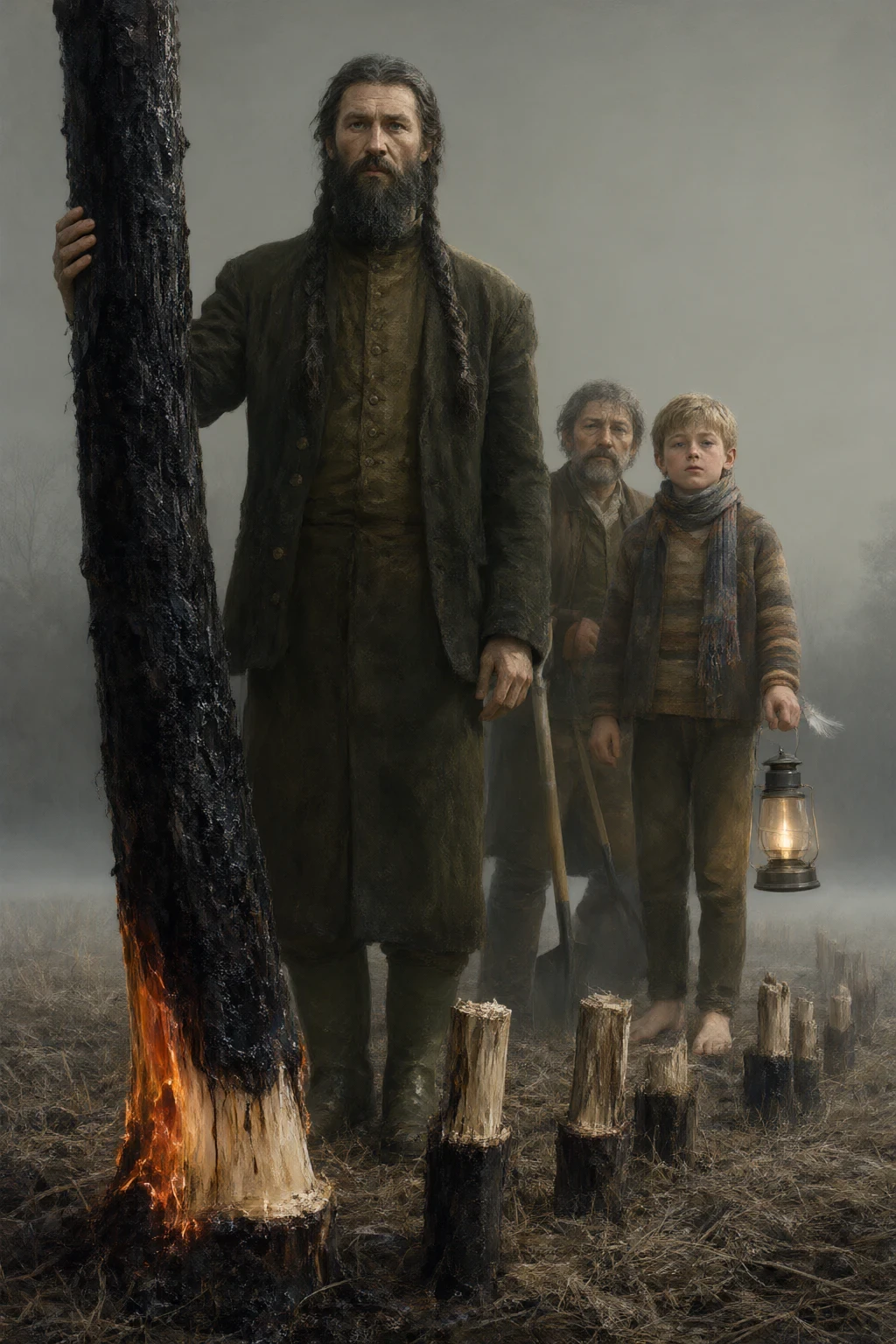
The last stem of the tenth row of Row Eleven came down at eleven minutes past seven on a Thursday morning with a sound like a gate being shut a long way off, and Fennim Sallowe said, aloud, before he touched it, “I am sorry. You have had eleven years of me and I have never once asked you how you were.” Then he put his hand flat on the bark, and the bark was warm on the north side where the sun had not got to it, and it was the last warm thing in the grove. Row Eleven is twenty-two acres of black sappy trees four miles north of Candleford, planted in hard lines on peat and cut, in the end, for the sap in them. Twenty-two acres, eleven rows, and the rows run east to west between the tapping trenches so that a man can bleed a whole line in one walk and the lead pipe can be laid straight to the spinning house without a bend. It smells, at felling time, like a cut apple and a hot lamp, and the smell is the smell of the north end for six weeks of every autumn, and there is a folk idea that a Candleford child can be found by following it.
Of the eleven rows there was one left, the last, and it was four hundred and eleven stems long, and it had been standing while he took the other ten. He had been twenty-two years in this grove. He had cut it once a year in the last week of the season and he had kept a book, and the book did not record trees, because Fennim Sallowe does not think in trees; the book recorded the trench he was working and the day and the number of barrowloads off the spigots, and every page of it for twenty-two years had a heading at the top, and the heading was the same, and the heading was: ROW ELEVEN. “It’s the last of this row,” said Teasel Sillet.
He was twelve and he was standing eight feet off the ground in the crotch of the second stem with a hand-lamp hooked to his wrist, and he had a striped wool scarf he had never once been seen without, and he had one bare foot, because it was November and the other one had a boot and the boot had been a birthday present from a person who had never once seen him wear shoes. He was a lamp-service runner, which is a child who carries a hand-lamp along a Row after dusk so that anyone walking behind can see the ground, and he was the youngest person on the Releasing Loft stairs, and he had come out with the early lamp because Fennim Sallowe had asked him to, and had not said why, and Teasel had not asked, which for Teasel was an act of almost physical restraint. “Four hundred and eleven stems standing in the spring,” said Fennim. “Thirty-one now. It was one thousand eight hundred and thirty the day I came.” “Nineteen sixty-six,” said Teasel. “You came in nineteen sixty-six. You told the loft. You said nineteen sixty-six and the eleventh of October and the fog was up.” “It was,” said Fennim Sallowe, “and you counted off three and got to four.”
Teasel said nothing to that, because there was nothing to say to it, and because the number had been right in his own book where he could not get at it, and he had been whispering numbers into the iron lamp-rail on the Loft stairs for six years so that they would be somewhere, and a number in your own book is a real number, and a number in a rail is not.
The news came up the lead pipe line at nine, on foot, by a boy on a bicycle who was told to say it once and then go home, and the words were: the spinning house is three hundred and forty barrowloads short and the house is out of stock on the eleventh and the loft wants to know what it is releasing on Wednesday. Three hundred and forty barrowloads. Fennim stood in the stubble with his saw down and did the sum, because he could not help doing the sum, because the sum was the only language he had ever been fluent in and because it had been the same sum every autumn for twenty-two years and it had never once come out the same way. A night of Candleford is nine thousand one hundred moths, and every moth carries a bobbin of nine coils, and every coil of living filament is spun from the ash of the last night’s spent moths, warmed with sap drawn from the feeder-groves, and the whole of that is a thing Candleford has known in its bones since before the gas main. Nine thousand one hundred bobbins is three thousand and forty barrowloads of sap in one night’s account, and the account is true, and column three of the release sheet has carried that number, in Orla Vessey’s unchanging hand, six nights a week, for two hundred years. Three hundred and forty short is not a flood. It is a Tuesday. “Bring me the last thirty-one and the sap off the ten rows I cut last week,” said Fennim Sallowe. “The pipe is still wet. I can have the full week’s cut in the vat by three.” “That’s the whole of it,” said the boy. “That’s all the sap there is.” “Yes,” said Fennim. “That is the whole of it.”
The northern spinning house is a long low brick shed with a copper roof gone green and a floor of brick that has been scrubbed so long it is dished in the middle, and at the north end of it there are six copper vats standing on a brick hearth, and on the hearth a fire that is never let out from the first week of the season to the last. The shed is the hottest place in the city for a hundred and eighty days a year and in November it is the only place a person can stand for ten minutes without a coat, and everyone who works in it has the same pale waxed look and the same scorched upper lip. Nell Ashgrove had asked to be shown into the spinning house once a month for two years, and had been refused once a month for two years, and had never once been told a reason, which she had come to understand was the guild’s way of saying the answer was no and the reason was that the answer was no. Ansel Reyne met her on the stair with the third line of the assay card in his hand. “That is a fault,” he said.
“It is the supply for a fault,” said Nell. “The Concord has to be shown where the filament comes from, because the Concord is going to be asked to decide something on Thursday and Ansel, you have said that a fault is void and that a moth is rendered, and the ash in that vat came out of the Rendering Yard on Monday in four sacks and it was the ash of moths that were void, and if the guild is going to spend the ash of its own mistakes twice a week then somebody ought to be made to look at it.” “That is not an argument.” “It is a reason,” said Nell Ashgrove, “and I have been on the count of three for two years and I have not yet been made to be anywhere at all, and if the Concord is going to decide about sap I would rather be the one who can count the coils than the one who has to be told.”
Here is what a coil is, and Nell Ashgrove had not been told, and had not guessed, and turned out to be the single most upsetting fact of her working life. The ash comes in from the Kilnfield in sacks, grey and fine and warm, and it is sifted twice, and what is left after sifting is fed into the vats a ladle at a time along with the sap, and the sap is what makes the warmth and the warmth is what makes the ash give up the last of the living coat, which is the only part of it that was ever alive, and the two of them together are stirred on the hearth for four hours until they stop being two things. “And that is where it dies,” said Nell. “That is where the alive part is killed.” “It is not killed,” said Sefa Ildry, who had run the northern house for nineteen years and had hands like a farrier. “It is finished. There is a difference and you will learn it or you will not, and either way you will not hear me say the other word for it in this shed.”
She took her round the frames. There were eleven of them turning, and on each there was a bobbin the shape of a short fat spool, and Nell Ashgrove had been building bobbins herself since she was thirteen, in the loft, in a tray, and she had never in her life seen the frame turn. “Nine passes,” said Sefa Ildry. “That is what nine means. It is not nine nights and it is not nine days. It is nine times round the frame at the same tension and the same gauge, and if the ninth is a hair under the first the bobbin is spoiled and you do not find out until the moth is in the air, and then it is four hours of somebody’s night wasted and eleven hundred moths of somebody’s ash, and the guild calls that a fault and it is not anybody’s fault, it is the ninth pass.” “And the plate,” said Nell, “with the nine holes. That is a gauge.” “That is a gauge,” said Sefa Ildry, “and it is the only honest object in this city, and it does one job, and it is the whole of what anybody has ever been able to say about this trade.” “How much Row does a bobbin do?” Sefa Ildry stopped the frame with her hand, which she should not have done, and looked at Nell Ashgrove for a while.
“Now there is a question,” she said, “and nobody has asked it in nineteen years, and I am not going to answer it either, and I will tell you why. A bobbin carries a certain weight of living coat and it lays that coat down at a certain rate, and the rate is set at the bench, and the bench is in the loft, and the girls at the bench are told a width. Nobody has ever written down the width in feet. It is not in the Pattern, because the Pattern is nine holes and a number. It is in the moth. And the moth is in the air at dusk over ground a person cannot reach, and by morning the coat is dead and the width has gone with it, and in the morning the book says how many went out, and it does not say how far they got or how much of a Row they covered, and there has never been a night, in a hundred and forty years, when anybody could have gone out at first grey with a rope and found out where the edge was.” The reel turned. Black silk came off it in a soft loose curve and lay across the warm oak bench like something spilled and alive. “You have just told me the width of a moth is a number in a girl’s head,” said Nell.
“I have told you the width of a moth is a number in a girl’s head,” said Sefa Ildry, “and that the girl was told it by a man who was told it by a man, and I have not slept properly about it since about 1919, and I have never said it, and I have said it now to a fifteen-year-old in my own shed because it is Thursday and because the whole thing is being talked about in Ledger Hall for the first time in two hundred years.” The Concord met at two on the Thursday in the long room at Ledger Hall, and the shutters were open a hand’s width, because Halvard Tace had ordered them opened, which no one could remember him doing in eleven years, and the weather outside was the cold blue-grey that comes off the fen at two in the afternoon in the last week of the season. He had his gloves on. The right one was cut from a different, browner leather than the left, and it had been that way for years. “Who paid for that?” he said, when Ansel put the two sacks on the table. Nobody answered, and he did not repeat it, which for Halvard Tace was an answer. “I will pay for this,” said Mave Ollick.
She was the ash-sifter at the Rendering Yard and had been for thirty-one years, a small hard woman of about sixty with a burn on the inside of her left wrist from a kiln door and a piece of gauze round it that she had never once had changed. She had come in from the Kilnfield that morning with two sacks of ash and a shovel and she had put the ash on the Concord table in Ledger Hall, which is not done, and which she had done anyway, because she was the only person in Candleford who had spent her whole life standing between the two halves of this and had never been asked to put them in the same room. “There,” she said. “That is Monday’s. That is the ash off four sacks of moths from the Sixth district, and every one of those moths flew its four hours and came to rest and was collected and brought to me in a sack on Monday, and that is the whole of what there is of them, and I sift it and I send it up to the house and it goes in the vat. That is what a moth is. That is all a moth ever is. It is a thing that makes a noise and then it is a sack.”
The room was very quiet. Beyond the shutters a barge horn went off on the canal and went on going for a while. “Thirty-one,” said Ansel Reyne. They brought the sap up in a barrow, and it went in on the second sack, and it was dark and slow and the colour of a bottle held up to a window, and it smelled exactly as the grove had smelled that morning, and for a moment the long room was the north end of the city and not the middle of it. Mave Ollick put two ladlefuls of ash into a plain china bowl that had come from somewhere in a kitchen, and the spender of the Concord’s money had sent for a proper one, and the two ladlefuls sat in it grey and did nothing at all until somebody found a lamp and held it low over the bowl, and then, in about four minutes, the surface of the ash began to darken at the edges. “There,” said Mave Ollick. “Now you can see the seam. That is where the coat comes off the ash. It will be a spool of black silk in an hour and a half and I have watched it four thousand times and I have never once been in a room where anybody wanted to know.”
Halvard Tace took off the left glove and kept the right one on, and no one in the room commented on it, and it was the single most remarkable thing that happened in the next hour. “Then let me put the plan on the table,” he said, “because I have had one since the boy on the bicycle and it is not the plan anybody in this room is expecting, and one of you is going to object to it and I would rather the objection came before the vote than after.” He put his hand flat on the cream sheet in the middle of the table, which nobody was permitted to do. “We cut the last of Row Eleven. That is not in dispute. What is in dispute is what we do with the fact that it is not enough. We are six hundred and eleven barrowloads into the vats and we were nine hundred short, and there is no more sap in the northern line this side of the Sallow, and the southern groves are thinner and two days away by barge, so the season ends. Not fails: ends. On the last night of the season we will have nothing to spin, and the loft will turn out two thousand nine hundred moths instead of nine thousand one hundred, and the Fifteenth will be one district among thirty that go unfed, and a Row that goes unfed for a year is a year and not a tree, and I have said that already and I am not going to say it again.” “Then what is the plan,” said Orla Vessey.
“Three thousand, not nine thousand one hundred. Every night from tonight to the last night we have, and the Fifteenth unfed, and the Second unfed, and a district chosen each week off the second wind where the seed has never in forty years reached the weight the weighing house records, so that the falling is not in the arithmetic that anybody reads.” He took his right glove off too, and put both of them in his pocket, which nobody in the long room had ever seen. “And then the winter.” “The winter,” said Ansel Reyne. “The moth does not care about the calendar. A moth will fly between the first lamp and the first grey in still air at ninety-four degrees, and Candleford has two thousand one hundred hours of that between the last week of the season and the last week of February, and the guild has used about four hundred of them in two hundred years, and I have looked it up, and it is on the fourth page of the flying calendar, and nobody has looked at the fourth page since my predecessor, who was a man who did not read the second column either.” “That is a winter release,” said Ansel Reyne.
“That is a winter release,” said Halvard Tace, “and I know exactly what I am asking, and I will say it plainly. Every machine in this city was designed around a September. The nine-coil bobbin is a September instrument. The Rows fruit in the autumn. The whole of the Concord’s two centuries is an argument that what a moth does, it does in the autumn, and a release made in December is a release made against a standard that does not exist, and if it does not work, it does not work quietly, because a Row that has been fed in the wrong month is a Row that will not know what to do, and four hundred trees in the Fifteenth will sit there through a winter being fed at the wrong time, and we will not be able to say whether that is nothing or that is everything.” “Then do not do it,” said Nell Ashgrove.
“No,” said Halvard Tace. “Do not do it, and fly three thousand a night for eleven weeks, and lose a year off thirty districts, and do not do it again next year, because the sap will be gone next year too. My plan has a moth in it and four hundred trees and a winter, and every part of it is a thing I cannot defend, and I would rather be recorded having tried that than recorded having done the safe thing for the fourth time in a season.” Fennim Sallowe had been standing at the end of the table through all of it, with his green boots leaving a print on the Ledger Hall floor that he would apologise for later and that nobody would ever think about again. “A feeder-grove cutting will not stand a hard frost, and the north end will have two hard frosts before Candleford, and the sap is in the vats and the vats are stone, and the stone is cold, and I will have the frost out of it if the fire burns Thursday night and Friday and Saturday and I will keep a man on that hearth. The Pale Hundreds will stand any winter you like. That is the difference between them. That is the only difference between them, and I have spent twenty-two years being the man who makes that difference with a saw, and I am telling you that if you are going to lean on the Pale Hundreds in February, you may lean on them, because they have stood in worse than February.”
Fennim Sallowe had not said any of it, because none of it was the arithmetic he had come for. “Nine hundred barrowloads is four hundred and fifty stems,” he said. “I have three hundred and eighty. So it is not enough. I want that said out loud in this room before anybody decides anything, because in about four days every man in Candleford who can hold an axe is going to be told there is one more night in the grove, and he is not going to be a Candleford man, he is going to be a man who has been sent, and I would like it on the record that the grove was not the answer even when it was whole.” “Thank you,” said Halvard Tace, in a voice nobody had ever heard him use. “But that is not the arithmetic I came up here for.” Fennim put his hand on the table. He apologised to the table first, under his breath, which he did to everything. “You are all thinking that we cut the grove and then plant it again. That is what is in Halvard Tace’s head and it is not said yet and I can see it in the glove. Nine years. A feeder-grove cutting wants nine years before the spigots will carry, and it is nine years of nothing, and in nine years you would have needed four thousand and fifty stems.” “Nine years is a season and a half,” said Ansel Reyne. “It is inside a career.” “It is inside a career,” said Fennim Sallowe. “It is not inside a rolling stock of bobbins. The guild does not hold nine years of thread. The guild holds eleven weeks.”
There was a silence on that which was the first silence in the long room that afternoon that was not about arithmetic. Then Fennim said: “I have kept the book.” “A book,” said Halvard Tace. “Twenty-two years. Every cutting, the trench, the day, the barrowloads.” He did not take it out; it was in the cottage four miles north, in a tin. “And I have planted a row of cuttings in the north corner every winter since nineteen sixty-seven, because that is what a man does who has read a book. Twenty-two cuttings. Eleven of the last twelve did not take. They burned in the peat. The ones that took, the deer took. In twenty-two years I have raised nine feeder-grove trees from my own cuttings and four of them are still standing and two of those four are the wrong shape to tap and one of the other two is forty and the last one is not forty, it is nine, and I put it in the ground in the spring and it is nine years old this month and its spigots carried a barrowload and a half in October.” “Six in twenty-two,” said Orla Vessey.
“Six in twenty-two,” said Fennim Sallowe, “and eleven burned, and that is the number, and I have never put the number anywhere that anybody would look at it, because I am the necessary man and the necessary man does not publish. I have been the necessary man for twenty-two years and the necessary man has been spending a thing that does not grow back on the scale the city spends it, and I did not tell you, and I am telling you now, and you may have it in the book.” The Concord sat for an hour and forty minutes and did what the Concord does, which is to establish the shape of the problem and then to establish, in the same session, the shape of the thing that is not the problem. They established that the standing answer is to fly no fly: to designate a district, cover it partially, and let the ground that will not notice go a season without. They established that the Fifteenth would lose a year and not a tree. They established all of that in an hour and forty minutes, and then they adjourned, because Halvard Tace had called it and the next item on the paper was the price of lamp oil.
The felling of the last row took the whole of Friday and most of Saturday. Fennim Sallowe apologised to every stem. That is the thing about him, and it is the thing that makes people uncomfortable in a room, and it is not affectation; he has done it since he was nineteen and he does it before he puts a hand on the wood, and he says it in the ordinary voice of a man saying the time. On Friday he said it one hundred and one times. Teasel Sillet counted, because Teasel could not help counting, and whispered every one of them into the iron of his lamp-frame where the number went somewhere, and by Saturday the frame had a hundred and forty-one in it and Teasel had stopped finding it funny and had begun to whisper them under his breath instead.
The men from the barges came at four in the afternoon of the Saturday and there were twenty-two of them and none of them were from the north end, and by the time the light went at half past four they had a fire going in the middle of the grove that could be seen from the Sounding Bridge, which is a thing that happens perhaps twice in a life, and the men of the Lamp Service kept the Rows lit behind them and the whole of the north end was a low orange country with black lines standing up out of it. Mave Ollick came out at eight to take the ash off the hearth, because the hearth had to be swept and cooled before Monday, and she stood in the stubble in front of the fire with her gauze and looked at eleven rows of stumps going away west, and she said to Fennim Sallowe: “Twenty-two years.” “Twenty-two years,” he agreed. “I sift what you grow,” she said, “and you grow what I sift, and neither of us has ever once been asked to look at the other end of the thread.” “No,” said Fennim Sallowe. “We have not.”
On the Sunday at dusk Teasel Sillet came down the Loft stairs with his hand-lamp and a number, and stopped at the bottom, which he does not do. “Nine thousand one hundred,” he said, to the iron rail. “Off the cradle. And they are all to Pattern, Ansel says, and the bobbin stock is there, and we are flying on the count of three.” He counted. “One — two — three,” he said, which was the first time in six years that Teasel Sillet had counted correctly out loud, and Nell Ashgrove, who was standing in the loft doorway with her scarf pulled up, heard it and did not say anything about it, and thought about the six hundred and eleven barrowloads that had gone into the vats that weekend and where they had gone, and did not say anything about that either, and went down to her cradle.
The Fifteenth district was not covered. That is what the order said, and the order was read out on the Loft stair by Halvard Tace in person with his gloves off, which he never did, and the Loft had four hundred and eleven people on it and every one of them had to hear it and every one of them understood exactly what they were being told, and about two hundred of them did not like it, and Halvard let them not like it, and said: “The Fifteenth is not covered. That is the whole of the order. I am not going to explain it, because an explanation is a thing I can be asked to defend, and this is a thing I am not going to be able to defend, and I would rather you had it undefended. And it is the last night the city can turn a full cradle, because tonight is the night the grove paid for. From tomorrow the loft turns three thousand, and one district a week goes without, chosen off the second wind where the seed has never in forty years reached the weight the weighing house records. I have signed that as well. I have not had time to explain it and I am not going to try.” Then the doors opened, and the lamp-bell rang over the water, and nine thousand one hundred moths went out, and the room became absurdly quiet, and you could hear the wings for two full minutes after the doors closed.
The Fifteenth on the Tuesday morning was a Row of four hundred and nine trees that had not been fed, and that is the whole of the report, and it was made by a Row clerk called Osme Daintry who had been the Fifteenth’s clerk for nineteen years and who walked it in four hours in a cold grey rain with a hand-lamp he did not need at ten in the morning. What he found was this. Nothing, in the sense that a clerk can write nothing. The trees stood. The bark was the colour bark is in November. There was no seed on the ground, which was the first thing he had expected and the thing he had come to be disappointed by, because a week of wind on a Row will take the seed off the ground whatever the Row is doing. There was no difference in the colour of the bark, and no difference in the leaf, and there was no difference in a tree. “They look fed,” he said, to Teasel Sillet, who had come out with the day lamp because the Lamp Service runs all day in the last week of the season and Teasel had the Fifteenth. “They are not fed,” said Teasel.
“That is not what I mean and you know it is not what I mean,” said Osme Daintry, and stopped, and stood in the middle of Row Fifteen in the rain, and then said: “Twenty-two years I have walked this and I could tell you in a minute. I could not have told you how. And today I have walked it and I cannot tell you, and there is nothing to see, and I have never in my life walked a Row and found nothing to see, and I do not know what this is and I have written it down as NIL.” The trouble with NIL was that it is a clerk’s word for a tally that came to nothing, and this was not a tally that came to nothing. This was four hundred and nine trees which had gone through an autumn in the ordinary way and had not been spoken to, and there is not in the whole of Candleford a single set of records — not one — of what a tree does when nobody has done anything to it, because in two hundred years of the Pale Hundreds there has never once been a Row that the guild did nothing to, and every number the city owns is a number taken out of a machine that was working, and there is no number anywhere for the silence of the machine.
“The Fifteenth is the only experiment this city has ever run,” said Ansel Reyne, on the Loft stairs that evening, “and we did not design it and we did not control it and we have four hundred and nine trees in it and no question to put to them, and in the spring we will walk out there and see what came back, and whichever way it comes back, we will not be able to say whether it came back because they were starved or in spite of being starved, and that is not a thing a city can afford to do again.” “Then next time,” said Nell Ashgrove, “design it.”
Orla Vessey wrote the line on the Sunday at eleven, alone, in the long room over the canal, with the shutters shut and one lamp going. The sheet is ruled in seven columns and everybody in Candleford knows the shape of it by heart. One is the plantation. Two is the number released. Three is the sap drawn from the feeder-groves, in barrowloads. Four is the seed returned, in bushels, weighed in the autumn. Five is the hour. Six is the name of the releasing party. Seven is the weather, and it has its own small private language, of which the guild’s favourite is NIGHT: NO FLY, RAIN. She had filled in five of those seven for seventeen years and the other two as well, in the same hand, on the same night, and had never once been asked about either. Tonight the sap in column three was six hundred and eleven, which was the highest number in the history of the book, and she wrote it, and the ink sat on the cream and shone for a second before it went in. And then she came to the Fifteenth, and the Fifteenth had no line.
Not a blank: there is a difference, and she is the only person in Candleford who could state the difference and she stated it aloud to the empty room. A blank means the line has not been written. A zero means a number was required and the number was nothing. The Fifteenth had not been released and had not been omitted; it had been, on the order of Halvard Tace, factor of the Concord, read on the Loft stair in person with his gloves off, not covered, and that is a decision, and a decision is not a value. She had a form in front of her and the form had seven columns and every one of them wanted a number, a name or a mark out of the guild’s weather-book, and there was nowhere on the whole of forty thousand lines for a line to say what it was for. So Orla Vessey wrote the zero, because a zero is honest, and then she ruled a light line down the margin of the sheet, which is not done, and wrote in the margin, in the hand that has not changed since she was twenty-two: NIL BY ORDER.
And then she sat with her hands flat on the desk for a while, in a room with forty thousand glazed presses receding on both sides of her, and the fog coming up the drain outside, and understood that she had just written, in the first year of her own hand, the first line in the history of the release ledger that was not a record of something that had happened but a statement of why something had been allowed not to happen, and that there was no column for it, and that she had ruled a margin, and that a margin is the part of a page you are allowed to write in when the form has not thought of you yet. “Six hundred and eleven,” she said out loud, to nobody, correcting the number in the room, because that is what she did, and because the room was empty, and because for the first time in seventeen years the correction was not in service of a line.