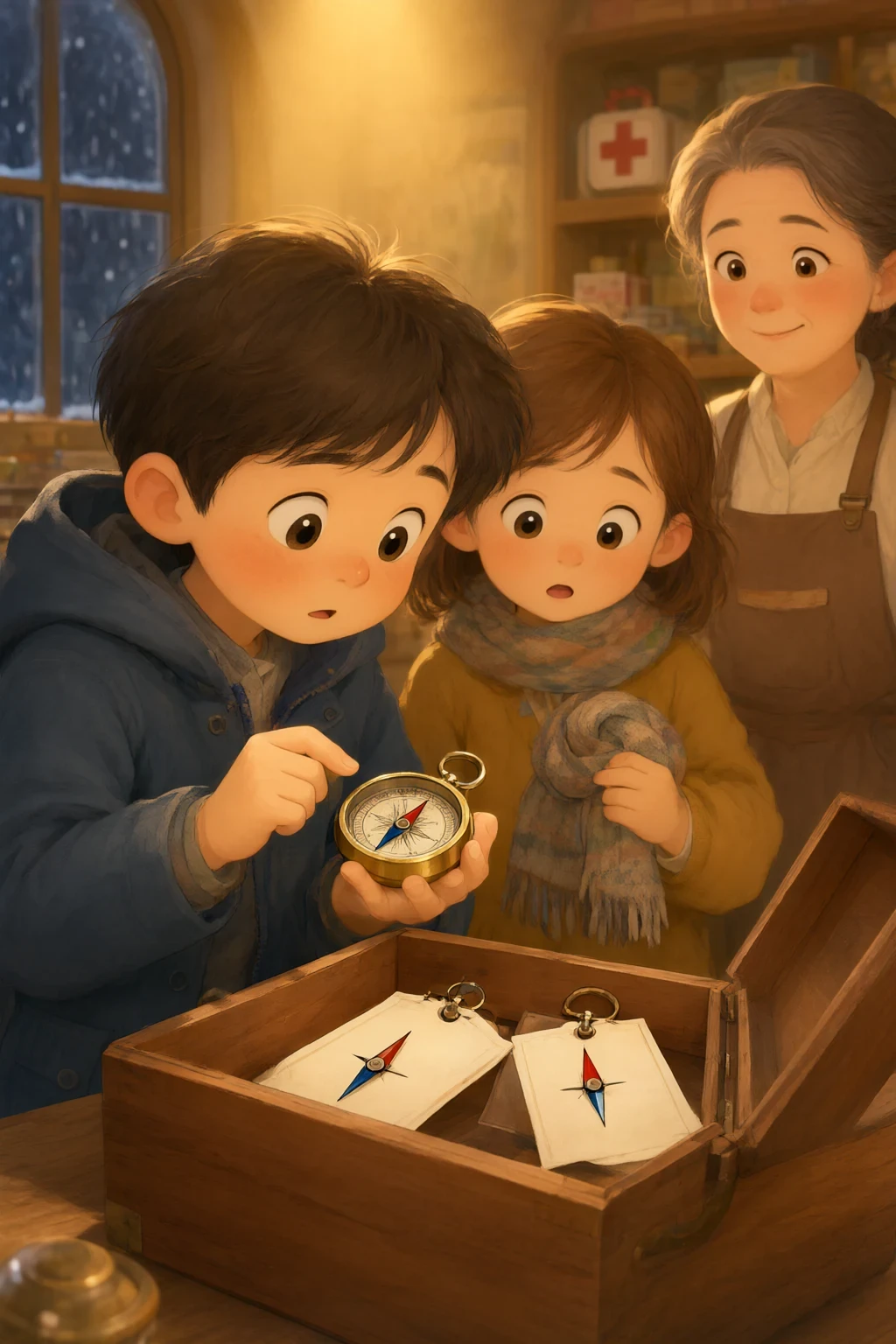
The old lost-and-found box sat under the stairs at Juniper School. It had a dented blue lid, two little keyholes, and a paper label that read: TWO THINGS MAY BE TRUE.
Jo found it first. She was looking for a lost water bottle when the lid clicked open by itself. Inside lay a brass compass with a cracked glass window. The needle pointed toward the door, though the basement had no windows. Jo’s fingers stopped on the rim. A silver crescent had been scratched into the brass.
Her father had shown her a compass just like it. He had called it his walking compass and kept it in the pocket of his blue coat. For three days, Father had been in bed with a fever. He needed medicine from the town clinic, and the bus fare was in the jar on the kitchen shelf.
Jo had been afraid to ask for more. Before she could lift the compass, Nell came around the stairs. She dropped her school bag and pointed. “That thread is mine,” she said.
A strand of red yarn was wound around the compass stem. Nell touched it, then pulled at the end of her red scarf. The same color, the same twist. She bit her lip. “My grandmother lent this compass to your father,” Nell said. “She said it would help him find the hill clinic. He must have dropped it.”
Jo’s stomach clenched. Father had not given permission to sell the brass, and the red thread still pointed to Nell’s family. Even if he said yes, she would have to ask who owned the compass before touching it.
The box gave a soft click. A narrow slot opened in its lid, and two paper tags slid out. One said SILVER CRESCENT. The other said RED THREAD. The box chimed, “Two true things. One answer still hiding.”
They carried the compass to the school office, where Ms. Bram kept the lost-and-found register. Jo told what she knew: the crescent and her father’s illness. She did not claim the compass was hers.
Nell said the red thread had been cut from her scarf when she was six and tied by her grandmother. She did not know whether it had been replaced. Ms. Bram did not reach for the compass. “A clue is a clue,” she said. “It does not open someone else’s pocket.”
She drew two columns. Beneath Jo’s and Nell’s names, she wrote what was known, what was missing, and who might remember. Then she called for help.
They asked the caretaker, the office clerk, and the children near the river. One remembered a red scarf. Another saw Father walking toward the clinic with one hand on the wall. A delivery driver saw an old woman search the roadside, but could not remember her name. Each answer added a piece, and none fit perfectly.
Jo thought of the medicine jar. Nell touched the thread, afraid of being called a thief. Ms. Bram recorded both statements and covered the compass with a clear glass cup. “We will not announce an owner while the evidence is still speaking,” she said. “That protects both families.”
That afternoon, Jo went home and found her father awake. She showed him a charcoal drawing of the crescent. He blinked at it. “Yes,” he whispered. “I had one. My sister gave it to me before she went to the sea. I must have lost it near the clinic.”
“Could we sell the brass for your medicine?” Jo asked. “Only if it is truly ours.” Father shook his head. “Not until we ask the Vales. And not by taking a thing you have not been given. I need that medicine, Jo, but I will not buy it with someone else’s loss.”
Jo’s eyes burned. “Nell’s grandmother lent it to you.” Father nodded. “I borrowed it. I should have returned it. Tell her I am sorry, not only for the compass, but for forgetting.” The next morning, Nell came with her grandmother, Mrs. Vale. Mrs. Vale looked at the red thread and then at Jo.
“He did borrow it,” she said. “I tied the thread so he would remember. The blue crescent is my husband’s mark. The compass has been in our family for years.”
The two pieces met at last. The compass had passed from the Vale family to Jo’s father and back into the school’s keeping. Neither child had lied about the evidence they had found.
Ms. Bram made a careful record. Mrs. Vale accepted the compass, but she did not take it home at once. She placed it in the open box beside a note naming both families. Jo’s father would need it on his next clinic trip, and the box agreed to keep the compass safely until then.
On the next market day, Jo and Nell met beside the bus stop. Jo had a small envelope with the fare for Father’s medicine, made from coins the neighbors had gathered without asking questions about his illness. Nell carried a thermos of ginger tea and a cloth for wrapping the compass.
They opened the box together. The silver crescent and red thread rested on the same velvet bed, no longer arguing who should carry the story alone. The lid stayed open while Father’s bus came. Mrs. Vale placed the compass in his hands. He thanked the children, then carefully offered it to Nell too. She shook her head.
“Keep it for the road,” she said. “Bring it back when you return.” Father nodded. The two names on the box remained visible beneath the lid. The compass had one more journey to make, and Jo and Nell had learned to let a question stay open until every voice in it could be heard.