Hanne had run water for Master Ortlieb's forge since she was nine years old, and by seventeen she could tell the weight of a thing by looking at it, and Master Ortlieb had stopped correcting her figures, which was the only promotion the trade offered anybody. The valley had one mountain in it and the mountain was flat on top. It stood at the head of the valley, four hundred paces long, three hundred wide, and ninety high, and it had a rim of stones along the crest like a table edge, and the people of the valley called it the Table and had never once asked it a question, because it had always been there and it was not a thing you asked things.
There had been two others in the valley's history. The lower one had gone down in a single week in the year of the great thaw, with a dwarf under it, and what was left of that ground was the field where the sheep were, and the field had a name, and the name was a word for a thing that had been taken away in one piece. This was the last table, and everybody in the valley would have said so, and nobody in the valley had ever put the two facts side by side in his head. Under the valley, where the water came out of the ground sour and warm, there were bog fires that had burned since before anyone could read, and there was ore in the hillside, and there was a forge. The forge had made iron for the valley for two hundred years, and in that time the mountain had gone up.
Nobody in the valley thought of the mountain as the mountain. They thought of it as rock that had always been north of them. But Hanne had carried water to the tip heap since she was nine, and the tip heap was where the smith threw the dross, the burnt-up stuff that could not be used and could not be buried, and the tip heap had a different colour from the mountain, and a different smell, and it had been growing all her life at the rate of a wagonload a week.
The three sisters kept a wheel in the mill house and were the largest customers in the valley, and the oldest wanted a wheel with iron tyres, and the second wanted a door with a hinge that would not sag, and the third wanted a cauldron big enough to hold a pig, and they argued about it in the yard the way the three of them had argued about everything since they were small. "All three," said the middle one. "And tell Ortlieb we will pay when the iron is up." The youngest, Grete, who was seventeen and small and who was the only one of them who ever went up the tip heap, said nothing at all, which was how she usually made herself useful. "Irmgard's people were in the hall on Tuesday," she said, to the wheel, later. "She wants an iron chair." "An iron chair," said the eldest.
"An iron chair at the long table, in the middle, where a man cannot be got up from in a hurry, and where a man cannot be robbed of because it is nailed down." Grete went on winding. "She has asked for it in writing. It is signed. It wants a bar of iron, a good one, and there is no bar of iron in this valley that is not already promised to somebody."
There was a bar of iron, in the sense that there was iron in the hill and a forge that could pull it out of the hill, but the last three bars of good iron had gone up the valley in the autumn, one to the Baron for his gate, one to the Abbot for his bell, and one to the King's own smith in the city, and none of them would hear of returning it, and Master Ortlieb, who was sixty-one and had a bad shoulder and no son, had said the thing that Hanne had not been able to forget. "There is no bar in this valley," he said, "that is not a promise somebody else has already made. And at the foot of the hill there is a hole where the ore comes out of, and it has been closed, and I am fifty-nine years old and I have never seen it open." "Where does the ore come from, Master?" "From under the mountain," said Ortlieb.
He said it the way you say the name of a man who owes you money. Hanne waited. Ortlieb worked the bellows with his good shoulder and did not say anything else for a while, and then, because he was a decent man in an impossible position, he said the rest of it. "Go and find somebody who can make the chair. That is your errand. And do not go asking the Baron."
She went to the Baron first anyway, because she was seventeen. The Baron's steward was a small dry man with a very clean collar who took the message and read it and put it face down on the desk. "Your master wants the bar that the Baron has bought," he said. "My master wants a bar that is not spoken for. He has offered credit at the yearly rate against the whole of next year's work." "The Baron does not require an iron chair. The Baron's gate is iron. The Baron is an excellent customer and has never once been disappointed in a thing, and the Baron would be glad to know that a smith in the valley has begun to sell the same bar twice." He pushed the paper away. "Tell him the bar is spoken for." That left the Abbot, who was a worse man and more honest. The Abbot received her in a cold room with a good fire in it and asked what the valley wanted. "An iron chair for Irmgard."
"Ah," said the Abbot. "Then you have come to the right house. I have a bar. It came down in the autumn with a great deal of snow still on it. It is in my store, and it is iron, and it is the right weight, and I will give it to you for the price of the bell, which has to be recast, and the price of the bell is more than the chair is worth, and the Baron's good lady will be delighted to hear the terms of the reverend."
The third sister came to the mill house at dusk and sat on the step with her boots off. "Heinrich has been out," she said. "Out where." "Out of the mountain, as far as the shoulder. He comes out when the water is low and the slag is cold, and he walks down to the water and stands in it up to the knee, and Grete and I have watched him from the ridge and we have never once got closer than the scree." She pulled at a splinter. "He is not a prisoner down there. He is a man doing a job, and the job is standing under a mountain, and it goes on for as long as the heap goes on growing." "Growing?"
"Every time the forge makes a bar, the heap gets a wagonload bigger. That is the trade, Hanne. Iron comes out of the hill at one end and the waste goes on the mountain at the other end, and the waste is heavier than the iron, and the mountain is the waste. Four hundred years of it. The rock under it is a hundred yards down." She looked at her hands. "That is what it is. It is not a mountain. It is a tip. And there is a dwarf in it holding it up, and the reason the hole in the hill is shut is that the hole is under the mountain, and if it is opened the mountain settles." "You have told this to your father." "I have told it to my father," said the middle sister, "and he has told it to the Baron, and the Baron's steward has told it to a man in the city who writes for a paper. It was in the paper. It said that a girl of the mill house says the mountain is made of rubbish. My father did not contradict him."
She went up to the mountain in the second week of the flood month, on a day when the heap was cold, which was the only day anything down there was safe. The path was a goat path made by two hundred years of dwarfs, and it went up the scree and along the rim and then down onto the flat top, which was not flat but slightly dished in the middle, the way a heap that has been standing for four centuries is dished. The stones underfoot were not stones. They were clinker: grey, vesicular, light, ringing when you struck them, and full of little holes where the gas had gone. At the centre there was a ring of flat slabs laid in a circle, and inside the ring the ground gave. Down. Not far. A chamber, and in the chamber a man.
He was standing with his arms up, both hands flat on the underside of something that was not visible from where Hanne stood, and he was a small man, grey from the thigh up, with a face like a man who has been holding something for a very long time and has had the entire interior of his attention turned in that direction. His boots were in a channel of standing water two inches deep. He was not straining. That was the thing that took her breath. He was not straining at all; he was simply there, the way a door is there. "The hole is shut," he said, without turning round. "Go away, and do not open the hole." "I was told to ask you for an iron chair." The dwarf laughed. It was not a good laugh; it was the noise a man makes when the funniest thing of the century happens to him. "Then you have come nine miles for a chair," he said. "Sit down, girl, and do not put your hand on the ring, and I will tell you what the chair is worth."
He talked for an hour with his hands still up, and he talked the way a man reads aloud out of a book he has read every day for four hundred years. "When your forefathers cut the first gallery they took iron out of the rock and they had nowhere to put what they could not use, so they put it on the north side, and the north side began to grow. And when it grew, we came out of the rock and we did the only thing anybody can do with a heap that will not stop growing, which is to stand under it. One of us, or two, or nine, or four hundred, and it makes no difference what the number is, the number is not the difficulty. The difficulty is that the heap gets an extra wagonload every time a man in the valley makes a bar, and there is a man in the valley who makes four bars a week, and he will make five next year." "So the debt is the waste."
"The debt is the waste," said Heinrich. "Not the iron. Nobody ever owed anything for the iron. The iron was the good part and it went away up the valley on somebody's cart and we let it go, because what is kept is the mountain and what is in the mountain is the debt, and the whole of the debt is weight. There is no other figure in it. There is no rate, there is no term, there is no year. There is a weight, and it is on me, and it has been put on me for four hundred and two years." "And when the forge shuts."
"Then it stops growing," he said. "Then it is only a settling. It does not fall. Nothing here falls. It settles, and it settles about a hand's breadth in a year, and a hand's breadth a year on four hundred paces is a great deal of valley, and the valley is standing on it, and the valley's ground is the mountain, and that is not a figure of speech. Take a spade to the back wall of your churchyard and you will come up with clinker in it before you have gone four feet."
The key is a hard thing to be told and harder to carry down a mountain. You cannot pay off a weight with money. You cannot pay it with good deeds. You can only take metal out of the valley and put it back on the heap, because the heap is made of metal that the valley has refused to use, and the only way to make the heap smaller is to make less iron, and the only way to make the heap smaller all at once is to unmake the valley. Master Ortlieb heard it and did not laugh, which she had expected. He sat down on the anvil, which he was not supposed to do, and put his good hand flat on the cold iron and thought about it for a long time.
"Two hundred years," he said at last. "Two hundred years of bars, and every bar in this valley is iron, and the valley is a hundred and forty houses with iron in every one of them from the hinge to the bucket, and the bar that Irmgard has written for is the one that finishes it." "Not finishes it. Sizes it. It puts a last piece of iron on a heap that is four hundred years high, and the heap goes where the heap goes, and that is the whole of what a chair is." "Yes," said Ortlieb. "I have been a smith for forty years and you have just told me my trade is a way of drowning a man, and I would like you to be very sure." "I am sure. I stood in the water with him and he did not move his hands."
The Baron refused on a Thursday, in a hall, in front of eleven people, and the reason the Baron gave was not greed and Hanne wrote it down in the book exactly as it was given, because that is what the book is for. The Baron said: the iron in my gates is the Baron's, and the Baron paid for it, and it stands in the world doing the Baron's work, and if the Baron gives it up then two hundred years of Baron's money will be in a heap in the north, and the next Baron will say to his son, your great-grandfather gave his gates to a dwarf, and there will be nothing on the gates to say that it was ever true. The Abbot refused on the Friday and did not give a reason, and the bell stayed in his belfry.
The middle sister gave up her wheel-tyres herself, and the eldest gave up the cauldron, and it was the Grete who got the King's own smith to send back the third bar, which she did by walking to the city and back in two days, and by standing in a doorway until somebody came out, and by saying, when he asked what she wanted, only: "It is the wrong valley."
They began in the smithy, because Master Ortlieb said that if the valley was going to be taken apart then it would be taken apart in the right order. He took the tools out of his own rack first and stood them in the yard in a row where the whole valley could walk past and look at them: twenty-four files, the great hammer, the top and bottom swages, the small trunnions, the crowbar, the vise, the two pairs of tongs, the riffle file, the scale and the set of weights that had not been touched since his father bought them. "You are taking the weights," said Hanne. "I am taking the weights," he said, "because a man who cannot weigh a thing is not a smith, and I am going to want to be able to weigh things. Take them up last. I want everything else in the valley on the heap before the weights come off my wall."
Then the houses. A door is two hinges and a bar and a latch. A bed is a hoop and ten nails and a sheet. A bucket is a hoop and a handle. A cart is a great deal more. The mill house gave up its shaft, the millers' shoe, its screen wire, and the three sisters carried it to the road themselves, all three of them, without being asked, in a wheelbarrow, and the youngest cried on the way up and kept going.
They worked for five weeks. It was not noble work. It was the work of taking a thing apart with the right tool so that the taking apart does not spoil the metal, and the whole valley had to be shown the difference between those two things, and the ones who would not learn it had their iron taken from them cold and unmeltable, and it went up the mountain road in pieces to be broken by hand, and the finest of it was done by the women and by Grete and by Hanne, on their knees, on the flat top of the Table, in the cold, for nine days.
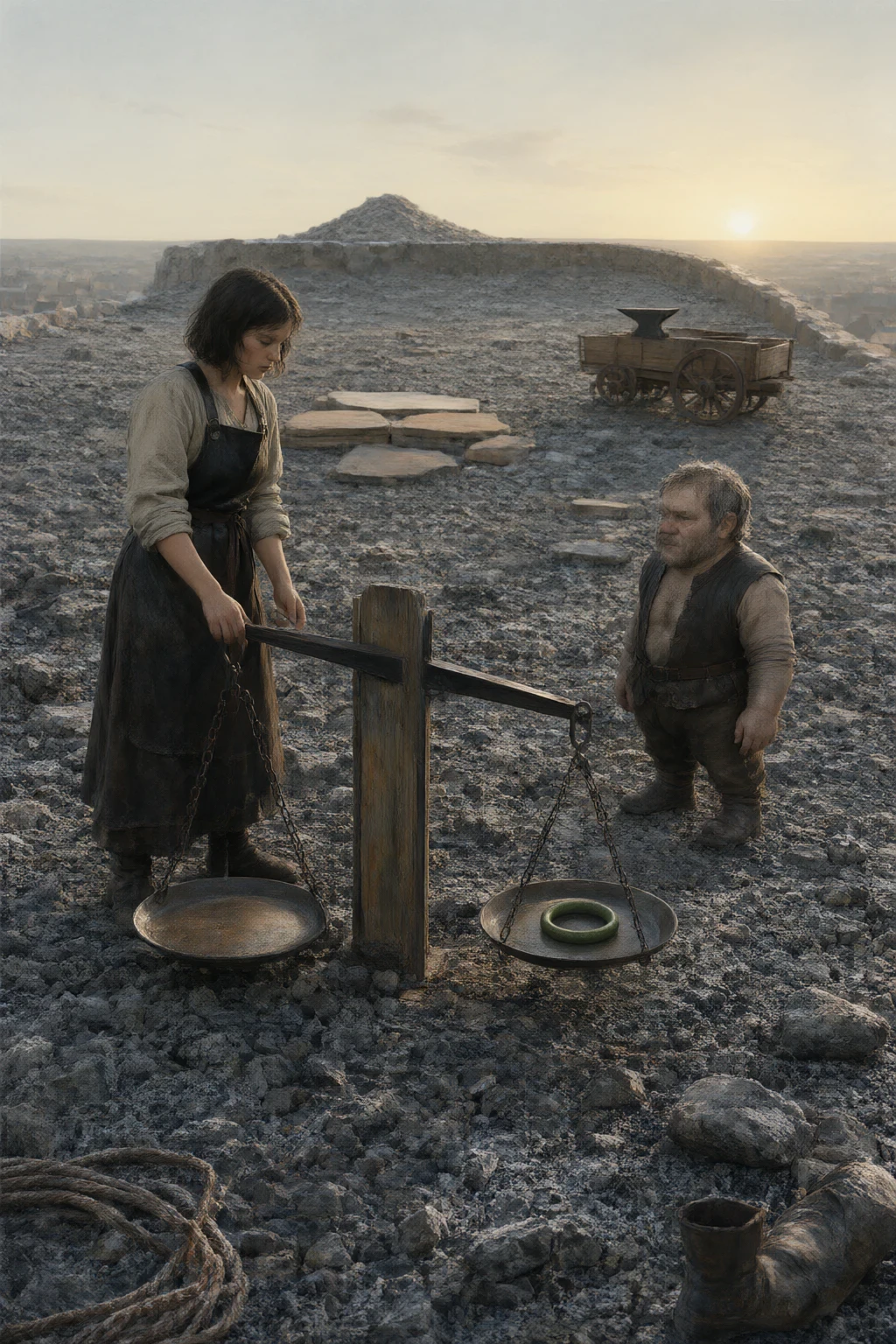
The last load went up on a Thursday, because Thursday was the day the account came due. Master Ortlieb carried the anvil up himself, on a hand-barrow, with Hanne at the other end, and nobody else was allowed within ten paces of it, which was his instruction and not hers. They set it on the flat top beside the ring of flat slabs, and Hanne brought out the scale and the set of weights, the last things off the smithy wall, and set up the beam against a post the dwarfs had cut for the purpose some time before anybody had thought of needing it.
The account was in a book the dwarfs had kept for four hundred years, and the entries were in weight and nothing else, and the last line in it, in Heinrich's own hand, said that the account is to be closed on the ninth day of the flood month, and that the last weight is to be a thing which is not a tool and not a building and not a thing anybody is going to miss. Irmgard's ring was that weight. It was a plain iron ring, a little green in the hollow, and it weighed a quarter of a pound less than the account wanted, and Hanne found it out at the second weighing and had to go back down the mountain for something else, and there was nothing left in the smithy, so she took a nail out of the smoke-house door with the pull of the tongs, and carried it up in her fist, and it went on the pan, and the beam came level, and it stayed level for the whole count of forty.
Then Heinrich came out of the mountain for the last time. He came up through the ring of slabs and stood in the open for the first time in four hundred and two years, and he did not look at the valley, and he did not look at the sky, which is what Hanne had expected him to do. He looked at the heap. He walked to the edge of it, and he put both hands on it, the same hands, and he looked down at them for a long time, and then he sat down on the flat top of the mountain in the sun with his back against nothing, because there was nothing there to sit against, and it took him a moment to discover that, and Hanne watched a four-hundred-year-old habit die in his shoulders. The heap settled.
It did not fall. It came down four inches over the whole of its four hundred paces in a single afternoon, like a loaf that has been taken out of the oven a minute early, and the sound it made going down was a long soft grinding that the whole valley heard and none of them was afraid of, and then it stopped, and the birds came back onto the rim within the hour. What it took was the ground. There had never been any ground under the village end of the valley; there had only been heap, packed, for four hundred years. When the heap came down four inches it went down four inches everywhere, and the ground went with it, and the back wall of the smithy and nine feet of the churchyard and the corner of the Kranz house went with the ground, all at once, quietly, in the afternoon, and the smithy roof stood where it had stood for a century and then came down in the middle like a paper hat.
Nine people got themselves out of the smithy and the churchyard and the Kranz house without harm, one of them a boy of eight who had been showing a mouse to a friend. Nobody had been in the yard, because it was a Thursday and the smithy was shut, and that was the only reason in the whole of it, and everybody in the valley understood within a day that the Kranz family had been owed an afternoon off by the smith's habit of shutting on Thursdays, and that is what they said, and it was true, and it was not the reason.
There is no iron in the valley now. They say so the way you say there is no fish in a river. The bog fires went out in the second winter. The road up the Table is a road now and people walk up it. The mill house has a wooden shaft and a wooden shoe and the wheel is oak, and it turns. The market holds on the first Monday, at the low end, at the cross, under a new roof of pine, and there is a stone set into the middle of the weighing table, and the table belongs to the valley, and the man who keeps it is small and grey to the shoulder and has a face like a man listening to something, and he weighs the wool and the butter and the salt, and nobody has ever thought to ask him what he is, because in a valley that has stopped making iron, a man who knows exactly what everything weighs is simply useful.
His name is Heinrich, and it is the only name he has ever needed, and the anvil went up the mountain on a Thursday with the two of them at the barrow, and he came back down the goat path in the rain, alone, and stopped once halfway, and stood there a while with his hand on the rock, the way a man touches a wall that has just told him something he will not argue with.