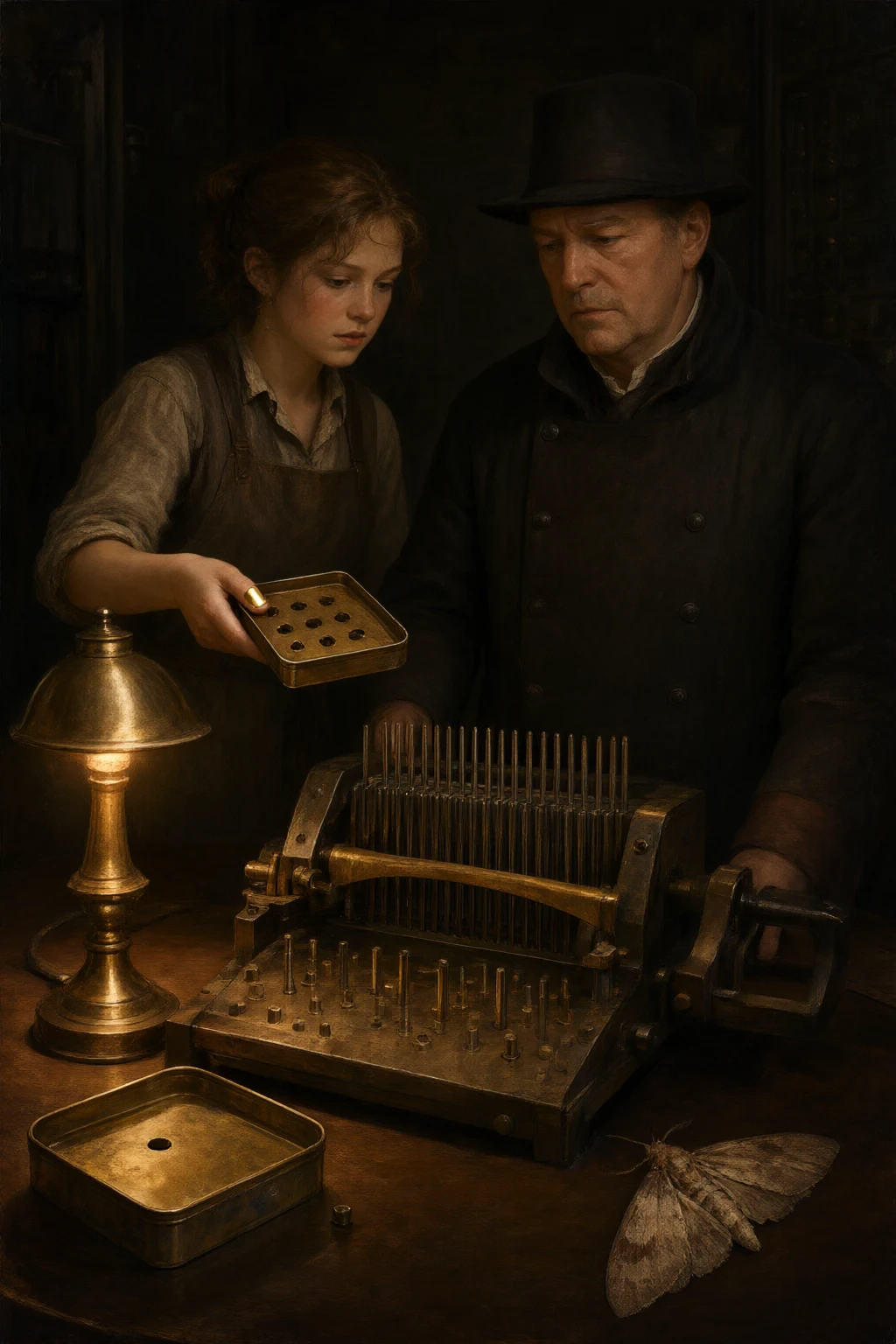
Ansel Reyne put the moth into the comparator at four minutes past the hour, and the tenth coil took the arm past the ninth of the nine steel pins and off the end, and the arm struck the stop with the sound of a dropped pencil, and in twenty years he had never heard that sound. The Comparator Vault sat six floors under Ledger Hall and had held ninety-four degrees since the day the gas main went in, because the comparator drifts in the cold and a moth measured in a cold room is a moth measured wrong. The walls were black with lampblack to the height of a man. The floor was scored by twenty years of boots. On the brass bench stood the machine, the size of a bread slicer, and beside it an open tin of oiled tin holding two hundred and nine moths run down from the Sixteenth district, every one of them dead, because they had flown their four hours and had come to rest, and the instant a moth comes to rest the living coat in its bobbin dies, and nothing can be stored, or saved, or flown again.
Nell Ashgrove had carried the tin down herself. She was fifteen, a junior in the Releasing Loft, and the youngest person in Candleford who could read a Row of trees by eye, which is to say that she could walk between four hundred trunks and tell you inside a minute which had been fed this year and which had not. There is no school for that. The loft hires children because the loft has always hired children. She had put the lid back on and then taken it off again. “Mr Reyne,” she said. “One of them has a hole I have not seen before.” “All of them have nine holes.” “It has ten.” He looked. She was right, and being right was a thing she had brought down six flights of stairs at two in the morning for, and he made her hold the moth up to the bench lamp while he turned it, and the tenth hole was less a hole than an argument: a small drilled pit set below and outside the arc, off the end of the pattern line, made by hand, and beautiful. “Put it in,” she said. “On the count of three. One — two — four.” “Ansel,” said Nell, who had been calling him Ansel for six months and was not going to stop now on the eve of her sixteenth. He put it in.
The assay card was a rectangle of stiff cream, three lines printed on it in small type, and for twenty years he had filled in two of them and had never once touched the third. Line one asked for the coil count, in or out. Line two asked what was different. Line three, printed along the bottom in a smaller face than the other two because somebody in the guild house had wanted it to be harder to reach, said this: THE ABOVE IS VOID AND THE ROW OVER WHICH IT FLEW IS STRUCK. He wrote one: TEN. He wrote two: ARC OF THE TENTH HOLE, FOUR THOUSANDTH OUT. Then he sat with his hands flat on the bench for a while, in ninety-four degrees, with a moth that had flown its four hours and could never fly again, and thought about the ninth hole, which is a night’s worth of living filament, and the tenth, which is one extra night, and what a tenth night does to a tree that has had two hundred Septembers of nine. “That is not to Pattern,” he said. “Yes,” said Nell. “I know. I have known since the stairs. I did not think you were going to say it.”
They went up to Ledger Hall at half past two, because a fault has to be written against the district it came from, and the district is written on the tin, and the tin is written on the line. Ledger Hall was a long cream-plastered room over the canal, every window shuttered, forty thousand ruled sheets in glazed presses along both walls, and the smell of hot brass and sealing wax and paper warmed by forty thousand little radiators. Two clerks worked at a time. The second desk had been used as a pigeon perch since 1902. At the front hung the Roll, framed: a hundred and forty years of certified workshops, the struck ones left visible, not erased. “Two hundred and nine,” said Orla Vessey, before he had asked anything at all. Ansel stopped in the doorway. Orla Vessey was thirty-nine and had been the ledger-clerk of the release ledger for seventeen of those years, and she wrote the line every night in a hand that has not changed since she was twenty-two. She had spectacles with the right lens ground from oiled horn, which is what the desk lamp threw into her eye all evening, and which she had never had ground properly, on the grounds that a proper lens would see less.
“Two hundred and nine in the tin,” she said. “That is the number off the cradle, and it is three more than the number on the line, and you will want to know that before you say the other thing.” “Which other thing.” “The number that went up. Nine thousand, one hundred and six went over the water last night. The cradle count is nine thousand, one hundred and nine. It has been three more than the line for a season and I have never been asked and I have never asked.” She took her pen off its cord. “Now. What have you brought me.”
The sheet is ruled in seven columns and everybody in Candleford knows the shape of it by heart. One is the plantation. Two is the number released. Three is the sap drawn from the feeder-groves in barrowloads. Four is the seed returned, in bushels, weighed in the autumn. Five is the hour. Six is the name of the releasing party. Seven is the weather, and it has its own private language, of which the guild’s favourite is NIGHT: NO FLY, RAIN. Five of those seven are the line. The line is exact and complete and unalterable, and there are forty thousand of them, and it is the only thing anybody has ever thought to ask the book. The other two are filled in faithfully, in the same hand, on the same night, and have never in two hundred years been set side by side. Ansel put the assay card on the desk. “There is a moth in the Sixteenth tray with ten coils,” he said. “Four thousandth out at the arc. It is not to Pattern. A moth that differs in any measurable part is not a moth, it is a fault.”
“Then it is void,” said Orla. “And the workshop that built it is struck from the Roll, and the Row it flew over is struck from the records inside one season along with every other tree in the same Row.” She was not being cruel. She was reading the rule, and she reads rules the way other people read weather, without any opinion of them whatever. “Yes,” he said. “Then I need the Row.” And that was the question, and the whole of it, and there is no column on any sheet in the building for the answer. A fault is void. That is settled. But the fault flew, for four hours, over some particular piece of ground in the dark, and the guild has never once written down where a fault went, because a fault is a thing that happens in a workshop and a moth is a thing that happens at night, and nobody has ever put the two halves of the same night in the same hand. “The Sixteenth is one of ten plantations off the Sixth cradle,” said Ansel. “I cannot tell you which ground it flew over. There is no mark on a moth. There is no mark on a tree that would tell you either, and I have looked.” Orla Vessey put the pen down. “Then you have brought me a fault,” she said, “and a rule, and no Row, and I am to write a line saying a fault occurred in the Sixteenth district at eleven o’clock, and every tree under that line is struck, and the line does not say how many trees, or where, or whether any of them would have been all right.” “That is the form.” “Yes,” she said. “It is the form.”
Halvard Tace came up at three, and he came up alone, and he stood in the doorway of the Assay office with his gloves on, which nobody does in a room at ninety degrees. “Who paid for that?” he said. “It is a fault,” said Ansel. “Nobody paid for it. A moth came down from the loft with ten coils.” “Then who paid for the two hundred and nine in the tin, because Crale & Crale put that tin out, and the Concord pays Crale & Crale on the twelfth, and the Concord pays me a very small sum to keep a Roll that can be defended, and I have been sitting here for an hour working out how to do that without writing your name in the wrong place.” Ansel looked at him. The right glove was cut from a different, browner leather than the left, and Halvard had never replaced it, on the theory that a man who notices a thing like that is a man thinking about the Roll. “Nineteen people,” said Ansel.
“Nineteen people,” said Halvard Tace. “Wenna Crale, her two daughters, a boy of nine who does the wing-plates, two bench-men, fourteen. I have the list because I keep the list. Every one of them is on a Row in that district, and every one of them will be struck with the Row if the Row is named. That is the part I have been turning over since the stairs. I have been asking myself, on my own stairs, for an hour, whether it is cheaper to strike a row or a house.” “I would not know,” said Ansel. “No. You would not. You only measure.” Halvard came in and sat down, which he did not do. “The rule says a faulted moth is collected, rendered, and the workshop struck. The rule also says a tree touched by a void moth is struck from the records, along with every other tree in the same Row. The rule does not say the Row is struck if the fault never reached it. The rule assumes it reached it. That assumption is doing an enormous amount of work and nobody has ever looked at it, and I have, and I am the man who makes amendment ruinously expensive, and I can tell you what it costs to look at it: it costs me the Roll. So I am going to ask you a question with a number in it.” “Ask.”
“How many faults have you taken out of a tray in twenty years?” Ansel had the answer in a moment, and it came out of him without being looked up, which told him, if he had been the sort of man who watched himself, that he had been carrying it a long while. “Ninety-one.” “Out of a tray. Not out of a workshop.” “Out of a tray. Eighty-eight of the ninety-one were void before they left the district. They never left the ground. The other three flew.” “Ninety-one faults in twenty years, and I have never once been told, and neither has the Concord, and neither has the Roll, because the assay book records what a fault is and not how often, and there is no column for how often, and so I have governed a Roll for eleven years without knowing that the number is ninety-one.” “I have it in the margin,” said Ansel. “Of what.” “The assay book. My own. A count, kept because the guild’s book has nowhere to put it.”
Wenna Crale came up at four in the morning, on her own feet, and she would not have her daughters with her. She was forty-three and had run a house on Ferrier’s Cut for twenty-four years, and there was a grey feather-down on the shoulder of her coat that she did not brush off, because a moth handled in a workshop leaves down, and a woman who has spent a night on the floor of her own loft with a hundred moths dying round her will have down on her. Ansel had thought, for eleven minutes, about a hundred and forty years of assay language, and had come to this: the moth is a document, and a void document is still a document. It is not a forgery and not a lie. It is a thing made in good faith by a man who had every right to make it, and it is void anyway, because the office which issues it has a fixed number and the fixed number is nine. It has never once been a question of harm. The guild cannot measure harm. The guild can measure the ninth hole, and the ninth hole is four hundredth in, and always has been, and that is the whole of what Candleford knows about the forest, and Candleford is extremely good at the thing it knows.
And then he had thought: which means the guild has never established that the ninth hole is why the trees are alive. It has established that the trees are alive. It has established that moths are flown. It has established that the two occur in the same district, in the same season, in the same proportion, which is a much weaker thing, and the kind of thing that holds up for a hundred years and then does not.
“One hole,” said Wenna Crale. “One hole out of a machine of nine. That is the whole of it. One hole.” “It is not to Pattern,” said Ansel. “I know that it is not to Pattern. I have been in this trade since I was nineteen. I do not need a man in a cold room to tell me where my drill guide is.” She put her hand flat on the desk, and there was sap on the thumb, because she had come the whole way out along the lead pipe line where the men were still tapping in the dark. “Row Sixty-Two fruited nine tenths heavier this year. I have stood in it and counted the seed on the ground. Four hundred and six trees. My moths. My four and a half thousand, in the Sixteenth, on the eleventh, on the only still warm night since the equinox. And I have brought you a girl of fifteen who says one hole is one hole, and she is right, and she is also describing a forest.” “The row may have fruited heavily for any of nine hundred reasons.” “Eleven,” said Wenna Crale. “I have been in the Sixteenth twenty-four years. There are eleven things that make a Row fruit heavy and a still night is the first and the hardest. I can give you eleven.”
“Eleven reasons are not one reason. I cannot certify a Row on the strength of nine tenths.” “Why not? Certify a Row on the strength of nine tenths. Write it down. I will put my name to it. That is the whole of what I am asking and it is not a great deal. Do not certify the moth. Strike me. Strike the house, the nineteen, every moth in the bin; I have already written to them. Strike the Row as well if the rule requires it, and put the nine tenths beside it, and let the Concord have a page with two numbers on it. Let the next girl in the loft read it and learn that the guild once had a Row that came in heavy on a void.” Ansel Reyne had been certifying against the Pattern for twenty years and had never once been asked to certify a harvest, and the discovery that he could not do it was not a shock. It was a wall he had known was there and had never walked into because the corridor he was given did not go that way. “No,” he said. “Why not.”
“Because I cannot tell you what the nine tenths was, and if I certify a number without knowing what made it, then I have certified a coincidence, and the Concord will have a page with a coincidence on it, and the next time there is a fault in a Row that did not fruit, the page will still be on the wall, and it will say that a fault is survivable.” He turned the assay card over. “What I can tell you what it is. That is the entire extent of what I am able to say. I can tell you what it is, and I cannot tell you what it did, and I have never once in twenty years been able to tell anybody what anything did.”
They did it in the Assay office with five people in the room, because there was nowhere else, and Halvard Tace would not have it in the long room. Pell Crenn was the Row clerk of the Sixty-Second and had been for twenty-nine years, and Halvard had sent for him at half past four because the rule gave him a right to be present, and Halvard Tace would not strip a man of a right to save himself a scene. He was a thin, ordinary, badly-lit man in a good coat, he knew the number of every one of the four hundred and six trees, and he had brought the tally board because he did not know what else to bring. Fennim Sallowe came up from the north end at five, forty-four years old, black beard re-braided that morning, stiff green boots, a beard he had re-braided every week of his life because his mother had once told him it looked better and he had been trying to please somebody ever since. He had come because there is no version of this in which the guild does not eventually need a man with a saw.
“If the Row is struck,” he said, when Halvard had read out the rule in the flat voice he kept for rules, “the trees come down in a season. There is no sense leaving a struck tree standing. A struck tree is not on any paper, so it is not watered, it does not set seed, and it does not die of anything you can point at. It stands there for eleven years being nothing.” He looked at the wall. “I will bleed them first, because the sap in a struck tree is the same sap as in any other and the loom will want it, and I would rather the loom had it.” Nobody said anything for a moment. “You are a very practical man,” said Halvard Tace. “I have been the necessary man for twenty-two years,” said Fennim Sallowe. “It is not a talent. It is a chair.”
The next evening Nell Ashgrove came down the Releasing Loft stairs on the count of three, and got to four, and nobody corrected her. She found out why at ten minutes past six, standing on the Sounding Bridge in the cold with her scarf over her mouth, because that is what everybody in Candleford does after a flying night, and the canal goes black and the wings go over it as a soft continuous hiss, and the water keeps the sound a half-second longer than the air does. There was a gap in it. Not a gap in the swarm so much as a place where the swarm leaned, and it came in clean at ten minutes past six: a lane about the width of a Row in which nothing whatsoever happened. The bridge had thirty or forty people on it in coats, and they stood in two ragged groups well apart from one another, all looking at the same piece of empty sky, and not one of them knew what they were looking at. At the iron rail a lamp-runner of twelve stood with his scarf up and his lamp out, going along the metal with his lips, because that is where Teasel Sillet puts the numbers he finds, and that evening he had found one, and had counted it twice, and had told nobody.
Pell Crenn said it in the end, and he said it to Wenna Crale and not to the guild, which afterwards appeared to several people to be the single most consequential thing that happened in the room. “I have been Row clerk of the Sixty-Second for twenty-nine years,” he said, “and nobody has ever asked me what the Row does, only how many trees are in it. I am not a clever man. But you will all be arguing about whether your moth did harm, and I would like it observed that nobody in this room knows, and that we are going to strike four hundred and six trees on a maybe, and that in two hundred years nobody has struck a single tree on a maybe, and that this is the first time.” “That is correct,” said Ansel Reyne. “I know it is correct. I would like somebody else to have said it.”
“Then it is struck,” said Halvard Tace, and there was a great deal in the way he said it, and the greatest part of it was the line he would have to write in the morning in the Roll, in a column he had kept for eleven years and had made ruinously expensive for anybody who wanted anything added to it. Ansel Reyne put the assay card on the desk and turned it so that the whole room could see the bottom line, the small one, the hard one to reach, and it said THE ABOVE IS VOID AND THE ROW OVER WHICH IT FLEW IS STRUCK, and no assay in the history of the guild had ever had that line filled in because the line is only filled in when there is a Row, and there has never been a Row. He took out his pen. “Mr Tace,” said Wenna Crale. “If he fills that in, it is his hand on it.”
“It is his hand on it,” said Halvard Tace. “It is his hand on it and it is mine on the Roll and it is hers on the second column and it is mine on the first, and that is how the city is built, and the day the city is not built that way, the day a Row is struck by a committee on the strength of a rumour, is the day the Pattern is a suggestion.” “Row Sixty-Two,” wrote Ansel Reyne. And then he read it out loud, which nobody asked him to do, and which is the only part of the whole night that he will have said that he can defend.
“I am certifying that a moth of the house of Crale & Crale came into this vault this night with ten coils in its bobbin and the tenth hole four thousandth out of arc. That is to Pattern in every measurable part, and I have measured every measurable part, and I am not signing that it is to Pattern. I do not know what it did to Row Sixty-Two. I do not know what nine holes have done to Row Sixty-Two. I have signed eleven thousand lines and I have read past the release column on every one of them, and if a tenth hole in a machine of nine would have done the Row no harm, then neither did the ninth, and there is nothing in the vault to tell me that is so, and there has never been anything in the vault to tell me that is so, and that is what I am striking it for.” He signed it, and put the pen down, and it was the first time in eleven years that Halvard Tace had seen him do an act of any kind with a witness present, and the reason was not courage. A signature is worth what the person signing it can say out loud about it, and he had discovered he had nothing else to say.
Orla Vessey wrote the line at eleven minutes past five, in the room with the shutters shut and one lamp going, in a hand that has not changed since she was twenty-two. Sixteenth. Released 9,106. Sap 41 barrow. Seed 388 bu. Hour 11. Party Loft, Crib Tower. Weather STILL, WARM. Strike invoked, Assay of the Concord, card third line, Row the Sixty-Second, four hundred and six trees. She read it back to him, which she had never done for a fault. “Ansel,” she said. “The night’s line is written. It is a true line. Every word of it is true, and the sheet carries seven columns and I have filled in five of them, and the other two are the sap and the seed, and I have filled those in too, and nobody has asked me a question about either in seventeen years.” “That is the form.”
“Yes,” said Orla Vessey. “It is the form, and the form is not the difficulty, and I want you to hear me say the difficulty, because I am the only person in this building whose hand has not changed since I was twenty-two and I would like somebody to have it from me while I am upright and able to be disliked for it. The difficulty is that there is no column for what a fault did. And the difficulty before that is that there is no column for what anything did. That book has forty thousand lines in it and I could not tell you what one night was for, and if you asked me on Sunday I would say the moths are released and the sap is drawn and the seed comes back, and every one of those three would be a lie, and I would not have been lying, because I would have been filling in the form.” Ansel Reyne stood in the middle of the cream room with the lamps going and forty thousand glazed presses receding on both sides of him, and the pale crescent under his left jaw was uncovered for the first time since the eighth of June, and he made no move to do anything about it. “Write one,” he said. “Write one what.”
“Write down that there is no column for it. On the sheet. Under the line. In your hand. I will not sign it and the Concord will not read it and Tace will strike your name off the Roll of clerks by Tuesday, and the line above it will still be true, and underneath it will be a true line that says there is nowhere to put the other true thing. Put it in the book.” He was quiet for a moment. “I have signed eleven thousand lines. I would like one of them to have been written by somebody who was not sure, and I have never once been able to ask for that, because the book does not ask and the book does not answer and the book is not a person, and that has been very convenient, and I am fifty-eight years old and I have just found out what it was convenient for.” Orla Vessey took off her spectacles, and cleaned the right lens, which was ground from oiled horn and which cleaned perfectly well, and put them on again.
“Nine thousand, one hundred and six,” she said. “Released. Three more came off the cradle than came off the line. I have said that number to nobody for a season, and you may have it, and you may not have the rest, because the rest of it is a column that does not exist, and I have wanted it since tonight, and wanting it is not a question the book is permitted to be asked, and I am telling you so in a room with four witnesses in it.” She took up the pen. “Roll up your sleeves, Mr Reyne. I have got a night to write.”