The plan chest stands under the north window of the survey house, because the north window is the one that never fogs, and because Marren Ashlock, who is forty-one and has not given ground to anybody in his life, decided in the winter of 1878 that a man ought to be able to see his own breath over his own plans. Hollis Bray was sent for the Fenrow ditch levels at four o’clock on a Thursday in late October, with his instructions delivered in the tone of weather. You will find it wet under the north row. It is always wet under the north row. The levels for the current season were tied up on the desk, going into Ivet Roke’s fair book, so he went down the drawers looking for the old ones to copy the figures off, the way he was shown, narrating the whole descent, because that is what he does and cannot be stopped from it and has never tried to be stopped from it. The drawers go back. The drawers go back to a hundred and forty years and every one of them is indexed in Ashlock’s own hand at the front of the chest, in a pencil that is a man alive yet.
The 1891 Fenrow sheet was gone, tied up. The 1880 was a trace of a boundary in hard pencil and nothing else. The 1860s were ditch sections, beautifully kept, the ink still black. And the 1851, which nobody had wanted since the year it was made, was a folded sheet of tracing paper over nothing at all, and under the tracing paper, flat, was something that was not a sheet. It was the thickness of a folded map. It was a wrapper of manila that had gone soft the way cloth goes, and it had a string round it, three-ply, tied the way you tie a thing you intend to open more than once, and it made a small dry sound when he lifted it. “That is not a plan,” he said. “That is a parcel. That is a parcel of paper and it is in the plan chest, and the plan chest is indexed, and the index ends at 1874 for this drawer because he ran out of patience or the world ran out.” He said this to the room. The room did not have anybody in it who had told him it was a plan to begin with.
They did not open it there. That was Ivet Roke’s doing, and she was sixteen, and she was not yet permitted to open a ledger alone but was permitted a plan chest, on the grounds that a plan is not a record of descent and so cannot corrupt anybody. “You have found paper in a plan chest,” she said. “That is not the same as paper in a plan chest being yours. My standing instruction from the keeper is that paper is never opened where it was found, and the reason for it is that the drawer is where it was put by somebody who had a reason.” “That is a wrapper,” Hollis said. “And nobody puts a wrapper in a plan chest for a reason. Nobody puts a wrapper in a plan chest at all. That is the whole of what drawers are for.” His mother came in then, at four minutes past four, because she comes in at four to tell him what he has been doing, and she had a handcart handle in one hand and the thimbless mitten on the other, and the bootlace with its mouthful of iron keys down the front of her coat. She looked at the parcel. She looked at it a long time, longer than a parcel of paper requires.
“You will want,” she said, “to carry that to the Register Room and put it on the keeper’s table with both hands and say where you found it and say it twice, because she will ask you twice, and you will not have anything else to say about it, and that is the correct amount to say.” “Where did it come from, do you think?” She was already out of the door. “I have a key-ring that has never been asked for,” she said, “and I have a boy who has found something, and one of those is a thing I keep and one is a thing I give. You will not be able to tell them apart by Thursday.”
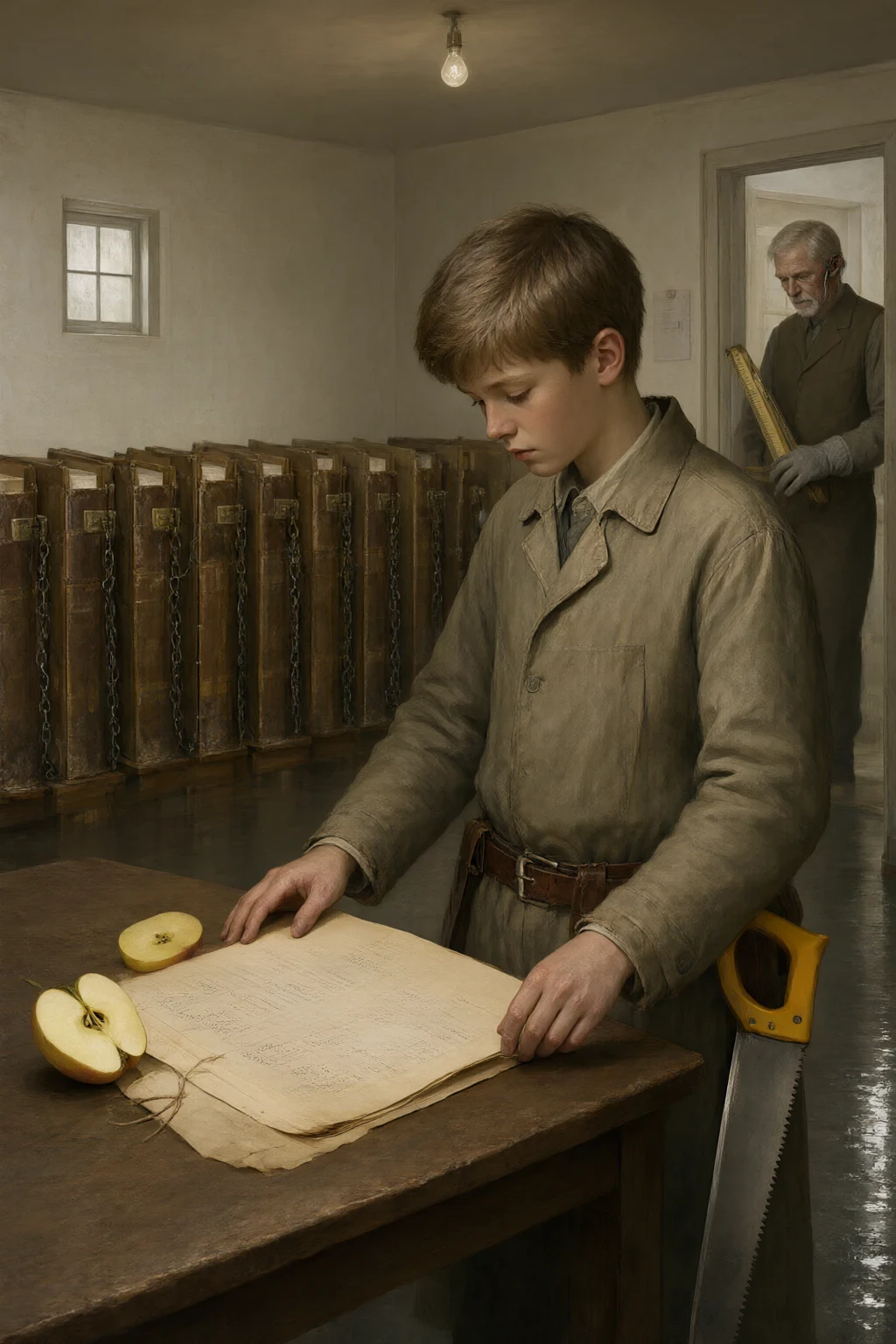
The Register Room is at the east end of the packing shed and it is the only room in the Rootwork where people lower their voices without being asked, and by the time they were in it Hollis had stopped narrating, which Ivet Roke noted and did not comment on, because she had a copy of the following year to finish. The room is low and whitewashed and cold in a way the shed is not. It holds eleven tall ledgers on wooden stands, chained by their spines and not by their clasps, which is a decision somebody made in a temper and nobody has reversed. There is a bare bulb on a flex, and a second bare bulb that is not connected. The smell is glue and foxing and, under both, the cold mineral tang of a cellar, because the floor runs over a flagged corridor that nobody upstairs has ever mapped on the strength of there being nothing on the plans above it. Ottiline Vrey was still in her coat. She is thirty-eight and she has been the keeper of the Grafting Register for nineteen years, and she has a grey archive glove on her right hand, always, including in the orchard, and a warding pin of bone-white boxwood in her left ear that she has worn since she was nineteen and has twice been asked to explain at a funeral.
She took the parcel. She did not untie it. “Under the Fenrow sheets,” she said. “For 1851.” “Yes.” “Behind the tracing paper.” “Yes. He has it indexed. It is the fourth thing down.” “It is not,” she said. “Look.” And it was not. There was a gap in the index, between 1850 and 1861, and the gap was not the gap of an omission. It was the gap of a line taken out, and the paper where the line had been was faintly paler than the paper around it, and there were two small pinholes. “Who pinholes an index?” “Forty years of somebody being tidy,” Ottiline Vrey said. “Now, the string.” She untied it. Three-ply, and a sheet knot, and she retied it, so that the next person would have to admit they had opened it. Under the string was a cover of foolscap folded once, and on the cover, in ink, a year and a word. 1851. Cold Unions.
They did not read it that night, because she made them take it home and come back, and because she wanted it, she said, to be read by people who had not been in the room when it was opened. They came back on the Friday and the Saturday and the Monday. It took nine evenings because it must be read the way it was written, which is to say in order, and in order means that you cannot know what a thing means until you have read the thing it is written next to, and the folder runs from September 1851 to April 1859, and the entries run one to nine. The columns first. Seven of them, ruled in ink, in a young hand that was quick and level and had not yet been spoiled by hurry. The day. The tree. The scion, whence. The stock, whence. The root, as known. The union. The hand. Those are the columns of the district’s own form. They are the columns of every graft entered in the eleven ledgers in the room, and they are the columns of the Grafting Register, which is a document of descent, and which tells you with perfect clarity where a thing came from and tells you nothing whatever about what was there.
And there was an eighth column, ruled at the right in a space the form had left blank, ruled in ink, and headed, in the same young hand, in capitals, a single word. TASTE. The ruling was ink. The entries under the ruling were pencil. “Pencil,” Ivet Roke said, in the way of a person who is looking for the mistake in a will. “Pencil,” Ottiline Vrey said. “And that is the whole of the file, and it took me nine days to see it, and I have been in this room nineteen years.” She held the page under the bulb and tilted it, and where the pencil had been the paper had gone soft and furry, and where the pencil had not been the ruling was as sharp as the day it was cut, and the softness ran in one continuous band down the length of the column, without a break, and it was wider at the bottom. “He did not want it to come off,” she said. “He wanted it to come off. He wanted it to be the thing that came off.”
The first entry is dated the fourteenth of September 1851 and it is four lines long. The tree: Middle Orchard, third from the ditch. The scion: Ward, No. 12, the year it was a sapling. The stock: Middle Orchard, third from the ditch. The root: not known. The union: waxed, and the wax is on it still, a brown bead in the crack, and this is the only wax in the folder that has not been broken out. And in the last column, in pencil, four words and a full stop. Dry. Warmer than dry. No street. Underneath, in the same pencil, in a smaller hand, as though he had written it later and feared to be caught at it: There is a floor.
Ivet Roke copied the first entry into her fair book on the Monday, in fair copy, with the heading and the ruling and nothing left out, and when she had finished she read it back and it was accurate and it told her nothing at all about where she had been. The second entry is the same root again, the third of the Middle Orchard, in May 1852, and the scion is the Ward No. 12 again, and this time the pencil column says that he can find the edge of it now, and that the edge is not a wall. It is not a room. A room has a door. This has an edge and nothing at the edge. Hollis Bray read that one out twice, which he was not asked to do, and then said, “There’s a wall in the middle orchard under the third tree, because when I was nine I put my hand in and there was a brick under the grass and Mother pulled me out by the belt, and she said the grass there is only grass over the top of something and a boy that puts his hand in has to be an apprentice to somebody.” Nobody said anything to that for a while.
The fourth entry is in the Bellhouse Cellar and it is dated the second of February 1854, and the stock is a tree in the ground behind the north wall of the cellar, which means a tree growing out of the floor, which is a thing a person who has not seen it will assume is a mistake. TASTE: iron. Under the iron a sweetness. Under the sweetness nothing at all, and I do not mean empty. I mean that when I get to the bottom of the taste there is no more address, only more taste. Ivet Roke, who had been writing, stopped writing, and then went on writing, which was the first thing about her that was not clerkly. The sixth entry is a graft to a tree in the Ward block and the pencil column is a single line, and the line says: this one is only the ward block. Ordinary. I have made this one to see whether I could. That is the only entry in the folder that is not a place. It is the control. Somebody who has spent a fortnight of his twenties chasing a dry floor with no street has thought, at some point, to try the ordinary thing so as to know what the difference was, and the result is exactly as dull as the clerk who was doing it expected it to be. Nobody has ever thought of that entry as evidence of anything, and it is the reason nobody has once asked for the file to be destroyed. You do not destroy a file that has a control in it. You only destroy a file that is all monsters.
The seventh entry is the one that costs something, and it is dated the eleventh of October 1857, and it is on a tree in the ninth row of the Fenrows, and the tree is entered as a scion of the third of the Middle Orchard worked onto a stock of the ninth row. The scion column is very full. It gives the variety, the year of the bud, the parent tree in the middle orchard, the branch it was cut from, the number of the union, and it goes on for two lines, because he was proud of it, and because it took him the best of an afternoon to get clean enough. The root column says: this tree was given to me to improve. I have improved it. And the pencil column says: the whole of it. This tree now tastes of nothing but the middle orchard. Ask anybody on the row. There is nothing left of the Fenrow in that fruit to ask. Ottiline Vrey put her hand flat on the page, glove and all, and left it there.
“The union holds,” she said. “For as long as the union holds, the stock reads both. That is rule three and every child in this district has it by heart. And a stock that shares a root with that tree — the whole ninth row shares a root with that tree, the ninth row has shared a root since it was planted, it is a Fenrow row and a Fenrow row is one plant with nine heads — the whole row has been drinking from the middle orchard since 1857.” “How long?” “Until 1858, when it was taken out. One year, to my guess. Perhaps two. That is the length of time it takes for nine men to notice that their fruit has changed and to say nothing about it, because if the whole row has changed then the fault belongs to the row.” Hollis Bray said, very fast, “That’s my mother’s tree. That ninth row third is the one she— Mother gave it to a man from the office in ’fifty-eight. He came with a grafting knife and he worked it and he did it wrong and she was not allowed to say so, and I know that because I was nine and I was there and I have never asked her about it because you do not ask a person about the year they were not given an answer.” The room was very cold. The second bulb hung over nothing.
Entry nine is dated the thirtieth of April 1859 and it is longer than the others, and it is written in a hand that has begun, by the fourth line, to lose its level. The union came apart in the night. I did not cut it. Nothing was cut. Nothing was seen to be cut. In the morning the scion lay on the grass with its wax wrapper on it, whole, and the stock beneath it was as sound as the day I set it, and I put my thumb in the break and there was nothing in it to say why. And then, because he was twenty-three and alone with it: Windfall under the third of the middle orchard at first light, and I have cut it, and it has eleven carpels. I have cut eleven in this district and never one in this orchard, and the variety carries five, and I have checked it twice with the Ward book open. And then the last line, and Ottiline Vrey read it aloud, and the bulb moved, and neither girl said anything: I cannot enter that. I can enter that the graft was made.
Inside the front cover, in a different hand, in ink, in a clerk’s round official script that four generations of the district office have taught and that anybody in the district can read at a glance, there were four words. Rec’d. Not ent’d. G.H. “George Hollis,” Ottiline Vrey said. “My predecessor’s predecessor, and the last of them to be appointed from outside, and dead in 1881. He received the file and he did not enter it.” “So it was hidden.” “No,” she said. “It was shelved. There is a difference and the difference is the whole of what happened next, and the difference is that a man who shelves a thing is making a decision about a Tuesday, and a man who hides a thing is making a decision about a year. He had it on his desk. He read it. He wrote four words and he put it back in a drawer, and then somebody came along and did something to the index with a pin.” “The folder’s the whole map,” Ivet Roke said. “That is what is in it. Nine places, with places that are not on anything, in a district of a hundred and eleven acres, and it is the only time anybody ever wrote them down.”
“And it is also,” Ottiline Vrey said, “the only surviving record that a district clerk made nine grafts in eight years and entered none of them, in a district where the whole of the ground stands on the register, and where a graft that is not entered is the one thing that comes apart in the night.” She put her glove over the page and looked at the two of them. “One of you is going to have to decide,” she said, “whether that is a crime or a coastline, and I would rather it was done by somebody who has not been in this room for nine evenings.”
They went and found Dellory Fenn on the Tuesday, which took two days, because he is not at his house on weekdays and not at the Bellhouse Cellar on Fridays, and on Tuesday he was in the middle of the second orchard doing nothing at all, standing in a gap between two unlisted trees with a folding rule he has never separated in his life held shut in one hand, as though a thing not opened cannot be a fault. He was sixty-three. He had been the district analyst from 1849 to 1874 and had been, before that, for two years, a clerk in the register room, which is how he came to have the hand. He was also the last handwriting hand on the Grafting Register before Ottiline Vrey, and he had signed eleven entries, and she had corrected none of them, and this was the only compliment either of them had ever passed. “On the record?” he said, before either of them had said anything else. “That depends,” Ottiline Vrey said. “Do you want it to be?” He looked at the parcel under her arm for some time. “No,” he said. “Then we have not come to ask you anything. We have come to read you something. Nine evenings, from the beginning, in the room, with the bulb, because it is not legible on paper and it is legible out loud.”
So they read it out loud to him in the gap between the two trees, on the Tuesday and the Thursday and the following Tuesday, and Dellory Fenn stood and listened with the rule shut in his hand and corrected eleven words and one date, and permitted all three corrections, which is more than he has permitted anybody in his life. When they came to the ninth entry he asked them to stop, and they stopped, and he did not ask for the page. “The carpels,” he said. “Eleven.” “Yes.” “Did you cut it?” “We did not. The middle orchard third fruited in 1859 and nobody has had a reason to look at it since, because it is an unlisted tree and unlisted trees do not get picked, and the fruit goes down in the grass and the grass is mown and the mowings go on the cart and the cart goes to the far end of the block.” “Then you do not know whether it still reads that place.” “No,” Ivet Roke said. “We know that in April 1859 it did.” He nodded, and put the rule in his coat, and then took it out again, which she saw and Hollis saw and which is the reason she knew the rest.
“It will not,” he said. “Or it will. I have no way of putting it to you that is worth the paper, and the register cannot take my answer, because the register takes descent and I have only ever had findings, and that is not a complaint about the register. That is what the register is. A graft tells you where a thing came from. It has never once in the history of this district told anybody what was there, and there is no column for it, and the reason there is no column for it is that the man who ruled the columns knew what he was making, and he was making a record of who owns a tree.” “Yes,” Ottiline Vrey said. “I thought so.”
Marren Ashlock came out on the last evening because Marren Ashlock is told everything that happens in his own plan chest within a month, and it had been nine evenings, and the month was up. He is the head of the Ward Survey and he wears a plumb bob in his chest pocket like a bad tooth, and a notebook is lashed to his left wrist with a brass buckle he has had punched twice because the first hole tore and the second hole tore and he would not have it re-stitched. He did not sit. He read the folder standing, at the table, with the bulb over it, and he read the seven ink columns and the pencil one, and he read the pencil one twice, and he did not touch it. “The positions are wrong,” he said. “Which positions?” “There are none. That is what I am saying. There is not a station, a bearing, a distance, a level, or a note of any kind in that column. A man walked out on this ground in 1857 and wrote down what his tongue told him and did not write down where he stood.” “That is what you have in it?” “I have had it since the Thursday. It came with the parcel.” “Then it came from a drawer, and I have the drawer.”
Marren Ashlock looked at the bulb. He had a plumb bob in his pocket and a survey of a hundred years in his head and a hundredth year to finish, and there was a man in the room who had just told him, in the only way that could be told, that there is a place inside his orchard that he cannot stand on. “Noted,” he said. Hollis Bray, who was fourteen, and who was frightened, and whose habit at such moments is that the story he is telling simply speeds up, said: “That is not what the word means. Sennet— Mrs Bray says you say that when you are about to do something you will not do, and she has said so four times and I have counted, and she says a man who says noted, corrected is a man who has just been shown he is wrong, and you have never said that word out loud in your life, and if you say it tonight it will be the first, and the whole of the Fenrow block will hear about it from me by Thursday, and I do not care.” Nobody stopped him. That is the thing about him. There is no question you can put to Hollis Bray that he will stop for. Marren Ashlock looked at the boy for a while, and then he said: “Noted, corrected.” And went out into the fog with his hands in his pockets, and did not come back that year, and the hundredth year of the Ward Survey was finished in the end by two men and a boy with a tape, and it was finished in 1893, and it is a very good survey, and it is not the only one.
The last entry in the Grafting Register for that season is number 4,118, and it was made on the nineteenth of November, in the hand of the keeper, and it is the only entry in eleven volumes that was made after the fact and out of a file. It records nine unions. It gives the day, the tree, the scion and whence, the stock and whence, the root as known, the union, and the hand. It says of the ninth, of the third tree in the Middle Orchard, that the stock is not known and was not known. It does not say where any of the nine are. It is a complete, accurate, checkable record of a series of parentages, and any person in the district could have taken it to the county office and shown it and been believed about every word of it. Beneath it, on the fair copy that Ivet Roke made for the district file, there is a margin. The fair-book forms are printed with a binding margin an inch and a half wide, ruled on one side only, left blank by the printer because a binding margin is for a binder and nothing else.
In that margin, in pencil, in a young hand, at the bottom of a page headed nothing, is the whole of the eighth column. The word TASTE, ruled, and under it nine lines, and the ninth line ending in a full stop after the words: I cannot enter that. I can enter that the graft was made. It is unsigned. Underneath it, in the same pencil, in the same hand, but steadier, and clearly written by somebody who had watched the first hand do it and had decided to do it properly, is the fourth entry again, in full, and the twelfth line of it, which the first hand had not yet reached in April 1859, and which reads: The floor is not a floor. I have stood on it. It is a lid. Ottiline Vrey read that twice, and looked for a long time at the page, and then she said: “Eleven graftings, forty-one years, a docket number, and eight hundred and six words, and none of which may be used to move a boundary, settle a will, or sell an acre.” “No,” Ivet Roke said. “But it may be used.” “By whom, in particular, and for what particular purpose, and checked against what? Name me the office. Name me the column.”
The girl put her hand flat on the margin, the way the keeper had done nine evenings before, and closed the fair book, and the bulb swung a little because the door had been left open in the corridor, and eleven ledgers stood chained by their spines in a cold whitewashed room under a bare bulb, and the bulb swung, and on the last page of the fair book, in an inch and a half of binding margin that the printer had ruled on one side for nothing whatever, nine places in the Rootwork were written down for the first time in the history of the district, and were not in the register, and could not be, and were true. Nobody had asked her to count the carpels. Nobody had ever asked anybody in this district to count anything that the register did not already require to be counted.