The full assembly of the parish of Gethin Bell sat on the sixth of October in the Cloth Hall, which is the only warm room in the town and the only one a bell cannot reach uninvited, and it sat there for three weeks in the rain, and the reason it was sitting there was a line in a book. Aldous Crenn read the line out himself. He had wanted to. It is four words long and it is the shortest line in four hundred years of the book and he had written it himself in 1971, which nobody in the room knew, and he read it from the lectern at the north window with the brass lamp swung over and his cataract-yellow eye to the left of the page, and he read it twice, because the first time the room did not hear it. The purpose is held over. “That is the whole of it,” he said. “Read out in the hand of Ferrow — ”
“No,” said Ivet Trewin, who had the book now, and had had it for four months, and who was twenty and did not stop. “That is not the whole of it. You are all going to sit here for three weeks on a sentence with a gap in it, and at the end of it somebody is going to write a word in the gap, and every one of you is going to come out of this room believing that word was already there.” “It was there in 1971.” “It was not there in 1971. It was made there in 1971, out of nothing, by him.” She put her thumb on the line. “That is the first thing the assembly has to decide, and it is not a small thing, and it is not about a bell. If this book is full of sentences that men have written, then the fifth purpose has been held over for sixteen years on the strength of a sentence, and the parish is entitled to know whose sentence it is.” Nobody in the Cloth Hall said anything for a while, which is a thing the Cloth Hall is good at. It is a barrelled room with a low oak ceiling and a fire lit twice a day whether or not anybody is in it, and about forty people came to the first sitting and eleven had come to the last one in March, and the difference between those two numbers was the entire subject.
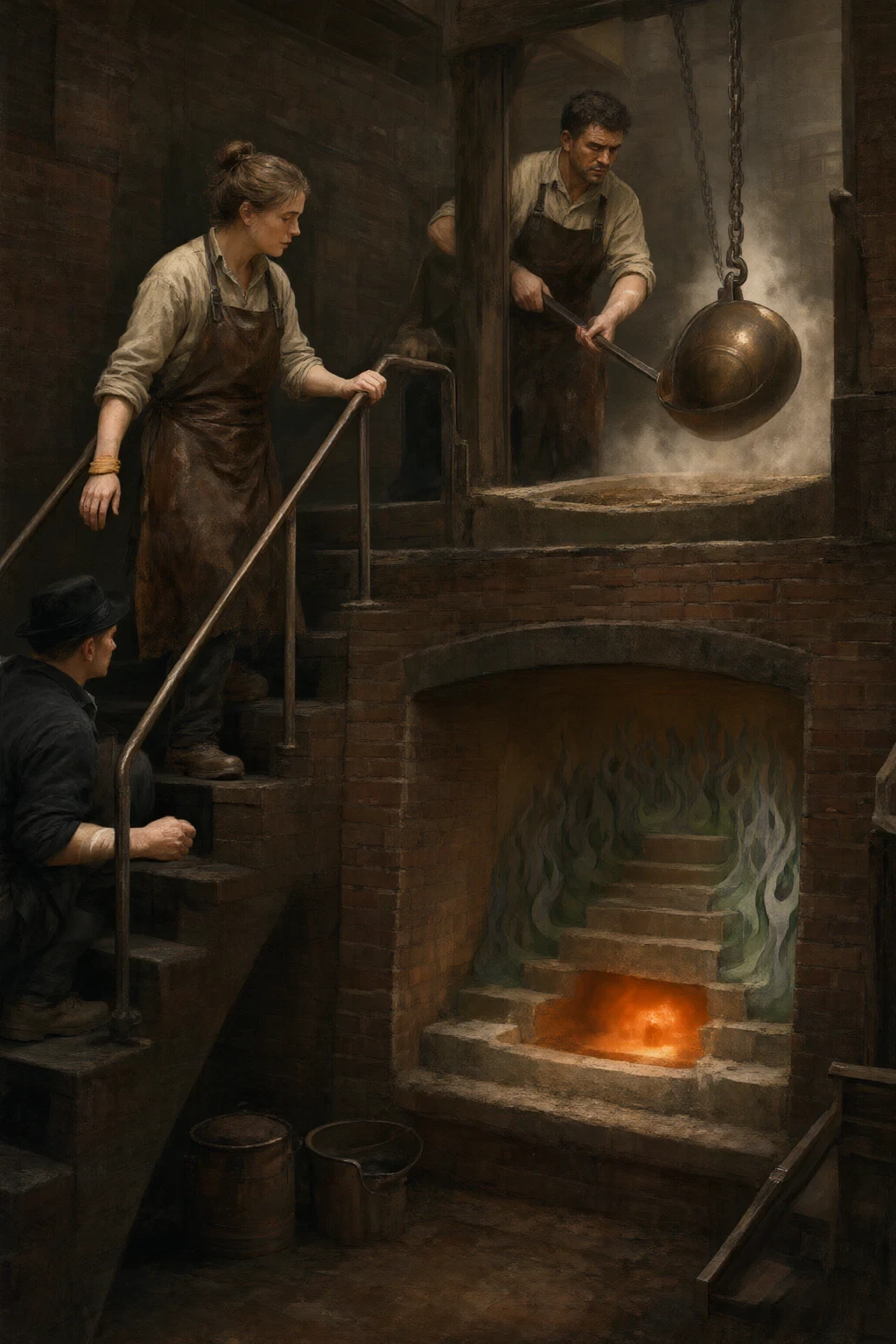
Nan Ilva had the casting pit cold and the water tank full and two hundredweight of old bell-metal stacked in the corner under sacking, and she came up to the Cloth Hall on the second morning with her sleeves pushed down. “Twelve hundred and falling,” she said, at the door, to nobody. “Fourteen hundred by Thursday. And I will tell you the temperature of this room, which is fifty-two, and it is colder in here than it is over the pit, and that is because a room full of people arguing has no furnace in it and a pit has.” “Eleven hundred and forty is what a charge runs at.” “Eleven hundred and forty is what a charge runs at if the man who is pouring has his attention somewhere else, and one of you is going to be standing on the stair landing on the day, and I do not yet know which of you, and I would like to know, because I pour for the person I know.” She put a paper on the table. It was the schedule, and it was a schedule for a bell that did not exist, because that is what the assembly had asked her for on the first morning: how long.
“Four months,” she said. “Pattern by the end of this month. Mould a fortnight, and the mould wants drying in the shed, and the shed is not warm, and a mould that dries in a shed that is not warm is a mould that cracks. Core set, another fortnight. Then the pour, a hundred and forty seconds, then three weeks before you touch it, and then a month of air before anybody puts it in a frame.” “Four months.” “Four months and eleven days, and that is in a shed, and not in a wet October.” “And that is casting a bell of what size?” “That is casting a full cast,” said Nan Ilva, “and a full cast is two tons and something, and I have not been asked for a weight because the assembly has not yet decided what it is casting, and I have been pouring for this town for twenty-two years and I have never once been asked what a bell was for before I was asked how long it took.”
The argument of the first week was not about the metal and it was not about the money. It was about whether a purpose can be entered before the bell that will carry it exists, and it went wrong on the third afternoon, in the way these things go wrong, because somebody said out loud the thing everybody had been circling. It was the schoolmaster, who had been a schoolmaster for thirty years and who had a way of arriving at the truth by being slightly bored by it. “Then what we are voting on,” he said, “is whether we can name a thing we have not decided. Because that is the form of it. The book wants a flaw and a purpose, and the flaw goes in the mould, and the mould is cut by a man, and the man cuts what the town has told him the bell is for. So the town has to say the purpose first. That is the procedure. That has been the procedure for four hundred years and it is not going to be improved on by a wet October.” “Go on,” said Verity Ash.
“The town has to say the purpose first. And the town has been asked to say a purpose it has held over for sixteen years without being able to say what it is. And if we cannot say what it is, we cannot cut a flaw, and if we cannot cut a flaw, then we are not casting a bell.” He looked at the paper in front of him. “We are casting nothing. A bell cast without a flaw will not ring. Everybody in this room knows it and nobody has wanted to put it in a sentence, and I am putting it in a sentence, and there it is.” He put his hand flat on the table. “Whatever we have wanted to say for sixteen years, we cannot say it with a bell, because a bell has to be told what it is for before it is cut, and we have not managed to tell each other what it is for once in sixteen years, and I do not think we are going to manage it in three weeks in this room.” And after that there was no more arguing about procedure, because there was nothing left to argue about procedure with.
Tamsin Lowe was twenty-two and had a crescent of sand-cake burn on the inside of her right wrist and sand in her eyebrows that nobody ever told her about, and she had been standing at the back by the door for the whole afternoon, and she said: “So which is it meant to be?” “Which is what meant to be what?” said the churchwarden. “The bell,” said Tamsin Lowe. “So which is it meant to be? I have never in my life cut a flaw for a thing that was not settled. If the purpose is not settled I have nothing to cut, and you are not asking me about the parish, you are asking me to cut metal to a shape nobody has agreed on, and I have watched a man do that in 1971 and I was fourteen and I remember the noise it made when the metal went in wrong.” The Cloth Hall went very quiet, and eleven people in that room understood the whole of what had just been said, and understood it in different directions, and not one of them said anything.
On the eighth of October the assembly sat down to arithmetic, because arithmetic does not care what anybody feels and Verity Ash had discovered in the spring that this was the only reliable way to make a room behave itself. She had a board. She had brought the board herself and had it carried in by two men, and it was one of the waxed survey boards with a frame round it, and it stood on trestles at the front of the Cloth Hall with a sheet of cartridge paper pinned to it and eleven sheets behind it, and the first sheet had no words on it at all, only columns. “Seventy-two castings in the last campaign,” she said. “Eleven in the last twelve months. On every one of them the bell came out of the sand lighter than the pattern says it should, and the shortfall rose in a straight line, and the line did not flatten, and the last of them was a hundred and seventy-two pounds light on a bell of fourteen hundredweight, which is more than the weight of the smallest bell in this tower.”
Nobody spoke. Verity Ash put two fingers flat on the edge of the board the way she did to a window sill, and looked at the figures instead of at the room, because a gauge in her hand is a thing she can hide behind, and she has never in her life given an opinion while she was holding one. “The water is in the returns. Seven parts of metal in every ten parts of what came off the steelyard at the lime yard. Eleven thousand gallons last year. The rain that had been standing in the crowns of our own dead bells, sold to us by the churchwardens, and credited to the alloy, and boiled off in a furnace at twelve hundred degrees.” “And the metal underneath it?” said the churchwarden. “The metal underneath it is the town.” She put a hand on the second sheet. “Eleven bells in four counties. Six tons and three hundredweight. Entered in that book as being in service. Every one of them broken and carried down to the lime yard on a Tuesday and sold by the pound to this foundry, and the money in the fabric fund, and the roof is good.” “Eleven,” said Aldous Crenn. “Eleven in the counties. And one here.”
She did not say it. She wrote it on the sheet and turned the sheet round, and the words were four hundredweight and four pounds, and the words after them were the school, and the curfewe, and it will not be stopt. “Cast in 1881,” said Verity Ash. “Hung in this tower. There is an empty headstock on the small stay with a new rope on it and the stay oiled in the last fortnight by somebody who had no reason to oil it. It was broken in the February of 1981, in the yard, by men who were not at work, and a rope was cut before it came down.” The fire was made up. Nobody had asked for it to be made up. The metal was the next three days, and the metal was where the room turned. An answer that the valley must hear is not a hand bell. That was not in dispute; it was a matter of arithmetic, and Verity Ash put it on the board as a figure, which is the only way anybody in that room can accept a fact of that size. A bell that carries has to be hung high and struck hard, and a bell that carries has to weigh, and the smallest bell in the county that reaches Fennick Bridge on a still evening is a bell of a ton and a half. “A ton and a half of metal of known provenance,” she said. “That is all the ingot there is. The lime yard had four hundredweight of foreign in the spring and it went into a market cross at Fennick Bridge in March. Everything else that has been poured in this town since 1971 has gone into this town’s own metal, and the town’s own metal is the returns, and the returns are the parish, and this foundry is the only buyer the parish has ever had.” “So we buy metal,” said Josiah Tranter.
“You can buy metal. From the merchant at Liverpool, at four pounds the hundredweight delivered, and it will be here in eleven weeks because it goes up the wharf road behind the coal, and it will be somebody else’s metal, and it will be the first time in four hundred years that a bell in this valley has been cast out of metal that did not come out of a bell in this valley.” Josiah Tranter was fifty-four and had been churchwarden for eleven years and his father had been churchwarden for nineteen before him, and the returns for the parish had gone out under his father’s signature for as long as he could remember, and he had signed them himself since 1976, and he had never once asked what the foundry did with the metal, and the roof over his head was thirty-one years old and had been paid for out of it. “No,” he said. “No?”
“No. I will not have this bell made out of the roof. That is all there is to it. There is a hundred and forty people in this parish who are alive because of what a bell did, and there is a town of eleven hundred that is fed because the iron trade came up the Corrach, and I am not going to be the man who says that the price of a bell is that the town eats itself once every twenty years, and I will put my name against that in the vestry book tonight if anybody wants it in writing.” Nan Ilva, who had been at the back with her sleeves down, said: “Eleven hundred and thirty, and the mould is not cut, and we are eight days into three weeks.” “Then there is no bell,” said Josiah Tranter. “There is no bell,” she agreed, “and the purpose is held over, and in four hundred years that sentence has been said in this room twice before, and both times somebody was very glad of it, and both times it was held over on the grounds that it was a hard thing to do.” She pushed her sleeves up, which she did perhaps twice a year, and looked at the churchwarden, and it was not a hostile look and it was not a kind one.
“You do not have to vote for it,” she said. “You have only to say no out loud, in a room with a minute book, which is what you are doing now, and that is a decision, and it goes in the book in the same column as a decision, or it does not go in the book at all, and if it does not go in the book at all then we will be back here in 1988 asking why.” The metal that was actually in Gethin Bell on the eighth of October, weighed, proved, and not sold to anybody, was as follows. Four hundredweight of foreign ingot, in the pattern shop, under sacking. A ton and a half of provable parish returns, dry, of which the parish would not sell. The whole of the hanging stock of the parish, which is three bells, two of them cracked. The tide bell at the river stair, a hundredweight, whose purpose is not in doubt. And the fire bell. The fire bell was cast in 1871. It weighed two tons and fourteen hundredweight. There is a three-inch seam in its shoulder, exposed metal filed visible by a founder who refused to have it dressed, and it has been rung for a fire in this valley perhaps two hundred times, and it arrives as a scream that gets to a man on the far gravel before the stroke gets to him, which is the whole point of it and has been the whole point of it for a hundred and sixteen years. It is also, Aldous Crenn said, the only object in Gethin Bell big enough, heavy enough, and well documented enough to make a bell the valley can hear.
“Two tons fourteen,” said Verity Ash, from the back of the room, with the waxed notebook closed. “A full cast. A carrying bell. Every hundredweight of it accounted for, and the account is in the book in the hand of Ferrow, and no clerk has ever had to correct it, because there has never been a reason to.” “Eight hundred pounds of metal at four pounds the hundredweight is a different answer.” “Eight hundred pounds of metal at four pounds the hundredweight is a bell that is not a bell, because a bell of two tons and fourteen that is nobody’s is a bell with no history, and the whole of the reason this town is a town is that everything in it has been here before.” She shut the notebook. “And I will say one more thing and then I will sit down, and it is not an opinion, it is a distance. The seam in that bell is three inches long and it is a hundred and sixteen years old and it was cut for a purpose and it has never done anything else. If you break it, there is no bell in this valley with any warning in it until the spring, and give or take the weather that is four months.”
They did not decide it in October. That is the thing about it, and the only thing about it that people who were not in the room get wrong. The assembly did not decide it in October, or in the first week of November, and the fire bell came down on the fourteenth of November, in the rain, with eleven men in the yard and no bell anywhere in the parish except the tide bell and the two that are cracked. Josiah Tranter did not attend. He had written his refusal in the vestry book on the eighth of October and he stood by it, and what he did instead was send a handcart and two men to move his own father’s papers out of the counting house, which was the only thing he could think of to do, and which everybody understood to be an apology of a kind that costs something. The breaking took four hours. A bell of two tons and fourteen is not hard to break. That is the thing nobody is ready for. It is a shell about two inches thick at the shoulder and it was cast in 1871 and it has hung in a frame in the wind for a hundred and sixteen years, and a cold chisel and a sledge do it in an afternoon, and the sound of it is not a crash. It is a series of reports, going away down the yard, one every twenty seconds or so, and each one of them is the last sound that bell will ever make, and there is nobody standing in the rain to hear the last one properly because by then the others have gone past the boundary wall. It lay in the foundry yard in the open air with its inscription face up, and the rain came onto it and stood on it, and Verity Ash, who came down to look at it because she is a surveyor and could not help it, stood there a while in the wet.
It was not a bell. That is the whole of what there is to say about it and it is worth saying exactly once, because everything afterwards depends on it. A bell out of its headstock, in a yard, in the open air, is a heap of bronze. It cannot be heard at all. Two tons fourteen hundredweight of bell-metal, forty feet of good casting, a hundred and sixteen years of somebody choosing something and cutting it and pouring for it, and it lay in the yard and it was not a bell and it could not be heard, and the rain stood on the inscription and nobody in that yard would ever be able to tell anybody what it had sounded like, because there had not been one. “Twenty-two minutes past two,” said Ivet Trewin, from the top of the stair, with the book under her arm, writing. “The fire bell was broken. The last report was at twenty-two minutes past two.” The purpose came out of the floor on the ninth of November, in the fourth hour of the afternoon sitting, and it came out of Tamsin Lowe, who was not on the assembly and was there because Nan Ilva had told her to be there. She had been at the back by the door for three weeks. She had sand in her eyebrows that nobody ever told her about, and she had not once spoken except to say that which is it meant to be, and when she spoke it was eleven hundred and twenty words, and Aldous Crenn counted them afterwards because he is a man who counts. “You have spent three weeks asking each other what the bell is for,” she said, “and you have all been thinking about the bell.” “We have been thinking about the bell.”
“You have been thinking about the bell because a bell is what the book is for. And what the book is for is the thing that is written down, and what is written down is what somebody decided, and you have not got a single one of those. I have read it. I have read all of it, in a counting house, at a lamp, which I am not supposed to do.” She put her hand flat on the table, in the place where a moulder puts a hand when a mould is good. “Not one line in four hundred years says anybody chose anything.” “That is the whole of what a casting book is,” said the churchwarden. “Then the book has four hundred years of faults in it,” said Tamsin Lowe, “and the town has spent four hundred years letting its own metal look like bad luck. Every bell in this valley is in that book as a thing that came out wrong. Seam, void, hum, crack, weld, a bell that will not be hurried, a bell it will not be stopt. Four hundred years of things that happened to us.” She looked round the room, and there were nine people in it, and one of them was fifteen.
“The thing this town most needs to say is not a thing,” she said. “It is that it decided. And it cannot say that with a bell for the fire, and it cannot say it with a bell for the dead, and it cannot say it with a bell for the school, because a bell for a thing is a bell that says the thing, and the thing is not the thing this town needs. The thing this town needs is for somebody to stand up in this hall and say out loud that they chose a thing and it cost them something, and for the valley to hear that somebody did.” The hour was not in anybody’s list and it arrived on the eleventh of November from the parish clerk, who had one job left. “There is a rule about the night,” he said. “The seventh. No bell can sound at night without a named human hand on the rope, awake and intending the sound. I want it minuted that I have asked twice and been told the assembly did not know it was meeting the question. Does the bell sound at night?” “No,” said Aldous Crenn. “It cannot. The rule is not a courtesy. A bell left on a wheel, or rung by a child asleep, or rung by a man thinking about something else, gives a half sound, and the whole valley hears a mistake it cannot account for. This bell will not be left on a wheel. It will not be rung by anybody who is not named and awake and intending it, and it will not be rung at all between sunset and sunrise, and that is not a decision of this assembly. It is four hundred years old and it is the law of the hour.” “Then the town will have a bell it cannot use at night.”
“The town will have a bell it cannot use at night, and the town has never once in four hundred years had a bell it could use at night, and the night has been kept by the frame and the rope and the rain on the louvres, and the rain is still there.” He shut the book. “You are not asking us to give up the hour. You are asking us to give up saying things in the dark, and I do not think this parish has ever wanted that badly enough to ask for it.” Eleven people voted, without an argument, and it was unanimous, and Ivet Trewin wrote it in the minute book and then, because she had by that week understood what this room was for, wrote underneath it in the same hand: no one has asked for it. Odo Marrack put his hat on at the back and said, “I am not going to say this is advice, but a bell that will not ring in the dark is the first honest thing this town has ever been offered. A great many of us have said the worst things we had to say at two in the morning, and not one of them was true, and that is the argument, and I have been making it since 1971.”
The flaw was cut on the fourth of December by a woman of twenty-two who did not attempt the ninth rule, and the reason she did not is the reason she gave at the time, and it is the only foundry law in four hundred years anybody has ever been glad of. The ninth rule says a founder may, once in a career, and in a bell that will be her own to ring, cast a flaw she did not cut. It is unpredictable, it is looked on as a sort of madness, and it happens about once in nine castings. Odo Marrack had attempted it twice and had the two fingers short since 1971 to remember the second by, and he told the assembly that a founder who gives a flaw gets the flaw the metal wanted, which is not what he wanted, and if the two agree then you have had a very good year, and if they do not then you have a heap of bronze in a yard and a hole where a purpose used to be.
“If I gave it,” said Tamsin Lowe, “the flaw would be the flaw the metal wanted. And the metal in this mould is a hundred and sixteen years old and it has been in a bell that only ever did one thing, and I do not know what it wants, and neither do you, and if I gave it I would be the only person in Gethin Bell who had ever rung this bell, because that is what the ninth rule says. It has to be my bell to ring. And this bell is not mine to ring. It is the town’s. And I am a moulder and I have never in my life been on a rope, and I would rather cut a flaw I have seen than be handed one I have not.” “Which brings us to the stair landing on the day,” said Nan Ilva. “Eleven hundred and forty. You pour for the person you know.” “For the person I know,” Tamsin Lowe agreed. “So which is it meant to be?” The flaw she cut was a stair. It went up the inside of the soundbow in eight steps, each one a quarter of an inch deep and three inches wide, cut in the sand with a tool she made herself out of an old chisel ground down, and the moulder who was watching her said that it was not a defect and she said that it was a defect, and the defect is a pattern of grey and green flames on the mould that no passer-by can read, and this one read like a staircase, and there is no flaw in the whole of the casting books of the world that has ever been that shape.
A bell with a stair in the soundbow breaks its note into eight. It does not carry. It does not count. It does not scream an hour ahead of itself. What it does is sound, and the sound is a note that a person standing in the room is not able to talk over, not because it is loud but because of what it does to the pitch of the room it is in, and the only thing it changes about the conduct of the people inside that room is that they stop making a noise and begin to talk. It is a flaw that makes what people do be words. It cannot do it twice in a minute, because the second blow comes in the same note and the room is already in the right state, and it cannot do it at all unless somebody in the room has first asked a question out loud, in their own voice, and meant it. That is not in the flaw. That is in the room, and Nan Ilva put it in the room, and the room is not a rule and cannot be entered in a book. The pour was on the nineteenth of December at eleven hundred and thirty-eight, and it took a hundred and forty seconds, and the mould took the flaw, and Tamsin Lowe heard it take it, and sat down on the bottom step of the stair and could not get up for a while, and the step she sat on is the same step her predecessor sat on in 1971.
The book was the last thing and it took the longest, and the reason it took the longest is that it is not a document problem. The Casting Book is one book. It has been one book since 1688 and it is ruled in eleven columns and it is in one sequence of legible hands, and every page after the first is a page somebody ruled for the page before, and Aldous Crenn had spent forty-one years being the eleventh hand in a run of eleven and had told the parish in March, in writing, that he was the source of two of its phrases, which is the only self-indictment in the history of the foundry office. There was no column for a decision. That was not a matter of sentiment. Every page in the book is ruled, and the ruling is eleven columns wide, and the columns are: year; metal; weight; founder; flaw; purpose; where it hangs; who cut the flaw; struck; remarks; and hand. There is nowhere on that page to put a decision, because the whole of the book is a record of what a bell is, and a decision is not what a bell is, and in four hundred years nobody has required a place for one.
“There are two ways,” Aldous Crenn said, on the second of December, with the board and the lamp and eleven sheets, and Ivet Trewin writing. “We rule a new column into the old book, and we cut eleven columns down to ten for every page from 1688 to this year, and the ruling of a three-hundred-year-old book is a thing that cannot be undone and would show. Or we open a new book.” “The parish will not have the old book touched,” said the churchwarden. “Then it is a new book,” said Aldous Crenn. He said it in one sentence, and he did not argue for it, and nobody in that room understood at the time what it had cost him, and Ivet Trewin understood it four days later and did not tell anybody for a fortnight. “Forty-one years,” he said, when they asked him why he was not fighting it. “Forty-one years, and the thing I have wanted to do since I was seventeen is to retire with this book in one unbroken sequence of legible hands, and there is no sequence any more. From today there are two books. There is the book, and there is the other one. And the other one begins on an empty page, and it is not a continuation of anything, and any fool can start a book.”
The entry was made on the eleventh of January, in the new book, on the first page, on the last line of the first page, because the ruling of the new book is the same eleven columns and there was nowhere else for it to go. It is in the hand of A. Crenn, who has no precedent, and Ivet Trewin copied it fair, and the new book required two people to carry it before it was nine months old, and the two people were Ivet Trewin and Tamsin Lowe, who between them could not agree about anything and who carried it between them for thirty years. ALDERSON, BRONZE, 2 T 14 CWT, CAST FROM THE METAL OF THE FIRE BELL CAST 1871, BROKEN BY THIS ASSEMBLY, ITS PURPOSE BEING HELD OVER SINCE 1971 AND ENTERED HERE. FLAW: A STAIR IN THE SOUNDBOW, EIGHT STEPS, AND THE NOTE BREAKS, AND WHAT PEOPLE DO IS SPEAK. PURPOSE: THE ACCOUNT. CUT BY THE HAND OF T. LOWE. POURED BY THE HAND OF N. ILVA. ENTERED BY THE HAND OF A. CRENN, WHO HAS NO PRECEDENT. Before it, at the top of the page, in the same hand: 1971. The purpose of the hour bell, broken in the stoppage, is held over. The sentence of 1971 is not closed. It is finished here.
And under the entry, because there was nowhere in the eleven columns to put it, in the margin, in pencil, in the smallest hand Aldous Crenn had: The watch of the ridge, four months and one winter thereafter, which cannot be entered, because the book has no column for a man in the rain, and there is not going to be one, because a man in the rain is not a decision. It is a cost. He had put that in the margin on purpose, and it was the first thing he had ever entered in the margin in forty-one years, and Ivet Trewin asked him why, and he told her that margins are not read, and she said yes, and he said, and this is the whole of what the assembly of 1987 had to say for itself: “I have known what it was for since I was seventeen and I have never once been the man who had to put it down, and I have watched a hundred and forty other people put things in margins, and I could not tell you the name of one of them, and that is exactly why I can do it tonight.”
The bell was hung on Candlemas in the Cloth Hall tower, in the rain, at two in the afternoon, by six men on a gantry and a rope that was eleven years old, and there were about a hundred people in the tower and the belfry and the lane below, which was more than the town turns out for a funeral. The tower has four headstocks. The fire headstock was empty and had been empty for a hundred and twenty-two days and had been the worst sight in Gethin Bell, because an empty headstock on a stay with a good rope on it is the shape of a promise somebody did not keep. The smallest headstock, the school one, has been empty since 1981 and nobody in the town had ever known it, and the stay is still oiled, because Ebba Roke has been oiling it every third Thursday for six years in the belief that it is a bell. The new bell went into the third headstock. Two tons and fourteen hundredweight, and there is no seam in the shoulder, because the shoulder of a bell with a stair in the soundbow has nothing to be proud of, and the founder filed a three-inch line visible in the metal anyway, because she is the fourth woman to hold the job and it is a thing the job does.
Odo Marrack was sixty-eight by then and came up the tower stair without help and stood under it a while with his hat in his hands, and everybody in that belfry watched a man wait for a sound, and it did not come, and he nodded, and put his hat back on. “It will not speak first,” he said. “That is what I have been telling this town for twenty years and nobody would have it, and now they have paid for it. I never heard of a town that would buy a bell that cannot speak first, and I could not think of one, and it turns out I was standing in it.” Nobody rang it. That is the last fact and it is the true one. It hung there from the afternoon of Candlemas and the town went on doing what it had been doing since the fourteenth of November, which was the watch. The ridge is a mile and a quarter above the river and there is a stone bothy on it with a door that shuts, and the rota has been drawn up in the Cloth Hall every November since, thirty-one names, two hours each, and a man or a woman goes up to the bothy with a horn and stays there, and Gethin Bell has had no bell that will start a thing in the whole of the time since.
The reason is the flaw. An answer cannot be given before the question, and a fire is not a question, and a bell that can only do one thing cannot also do the other, and the town chose that in a room in the rain and paid for it with two tons and fourteen hundredweight and a hundred and twenty-two days of an empty headstock and four months of a man on a ridge in the wettest months of the year, and the sum came to nine hundred and six pounds, and the fire bell had been entered at two hundred and eleven. Ebba Roke had a strip of grey wool wound round her right palm, permanently damp, over a rope burn she would not show anybody, and she had been the youngest hand on the ropes in the Cloth Hall tower for three years, and she had wanted the fire rope since she was eleven, and the fire rope had been taken off the fire bell in November and had not been put back on anything. The fire headstock is empty and it will be empty until the spring, when a new fire bell comes up from the coast, cast of metal bought at four pounds the hundredweight from a merchant in Liverpool, in the first bell in four hundred years that this town has cast out of metal that was not already in the valley.
On the afternoon of Candlemas, in the rain, with a hundred people in a belfry, Ebba Roke went up the cold stair and put her hand on the rope of the new bell, and held it, and did not pull. “Go on,” said somebody behind her, from a great many people back. “That is the fourth,” said Ebba Roke. “That was the second. And that one is the answer, and you do not pull the answer. You pull it when somebody in the room has asked a question out loud and meant it, and then it answers, and then the valley hears whatever the person said, and that is all it does, and that is everything.” She let go of the rope and went down the stair past nine people who had been in that room in October and who did not say anything to her, because there was nothing to say to a girl of fifteen who has understood a thing about a bell that the whole of the town took three weeks and a bell to agree upon. The rain came on the louvres of the belfry and the tower made a hundred small noises, none of them a bell, and down in the lane somebody shut a door, and that was the sound of Gethin Bell that winter.