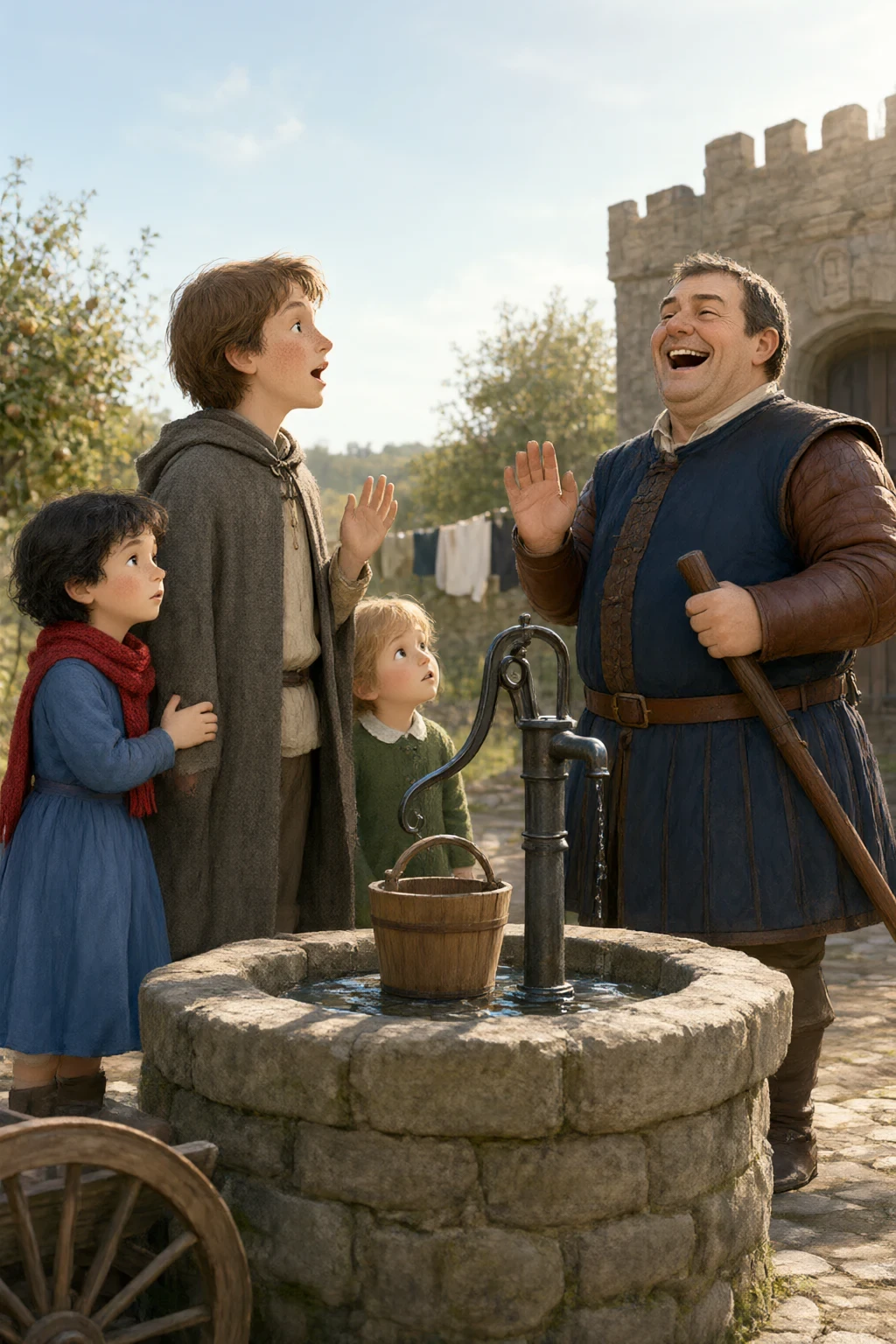
The three children came down the road from the hills. The eldest was called Tove. The middle one was called Kirstin. The smallest was called Sine, and she had to run most of the time. At the top of the road was a castle. It was not a rich castle. It was a working one. There was a laundry in the yard, and a cart going out of the gate, and a boy on the steps eating bread. There were three guards, one at the gate, one at the well, and one at the orchard wall. The king had told them what to do, and this was it.
"Three children come down the road from the hills. Three of you, one question each. If all three answers are right, the children may eat and sleep here. If one is wrong, the children may go on to the next castle." Nobody had ever got into the castle before. The ones who got the answers wrong said afterward that they had guessed, and the ones who got them right said nothing at all, because they did not want to be asked again.
The guard at the gate looked at the three of them, and Sine hung on Kirstin's coat. "The first question," he said. "What is in this courtyard that the castle did not build?" Tove thought for about four seconds. "A shadow," she said. "Where does it come from?" "The sun," said Tove. The guard moved to one side. "Ten years," he said, "and nobody has got that in under four seconds. Do not step on that shadow, it is not yours."
The second guard was at the well. The well was new, with a pump handle and a stone rim. "The second question," he said. "What leaves this castle every morning empty and comes back every evening full?" Sine put her hands into her sleeves. It was cold. "A cart," said Kirstin. "That is a start. What is on it?" "Flour." "And before the flour?" Kirstin looked at the yard. She looked at the cart, which was going out through the gate with nothing on it, pulled by a brown horse with a bad knee.
"Six sacks, empty, for the mill," she said. "And the sacks come back full because they go to the miller, and the miller takes the flour out of them and puts it back in, and the horse does not care which." The guard at the well laughed, which the other two guards had certainly never heard happen. "Go and hold the pump," he said. "You can have a turn."
The third guard was the oldest. He was at the orchard wall, and he was not looking at the children. He was looking at the apple trees, and one of the trees had a bad limb.
"The third question," he said, and then he stopped, and thought about it, and then went on, which the others found frightening. "If the king gave you this castle tomorrow, all of it, the walls and the roof and the orchard and the laundry and the cart and the horse, and he said take one thing out of it and keep it, and throw the rest away, and live there alone for the rest of your life. Take one thing out of the castle and keep it. What do you take?"
That was a different question. That was not a question with a right answer in it, and Kirstin looked at Tove, and Tove had gone quiet in a way that was not being clever. "The gate," said Sine. The guard turned right round. "The gate," she said again, more quietly, because everyone had turned. "Because anybody who is hungry can come and knock and we will give them the apple, and if we are all dead then it is just a gate and it does not know."
The old guard did not say anything for a while. He looked at the third tree, where the bad limb was, and he took out a knife and cut the limb off and put it in his pocket. "Two of you can eat in the kitchen," he said. "There is bread and there is soup and there is a long bench. And the small one sleeps in the hayloft, because she is the small one, and the hayloft is where we put the small ones."
They gave them beds in the hayloft, all three of them, with the horses below and the rain going on the tiles, and Kirstin asked what the work was in the morning. "There is no work," said the guard at the gate. "There is a castle. Somebody has to feed it." That was a thing Tove had not thought about at all. She had thought about the three questions, and the three answers, and the gate, and she had not once thought about what happens to a castle in the ordinary way, on an ordinary morning, when nobody is being tested.
In the morning the flour cart went out. It went out light. Kirstin pulled, because the horse had the bad knee. Tove took the sacks to the miller and carried them up the steps herself, four, then four, then four, and the miller showed her how to fold an empty sack so that it lies flat and takes up no room, which is a thing you cannot know unless you are shown. Sine sat on the pump handle and worked it with her feet, and a queue of people came and filled their pails, and she counted them out loud, and got to nine, and started again.
Then the noon bell, and bread in the kitchen, and the washing on the line, and the guards changing over, and the three of them carried the water up from the well in a flat wooden pail between them, two at a time, because the handle is worn and wants two. At dusk the cart came back in, and it was heavy, and the flour was warm from the mill. The three of them unhitched the horse together, which the horse did not need help with and let them do anyway. Tove went up to the old guard at the orchard wall.
"Was there ever a right answer to the third one?" she said. "No," said the old guard. "That is why I have had it for eleven years. A child who guesses a riddle gets a bed for the night and goes away in the morning with nothing, and one of you three has to be let in, or I am not doing it properly."